Daily insights for city builders, delivered every morning at 6 AM ET. I’m Brandon Donnelly — a Toronto-based real estate developer and founder of Globizen. I’ve been writing here since 2013.

Tag: dan gilbert

  • Detroit is back!

    Fascinatingly, buildings are always a product of their time.

    Detroit’s Book Tower, for example, started construction in 1916. This is right around the time that Detroit became the 4th largest city in the US (after New York, Chicago, and Philadelphia). From 1910 to 1920, the city’s population grew by about 113% to nearly a million people (more people than the city has today).

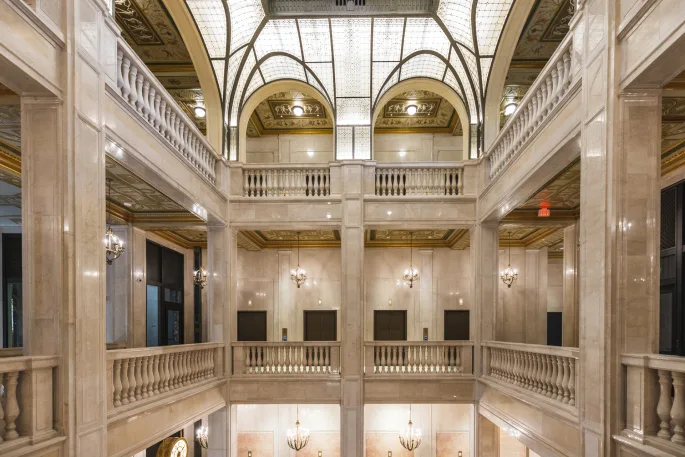
    Because this was the time, the tower was obviously grand. It totalled almost half a million square feet of office space (483,973 sf to be exact, according to Wikipedia). It had a large 3-story atrium with an ornate glass dome. And up until the 1970s, it seems that it remained a desirable office address on Washington Boulevard.

    But as we all know, things changed for Detroit. Grand and ornate no longe made economic sense. And so the owners at the time, whoever they were, covered up the ornate dome, filled in the floors of the atrium, and presumably did whatever they could to eek out as much leasable square footage as possible. Necessity trumped grandeur.

    Then in 2007, the then-landlord filed for Chapter 11 protection. And in 2009, the last tenant left the building, leaving it 100% vacant — or “unencumbered by tenants” as we like to say in the business.

    Thankfully in 2015, Dan Gilbert of Bedrock came along to do what he does, and acquired the building for a reported $30 million. This works out to about $61 psf for what was once the tallest building in Detroit and one of its most prestigious office addresses. Things change.

    But what Bedrock has done since is work to return the building to what architect Louis Kamper had originally created nearly a century ago. The atrium is back. The ornate glass dome is back. And there are now 229 apartments, 117 extended-stay hotel rooms, 3 food and beverage concepts, and about 40,000 sf of office space. Official website, here.

    What an awesome way to say, “Detroit is back!”

    Photos: Rebekah Witt via Fast Company

  • Why Detroit lost the Amazon HQ2 bid

    Dan Gilbert – billionaire Detroit promoter and owner of the Cleveland Cavaliers – penned this statement in response to the city’s failed Amazon HQ2 bid. He chalked up the loss to reputational hangover:

    We are still dealing with the unique radioactive-like reputational fallout of 50-60 years of economic decline, disinvestment, municipal bankruptcy, and all of the other associated negative consequences of that extraordinarily long period of time.

    This was the “elephant in the room”, though his statement is primarily centered around both talent and transportation – the two critical and lacking ingredients that allegedly disqualified Detroit.

    He ends by stressing the importance of physically visiting Detroit 2018. That is the only way, he says, people will fully appreciate the change and momentum that has taken hold in the city. (I experienced Detroit 2016 so I guess I’m overdue.)

    In response to this, Aaron Renn wrote this follow-up post suggesting that Dan take a page out of Tony Hsieh’s playbook. Tony is the founder of Zappos and the Downtown Project in Las Vegas. 

    To bring people to downtown Las Vegas, Tony – somewhat famously – rented 50 apartments in one of the only high-rises, called them “crash pads”, and offered them out for free to people who wanted to come and check out what was happening in downtown Vegas and with the Downtown Project.

    That’s certainly one way to lower the friction. 

    Equally interesting to me about this strategy, though, is that it was presumably necessary (he did it, right?) just to bring people to another part of Vegas, let alone another city altogether. 

    Full disclosure, I’ve never been to Vegas. But I understand that many people visit the place. So for me it speaks to the kinds of inducements that may be necessary just to revive or kickstart a place.

    Photo by Matthew Brzozowski on Unsplash

  • Detroit on the move

    image

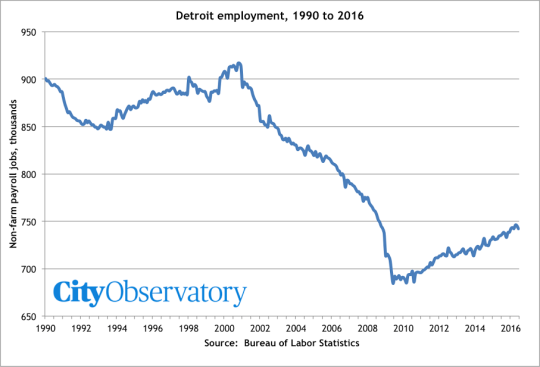
    Between 2001 and 2010, Detroit lost more than 200,000 jobs. It went from over 900,000 jobs to a low of about 690,000 jobs. All of this was happening while the United States was experiencing – up until 2008 at least – an economic growth cycle.

    But we all know that Detroit is now a city on the move. According to City Observatory, Detroit has exhibited 5 consecutive years of job growth. And 2016 looks to be no different. Since bottoming out, Detroit has added more than 50,000 jobs.

    The above chart is based on federal data for Wayne County, Michigan. It includes Detroit, Dearborn, and Livonia, but does not include any other counties within the Detroit metro area. (The above chart and stats are all via City Observatory.)

    Of course, the big question is: Has Detroit made the requisite structural changes to its economy to keep this trend line continuing or is this simply a case of a rising tide lifting all boats?

    I have visited Detroit basically every two years since 2009 and you can certainly feel the change, even in that short period of time.

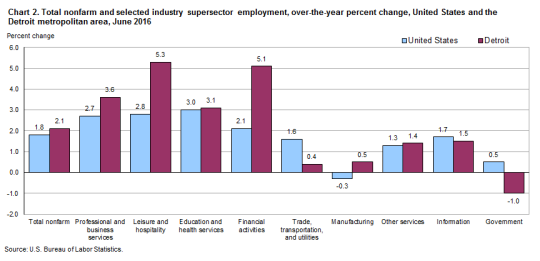
    And if you look at total non-farm employment growth over the last year (June 2015 to June 2016) for the entire Detroit metro area, you see that some of the fastest growing industries include: professional and business services (+14,200 jobs); leisure and hospitality (+10,500 jobs); education and health services (+9,300 jobs); and financial activities (+5,500 jobs). In fact, many of these industries are growing faster than national averages.

    In case you were wondering, manufacturing added 1,200 jobs and government lost 1,800 jobs.

    I’ve heard some people complain that the city, at least downtown, is now too controlled by one entity (Dan Gilbert). But that’s probably what had to happen to really kickstart the city’s renaissance. Somebody had to seed it before you could get the cool coffee shops, bars, restaurants, and coworking spaces.

    There’s still heavy lifting to do, but the data suggests that the city is now headed in the right direction.

    What are your thoughts? Also, if any of you are working on interesting projects in Detroit, I would love to hear from you.

  • When everyone thinks you’re wrong

    Sunset by Paolo Mastrogiacomo on 500px.com

    https://500px.com/embed.js

    I was recently talking to my good friend Jeremiah Shamess about the current state of development land sales in Toronto (he does this for a living) and he said something to me that I found really interesting.

    He said that because the market is so competitive, you can really only win development sites in one of two ways. Either you’re willing to spend the most money or you see something and have a vision that nobody else sees.

    And it was this second piece that really stood out to me because it reminds me of one of my favorite investing frameworks.

    Warren Buffet is famous for saying that you should be fearful when others are greedy and you should be greedy when others are fearful. And what I’m about to talk about is really that same core philosophy.

    Here’s how venture capitalist Fred Wilson put it (reiterating something that Bill Gurley said):

    I saw Bill Gurley say that you can only make money by being right about something that most people think is wrong. His logic was that you can’t make money by being wrong. And you can’t make money by being right about something everyone else knows. So you have to be right about something that most people think is wrong. I really like that framework.

    But this doesn’t just apply to technology companies or stocks. It applies to city building, most industries, and probably most things in life if you think about it.

    If all you’re doing are things that everyone else is doing, then how can you expect to outperform? You’re going to revert to the mean.

    Take, for example, billionaire Dan Gilbert and Detroit. Not everyone believes that Detroit will come back. In fact, I suspect there are probably more people who think it won’t come back, than people who think it will. Otherwise, it would already be back.

    But Gilbert is unquestionably long on Detroit (via Forbes):

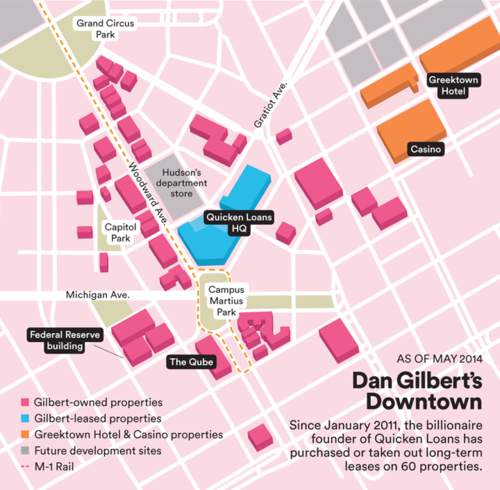
    As you’ve likely heard, over the past four years Gilbert has become one of Detroit’s single-largest commercial landowners, renovating the city with the energy and impact of a modern-day Robert Moses, albeit bankrolled with his own money. He’s purchased and updated more than 60 properties downtown, at a total cost of $1.3 billion. He moved his own employees into many of them–12,000 in all, including 6,500 new hires–and cajoled other companies such as Chrysler, Microsoft and Twitter to follow.

    If/when Gilbert proves to be right about Detroit, then he will have been right about something that most people thought was wrong. And because of that, he will no doubt make a lot of money.

  • Two thoughts on reviving post-industrial cities

    image

    Yesterday Adam Radwanski of the Globe and Mail published an interesting article called, Rust Belt revival: Lessons for southwest Ontario from America’s industrial heartland

    The article talks about some of the things that the Rust Belt is doing to revitalize their cities and the lessons that many cities in Ontario – which are facing similar fates – could learn from. It’s worth a read.

    I’m not going to summarize his article, other than to say that some of the key points were around tax increment financing, tax incentives, University connections, a DIY/entrepreneurial culture, and the American tradition of philanthropy – which Radwanski points out is probably the least imitable for Canada.

    And it’s this last point that I would like to focus on first. The US has a deep history of people getting rich and then giving back – certainly more so than in Canada in my opinion.

    If you think about the resurgence of cities such as Detroit, you’d be hard pressed not to think of people like Dan Gilbert. He has become the poster boy for Detroit’s resurgence by moving his companies to downtown and buying up most of the office buildings. If and when Detroit comes back (I think it’s a when), Gilbert will easily be one of the biggest beneficiaries.

    Now, you could argue that this is made possible because of greater income inequality, but there’s something to be said about powerful individuals acting on intrinsic passion. Gilbert is investing in Detroit because he personally wants to see his home city come back. And that’s hard to replace.

    The second point I would like to focus on has to do with this snippet:

    With oil’s current slide, Canada really can’t afford for it to remain a drag – and in fact there is some expectation that Ontario will instead reclaim its old role as the leader of Canada’s economic growth. Its premier, Kathleen Wynne, recently expressed optimism that plummeting oil prices and a sinking dollar will prove a boon to manufacturing. “I don’t wish for low oil prices and a low dollar for Alberta,” she said earlier this month. “But at the same time, we want our manufacturing sector to rebound. So if that [low oil price] helps, then that’s a good thing.”

    I don’t know what context this was said in, but I continue to feel strongly that we cannot rely on low oil prices and a low Canadian dollar for Ontario’s competitiveness. That is a terrible business model, and an unsustainable one. We need to figure out ways to create value and grow the economy without relying on currency differentials and other macroeconomic factors. Radwanski is right to point that out in his article.

    So let’s hope we don’t let any short term benefits go to our head. There’s lots of exciting work to be done.

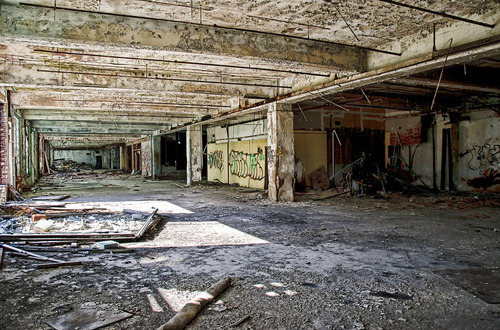
    Image: Old Detroit auto factory via Flickr

  • The role of the private sector in city building

    image

    The New York Times published an interesting and popular article last Friday called The Post-Post-Apocalyptic Detroit. It of course talks all about the efforts of billionaire Dan Gilbert, but it also talks about the initiatives of many small and local entrepreneurs who are doing their part to help revive the city – while at the same time making a profit.

    One thing that I found interesting about the article is the extent to which the private sector has taken over the responsibilities of the public sector. With only 35,000 of the city’s 88,000 streetlights actually working, the city simply doesn’t have the money to pay its bills. When I visited the city last fall, I was told that the city couldn’t even afford batteries for its parking meters. 

    So the private sector has stepped up. 

    In downtown, Dan Gilbert pays for his own security force to patrol the area 24 hours a day both on the ground and through 300 surveillance cameras. And in the Jefferson East corridor, John Stroh III – of the Stroh Brewery Company – is paying for 3,500 hours of private security in order to help transform the area into a walkable retail strip.

    It’s a model that relies on the funding and vision of rich people to catalyze change. And it strikes me as a quintessentially American way of going about it. In Canada, I’m not so sure it would be approached in quite the same way, which I think is both good and bad. I think in Canada there would be more government involvement.

    If the rich people are there and willing to step up (like they are right now in Detroit), then I would assume the capital would be deployed more efficiently and that change would happen more quickly. But if the rich people aren’t willing to step up, then nothing happens and the place declines.

    That might be an oversimplification, but I think there are differences.

    To end, I’m going to leave you with this Bloomberg video about Steve Case’s (former AOL founder) “Rise of the Rest” road trip to Detroit. If you can’t see the video below, click here.

    [youtube https://www.youtube.com/watch?v=_RUG0H4VThM?rel=0]

  • This Built America: Shinola

    If you’ve been reading this blog since last year, you’ll know that I’m hugely interested in Detroit. I went for a visit last fall and I hope to go back sometime this summer. I think the city has tremendous potential and I would love to see it come back. I’m rooting for it.

    Between people like Dan Gilbert and consumer brands such as Shinola, there’s a palatable sense of momentum developing in the city. Here’s a short video of the Shinola story from This Built America–which is a project focused on the people and companies that are rebuilding America and its manufacturing base.

  • Thinking of cities in terms of hardware and software

    Ted Serbinski is a Partner at Detroit Venture Partners. He works with billionaire Dan Gilbert. And obviously lives in Detroit. 

    On Monday of this week he wrote a post called, 24 Business Insights I’ve Learned from Billionaire Dan Gilbert. It was clearly inspired by a blog post Gilbert did last year called 27 Things I’ve Learned in 27 Years. They’re both great reads.

    But in particular I liked Ted’s 22nd point called “balance the hardware with software.” It goes like this:

    “Another interesting insight is Dan’s approach to rebuilding Detroit. You need to balance what buildings you own (e.g., the hardware), with what companies lease them (e.g., the software), along with properly connecting building to building via placemaking (e.g., more software), to create a truly vibrant area.”

    It’s an interesting analogy and I think it’s incredibly relevant to Detroit. The City of Detroit has great hardware. As I said before, the city is filled with gorgeous historic buildings. The bones are there. But hardware is useless without the right software. 

  • Nothing stops Detroit

    When I told my friends that I had booked a weekend getaway to Detroit, I got responses like: “By accident?” and “Why on earth would you want to go there?” But that’s exactly what I did last weekend. I went to Detroit.

    I wanted to see first hand what was going on the city. I wanted to see if it really was the lost cause that the media makes it out to be or if it had the potential to come back. I had been following Dan Gilbert’s efforts to seemingly buy up every building in downtown Detroit and I wanted to see if those efforts were working. I’m an optimist, so I wanted to believe that they were.

    I also have friends who live in the city and a friend who’s working on a number of urban renewal initiatives in the midtown area. It was a great opportunity for me to get a local point of view and also learn about what’s coming in the development pipeline. So I met my friend Alex – pronounced Ay-lex in Michigan – and I got the run down on Detroit.

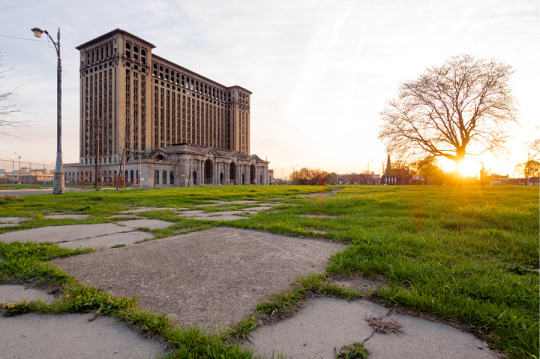
    Detroit is an absolutely fascinating city. As I mentioned before, it’s like visiting the ruins of a former empire, but one that’s recent enough to remind you of how ephemeral success can be. Whether it’s the death of Blackberry or the decline of Detroit, the mighty fall all the time. But it’s precisely this rich history that makes the city so interesting. When you walk inside some of the buildings built during the first half of the 20th century, you can’t help but be reminded of how important of a city Detroit was for America. Detroit was filthy rich.

    But even beyond the showpieces like the Guardian Building and Fisher Building, the Detroit landscape is littered with office and industrial buildings that would make any developer want to line up. One neighbourhood in particular that stood out for me was Rivertown. Running along the water just east of downtown, the area is filled with old brick buildings and the right street scale for a magnificent neighbourhood.

    However, I was told that this neighbourhood doesn’t really have a lot of momentum behind it. Most efforts are focused on the downtown and midtown areas. Still, I couldn’t help but imagine the area as a thriving mixed-use community. In the shorter term, I also thought the area could be really cool as an entertainment and nightlife district similar to Kuntspark in Munich, which was also a former industrial zone.

    Downtown and midtown are where it’s most evident that change is underway though. “Opportunity Detroit” is the slogan of Dan Gilbert’s real estate company, called Bedrock, and you see it plastered up in all of the windows downtown. Offices buildings are now leasing up and new retailers are moving in. I was told that five years ago none of this was happening. Woodward Ave was empty.

    As you move north towards midtown, you then discover a Michigan first: an urban depressed freeway. Detroit was the first city in America to build these and it’s certainly going to work in its favour as its city centre is reborn. I can only imagine how much more divided the city would be today had the freeways that wrap the core been built as elevated overpasses.

    But that’s not the case. Downtown and midtown are decently connected, albeit different in feel. In midtown, the buildings are more midrise in scale, the streets are broader, and the retail appears further along. There’s a Whole Foods that just opened up and fantastic new coffee shop called Great Lakes Coffee. It was busy when I was there on Sunday morning and I was told that it’s really the first place in Detroit where people could go to hang out and work.

    As you leave the core of the city things really fall off though. This is where Detroit becomes a prairie city and you see the one house on a block condition that the media likes to capture. It’s here where it becomes apparent that Detroit is simply too big, geographically, for its current population. You have infrastructure in place for 2 million people and yet a tax base of 700,000 people. No wonder it went bankrupt.

    So like many others have suggested before, I think Detroit needs to figure out a way to shrink in order to eventually grow. Just like a company going through restructuring, Detroit has to rid itself of some its liabilities. It’s going to have to take that write-down.

    At the same time, the population needs to be somehow consolidated and something needs to be done with all its excess land (urban agriculture is one idea). Jane Jacobs taught us that towers in a park don’t create urban vibrancy and the same can be said for houses in fields. Detroit is fragmented and divided. More so than dangerous, most of the city just feels eerily deserted.

    However, despite these challenges, two things really stood out for me during my visit.

    The first is that Detroit still very much has an ethos of production. It likes building and making things, and it’s visible in the emergence of brands like Shinola who are producing bikes, watches and leather goods right in the city.

    The second is that there’s a palatable sense of possibility. Detroit hasn’t lost that entrepreneurial spirit that made it a leader in manufacturing, music and sports. A great example of this is the Green Garage in midtown, which is a former Model T showroom turned sustainable coworking lab for Detroit entrepreneurs.

    But perhaps the best way to sum up this spirit is through a line I saw on a neon sign downtown on Woodward Ave. 

    It read: “Nothing stops Detroit.”

  • Why I’m planning a trip to Detroit

    I’m planning a trip to Detroit this month.

    Some of you might be wondering why on earth I would do that, but I’m actually super excited. Why? Because I’m fascinated by the city. Detroit is such a dramatic example of how the fortunes of a city can change. I think some people forget what places like New York City and South Beach were like in the 1980s.

    But more importantly, I’m interested in the future of Detroit and the opportunities that might lie ahead. In many ways, the city feels like a clean slate. It’s a city that’s trying to completely rebuild and reinvent itself. And there’s a lot of smart (and rich) people, like billionaire Dan Gilbert, putting their weight behind its renewal. Through his company Bedrock, he has quickly become one the largest private landlords in the cityI also have a good friend who’s working in Detroit on strategies for the Midtown area. He’ll be my “tour guide” during the trip.

    It’s easy to get wrapped up in media headlines and so I want to see what’s happening first hand on the ground. Detroit has a long history of entrepreneurialism and so the eternal optimist in me wants to believe that it can come back.

    One of its big challenges, however, is education. As Harvard economist Ed Glaeser put it in his book, the Triumph of the City, one of the greatest things about the Detroit of yesterday was its ability to create a lot of high paying jobs for people with little education. Now the city has to deal with that legacy and few jobs.

    I’ll have more to say after my trip but, in the interim, what are your thoughts on Detroit? Can it come back? Will it ever be the economic powerhouse that it once was?