Daily insights for city builders, delivered every morning at 6 AM ET. I’m Brandon Donnelly — a Toronto-based real estate developer and founder of Globizen. I’ve been writing here since 2013.
Using data from Turner & Townsend, Curbed recently reported that the most expensive city in the world in which to build is now San Francisco. On average, it costs USD 417 per square foot. San Francisco is followed by New York ($368 psf), London, Zurich, and Hong Kong. New York took the top spot last year, but San Francisco shot up this year because of, you know, tech.
This number was calculated using a blend of six different types of construction, everything from apartment high-rise and prestige office to general hospital and warehouse distribution centers.
Now, I’m not exactly sure what this number includes. But I’m assuming it is only direct construction costs and doesn’t include (contractor) general conditions, land, or any soft costs, which are all significant. Once you add in these other cost inputs, I am sure that you can start to see how things — including the cost of new housing — can quickly escalate.
The 2020 Summer Olympics, which will be held in Tokyo, have added 5 new sports, one of which is skateboarding. As someone who grew up skateboarding as a teenager, and is all too familiar with being chased out of public spaces, this lends a great deal of legitimacy to the sport.
It’s hard to think of a sport that is more closely connected with architecture and, more specifically, public architecture. Curbed’s recent long-form article about “the public spaces that shaped skateboarding” is a good reminder of that. Here is an excerpt (EMB refers to Embarcadero Plaza in San Francisco, which was previously known as Justin Herman Plaza):
When skateboarding debuts at the Tokyo Olympics next summer, some three decades after the first polyurethane wheels hit the bricks at EMB, it will have completed the long, improbable trip from criminal act to social and institutional acceptance. But even as an Olympic sport, skateboarding will remain a direct physical response to the varied terrain of American public architecture.
Interestingly enough, one could go on to argue that the history of skateboarding is really steeped in the adoption of public spaces that had, in many cases, failed to serve their intended purpose. In other words, skateboarders were often the only people using these urban spaces:
“What made Justin Herman Plaza attractive to skateboarders and work for skateboarders was its inappropriateness to the traditional city scale and function,” King says. “You had all these planners and architects in the 1950s and ’60s saying cities need these grand, celebratory spaces—and they really didn’t.” But apparently skaters did.
Welcome skateboarding to the 2020 Summer Olympics in Tokyo.
Landed is trying to solve this problem by offering downpayment assistance to “essential professionals” — starting first with teachers — so that they can buy homes in and near the communities that they serve.
The way it works is pretty simple.
They’ll contribute up to half of a traditional 20% downpayment — so 10% of the value of the home — in exchange for a 25% share in any future gains, or losses.
Put differently, for every 1% that Landed contributes, it takes 2.5% of any future appreciation (or depreciation). However, on an equity basis, they are actually putting up 50% of the required cash (in the maximum scenario) in order to get 25% of any future gains.
There’s no monthly payment associated with Landed’s money, but it does need to be repaid at the end of 30 years or when the homeowner exits the agreement, whichever comes first. Homeowners are free to repay Landed at any time should they decide to sell the property or they just want to pay them out.
Landed pitches the service as another version of “the bank of mom and dad.” And for many prospective homeowners, I am sure that it makes all the difference in the world.
At first glance, it would seem that each homeowner also benefits from a kind of positive leverage. They only put up 50% of the required equity, but they get to enjoy 75% of the potential gains. However, each homeowner is also responsible for 100% of the carrying costs.
I ran a couple of quick return scenarios, assuming a $500,000 purchase price and a 10 year hold, in order to test whether Landed or the homeowner would receive a higher IRR once the property gets sold.
I didn’t carry any transaction costs, but I did factor in principal recapture, as well as utilities, insurance, and maintenance.
My rough numbers suggest that it depends on the annual rate of appreciation. If appreciation stays close to the rate of inflation, it could tip in favor of Landed because they don’t put out any money after t = 0.
But at higher rates of appreciation, the homeowner starts to benefit from the favorable 75/25 split at the end of the hold period.
Either way, Landed is providing a service to people who may not otherwise be able to afford to buy a home. That has value. Here’s some more information on how it works, in case you’re interested.
Curbed has a section on their website dedicated to “deep dives on cities, architecture, design, real estate, and urban planning.” It is called Longform. And they have some great stories, including this one on “the female powerhouse [Florence Casler] who developed 1920s Downtown LA.”
Florence was born in 1869 in Welland, Ontario, about 25 kilometers south of Niagara Falls. She married an American — a plumber — and eventually settled in Buffalo, New York. After her husband left to pursue riches in the gold mines, she became a licensed plumber and took over the business.
Eventually this love of plumbing grew into a love of building, and somehow she found herself, with her daughters, in Los Angeles at the beginning of the 20th century.
By the 1920s, she had become a dominant force in the real estate business. Some 60 buildings are credited to Florence and she is thought to be largely responsible for ushering in a new era of multifamily apartments in Los Angeles. Unfortunately, many of her buildings have since been demolished.
As one of the first women in Los Angeles to head a development and/or construction business, I think this is a wonderful story worth telling. For the full Curbed article, click here.
Curbed published an article this week called, Why U.S. cities should stop whining and embrace winter. It is about Canada and how we allegedly embrace winter, which is arguably true, except I think there’s still a healthy dose of whining combined with trips to the south.
I went ice skating a few weeks ago along the waterfront here in Toronto. It was a cold night and we debated whether we should skate or do something indoors involving Niagara’s finest red wines. We opted for skating and weren’t cold at all. It was great.
I was reminded of this when I read the line: “The purpose is to get you skating. If you are skating, you are warm.” It is a good reminder that one of the keys to a successful winter space is physical activity. That and hot tubs.
According to a recent study out of UCLA, which I discovered via this Curbed article, American families tend to spend most of their time at home in informal, rather than formal, spaces. That means more time in the kitchen and family room, as opposed to in the living room and formal dining room.
I’m sure this comes as no surprise to all of you. Was a study necessary? Maybe you even have plastic on the furniture in your formal rooms because, you know, they’re reserved for “entertaining.” The reason I mention this is because I thought it was funny how Kate Wagner describes this phenomenon in her Curbed article:
The ironic inefficiency of hyper-exaggerated high-end entertaining spaces belies a truth: These spaces aren’t really designed for entertaining. They’re designed for impressing others. And not just impressing others: After all, it’s general politeness to compliment a host on their home no matter how impressive it is. The real goal, deeply embedded in these oversized, over-elaborate houses, is not for guests to say, “Oh wow, this is nice,” but to make them think, “Oh wow, this is nicer than what I have and now I feel jealous and insecure.” In true American irony, these giant “social” spaces (and McMansions in general) are birthed from a deeply antisocial sentiment: making others feel small. Considering that so often our guests are members of our own family adds another layer of darkness to the equation.
For those of you who aren’t familiar with Kate Wagner, she is the founder of McMansion Hell, which is a hilarious website dedicated to blasting McMansions. A pejorative term for houses that privilege raw size and the appearance of wealth over quality. Now that you know that, I am sure the above blurb makes a lot of sense.
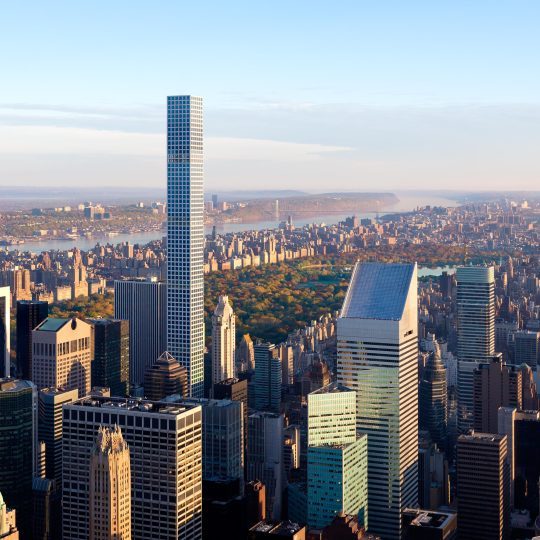
It was just announced that the full floor 8,255 square foot penthouse in the Rafael Viñoly-designed 432 Park Avenue (New York) has closed at a sale price of USD$87.7 million. That works out to be just over $10,600 per square foot.
It was purchased by Fawaz Al Hokair and is currently the most expensive sale in the building. However, the most expensive sale, ever, in New York remains the penthouse of One57, according to Curbed. It was purchased for $100.5 million.
Architecturally though, I much prefer 432 Park Avenue. I love its simplicity.
Each floor plate is 812 square meters. But because of the building’s height (424 meters / 1,395 feet) it appears a lot smaller. The ratio of building width to building height is about 1:15.
Because of this “slenderness ratio” the building is split up into 7 distinct volumes with a void between each. These voids – which are completely empty save for the building’s core – reduce wind loading and help with the building’s overall structural stability. (I’m sure it’s fine.)
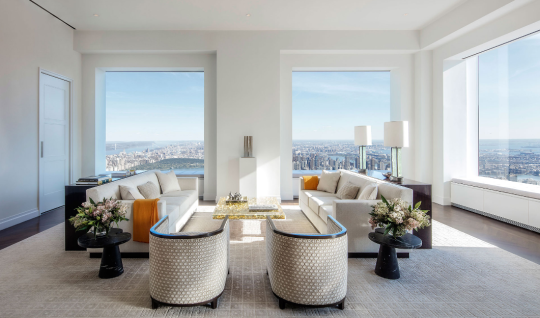
The structural system is the exposed concrete grid. This leaves the interior of the floors completely column-free. Every window within this grid is exactly 10 square meters.
Here’s a good interior example of that:
On a none architectural note, the building also features a private restaurant. I am curious how a private restaurant can operate sustainably in a building with 100 and some apartments owned by many people who probably don’t spend all (or much?) of their time in New York. Perhaps it’s partially carried by the ~$2.10 per square foot monthly maintenance fee.
Occupancy is available immediately if you happen to be in the market.
Resiliency is an important topic in urbanist circles these days.
New York is working on a 10 mile “Dryline” to protect itself from future storms similar to Hurricane Sandy. And Miami Beach – one of the most vulnerable cities in the U.S. to sea level rise – is frantically building pump stations and raising its seawalls, streets, and sidewalks.
Here’s what the city’s public works director had to say via a Curbed article published about a week ago:
Miami Beach is planning to spend upwards of $500 million over the next five years on the pump stations and street-raising projects. “We are quite certain we are going to buy ourselves another 30 years, and we are hoping we are going to buy ourselves another 50 years,” Carpenter said.
According to Wired, sea levels off the coast of South Beach have risen by 3.7 inches since 1996. But over the last 5 years the high tide levels have had an average increase of about 1.27 inches per year!
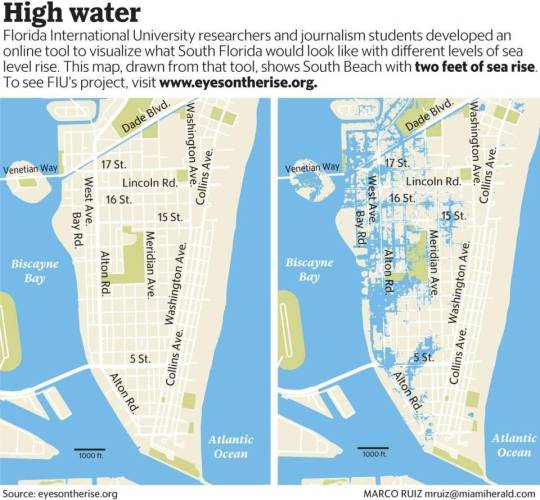
This matters a great deal because of what South Beach would look like if sea levels increased by 2 feet (via the Miami Herald):
It’s for this reason that Miami Beach has been working to alter its street elevations and install pumps – as many as 80 of them over the next 5 years – that quickly drain stormwater into Biscayne Bay. (The drains are equipped with backflow preventers so that the water leaves but doesn’t come back into the island.)
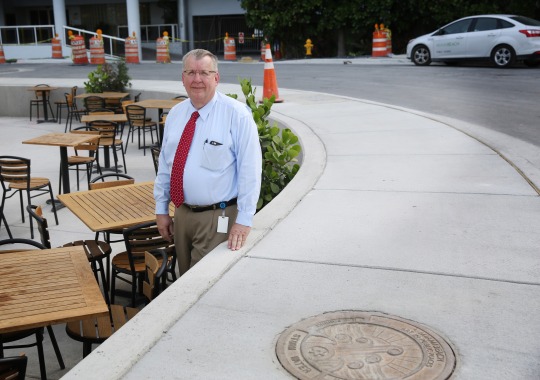
Here’s an example of a raised street and sidewalk (via the Miami Herald):
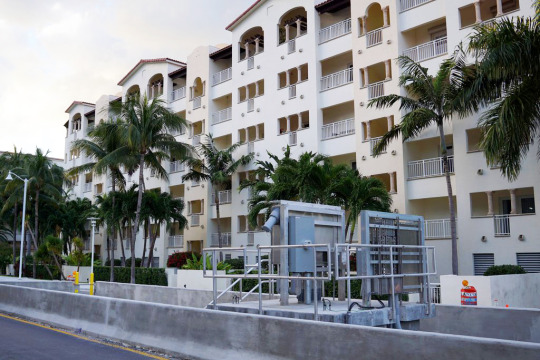
And here’s an example of a pump station (via Curbed):
All of this strikes me as necessary work for Miami Beach. But I also think it’s important to keep in mind that all of this is patch work – regardless of how necessary it is right now.
The bigger question is: what are we doing to stop sea level rise? That’s the only way we’re going to get to true, urban, resiliency.
As I approach one year of ATC and as people like Lockhart Steele (founder of Curbed and Eater) return to personal blogging, I wanted to share something that’s been on my mind for almost this entire last year. And that is, should ATC just be a personal blog or should there be some greater end goal?
Right now it’s a bit of a hybrid. It’s hosted at brandondonnelly.com, but along the way I created a somewhat independent Architect This City brand. The most obvious option is to continue to grow ATC and turn it into something like Curbed, This Big City, or Sustainable Cities Collective. In fact, a good friend of mine emailed me a few weeks ago and asked me why I’m not doing that.
But to do that would require a lot more time and many more posts a day. It would also mean more restrictions on what I can, or should, write about. Personal blogs are, well, personal. Branded blogs typically require a focus. Today I live comfortably in between both of those worlds. I write almost exclusively about city building, but I introduce many personal touches. Architect This City has become my personal brand.
In many ways, I feel like this tension is a natural one. With the rise of social media and the belief that “everybody is their own media company”, more and more people are finding themselves debating whether or not they should position themselves personally online or create an independent brand.
At the same time, blogging is evolutionary. It’s a laboratory. And most of the benefits are entirely indirect. Writing helps you get your ideas on “paper” and sort through them publicly. And sometimes that leads to unexpected outcomes. I mean, in the case of Lockhart, he started blogging about his Lower East Side neighborhood and that gave birth to Curbed, which he then sold to Vox Media.
So as much as I try and plan out where I think blogging everyday could take me, it’s also good to sit back, enjoy the ride, and just see where it takes me.