Daily insights for city builders, delivered every morning at 6 AM ET. I’m Brandon Donnelly — a Toronto-based real estate developer and founder of Globizen. I’ve been writing here since 2013.

Tag: creativity

  • Proximity matters for knowledge spillovers

    I am at my most creative when I’m in the same room with other people and we are bouncing ideas around. There’s a compounding effect that takes place. One person says something and that then triggers a new idea. I find the whole experience very rewarding and, for me, it’s a reminder that creativity can be a process. It is also a reminder that proximity is important for those of us who have jobs that deal in creativity.

    We have spoken a lot about this on the blog, but here is an interesting and recent study that looked at knowledge transfers across different tech startups within one of the largest co-working spaces in the US. For context, the co-working space itself consisted of five floors, about 100,000 square feet, and housed 251 different startups. To measure knowledge transfer, the researchers looked at instances of a startup adopting a component of a peer’s technology stack.

    What they found was the following:

    • Knowledge exchange is greater amongst startups that are dissimilar
    • Close physical proximity greatly influences the chance of knowledge spillovers; however, this effect quickly falls off
    • After 20 meters or so, there’s almost no difference between being down the hall or being on a separate floor within the building
    • One of the ways you can counteract this last finding is to create shared spaces; startups with overlapping common areas, such as a kitchen, saw greater distances of influence

    In short: proximity matters.

    If you’d like to download a full copy of the study, click here.

  • Good design is about caring

    I was in a “design charrette” meeting earlier today where the topic of good architecture and why some cities do better than others came up. It got me thinking about my recent post about the quality of Canadian architecture and so I’d like to revisit that discussion today. The Walrus article that I previously cited focused a lot on uninspiring public architecture and the procurement processes that generate them behind the scenes. But here are a few other things to consider.

    1/ Design guidelines and planning policies have an impact on our built environment in more ways than most people probably appreciate. For example, there are design moves in some of our projects that I really dislike. But we were given no choice. In fact, in one instance I remember us advocating for less area/density (shocking for a developer) because we thought it made for better architecture. We ultimately capitulated, and the additional area was certainly a nice to have, but it wasn’t our opening position.

    2/ Nice stuff does often cost more money. There is no question that a project like One Delisle is more expensive to construct compared to a “typical” building. However, we made the decision to invest in high quality architecture and we built our pro forma around this approach. In this regard, it is helpful to be in bigger and more expensive cities/submarkets so that you can generate the kind of revenues that will support high-quality architecture.

    3/ At the same time, there is no reason that thoughtful design needs to cost more. Good design is simply about being creative, responding to constraints, and, frankly, just giving a shit about what you’re doing. You want to see that somebody cared. So while nice things and elegant details do often cost more money, we shouldn’t use this as a crutch. The same is true for climate. Colder climates shouldn’t be considered handicapped. Creativity and thoughtfulness can thrive anywhere. We just have to give them the opportunity.

  • What did Benjamin Franklin, Albert Einstein, and Steve Jobs all have in common?

    According to Walter Isaacson – the bestselling author of their biographies – it is this:

    I started with Ben Franklin, and then Einstein, and then Steve Jobs—[they were all] innovative and creative. And I said, “Well, what pattern [leads to] that?” The pattern wasn’t that they were smart, because you’ve met lots of smart people, and they don’t usually amount to much. The pattern tends to be curiosity across disciplines.

    This excerpt was taken from a conversation between Isaacson and Adam Grant, which you can read or watch here

    Here is another excerpt that speaks to the way in which Jobs prided himself on working at the intersection of technology and the humanities:

    I’ll give you a tiny example. The Mac that came out in 2000 had a handle on it, and they say, “This is a desktop machine. We don’t need the handle—people aren’t really supposed to move it around. It’ll cost us another sixty dollars [per computer].” And Steve said, “The handle is there because it makes the machine approachable. My mom is afraid of her computer, but if there’s a little thing [where] she can put her hand, where she can touch it and she knows it won’t break, that makes her connect emotionally to the computer better.” And he was right. But it cost money, and the Mac didn’t make as much.

    The entire conversation resonated with me partly because I think of development as being a career that, by necessity, requires you to work across disciplines. 

    I also sometimes wonder if I have too many broad-ranging interests. It can be overwhelming. But apparently that’s a good thing for innovation and creativity.

  • We are all biased against creativity

    image

    I would like to do a follow-up to yesterday’s post about innovators and creators, because I recently stumbled up the following quote:

    “We think of creative people in a heroic manner, and we celebrate them, but the thing we celebrate is the after-effect,” says Barry Staw, a researcher at the University of California–Berkeley business school who specializes in creativity.

    It is taken from a Slate article called: Inside the Box – People don’t actually like creativity. And it’s supported by a bunch of research, including a 2010 study conducted by professors at Cornell University, the University of Pennsylvania, and the University of North Carolina.

    The key finding was that people generally hold a bias against creativity, and it’s activated when we become motivated to reduce uncertainty. This might be because we fear rejection or because we’ve come to learn that reducing uncertainty and promoting the status quo is often better for career advancement. 

    There’s less perceived risk.

    But here’s the thing: celebrating creativity after the fact is meaningless. There’s no genius in that. Everyone now knows this truth. The heroics come into play when you’re both willing to be misunderstood and willing to be dead wrong.

    Of course, talk is cheap. 

    Here are 5 suggestions for promoting greater creativity at your company taken from Tom Tunguz’s blog, who himself is borrowing from Barry Staw (author quoted above):

    1. Hire people who’s skills aren’t precise matches for the needs of the company.
    2. Encourage employees not to listen blindly to corporate policy and conventional wisdom; not all to speak with the same voice.
    3. Those in power should go as far as possible to encourage active opposition to ideas. (Similar to Drucker’s obligation to dissent).
    4. Optimize for adaptiveness. Have extra labor capacity and explore side projects. (How many creative companies started or were reinvigorated by side projects? Twitter and Slack are two that immediately come to mind).
    5. Lead rather than follow. Take risks.

  • Are you T-shaped?

    image

    The world-renowned design firm IDEO is known for hiring people described as being “t-shaped.” Here’s a quote from an interview with CEO Tim Brown explaining what that means:

    “T-shaped people have two kinds of characteristics, hence the use of the letter “T” to describe them. The vertical stroke of the “T” is a depth of skill that allows them to contribute to the creative process. That can be from any number of different fields: an industrial designer, an architect, a social scientist, a business specialist or a mechanical engineer. The horizontal stroke of the “T” is the disposition for collaboration across disciplines. It is composed of two things. First, empathy. It’s important because it allows people to imagine the problem from another perspective – to stand in somebody else’s shoes. Second, they tend to get very enthusiastic about other people’s disciplines, to the point that they may actually start to practice them. T-shaped people have both depth and breadth in their skills.”

    For an interdisciplinary design firm like IDEO, I’m sure you can see why the above would be important. But I also think it’s hugely important for those of us who work in the arena of the built environment.

    City building projects don’t get accomplished by individuals, alone, or “I-shaped people” who don’t play well with others. They get accomplished by people with breadth in their skills and by large cohesive teams with vastly different core competencies. The notion of the individual genius is overplayed.

    New buildings, for instance, typically involve a coming together of the project team (hugely diverse in and of itself), the city, the community, and other stakeholders. You can try and bully your way through that process or you can try and navigate through with empathy.

    Based on the tremendous success of firms like IDEO, one could certainly argue that creativity and innovation seem to thrive more on empathy.

  • Mapping the creative soul of US cities

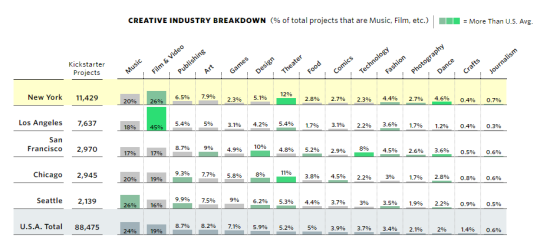
    Polygraph (visually-driven essays) has a great piece called, The Entire History of Kickstarter Projects, Broken Down by City. What they did was look at 88,475 Kickstarter projects to map the various creative communities across the US.

    Here’s a snapshot (you may need to zoom in):

    image

    In general, Kickstarter in the US sees a high concentration of music projects (24%) and film & video projects (19%). But where it gets interesting is to see which cities over-represent in certain categories.

    New York = film & video, theater, and dance

    Los Angeles = film & video (not surprisingly 45% of all projects)

    San Francisco = design and tech

    Chicago = theater

    Detroit = music

    Nashville = music (76% of all projects!)

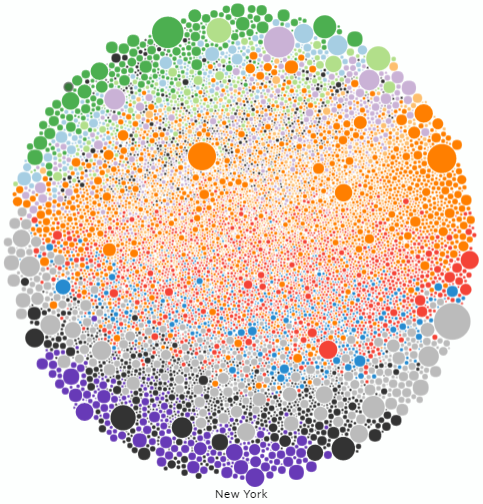
    They also measured the size of each project (number of backers) and created these neat bubble diagrams:

    image

    Above is New York. Red is music. Orange is film. And yellow is theater.

    I also like their explanation for why they did this project:

    Pretty much all existing attempts to map creative communities use census and jobs data. But creative efforts are often side-hustles. They’re garage/basement/cottage industries that will not appear in a census.

    It’s true. This data should be a much better capture of each city’s creative soul.

  • Compact and constrained

    I was walking by a tight construction site last night and it got me thinking. Besides the obvious environmental benefits of building up, as opposed to out, compact urban sites can force something else: intent.

    One of the ways I think about good design is that it is intentional. It is about seeing problems and/or opportunities and then being deliberate in how you respond. Every creative decision needs a reason why. I like how John R. Moran talks about design in this blog post from 2014:

    “The opposite of design, then, is the failure to develop and employ intent in making creative decisions. This doesn’t sound hard, but, astonishingly, no other leading tech company makes intentional design choices like Apple. Instead, they all commit at least one of what I term the Three Design Evasions.”

    The three design evasions he goes on to talk about are (1) preserving, (2) copying, and (3) delegating.

    The thing about compact and constrained urban sites is that they can force you away from the three design evasions that Moran lists in his post. You can’t just repeat what was done in the past or copy what someone else has done, because that precedent probably didn’t have the same challenges you face.

    Of course, if this were enough to promote great design, our cities would look a hell of a lot different. Still, it’s one of the reasons why I’m attracted to compact forms of development such as laneway housing and other urban infill.

  • Urban pet peeve: copycatting

    One of my biggest pet peeves is when cities copy things from other cities. 

    Let me give you an example. Whenever I see one of those red double decker tourist buses roaming around Toronto, I always look to see if it’s the type that has London signage and destinations plastered all over it. And when it is, I cringe. (I saw one earlier today.)

    Why would anyone design a tourist bus that makes you feel like you’re half in another city? I don’t get it. The whole reason people are getting on that bus is because they’ve come to visit this city. It should make you feel like you’re here and nowhere else. It should feel locally authentic.

    To be clear, I’m not saying that we shouldn’t be learning from other cities and building on top of other’s great ideas. That’s precisely what we should all be doing. I’m talking about kitschy copies with little additional thought put into them. And I can think of many examples beyond just tourist buses.

    Am I just being pedantic?

    What about you? Any urban pet peeves?

  • If man had developed a third arm, where might this arm be best attached?

    Roman Mars of 99% Invisible recently published an excellent episode called The Mind of an Architect. It has to do with a set of research studies completed in the late 1950s by an organization at the University of California, Berkeley known as the Institute of Personality Assessment and Research (IPAR).

    IPAR was founded by a personality psychologist named Donald MacKinnon. He initially worked for the precursor to the CIA and founded IPAR with the intent of studying “combat readiness and efficiency.” But over fears of how creative the Soviets were getting, the focus of IPAR shifted to instead studying creativity.

    And architects were deemed to be an ideal test subject (from 99percentinvisible.org):

    “Researchers saw architects as people working at a crossroads of creative disciplines, a combination of analytic and artistic creativity. As professionals, architects had to be savvy as engineers and businessmen; as aesthetes, they also acted as designers and artists.”

    So over a series of weekends in the late 1950s, some of the most celebrated minds in architecture – including people like Philip Johnson, Richard Neutra, and Louis Kahn – were studied and picked apart. 

    image

    They were asked to do quick sketches, create mosaics, and they were asked questions such as this one: “For the next 45 minutes we would like you to discuss this notion: if man had developed a third arm, where might this arm be best attached?”

    In the end, here’s what they concluded:

    The researchers began to notice certain patterns across creatives of all professions and genders, including a tendency to nonconformity and high personal aspirations. They also found many creatives shared a preference for complexity and ambiguity over simplicity and order. Creatives could make unexpected connections and see patterns in daily life, even those lacking high intelligence or good grades.

    In short: IPAR found that creative people tend to be nonconforming, interesting, interested, independent, courageous and self-centered, at least in general. Many of these traits may seem obvious today, but they were not necessarily obvious prior to these studies. Back when their tests were being conducted and findings presented in the 1950s and ’60s, the very idea of a “creative personality” was a novelty in academic and public discourse.

    The findings may not be groundbreaking to us today, but the documents and recordings produced during the study are certainly interesting. If you’re into this topic, there’s also this book you can pick up.

    Oh, and if we are to have a third arm, I would like mine to run almost parallel to my existing dominant arm (right). That way I could double up on my most potent dexterity. It would also be far less intrusive than an arm on one’s head or in the middle of one’s back. Then again, it would ruin our symmetry as humans. And perhaps that third arms need to be celebrated instead of being masked.

    What would you suggest?

    Image: Institute of Personality and Social Research, University of California, Berkeley / The Monacelli Press (via 99% Invisible)


  • Writing every day

    I often get asked about my daily routine and how I manage to write, every, single, day.

    Oftentimes people will say that I must not sleep. But the reality is that I love sleeping and I generally need a lot of it. I’m not someone who can function on 5 or 6 hours. I’m useless with that amount of sleep. One of the best productivity hacks for me is to simply sleep more and work less.

    In terms of when I write, my preference is to write first thing in the morning – even though I don’t consider myself much of a morning person. I like to wake up, make breakfast and a coffee, and then sit down at my desk to both read and write. I like to do this before diving into email, before thinking about all the stuff that I need to do that day, and before going into the office.

    Some days a post might take me 20 minutes and some days it might take me an hour. Where I struggle the most to write every day is when I’m traveling or when I have to be somewhere super early, which then means I’m writing in the evening. I like my routines.

    I’m thinking about this right now not only because I often get asked this question, but because I’m currently making my way through a book by Adam Grant called Originals

    Though talent still matters, one the things he argues is that creative people tend to be creative because they are prolific. They produce a lot of whatever it is they do. And while much of it may be crap – he argues that Shakespeare penned a lot of crappy plays – it is through sheer volume that they end up achieving those creative breakthroughs.

    This goes against the traditional notion of the “creative genius”, but I think there’s a lot of truth to it. It’s why good architects will iterate through many different building designs and it’s (partly) why bloggers like myself see value in showing up every day.