Daily insights for city builders, delivered every morning at 6 AM ET. I’m Brandon Donnelly — a Toronto-based real estate developer and founder of Globizen. I’ve been writing here since 2013.

Tag: creative

  • Mapping the creative soul of US cities

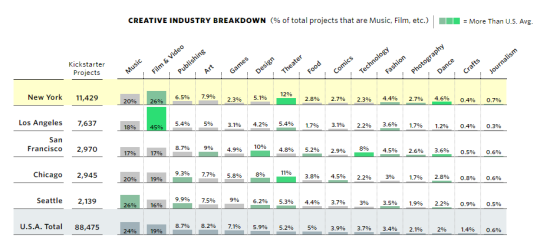
    Polygraph (visually-driven essays) has a great piece called, The Entire History of Kickstarter Projects, Broken Down by City. What they did was look at 88,475 Kickstarter projects to map the various creative communities across the US.

    Here’s a snapshot (you may need to zoom in):

    image

    In general, Kickstarter in the US sees a high concentration of music projects (24%) and film & video projects (19%). But where it gets interesting is to see which cities over-represent in certain categories.

    New York = film & video, theater, and dance

    Los Angeles = film & video (not surprisingly 45% of all projects)

    San Francisco = design and tech

    Chicago = theater

    Detroit = music

    Nashville = music (76% of all projects!)

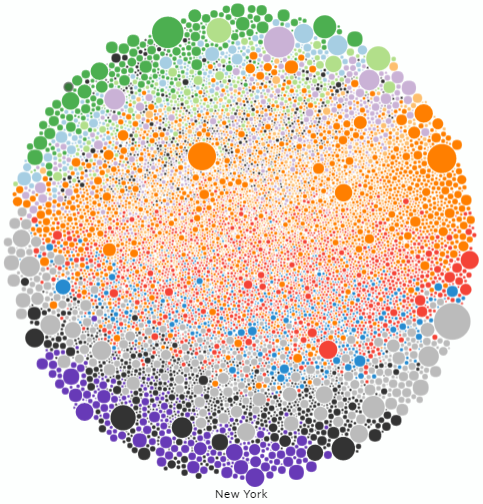
    They also measured the size of each project (number of backers) and created these neat bubble diagrams:

    image

    Above is New York. Red is music. Orange is film. And yellow is theater.

    I also like their explanation for why they did this project:

    Pretty much all existing attempts to map creative communities use census and jobs data. But creative efforts are often side-hustles. They’re garage/basement/cottage industries that will not appear in a census.

    It’s true. This data should be a much better capture of each city’s creative soul.

  • Urban pet peeve: copycatting

    One of my biggest pet peeves is when cities copy things from other cities. 

    Let me give you an example. Whenever I see one of those red double decker tourist buses roaming around Toronto, I always look to see if it’s the type that has London signage and destinations plastered all over it. And when it is, I cringe. (I saw one earlier today.)

    Why would anyone design a tourist bus that makes you feel like you’re half in another city? I don’t get it. The whole reason people are getting on that bus is because they’ve come to visit this city. It should make you feel like you’re here and nowhere else. It should feel locally authentic.

    To be clear, I’m not saying that we shouldn’t be learning from other cities and building on top of other’s great ideas. That’s precisely what we should all be doing. I’m talking about kitschy copies with little additional thought put into them. And I can think of many examples beyond just tourist buses.

    Am I just being pedantic?

    What about you? Any urban pet peeves?

  • Visions of urban living

    This apartment is such a great idea:

    Let me explain.

    Freunde von Freunden (FvF) is a Berlin-based publication that documents inspiring people from creative and cultural backgrounds. If you don’t read their stuff, I think you should. Sample: Here’s an interview with Chang Lin. He is Creative Director at Zalando and lives in Mitte, Berlin. I always find it fascinating to see how people live.

    In 2014, FvF decided to bridge the online and offline worlds and open up their first “apartment” in Berlin. They refer to it as: The FvF Apartment – Visions for Urban Living. And they describe it like so:

    “The apartment has been designed to be fully adaptable to the diverse and often unexpected scenarios of everyday life, reflecting how a creative, mobile and digitally-oriented generation lives. It serves not only as a platform for innovative products from friends and partners, but as a unique venue for events, workshops, and presentations.”

    Basically, the space serves as one part apartment and one part venue. They have used it as a pop-up shop, as a stage for photo and film productions, as a place for distillers to host private tastings, and the list goes. 

    Again, I think this is such a great idea as a brand extension. It is giving me all kinds of ideas and so I thought I would share it with you all today as well.

    Image: The FvF Apartment

  • Come original

    I am thinking about nonconformity and originality this morning because I just ordered a book by Wharton professor Adam Grant called, Originals: How Non-Conformists Move the World. I ordered it along with another book that was recommended by a regular reader of this blog. (Thanks Daniel.)

    I find this topic fascinating because there’s clearly a deep appreciation for originality and creativity in our society and yet I think we do a lot to encourage the opposite: conformity. Of course, part of this is that it’s inherently easier to conform. Think about how much pressure we have in our lives to please others and generally just “fit in.”

    This is something that I think about and try to fight in my own life, particularly as I get older. As a teenager, I was a skateboarder with bleach blonde hair who rode around in a t-shirt that said “skateboarding is not a crime.” That’s clearly not me anymore (I prefer my natural hair color), but I continue to believe that a bit of rebelliousness can be valuable.

    For instance, I don’t think it’s a coincidence that San Francisco – the epicenter of counterculture in the 1960s – ended up becoming such a hotbed of entrepreneurship.

    To drive that point home even further, here’s a quote from a recent interview with Adam Grant:

    “It often starts with a slight recalibration in perspective followed by a small, but defiant act. It’s the originals who keep pulling on that thread — they instinctively know that that’s the difference between inspiration and innovation.”

    So there’s also a lesson here for cities. Most cities around the world believe in the value of a thriving startup ecosystem. They want entrepreneurs to start companies and create jobs. But we shouldn’t forget that starting a company is also “an expression of nonconformity.” It is someone deciding to carve out their own path in life.

    If that’s what we’re trying to encourage – and most places are – I believe we should also think about what we’re doing and not doing to encourage the right kind of nonconformity in our cities.

  • The advantages of disadvantages in business and entrepreneurship

    This morning I stumbled upon an interesting book by Claudia Kalb called Andy Warhol Was a Hoarder: Inside the Minds of History’s Great Personalities

    I obviously haven’t read it yet, but I like the premise. The book examines 12 famous figures and makes the argument that each of them had some sort of mental health condition that aided them in their success. 

    Here is an excerpt from a recent Harvard Business Review interview with the author:

    “The most common one may be narcissism. Frank Lloyd Wright is a good example. He had classic narcissistic qualities — a sense of grandiosity, superiority, a huge and complete belief in his aesthetic sensibility, and disregard for architecture that did not live up to his standard. Narcissists also have an ability to be charming, and to lure people into their orbit. That’s obviously useful for an entrepreneur. The issue is that while these qualities may make you a good leader, they may not make you a winning boss. Employees often feel that narcissistic bosses are ruthless or lacking in empathy. Also, unlike people with depression or anxiety disorders, narcissists don’t suffer as much personally from their condition — but the way they behave can be much harder on the people around them.”

    Related to this topic is an emergent body of research that, more specifically, looks at the relationship between mental illness and entrepreneurship. And according to work done by professor Michael A. Freeman of UC-San Francisco and professor Sheri Johnson of Berkeley, there’s a significant relationship. 

    Below are two excerpts from a Washington Post article published last year.

    “Forty-nine percent of entrepreneurs surveyed reported at least one mental health condition. Nearly a third reported having two or more mental health issues, such as ADHD, bipolar disorder, depression, anxiety or substance use conditions. And half of the entrepreneurs who reported no mental-health conditions identified themselves as coming from families with a history of mental illness.”

    Why would these conditions be of any benefit to entrepreneurs?

    “For all of its ills, depression also brings empathy and creativity. Martin Luther King Jr. and Mahatma Gandhi attempted suicide as teenagers. Uncommon levels of empathy can allow a businessman to better understand a customer’s need. And a creative mind won’t be satisfied on the corporate ladder, but instead in a fast-moving start-up where he or she can unfurl ideas and dreams.

    Individuals with ADHD naturally make decisions faster, are comfortable working independently and are more creative, necessary skills at a start-up. They’re likely to be bored working for someone else.”

    From a city building standpoint, all of this is quite relevant. Because for all of the focus on promoting innovation and entrepreneurship, we don’t seem to be talking about healthcare and mental health systems. And there’s clearly an argument to be made that the two are connected.

  • Why creativity requires freedom

    Brazil colors by bruno Gueroult on 500px.com

    https://500px.com/embed.js

    In a knowledge and innovation economy, new ideas matter a great deal. But it seems to be a lot easier for existing companies to come up with sustaining, incremental innovations, than it is for them to come up with new, disruptive innovations. 

    New can be hard.

    That’s why I was interested in a recent New York Times article by Wharton professor Adam Grant called, How to Raise a Creative Child. Step One: Back Off.

    The article starts by arguing that many “child prodigies” rarely become adult creators who go on to the change the world:

    The gifted learn to play magnificent Mozart melodies, but rarely compose their own original scores. They focus their energy on consuming existing scientific knowledge, not producing new insights. They conform to codified rules, rather than inventing their own. Research suggests that the most creative children are the least likely to become the teacher’s pet, and in response, many learn to keep their original ideas to themselves. In the language of the critic William Deresiewicz, they become the excellent sheep.

    To become creators Adam argues that children need to be given the freedom and independence to develop their own sense of self:

    When psychologists compared America’s most creative architects with a group of highly skilled but unoriginal peers, there was something unique about the parents of the creative architects: “Emphasis was placed on the development of one’s own ethical code.”

    Yes, parents encouraged their children to pursue excellence and success — but they also encouraged them to find “joy in work.” Their children had freedom to sort out their own values and discover their own interests. And that set them up to flourish as creative adults.

    I firmly believe in this approach. But of course, this doesn’t just apply to children; though that is certainly an important takeaway. I also think that if you want the best work out of people in the workplace, you also need to: back off.

    Creativity needs freedom.

  • [Video] Interview with designer Marcel Wanders

    I just got home from Christmas dinner and I am so full that I can barely keep my eyes open. So rather than attempt to write something insightful, I am going to share a 2 minute interview with designer Marcel Wanders.

    [youtube https://www.youtube.com/watch?v=w78Bjfscii0?rel=0&w=560&h=315]

    It’s a short piece, but he covers some interesting topics such as his office culture and the value of Amsterdam for their creative process (specifically the city’s openness and tolerance).

    Regular scheduled programming will resume tomorrow. 

    And sometime before the end of the year I’m going to do a summary of 2015 on ATC and make some predictions for 2016. I haven’t really done the prediction part before, but I think it would be a good practice to start.

    Until tomorrow 😴

  • Real Scenes Documentary — a look at New York’s electronic music scene [Video]

    image

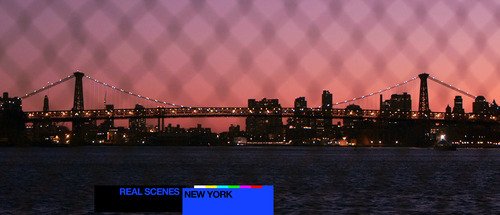
    I just stumbled upon a fascinating documentary series called Real Scenes. Each film explores “the musical, cultural and creative climate” within a particular city. 

    Below is Real Scenes: New York (click here if you can’t see it below). It’s an inside look at the underground music scene that has developed in Brooklyn, but that is at the same time being threatened by development and rising rents. Disclaimer: There’s a lot of f-bombs and a lot of hating on gentrification.

    [youtube https://www.youtube.com/watch?v=LDtf0uIUPuE?rel=0&w=560&h=315]

    I’ve only watched the New York video from this series, but I plan to watch each and every one of them. The other cities are Tokyo, Johannesburg, Paris, Berlin, Detroit, and Bristol.

    What’s fascinating about these short documentaries is that they give you a glimpse into a particular undertone within each city – one that would otherwise be hard to get if you weren’t living there and engrossed in the scene.

    It’s also interesting to see how some people view change within cities. 

    To some, transforming a neighborhood from one that looks like a “bomb went off” to something more pristine, is a good thing. But to others, it’s the worst possible outcome. It all depends on your frame of reference.

    Now, how do I get them to make a Real Scenes: Toronto? 🙂

    Image: Resident Advisor