Daily insights for city builders, delivered every morning at 6 AM ET. I’m Brandon Donnelly — a Toronto-based real estate developer and founder of Globizen. I’ve been writing here since 2013.

Tag: coworking

  • Will “bleisure” travel become a thing?

    According to this recent WSJ article, 60% of Marriott’s hotel stays in 2019 were for business travel. Given that this travel segment is believed to be one of the most permanently impacted by soul-sucking virtual meetings, the company has announced that it will be working to turn its hotels, or at least some of them, into “bleisure” destinations.

    The idea here, as I understand it, is that if this pandemic does in fact result in greater work flexibility, but less business travel, then this could be a way to target people who are “working from anywhere.” Don’t travel for work; work while you travel, is I guess how you could spin this.

    I’m not clear yet on how exactly this gets executed, but it sounds somewhat similar to the coliving/coworking spaces that currently cater to digital nomads and other location-agnostic professionals. Examples include companies like Outpost and Outsite.

    Regardless of whether or not this is actually practical, productive, and scalable (it could be), I think the idea of working from different (and potentially exotic) locations all around the world is a compelling concept for many people. Especially right now after a year of mostly working from the kitchen table.

  • One lease for the world

    image

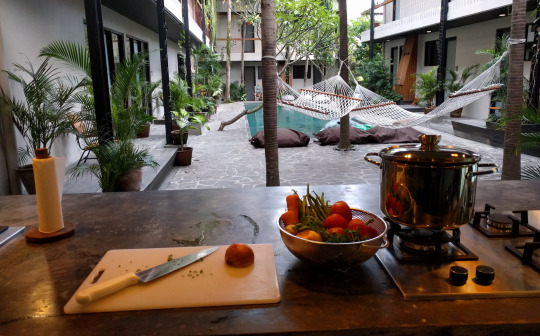
    If you’re looking for more evidence that the way we live and work is changing, then check out a new startup called Roam. They describe themselves as an international network of communal spaces. So far, they have locations in Ubud (Bali), Miami, and Madrid. Buenos Aires and London are coming soon.

    The way it works is that you start by signing a lease for either a week or a month. You get a private room and bathroom, but everything else, from the co-working spaces to the kitchens, are shared amongst the community. Like other co-working and co-living environments, the community they build is critical.

    However, what really differentiates Roam is that you can sign one lease and then live all over the world, freely traveling across their properties. All of the locations are offered up at the same price and you can stay for as long as you’d like.

    In my line of work, I don’t have the flexibility of living like a global nomad. But today, there are many people who can. And I also know that there are many people who would prefer to live like this. It’s liberating in so many ways.

    My friend and I actually had a similar idea to this back in University and we spent some time working on it. At the time, and this was over a decade ago, we felt that there was a segment of people who increasingly wanted to live like global citizens. I still believe that to be true and, clearly, so do others.

    To date, Roam has raised $3.4 million in funding.

    Image: Ubud kitchen via Roam

  • Coworking, coliving, and an old architecture school project

    Coworking spaces are big business.

    One of the biggest of those companies is WeWork. As of last month (November 2015), the company had raised close to a billion dollars from investors like JPMorgan Chase, Harvard Management, and Benchmark Capital, and was valued at $10 billion. (Remember though, this is in the private not public markets.)

    If you’re unfamiliar with coworking spaces, check out this post from The Spaces. It’s a great demonstration of how beautiful these spaces can be.

    All of this is interesting because it speaks to the changing nature of work. There are a lot of people freelancing, participating in the “online gig economy” and working on new ideas. And in many of these cases, they don’t want or need traditional office space and/or they want the community that many of these coworking spaces afford – both offline and online.

    But it’s not just the office that is changing. It’s also potentially living spaces. Since 2014, WeWork has been talking about their new coliving concept, WeLive. The idea here is to combine smaller living spaces with larger common areas and create an overall live-work community. And they are not the only ones thinking about this.

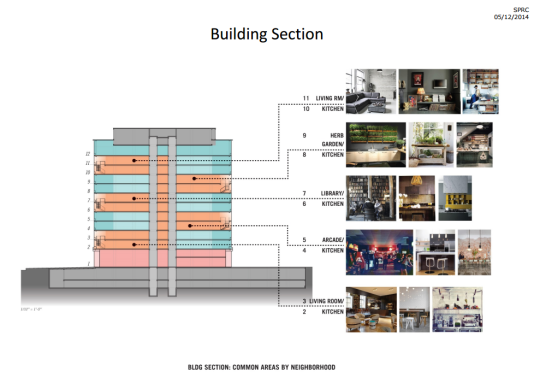
    Below is a building section of what this might look. It’s from a Vornado Realty presentation. They are working with WeWork to deliver their new WeLive concept in Crystal City, Virginia.

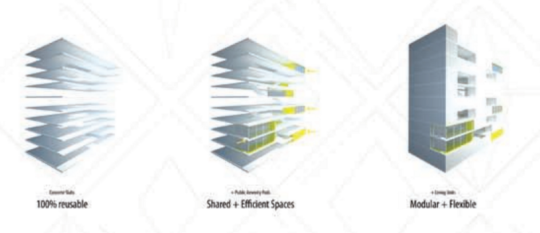
    It’s so interesting to see this concept come to fruition. Back in 2008 when I was in architecture school, I worked with a classmate of mine and designed a modular coliving apartment building. It was called the Philly Flex Dwelling and it worked like this:

    The idea here was to start with standard floor plates and use a structural exoskeleton to minimize interior columns. This way you could insert whatever prefabricated modules you wanted and also re-purpose the structure should you want to change the building’s use in the future. 

    This is not that dissimilar from what was originally proposed for One Bloor West here in Toronto. Though the goal there was column-free retail spaces. 

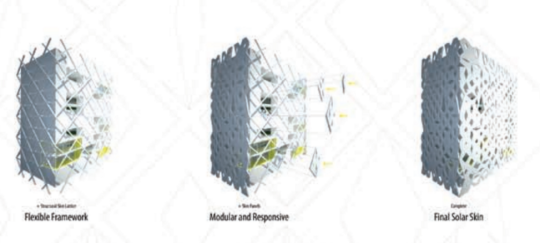
    The yellow spaces are the shared common areas and the remaining spaces are the residential living “pods.” We also designed a “solar skin” that was perfectly tuned to the building’s orientation and location in Philadelphia. The idea here was to maximize winter sun (for heating) and minimize summer sun (to keep the building cool).

    That was a fun project to work on.

  • East Room co-working space

    image

    Amy Bath needs to leave comments here on ATC more often because she has great feedback and insights.

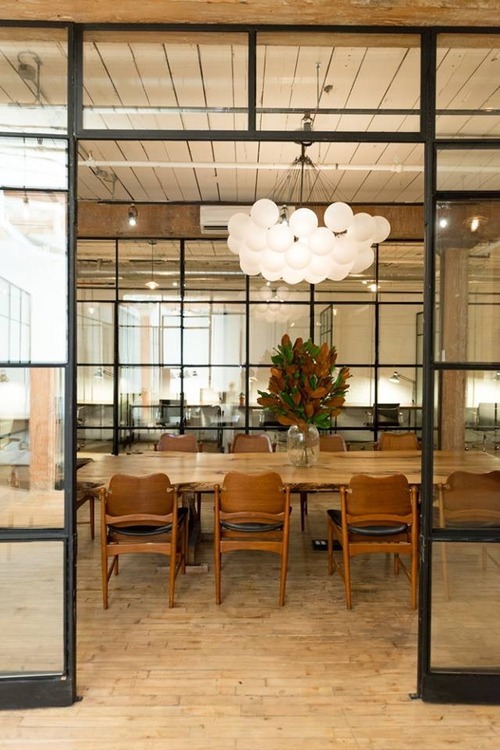
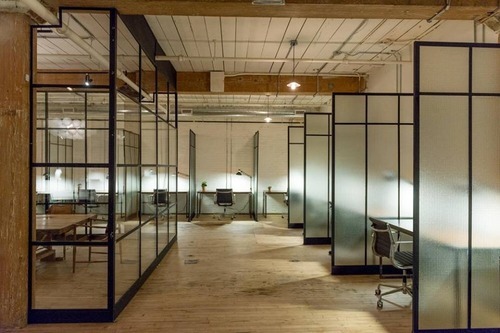
    This morning she tipped me off to a brand new co-working space on the east side of Toronto called East Room. If you haven’t yet heard of it, I would encourage you to check out their website. They’re in a gorgeous heritage building along the Don Valley and they seem to have executed really well. I love their design aesthetic.

    //platform.instagram.com/en_US/embeds.js

    They currently offer two different memberships: a resident membership ($500/month) and a club membership ($250/month).

    image

    This is exciting to me because I have a soft spot for both good design and the east side of Toronto. But probably more importantly, it speaks to the changing nature of work and the workplace, as well as to the shifts in how space is being consumed.

    Co-working spaces are, of course, blowing up all over the world from Philadelphia to Berlin. The internet has empowered new ways to freelance and make money, and these kinds of spaces are really a result of that. Because even though it’s entirely possible for many of us to work remotely at home, we still crave the social interaction that comes from being within an office environment. And that’s a big part of what these spaces are. They’re a social fabric.

    Amy’s hope is that condos will eventually start including amenity spaces that are similar to co-working spaces, and I think that’s a really interesting idea. The challenge, however, is that most developers today (and property managers) aren’t equipped to operate these kinds of environments.

    But maybe it’s only a matter of time before some do become equipped, because I’m sure we’re going to see more, not less, of these kinds of urban spaces.

    Images: @eastroom_

  • Nothing stops Detroit

    When I told my friends that I had booked a weekend getaway to Detroit, I got responses like: “By accident?” and “Why on earth would you want to go there?” But that’s exactly what I did last weekend. I went to Detroit.

    I wanted to see first hand what was going on the city. I wanted to see if it really was the lost cause that the media makes it out to be or if it had the potential to come back. I had been following Dan Gilbert’s efforts to seemingly buy up every building in downtown Detroit and I wanted to see if those efforts were working. I’m an optimist, so I wanted to believe that they were.

    I also have friends who live in the city and a friend who’s working on a number of urban renewal initiatives in the midtown area. It was a great opportunity for me to get a local point of view and also learn about what’s coming in the development pipeline. So I met my friend Alex – pronounced Ay-lex in Michigan – and I got the run down on Detroit.

    Detroit is an absolutely fascinating city. As I mentioned before, it’s like visiting the ruins of a former empire, but one that’s recent enough to remind you of how ephemeral success can be. Whether it’s the death of Blackberry or the decline of Detroit, the mighty fall all the time. But it’s precisely this rich history that makes the city so interesting. When you walk inside some of the buildings built during the first half of the 20th century, you can’t help but be reminded of how important of a city Detroit was for America. Detroit was filthy rich.

    But even beyond the showpieces like the Guardian Building and Fisher Building, the Detroit landscape is littered with office and industrial buildings that would make any developer want to line up. One neighbourhood in particular that stood out for me was Rivertown. Running along the water just east of downtown, the area is filled with old brick buildings and the right street scale for a magnificent neighbourhood.

    However, I was told that this neighbourhood doesn’t really have a lot of momentum behind it. Most efforts are focused on the downtown and midtown areas. Still, I couldn’t help but imagine the area as a thriving mixed-use community. In the shorter term, I also thought the area could be really cool as an entertainment and nightlife district similar to Kuntspark in Munich, which was also a former industrial zone.

    Downtown and midtown are where it’s most evident that change is underway though. “Opportunity Detroit” is the slogan of Dan Gilbert’s real estate company, called Bedrock, and you see it plastered up in all of the windows downtown. Offices buildings are now leasing up and new retailers are moving in. I was told that five years ago none of this was happening. Woodward Ave was empty.

    As you move north towards midtown, you then discover a Michigan first: an urban depressed freeway. Detroit was the first city in America to build these and it’s certainly going to work in its favour as its city centre is reborn. I can only imagine how much more divided the city would be today had the freeways that wrap the core been built as elevated overpasses.

    But that’s not the case. Downtown and midtown are decently connected, albeit different in feel. In midtown, the buildings are more midrise in scale, the streets are broader, and the retail appears further along. There’s a Whole Foods that just opened up and fantastic new coffee shop called Great Lakes Coffee. It was busy when I was there on Sunday morning and I was told that it’s really the first place in Detroit where people could go to hang out and work.

    As you leave the core of the city things really fall off though. This is where Detroit becomes a prairie city and you see the one house on a block condition that the media likes to capture. It’s here where it becomes apparent that Detroit is simply too big, geographically, for its current population. You have infrastructure in place for 2 million people and yet a tax base of 700,000 people. No wonder it went bankrupt.

    So like many others have suggested before, I think Detroit needs to figure out a way to shrink in order to eventually grow. Just like a company going through restructuring, Detroit has to rid itself of some its liabilities. It’s going to have to take that write-down.

    At the same time, the population needs to be somehow consolidated and something needs to be done with all its excess land (urban agriculture is one idea). Jane Jacobs taught us that towers in a park don’t create urban vibrancy and the same can be said for houses in fields. Detroit is fragmented and divided. More so than dangerous, most of the city just feels eerily deserted.

    However, despite these challenges, two things really stood out for me during my visit.

    The first is that Detroit still very much has an ethos of production. It likes building and making things, and it’s visible in the emergence of brands like Shinola who are producing bikes, watches and leather goods right in the city.

    The second is that there’s a palatable sense of possibility. Detroit hasn’t lost that entrepreneurial spirit that made it a leader in manufacturing, music and sports. A great example of this is the Green Garage in midtown, which is a former Model T showroom turned sustainable coworking lab for Detroit entrepreneurs.

    But perhaps the best way to sum up this spirit is through a line I saw on a neon sign downtown on Woodward Ave. 

    It read: “Nothing stops Detroit.”