Daily insights for city builders, delivered every morning at 6 AM ET. I’m Brandon Donnelly — a Toronto-based real estate developer and founder of Globizen. I’ve been writing here since 2013.
It has been cold and snowy in Toronto lately, which is great if you’re looking to shred pow on a snowboard, but suboptimal if you’re trying to construct buildings. It pains me deep inside my bone marrow when we lose productive days to weather. But what can you do?
I was, however, thrilled to see this first glimpse (pictured above) of the lobby / co-working space at Junction House this morning. The slightly elevated section (which is the point of view of the above rendering) is the co-working area.
The reason it’s elevated is that we needed the clearance below for our parking ramp. We thought about trying to make it retail, but a place for residents to hang out and work seemed like a pretty good idea.
A lot of us on the team are big fans of a great hotel lobby bar, but that’s kind of challenging to do in a residential condominium. This is maybe the next best thing. It’s been very popular with purchasers so far, but I’m looking forward to seeing how it performs in real life.
Transit City in Vaughan is providing direct access to an adjacent Buca restaurant. 55C in Yorkville is providing refrigerated storage space for perishable deliveries. And Junction House is incorporating a co-working space on the ground floor overlooking Dundas St W. We wanted it to have real utility (a place to work and hang out), but also serve to foster a sense of community within the building.
I have long been a fan of hotel lobby bars. They’re a place for social interaction, as well as a place for chance encounters. One of the best in the city is perhaps the Lobby Lounge (or “urban living room“) at the Shangri-La.
Of course, part of their success is aided by the fact that hotels are, by their very nature, transient places. And that transience can often encourage people to be more open. That makes the spaces more social. You also have the benefit of an operator (i.e. a bar/restaurant), which is what Transit City is leveraging with Buca.
Residential lobbies aren’t quite the same, but there are lessons to be learned. Oben Flats has been programming the lobbies in its rental buildings for years and they are doing a great job. And with the growing interest in co-living arrangements and small space living, I am sure we’ll be seeing more, not less, lobby rethinking.
Matt Levine’s most recent Money Stuff article is classic Matt Levine. It is both entertaining and informative. This one is on WeWork – the coworking startup that has committed to 14 million square feet of office space around the world and will have $18 billion in rent payments due over the next decade.
Here is an excerpt:
WeWork Cos. is a real-estate company with a couple of innovative twists on the model. First, rather than owning its buildings, it rents them: It leases office space from regular real-estate companies, adds … beer? … or whatever, and then subleases the space to tenants at higher rates. And second, rather than being valued like a real-estate company, it gets valued like a hot tech startup — “the sharing economy,” ping-pong tables, etc. — so it can raise gobs of money from SoftBank Group Corp. at a $20 billion valuation without ever getting particularly close to profitability. And look at all these words:
“Indeed, to assess WeWork by conventional metrics is to miss the point, according to [Chief Executive Officer Adam] Neumann. WeWork isn’t really a real estate company. It’s a state of consciousness, he argues, a generation of interconnected emotionally intelligent entrepreneurs.”
Really, what sort of multiple would you put on a state of consciousness?
Here are the results from my primitive multi-unit building amenities survey:
Gym is number 1. No surprise there. 46% of respondents said it was in their top 3.
Rooftop outdoor space at number 2 was perhaps a bit surprising. But then again, who doesn’t love a good rooftop patio?
As for concierge service, I tend to think this was driven by package delivery. That’s certainly the biggest value add for me.
One standout near the top, for me at least, is co-working space. Andrew LeFleur made mention of this on Twitter and I think he’s right: The changing nature of work is making these spaces more valuable in multi-family dwellings.
And now some color on the above results.
436 amenity selections were made as part of this survey.
About half of the respondents were from the Greater Toronto Area, followed by Calgary, San Francisco, Ottawa, Boston, New York City, Denver, Los Angeles, Paris, Miami, and many other cities. Shoutout to whoever responded from Kuala Lumpur and Porto Alegre.
In terms of “Other” amenities, there were suggestions for a band rehearsal space, a vending machine, a grassy area for sports, and programming the helps you meet your neighbors.
In terms of this one last, it can be tricky for condo buildings. Developers only provide the space. It’s then up to management. But I’ve seen it done very well in rental buildings.
Are you surprised by any of the results from this survey?
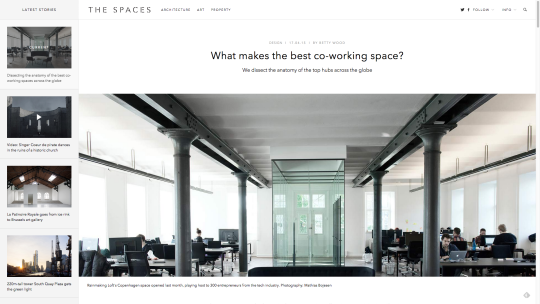
At some point in the past, I preregistered for a site called The Spaces. I don’t remember doing it, but I’m sure that the site seemed promising when I landed on it and so I gladly handed over my email address. I’m always on the lookout for new and interesting things.
Today that site has (soft) launched. And if you like architecture, design, art, and/or property, I am certain you will love it. I am already a fan.
Based in London, The Spaces is about exploring the new ways in which are we living and working. Spaces ranging from residences to coworking spaces and everything in between. It’s about unique and progressive spaces and the people behind them. I love the concept.
Since this is still a soft launch, I am sure the team is looking for feedback from the market. So if you have some, please share it in the comment section below. I will make sure they read it.
Click here to check out The Spaces. Happy Friday all 🙂
I usually write on Architect This City every day. But this past weekend I skipped both Saturday and Sunday, which is something I haven’t done in the 15 months that I’ve been writing this blog. I hate missing days. I really do. But I had no choice. I was at Startup Weekend here in Toronto.
Last Friday night, hundreds of people from Toronto’s startup community convened at the MakeWorks coworking space in Toronto’s west end to pitch and hear new business ideas. The floor is always open to anyone who would like to pitch, but you only have 60 seconds (hard stop) to convince the crowd that your idea is worth pursuing. This past weekend there were about 40 pitches.
Following the pitches, the crowd then gets to vote on their favorite ideas. The top pitches – there were 13 selected this past weekend – get to move on and the people who delivered those pitches become team leaders. They are then asked to get up one more time to tell the crowd who they need to develop their idea over the weekend. Once that happens, everyone starts scrambling around to try and put together a team. It’s all about hustle.
Immediately after the teams are formed, the work starts.
By Sunday at 5pm, you’re expected to have validated your idea and problem in front of real people, executed on some sort of minimum viable product (the solution), and ideally brought in some of your initial customers. Because at the end of the weekend, all the teams get up and deliver a 5 minute pitch in front of a panel of judges who assess you on how well you did against those 3 objectives.
It’s a weekend of raw adrenaline. I wouldn’t be surprised if I lost about 5-10 pounds as a result of how little food I ate and how much coffee I consumed.
I pitched a real estate related idea – just like I did 2 years ago at the last Startup Weekend I attended – and I was fortunate enough to win the top pitch on Friday night. I think it may have been because I said fuck in my pitch. Although, a lot of people also remembered me from the previous Startup Weekend and started calling me “Mr. Real Estate.”
Pitch 11 – Brandon dropping F bombs. Let others tell you the value of your home. #SWTO
Our team ultimately didn’t place – which may have been because it was an Internet of Things themed Startup Weekend and we weren’t that – but I think we developed a super solid business idea.
Either way, I had a blast. We knocked on people’s doors to validate our idea. We got a ton of positive feedback on what we were trying to do. And I was fortunate enough to meet a bunch of smart and ambitious people. I was so impressed by what our team accomplished.
But what I also love about events like Startup Weekend is that it shows you how vibrant the startup ecosystem really is in Toronto. There is no shortage of passionate entrepreneurs in this city fighting to change the world. And what’s great about this community is that they all know how hard it is to start something from nothing, and so they’re incredibly supportive.
If you have any interest, I would encourage you to check out events like Startup Weekend. They’re a lot of fun and they all contribute to the greatness of this city.
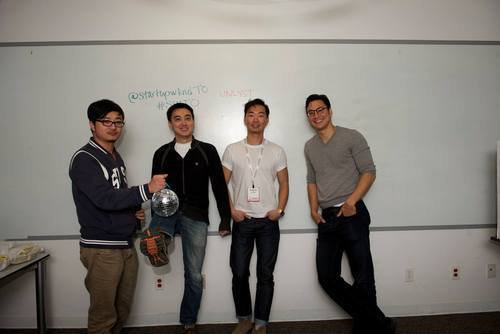
Image: The Unlyst Team at Startup Weekend TO 2014 (Jerry, Louis, Landon, and me)
Early this morning, before the sun even came up here in Toronto, I had a video conference call with a sharp and talented entrepreneur in Luxembourg. His name is Fräntz Miccoli and he’s working on an interesting startup called KonnectR.
The idea is to create a platform to connect with new people at any point in time and wherever you might happen to be. It may sound like a “hook-up” app, but that’s not the intent. He came about the idea while traveling and looking for other smart and engaging people to hang out with.
When we started the video conference call this morning, I showed him my window so that he could see the sun just starting to rise. He then showed me his coworking space, which made it seem like he is working out of an old industrial steel mill. Turns out, he is.
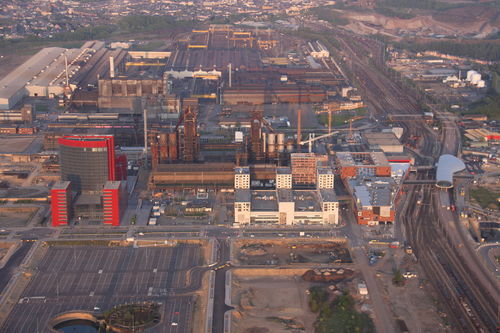
The area of Luxembourg he’s working out of is called Belval, which is a neighborhood in the west end of the country’s second largest city, Esch-sur-Alzette. The neighborhood used to consist of the largest steelworks in the country. But with the decline of steel production in Luxembourg, the area fell into decline. Today, it’s being reborn as a 21st century mixed-use community.
The developer behind the project is called Agora. And the site – equal to about 120 soccer fields – will house everything from residences and offices to shopping and cultural institutions. The University of Luxembourg has also centralized their campus in the new neighborhood. Having institutions “anchor” a community is becoming quite common for urban renewal programs. Here in Toronto, we did a similar thing with George Brown College along the waterfront.
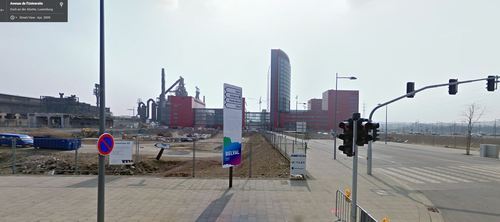
To give you a better sense of the transformation taking place in Belval, here’s a streetview photo from 2009:
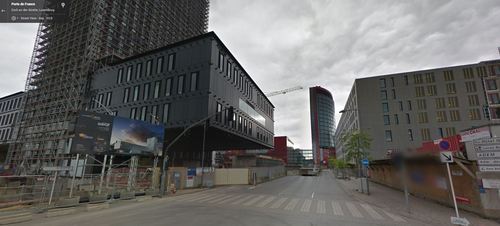
Here’s another one from the same intersection in 2013 (notice the same tower in the background):
I’m always fascinated by urban renewal projects of this scale because it so clearly speaks to the evolutionary nature of cities. Industries die. Businesses disappear. And new uses need to be found. In this case, the area has gone from steel production to tech startups. That’s not surprising.
But at the same time, I think it’s important that we don’t completely erase the past. Here, I think it’s great that they’re preserving some of the blast furnaces and other industrial structures. It gives the area character and a sense of place – which is oftentimes hard to manufacture and always better when it’s authentic.