Daily insights for city builders, delivered every morning at 6 AM ET. I’m Brandon Donnelly — a Toronto-based real estate developer and founder of Globizen. I’ve been writing here since 2013.

Tag: covid-19

  • Drinking in the park

    There has been no shortage of prognostications about the demise of cities, offices, and a bunch of other things, as a result of this pandemic. And by now, a lot of you probably know that I think most of this is overblown. I worked in the office today, did things on my three-screen setup, and had a burrito for lunch. It was lovely. But here are a few things that I do believe will happen: Canada will continue to relax its alcohol laws in the wake of this pandemic, most if not all of these relaxations will stick after we get through this, and city life, believe it or not, will be just fine.

    Earlier this month, the City of North Vancouver council voted 6-1 in favor of allowing alcohol consumption in some parks and some public spaces this summer. The mayor believes that they are the first city in BC to pass such a bylaw and I reckon that they are among the first in Canada (Quebec is generally the most chill). One of the justifications for this change is that about 80% of residents in North Vancouver live in a multi-family dwelling. And so this is a way for people, who don’t have backyards, to have a civilized drink on some grass.

    Will our puritanical province follow suit? My bet is yes.

  • The fall of the Roman Empire and the future of cities

    Harvard economist Ed Glaeser and former New York City Health Commissioner Mary Bassett were recently interviewed on national radio about COVID-19 and the future of our cities. What both of them touch on is the long history that cities and pandemics have had together, which is something that Glaeser also wrote about over here in City Journal. This pandemic isn’t the first and it won’t be the last.

    Using history as an example, Glaeser makes the argument all of this can go one of two ways. After the influenza epidemic of 1919, cities rebounded quickly. The roaring twenties were one of “the great city-building decades in American history.” But on the other hand, there’s the Justinian Plague (circa 541 to 750 CE), which is thought to have played an important role in the fall of the Roman Empire. Glaeser argues that this plague, which took over 200 years to extinguish, is responsible for 800 years of de-urbanization across the Mediterranean. Is that so?

    A quick search reveals that the impacts of the Justinian Plague are, of course, greatly contested. Some scholars have questioned whether it was actually an “inconsequential pandemic.” Whatever the case may be, it doesn’t change the fact that the modern world has been built around density and proximity. We are social beings and we are smarter and more productive when we are able to cluster together. That was the case in 750 CE and it remains the case today.

  • New York City is budgeting $30.8 billion in property tax collections

    According to the WSJ, New York City is budgeting to collect $30.8 billion in property taxes for fiscal year 2021. These tax bills will go out on June 1 and payments will start becoming due on July 1, which is the start of the city’s fiscal year. Here’s how the collections break down across houses, apartments, and commercial properties:

    Overall — and despite the fact that values have softened in the wake of COVID-19 — this year’s property tax budget represents a 5.7% increase over FY2020. The reason for this is that each year the city completes its annual assessments on January 5. And so according to the city’s January numbers, everything is just fine.

    Supposedly this January 5 date is usually non-negotiable. A lawyer is quoted in the Journal article saying that under normal circumstances, if your house were to burn down on January 6, you would still have to pay all of your taxes for the upcoming fiscal year.

    Time will tell if this time is different. But it is interesting, though not surprising, to note just how significant property taxes are to New York City’s overall tax collections. They represent a little more half of all taxes collected.

  • Surface Summer School at Penn

    The University of Pennsylvania Stuart Weitzman School of Design — my alma mater — has just launched a new initiative with Surface Magazine called the Surface Summer School at Penn. A fairly unique partnership between a media company and an accredited university, the goal of the “summer school” is twofold.

    One, it gives Penn students, who might otherwise struggle to find an internship in this climate, something productive and positive to do over the summer. And two, it applies design thinking to the problems of this pandemic.

    Penn students will have the month of June to design a prefabricated COVID-19 testing structure — one that could be rolled out in dense and compact urban centers around the world. A jury will then review the submissions and a winner will be announced by mid-July.

    The jury includes a host of noteworthy architects and designers: Winka Dubbeldam, Dror Benshetrit, Thom Mayne, Yves Béhar, Susan Sellers, Marion Weiss, Ferda Kolatan, Joe Doucet, and others. Starting on June 3rd at 6:30 PM eastern, members of the jury will also start delivering design lectures on Surface’s Instagram.

    I am looking forward to seeing the submissions. Hopefully all of them will be made public.

    Photo by Dyana Wing So on Unsplash

  • Jostling for space on the grass

    The talk this weekend in Toronto is about how everyone is jamming into downtown parks — like Trinity Bellwoods — to enjoy the beautiful weather and drink outside with friends.

    Some, including our mayor, are “extremely disappointed” by this selfish behavior. Others are chalking it up to those hipsters. And others, such as Richard Florida, are being highly sympathetic: these are young people who live in small urban spaces and they are clamoring for some green space. Let them be human.

    This, of course, is a debate that is playing out not just here in Toronto, but all around the world as we flirt our way into a reopening. Videos of the Lake of the Ozarks were making the rounds on Twitter when I last checked.

    I’m not here to pass judgement or predict a second wave (though a few waves are probably inevitable). I’ll leave that to the epidemiologists. The silver lining to all of this, I think, is that it is a clear demonstration of just how persistent urban life remains in the midst of this pandemic. The desire to be around other humans is a powerful force of attraction.

    Here is an excerpt from a recent FT Opinion by Ben Rogers called, Cities are not dead — they will get younger:

    Cities have always worked particularly well for young people. They flock to them to build up vital social and professional networks, meet their mates and learn how the world works. Around the world there is massive unmet demand for city homes and workspace. The idea that the centres of London, Paris and New York will turn into tumbleweed towns is fanciful. The age composition of these cities might change, but people and business will still be jostling for space near the centre.

    In Toronto this weekend, that jostling for space played out on the grass of Trinity Bellwoods Park.

    Photo by Adrien Olichon on Unsplash

  • Niall Ferguson discusses life with COVID-19

    Last night I watched this Munk Dialogue with historian Niall Ferguson. (Some of you may remember that I wrote about a previous dialogue with Malcolm Gladwell a few weeks ago.) One of the sobering lessons of history is that, without a vaccine, we’re probably not yet in a position to talk about life after COVID-19. At least in the short-term, this is going to be life with COVID-19.

    Here is an excerpt from an article Niall wrote talking about how “a second wave could capsize Trump.”

    In history, all the great pandemics have come in waves, including the Black Death of bubonic and pneumonic plague in the 14th century and smallpox in the 18th century. The first recorded plague outbreak — in Athens in the 5th century BC — had three waves: in 430BC, 429BC and 427 to 426BC.

    In some cases, the second wave was worse than the first. Take the great influenza of 1918-19. The first official recorded outbreak was at a Kansas army base, Camp Funston, in March 1918. But the global peak of mortality was in the second wave of October and November. A third wave affected some areas of the world in early 1919, principally England and Wales and Australia.

    The 1957-58 influenza pandemic hit Hong Kong in mid-April 1957. It reached America in June and produced a surge of deaths among teenagers that autumn. But there was a second wave in January-March 1958. There were further spikes of excess mortality in early 1960 and early 1963.

    The other topic I was left thinking about from the dialogue is what all of this does to US-China relations, and more broadly relations between the West and China. Even before this pandemic, Niall had been arguing that Cold War II had already begun. Today’s news that China is planning new national security laws for Hong Kong certainly doesn’t help.

  • Uber to close 45 of its offices

    On Monday it was reported — by the Wall Street Journal, Tech Crunch, and others — that Uber will be laying off another 3,000 employees and closing 45 of its offices around the world. Here is a quote from TechCrunch:

    “I knew that I had to make a hard decision, not because we are a public company, or to protect or stock price, or to please our Board or investors,” Uber CEO Dara Khosrowshahi wrote to employees today in a memo, viewed by TechCrunch. “I had to make this decision because our very future as an essential service for the cities of the world — our being there for millions of people and businesses who rely on us — demands it. We must establish ourselves as a self-sustaining enterprise that no longer relies on new capital or investors to keep growing, expanding, and innovating.”

    According to this SEC filing, the company expects to pay approximately $110 million to $140 million in severance and other termination benefits, and somewhere between $65 million to $80 million in costs related to closing its offices.

    All of this is, of course, being driven by a steep decline in ride bookings, which is about 70% of the company’s revenue. Ride bookings were down 80% in April from a year earlier. For Q1 2020, they were down about 5% compared to 2019.

    Uber Eats has seen a spike in demand with people staying at home. Bookings were up 52% in Q1 2020 from a year earlier. The problem is that, unlike its rides business, their food delivery business is far from profitable. That’s the point of the possible merger with Grubhub.

    The company has said that they are seeing some signs of a recovery in markets that have begun to reopen. But it’s too early to predict what that will really look like. The hole is pretty deep.

    Pre-COVID, ride hailing demand tended to surge on the weekends as people went out to restaurants, bars, and clubs. So presumably those activities will need to return for its revenue to return. But I also think we could see a spike because of people being nervous to take public transit.

    Either way, the company is making some really tough decisions right now. But it seems to be doing what it needs to do in order to get to the other side of this and become a self-sustaining and profitable business. Full disclosure: I own some $UBER.

    Chart: Uber Q1 2020 results

  • The America we need

    The New York Times is running an opinion series right now called, The America We Need. It is all about how the US might emerge from this crisis “with a fair, resilient society.” This piece by Carol Galante covers many of the topics that we discuss on this blog. Carol is a former city planner and nonprofit housing developer. She is now the faculty director of the Terner Center for Housing Innovation at UC, Berkeley. Here are a couple of excerpts from her article that I think will resonate with many of you:

    There are two things we know: The U.S. economy will recover. And the recovery will start in and be strongest in the same cities that were thriving before the pandemic. Economies in places like Seattle, San Francisco, New York and Boston are driven by the innovation, technology and biotech sectors, which are proving to be remarkably resilient to the impacts of Covid-19.

    We have an obligation to ignore the short-term reactionary impulse to blame density for the spread of the coronavirus and instead use this opportunity to rethink the policies that impede the construction of new housing, at more price levels, in the places where housing is most needed.

    In my subsequent career as a nonprofit housing developer working in prosperous coastal California communities, I spent far too many nights in City Council meetings working to get apartment buildings for lower-income older people and families approved. Underlying the “density” battle was almost always a battle over who has access to the opportunities of a place and who doesn’t, cloaked in arguments about neighborhood character and traffic impacts.

  • Sidewalk Labs, Uber, Lime, and the demise of urban density

    Today I am going to talk about 3 things that recently happened and/or that are on my mind.

    Sidewalk Labs pulled out of Toronto. I think this is sad. A lot of people have said that they’re surprised, but not surprised. The official reason is that this unprecedented environment has made it financially infeasible for them to develop the 12-acre site, while still adhering to their core principles. I don’t have any inside knowledge of the situation, but I can’t help but think that this is probably just an opportune excuse. They were getting beat up pretty badly by Toronto on all fronts, even though they had put forward an incredibly ambitious development proposal. As I said before, I can’t imagine many (or any) “conventional” developers coming forward with something like this. The last plan I saw was 1/3 non-residential, and 40% of the residential component was to be priced below market. And never mind all of the other innovations that were being contemplated.

    In other tech news, Uber just led a $170 million investment in Lime (the micromobility scooter company). I think this is smart — both from an overall mobility standpoint and, selfishly, as a shareowner of $UBER. It is being reported that this round of investment values Lime at about $510 million. This is a 79% decline from April 2019 when it raised its last round. So presumably, Uber is getting a pretty good deal here. The bet is that the urban landscape demands multi-modal transportation solutions, everything from bikes and scooters to cars and public transit. There is also an argument to be made that in the short-term, our post-pandemic world is going to gravitate toward individual mobility and away from things like public transit. I’ve heard a few people say that, as we re-open the global economy and try to maintain social distancing, we’re going to face two major mobility bottlenecks: transit and elevators. Sounds like more testing would be a prudent idea.

    Above, I was very careful to say “in the short-term” because I think the narrative that is emerging around the demise of urban density is entirely overblown. Few of us are clamoring to jump back into a mosh pit right now (perhaps a metaphorical mosh pit), but I also don’t believe that we will suddenly look to sprawling Brasilia as a source of urban inspiration. While it is true that “disease did shape architecture in the 20th century” (Alex Bozikovic wrote a good piece on this over the weekend) and that there have been oscillations in terms of how we view urbanity, I also know that this isn’t the first pandemic that our cities have lived through. The Hong Kong flu of 1968 is thought to have killed one million people around the world after, allegedly, emerging in one of the densest cities ever created. Hong Kong’s relationship with Beijing is a tenuous one right now, but it still remains one of the world’s most important global cities.

    Perhaps cities are more resilient than we give them credit for.

    Photo by Touann Gatouillat Vergos on Unsplash

  • New Yorkers are actually pretty healthy

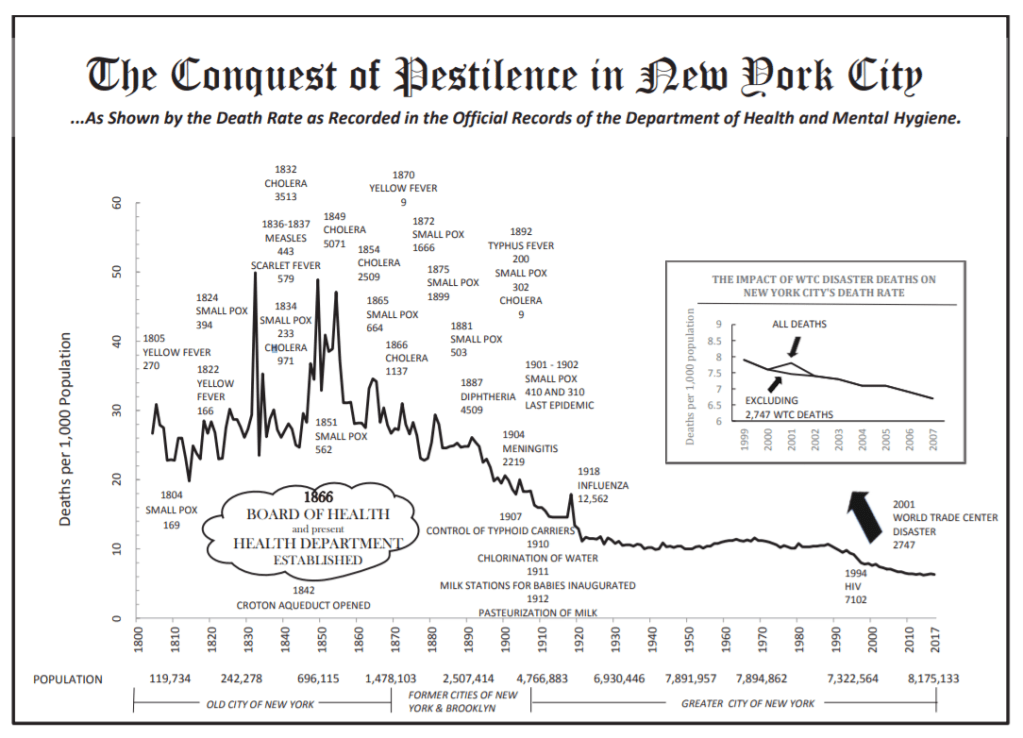
    Nicole Gelinas’ recent piece in CityLab is a good reminder that — despite all of the debates around COVID-19 and urban density — New York City is actually a really healthy place to live. Part of this obviously has to do with the city’s investments in public health. But the biggest factor, Nicole argues, is the city’s transit network. Six million people move around New York City each day without a car. That translates into a meaningfully lower traffic fatality rate. New York State’s rate is about 4.8 per 100,000, whereas Florida’s is 14.7 deaths per 100,000. Taking transit (and having an urban morphology that supports taking transit) also brings along with it other benefits, such as increased walking. And I have to believe that is an important factor. The obesity rate in New York City is thought to be about 22%, compared to a shocking 42% for the country. All of this rolls up into a life expectancy of about 81.2 years for New Yorkers, as of 2017. This is compared to 78.6 years for the US as a whole.

    For more on the health of New Yorkers, check out this 2017 Summary of Vital Statistics. (It’s the source of the above chart.)