
Daily insights for city builders, delivered every morning at 6 AM ET. I’m Brandon Donnelly — a Toronto-based real estate developer and founder of Globizen. I’ve been writing here since 2013.

Tag: cost of living

  • Incomes caught up with inflation. So why does everyone feel broke?

    Early on in my career, I used to run development pro formas where I would assume that our costs would increase at some rate in and around inflation. Combined with a conservative contingency allowance, I used to think I was being prudent. How cute.

    The pandemic made this approach seem silly. Our pro formas did not contemplate 40-50% cost increases for certain line items. But even without these outliers, the pandemic did cause things to become more expensive than one would have expected from pre-pandemic trends. Here’s a recent chart via the Bank of Canada:
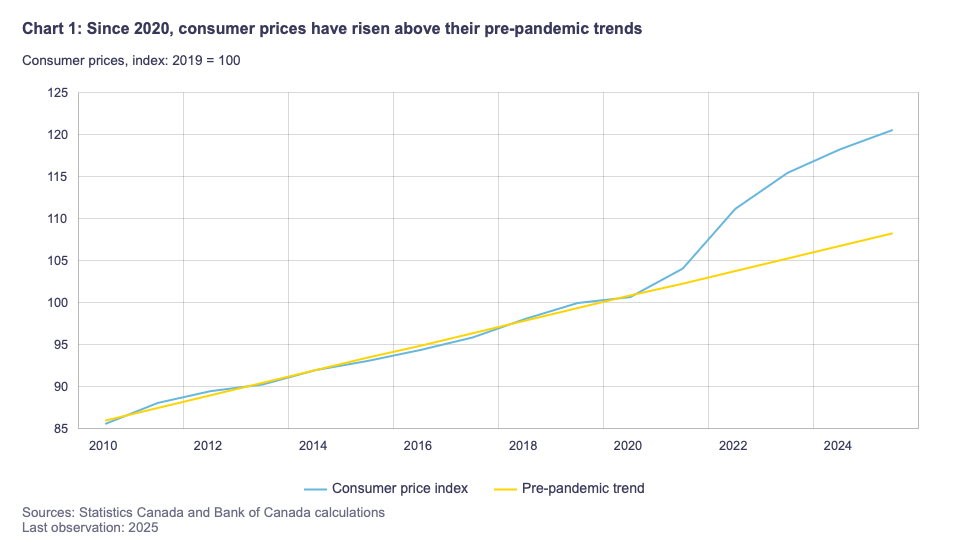
    But the cost of things is only one side of the equation. For things to be “more expensive,” we also need to look at their relationship to income, and that’s what Yaz Terajima has done here. Interestingly enough, household disposable income seems to have kept pace with the additional cost of things, at least on average.

    Between 2020-25, the average household spent about $6,500 more per year relative to pre-pandemic trends, but disposable income increased by about $7,400, creating a positive income-expense gap of about $900.

    So why, then, does it feel like things are more expensive? Well, for one thing, there is a meaningful difference across age groups and income levels. Yaz also found that younger and lower-income households did not, in fact, see their incomes rise sufficiently to cover these higher costs.

    On top of this, this study does not factor increases in overall wealth due to assets appreciating, which tend to be more concentrated among wealthier households. So the full-picture reality is almost certainly a bigger socioeconomic divide across age groups and income levels.

  • 2 parents, 2 kids, and 1 cat in 1,000 square feet

    Yesterday a colleague at the office sent around this Globe and Mail article talking about a Vancouver family of 4 (plus one cat) who live in a 1,000 square foot loft near downtown that they purchased in 2003 for $269,900. There weren’t really any photos of the place, but the article makes it sound like they have 3 beds crammed into one room. (I wonder how the parents ever manage to have sex. There are better ways to lay out 1,000 sf.)

    In any event, the point of the article is that there’s a growing number of families who are clinging to the downtown lifestyle that they’ve grown accustomed to and are refusing to follow the path of a conventional suburban house – regardless of how tight their current quarters might be. It’s happening in Toronto (here’s an article from the Toronto Star and here’s a post I wrote) and it’s happening in New York:

    A recent New York Times article on a similar trend noted that the number of white professionals with one or more children living in one-bedroom condo units in that city had jumped by almost a third between 2000 to 2006. Prof. Andrew Beveridge, from Queens College of the City University of New York, said the pattern was showing up in other expensive American cities. In Toronto, the 2011 National Household Survey showed there are about 72,000 families living in 71,500 units in buildings with five or more storeys – undoubtedly many of them the new, tiny condos proliferating there.

    To some this might sound crazy. I mean, why would a dual income family–such as the one in Vancouver–subject themselves to a smaller space when they could easily afford a bigger place somewhere else? Isn’t that the dream – to have a big house?

    The answer is that these families are considering–in addition to the direct costs of a bigger place–both the indirect costs of living further away from the core (such as longer commute times) and the inevitable lifestyle changes that would happen should they move out from their downtown neighborhoods. The urban lifestyle is different.

    But what I find interesting about this phenomenon is that if this trend continues (and I think it will), we’re going to have a new generation of people in North America who grew up in apartments, condos, and lofts, and don’t have the same biases around single family houses and suburban living. To them, an apartment will be a perfectly normal place to raise a family.