
Daily insights for city builders, delivered every morning at 6 AM ET. I’m Brandon Donnelly — a Toronto-based real estate developer and founder of Globizen. I’ve been writing here since 2013.

Tag: contra cafe

  • Not every neighbourhood wants to be urban

    Many cities today treat local retail the way medieval towns treated tanneries: as an offensive nuisance that must be segregated from where people live. This has led us to our current debate over whether small-scale retail should be allowed deep inside residential neighbourhoods. It’s allowed, sometimes.

    The detractors like to get people excited by suggesting that this will lead to all-night raves, multinational chains, or streets being overrun with cars. But of course, that is not what we’re talking about.

    There are lots of case studies that we can point to. Japan, for instance, has a national zoning code that permits small-scale shops, home offices, and cafes in even its lowest-density, residential-only zone. From there, all subsequent zones work cumulatively, meaning more intensive zones generally inherit all previous uses. The result is a land-use approach that is default mixed-use.

    Of course, there are also lots of examples that we can point to here in Toronto, and that’s because corner stores used to be a part of our daily life. But these remnant examples are generally found in the oldest, and most urban, parts of the city, and rejected in the inner suburbs.

    It is no surprise that Toronto is once again divided on this issue and across its typical built-form lines. This division runs deep, and it will almost certainly resurface when Torontonians head to the polls this Monday.

    At the end of the day, corner stores and local retail are an inherently urban sensibility. It is about not having to get into a car to grab a coffee or a soft washed-rind French cheese from Haute-Savoie. But we know that not all communities want to be urban.

    One resident’s feature is another’s bug.

  • Barriers to entry: Salvador vs. Toronto

    Netflix has a new docuseries out about Latin American street food. I watched two episodes of it last night. The first was about a chef from Buenos Aires, Argentina and the second was about a chef — named Dona Suzana — from Salvador, Brazil. Even if you aren’t necessarily into food shows, it’s a good way to remind yourself just how much you probably miss traveling right now.

    The story of Dona Suzana is an interesting one. Before opening her restaurant, she was doing laundry in order to make ends meet. Then at one point, the City of Salvador came to her community in order to undertake a large construction project. They needed someone to cook food for the construction workers and so they asked her if she would do it.

    Since she had always dreamed of being a chef, she jumped at the opportunity and took out a loan to buy everything she needed in order to fit out her kitchen. She cooked for the workers and everyone loved the food. But she never ended up getting paid. They stiffed her.

    That turned her off cooking for a bit and it was not until a trio of graffiti artists were working in her community and looking for a place to eat that she tried her hand at it again. They offered to pay her in advance and persuaded her to make them something. She agreed and the food was a huge hit.

    In fact, the group of artists loved the food so much that they made her a sign with the name “RéRestaurante” (titled this way because Dona has a stutter) and began sharing photos of her dishes on social media. All of a sudden she had people showing up at her door. And today she has people from all around the world showing up at her door.

    This is a wonderful success story. But I think it also says something about land use policies. As far as I can tell from the episode, she setup her restaurant at her place of residence — a community along the waterfront where her husband fishes and where she uses his catches for her renowned dishes.

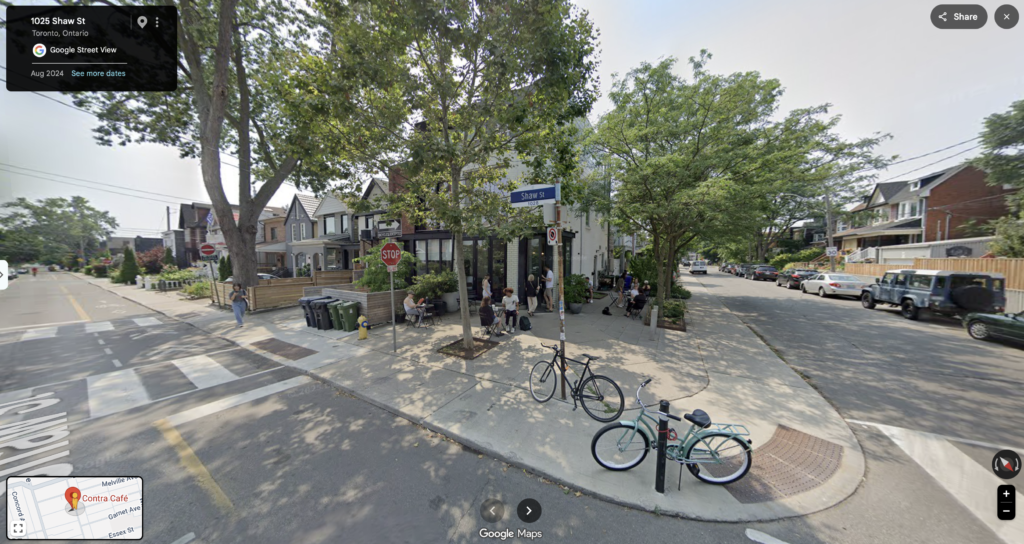
    Here in Toronto, we are operating in an environment where if you try and setup a coffee shop in a residential “Neighbourhood” — like, for example, Contra at 1028 Shaw Street — you might spend a few years fighting with your neighbors and battling it out at LPAT hearings in order to get the appropriate permissions.

    I’m not necessarily suggesting that we should do away with all zoning (or maybe I am). But I would like to draw your attention to this contrast. Because one has to wonder whether RéRestaurante Dona Suzana would exist today and be known around the world had the barriers to entry not been so low for her. Of course, had there been more rules, maybe she wouldn’t have gotten stiffed the first time around.

    Either way, I am currently in the market for some dende oil.

    Photo by Milo Miloezger on Unsplash