
Daily insights for city builders, delivered every morning at 6 AM ET. I’m Brandon Donnelly — a Toronto-based real estate developer and founder of Globizen. I’ve been writing here since 2013.

Tag: construction starts

  • Over-building and then under-building: Is Toronto headed for a severe shortage of new rental housing?

    As we know — because here’s the data — this is the current state of affairs:

    The GTA condo market is in a state of economic lockdown. The math doesn’t make economic sense from both the demand side (investors) and the supply side (developers), leaving the market at a standstill.

    The above excerpt is from a recent CIBC Capital Markets article by Benjamin Tal (CIBC) and Shawn Hildebrant (Urbanation). And what it ultimately means is that the supply of new condominiums in the GTA is falling and will continue to fall for the foreseeable future. Below are two charts, from the same article, that show that.

    Because of this, I actually think that, if you need or want a place to live, right now is a near ideal time to buy a condominium, especially if it’s from developer inventory (in an already completed project) or it’s a resale. Of course, most people won’t want to do this because they’d rather buy when most other people in the market want to buy. This is how markets tend to go.

    It has been a while since the GTA has gone through one of these real estate cycles, but it is typical: developers are prone to both over-building and under-building. It simply takes too long to build a building, and so it is natural for there to be moments when supply and demand don’t exactly line up.

    Pre-selling condominiums is — in theory only — supposed to protect against too much overbuilding. But as we have spoken about many times before, it can be challenging for end users to buy a new home so far in advance. And so the new condominium market has come to rely on investors who want to buy early and then either sell later or rent later.

    According to the above article (and MLS data), the share of newly completed condominiums used as rentals reached a peak of 34% in 2023. So a third of new condos. My gut tells me that the actual number is much higher. Many rentals never reach MLS. Overall, I think it’s very safe to assume that the majority of new condominiums are owned by investors.

    But right now, fewer investors want to own condominiums, which is why the number of resale listings has spiked this year:
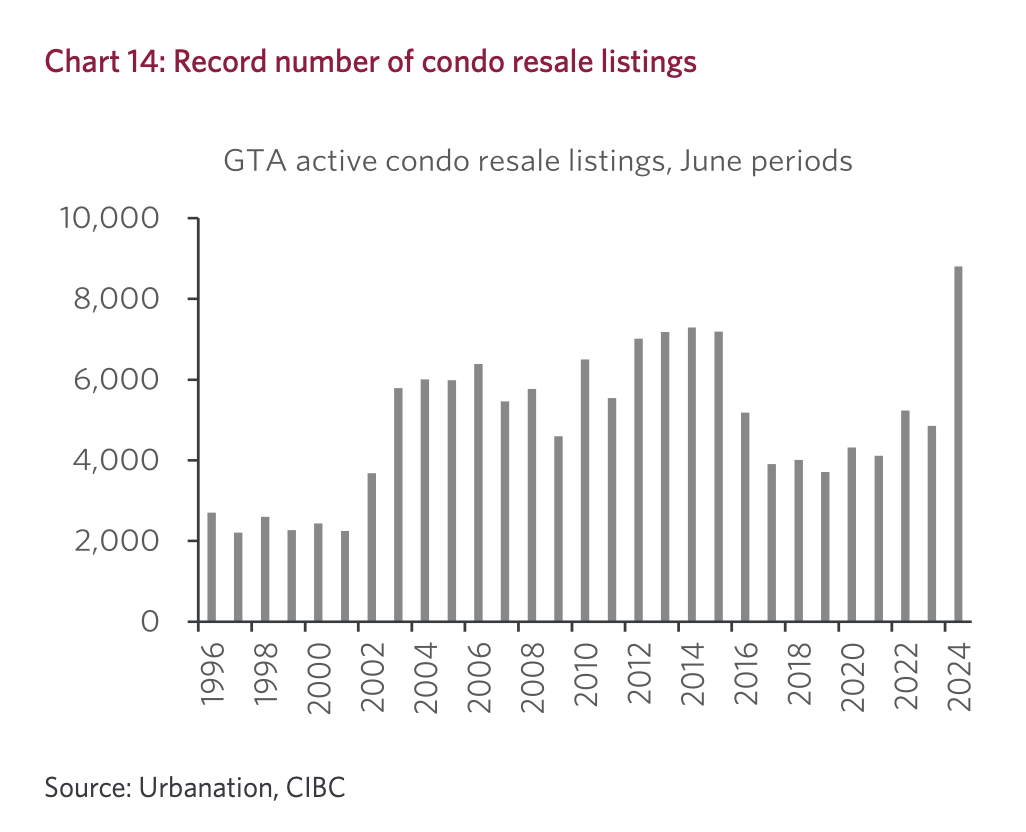
    This is, again, why I think right now is an excellent time to buy a condo. You know, be greedy when others… Regardless, this inventory will need to get absorbed and that will ultimately happen. Some of it will go to end users and some of it will go to investors who can make sense of the rental math and/or want to take a long view on Toronto. But if more goes to the former, we will be losing a lot of new rental housing.

    At the same time, while all of this is going on, construction starts are likely going to remain depressed (chart 3 above). It’s impossible to know how long this lasts, but at some point we will reach a moment in the cycle where we are under-building new housing. Maybe we’re already there. Development simply can’t turn on fast enough when demand spikes. There will almost always be a lag.

    So, since the majority of new condominiums have been serving as new rental housing, there’s a strong case to be made that at some point we will run into a potentially severe shortage of rentals. Condo investors are sometimes vilified in the media, but we will soon find out what happens when you take a big chunk of them out of the housing market.

  • 1,688 new condominiums were sold last quarter in the Toronto region

    Urbanation just released its Q2-2024 condominium market survey for the Greater Toronto & Hamilton Area (GTHA), and we should probably talk about some of the data:

    • The new condominium market reported 1,688 sales in the quarter. Outside of Q2-2020 (the pandemic), this is the lowest in the past 20 years. Note: This number is self-reported by developers.
    • Of the 3,625 homes launched for pre-sale during the quarter, only about 17% got absorbed/sold. That’s about ~616 homes, which isn’t very much when you spread it out across the region’s projects.
    • Unsold inventory increased to 25,893 homes. Urbanation equates this to 34 months of supply, versus a more “balanced level” of 10-12 months. This number breaks down to 15,157 homes in pre-construction projects, 9,788 homes in projects under construction, and 948 homes in recently completed buildings.
    • This is higher than Urbanation’s 20-year average, but the way I see it is that the ~15k homes in pre-construction projects could very quickly evaporate. If those projects don’t get to construction (and most probably won’t in the short term), then that inventory will disappear from the market. On the other hand, the ~11k homes under construction or recently completed is a hard number. These homes exist, or will soon exist, and they’ll need to get absorbed at some point.
    • There are also going to be homes that are currently sold, but where buyers ultimately say “yeah, I’m not going to be able to close.” So there will be some non-zero percentage of homes that will need to be reabsorbed. I don’t know what this percentage will be, but if it’s something like 5%, that’s not nothing. (See below for the number of condominiums under construction right now.)
    • Not surprisingly, average asking prices for unsold homes only declined about 2.6% over the past year. Prices have remained markably sticky. And this is how you know that development happens on the margin. Because developers are infinitely better off selling homes and starting construction, compared to holding lots of unsold inventory and starting construction, whenever. The fact that developers aren’t dropping prices to sell more homes demonstrates that they can’t. They’re hitting the floor of financial feasibility.
    • Finally, last quarter saw 727 new condominium homes start construction. In theory, this could have been a single tall building, though that probably wasn’t the case. As new starts fall, the number of condominiums under construction will naturally also fall. The current number is 87,508 homes, which is almost 19,000 less than a year ago. I expect this number to keep coming down.
  • Why are construction starts down?

    Last year in the Greater Toronto Area, condominium construction starts fell to a 9-year low of 15,891 homes. And this year, condominium construction starts are forecasted to fall to a 15-year low of 11,500 homes (though new sales are expected to rebound). Both of these figures are from Urbanation’s Q4-2023 market data.

    One possible explanation for this drop in construction starts could be that developers are somehow colluding to keep supply low and prices high. Another one could be that more developers are right now independently speculating that prices will be higher in the future, and so they think it’s better to just wait. But both of these explanations would be wrong.

    The correct answer is that more developers are unable to start construction because the market isn’t there. In the case of Toronto’s condominium market, this means that the pre-sales aren’t there. This might seem obvious, but there seems to always be a contingent of people who believe that developers can choose to build whenever they want.

    It is for this same reason that some people think that zoning approvals should have an expiry date. Call it a use-it-or-lose-it approach. But as I think we can see in the above numbers, developers don’t control the market. And so I would never want to be in a position where I need to start construction by a certain date, or else.

    That’s not entirely within my control. In fact, sometimes it’s completely out of my control.

  • Architecture billings are down

    When I was in grad school they used to always tell us that architects are a leading indicator for the development business. Because if architects are getting fewer jobs/billings, it means that at some point in the future there will be fewer construction starts and then fewer completions. And not surprisingly, that is what we are seeing happening right now. Below is the latest data from the AIA/Deltek Architecture Billings Index (via Bloomberg).

    Billings, inquiries (an even earlier leading indicator for billings), and design contracts are down:

    And it seems to be most pronounced in the West and the Northeast:

    This is always something to watch if you want to try and forecast where hard costs might be going and what completions might look like in the next few years.