Daily insights for city builders, delivered every morning at 6 AM ET. I’m Brandon Donnelly — a Toronto-based real estate developer and founder of Globizen. I’ve been writing here since 2013.

Tag: conference

  • The pre-meeting is often better than most panel discussions

    When you’re preparing for a panel discussion, one of the things you usually do is have a pre-meeting with all of the participants. The purpose of this meeting is, of course, to get to know everyone and decide on what you’re going to talk about. Everything then gets buttoned up and you have the actual panel.

    But one of the things I’ve been feeling lately is that oftentimes the pre-meeting is more interesting than the actual panel. And that’s because everyone is more relaxed and everyone is engaged in a genuine discussion that hasn’t been pre-meditated. Nobody wants to hear boring and overly-scripted answers. Natural and free-flowing discussions are so much more engaging.

    So I’m going to try and keep this in mind and not put on a sucky panel next week at the land & development conference (which, by the way, will be in person). I’m moderating a panel on innovations in project design, delivery, and building operations. If you’d like to join, you can register over here.
  • Some tweets about construction costs

    Today was the 2019 Land & Development Conference here in Toronto. I was on a panel in the morning about Proptech. I then sat in on a discussion about construction costs. But after that I had to get back to the office to prepare for a couple of meetings.

    Here are my tweet takeaways (from the back of the room) during the construction cost session. You may need to click through to see the full thread.

    The construction cost escalations that we have seen over the last 2-3 years have had a significant impact on new construction in this region. Niall Finnegan’s view is that we are 85% of the way through this “storm.”

    From his experience, it takes 18 months or so for hard costs to respond to changes in demand. And so the storm we are currently in is a result of elevated condo sales from 2017-2018.

    The general consensus from the panel was that costs should start to moderate sometime soon, though maybe not this year. Nobody really knows when that will happen. But if/when hard costs do adjust, it typically happens quickly.

    One comment that didn’t make it into my tweets, but that I found interesting, was about how uncertainty and volatility in the market — like what we are seeing today with construction costs — could actually stifle innovation.

    Because it creates additional project risks, it limits people’s appetite for other kinds of risks — like trying new things. I can see that.

  • Forum on Future Cities: Urban Intelligence

    MIT Senseable City Lab and the World Economic Forum’s Global Future Council on Cities and Urbanization are hosting a conference next month on the impact that artificial intelligence is having on our cities. Here is a summary of the event:

    As AI (Artificial Intelligence) becomes ubiquitous, it transforms many aspects of the environment we live in. In cities, AI is opening up a new era of an endlessly reconfigurable environment. Empowered by robust computers and elegant algorithms that can handle massive data sets, cities can make more informed decisions and create feedback loops between humans and the urban environment. It is what we call the raise of UI (urban intelligence).

    The 2019 Forum on Future Cities, organized by MIT Senseable City Lab and the World Economic Forum’s Global Future Council on Cities and Urbanization, will focus on four aspects of the UI transformation: autonomous vehicles, ubiquitous data collection, advanced data analytics, and governing innovation. Panelists include mayors, academics, senior industry leaders and members of civil society to explore such topics from different points of view, highlighting the scientific and technological challenges, the critical collective decisions we as a society will have to make, and the exciting possibilities ahead.

    The forum takes place on April 12th in Cambridge, Massachusetts. And since it looks to deal with many of the topics that we talk about on this blog, I figured that some of you might be interested in attending. If so, you can register here.

  • The next 20 years

    image

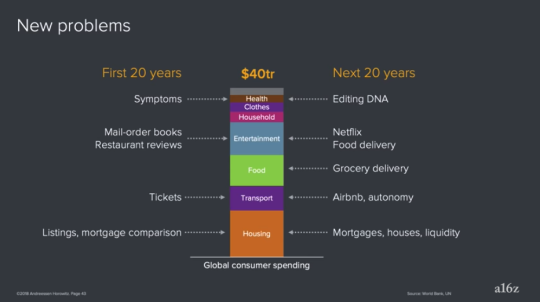
    Above is a screenshot from a presentation about the future of tech that Benedict Evans gave last week at venture capital firm a16z’s annual conference. And below is a video of the talk. If you can’t see it, click here.

    [youtube https://www.youtube.com/watch?v=RF5VIwDYIJk&w=560&h=315]

    The talk is positioned as “the end of the beginning.” In other words, here is where the internet and smartphones have taken us, but that’s just the beginning. Quote: “We used to do apartment listings [online] and now Opendoor will buy your home.”

    It’s only 24 minutes and well worth a watch.

  • World’s most diverse city-region

    For those of you who aren’t going to be in Toronto next week, you can stop reading now and check back tomorrow. For the rest of you, next week is The Future Cities Canada Summit, which will be taking place from November 7 – 9. Full schedule, here.

    Day 1 equals the Urban Land Institute Symposium 2018, which is all about Toronto urbanism. The tagline is: “Explore the urban frontiers of North America’s fastest growing, and the world’s most diverse city-region.” 

    A big part of day 1 will be bus tours around the city. And one of those tours is going to be focused on Toronto’s laneways. I am a speaker on that tour and the bus will be stopping at Junction House to talk about the laneway houses that we plan to release as part of the project.

    But there’s much more to this summit than just laneway housing.

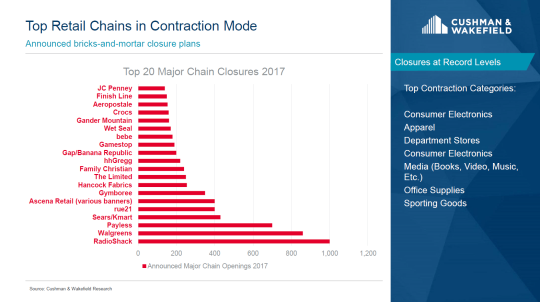
  • Notes from the retail apocalypse

    A friend of mine was in Scottsdale last month for an ICSC conference where Garrick H. Brown (VP of Retail Research for the Americas at Cushman & Wakefield) delivered this retail presentation

    My friend flipped it to me this week and below are a couple of slides that stood out as I scanned through it.

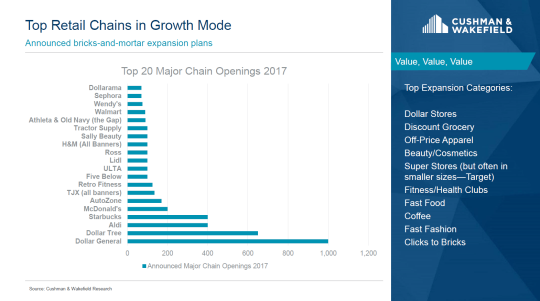
    image

    Apparently over the last five years, a new dollar store has opened every four hours in the US. That’s how quickly this category is growing. A race to the bottom.

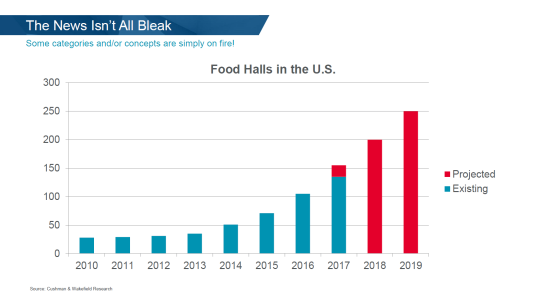
    image

    Food halls are hot and not just in the US. Check out: “5 huge food halls opening soon in Toronto”.

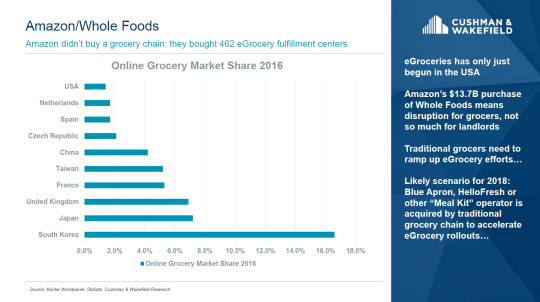
    image

    This is similar to a chart I posted a few weeks ago that pegged online grocery shopping in South Korea at closer to 20%. I’m still fascinated by this market share number and want to better understand what’s driving it.

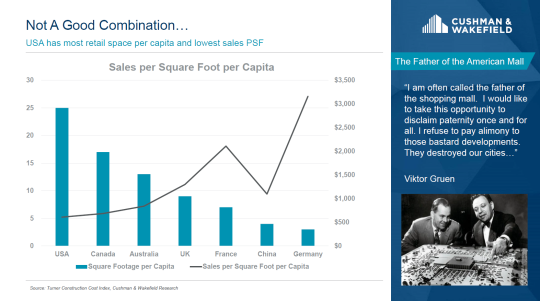
    image

    This is an interesting chart that shows the relationship between retail square footage per capita and sales per square foot per capita. The US has lots of retail space per capita but low sales. Now look at Germany.

    image

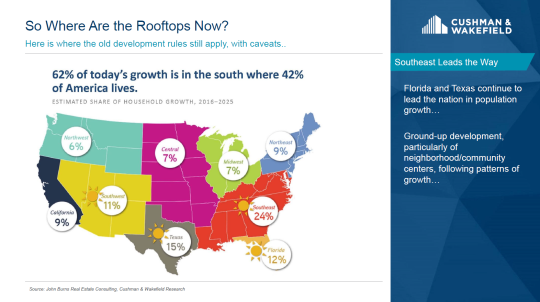
    Finally, this is a chart that shows where household growth is expected to happen from 2016 to 2025. It follows a very clear historical trend of Americans moving from cold places to warmer/hot places.

    image

    For the full presentation, click here.

  • It sold for what?

    Today I spent the day at the Land & Development conference here in Toronto. If there was one running theme throughout the day, it was: “Holy shit, I can’t believe that X piece of land sold for $Y million. How will they (the developer) ever make the numbers work?”

    Outside of the real estate development community, there’s often the perception that developers are building everywhere and that there’s lots of land left in cities, like Toronto. When you see all the cranes in the skyline, it naturally seems like we’re building a lot. Things seem easy.

    But the reality is that it’s extremely difficult to find “land” in markets like Toronto and Vancouver. And by “land”, I mean properties that can be feasibly acquired/assembled, entitled, developed, and then brought to market. The way the speakers today spoke about land it’s as if it were a rare precious commodity.

    I say all this, not to complain about how tough things are, but simply to shed light on the process. A developer’s job is to take a piece of property and figure out a way to create additional value. But to do that, they need to find a suitable piece of real estate. “Land” is an input.

    This has implications for consumers, because inputs turn into outputs. And if one of the inputs is becoming scarcer, then it’s pretty safe to assume that the outputs, such as new housing, are also becoming scarcer.

  • Build the Future – A CityAge Summit this October

    The View from CN Tower II by Roland Shainidze on 500px.com

    https://500px.com/embed.js

    This October 8th and 9th (2015) in Toronto, CityAge will be hosting a summit at the MaRS Discovery District called, Build the Future. The goal is to explore the future of Canada’s economic powerhouse.

    Here’s a little bit about CityAge:

    CityAge is a platform for ideas and business development, designed to enable new partnerships among the business, government and societal leaders who are shaping the 21st Century.

    Founded in 2012 in Vancouver, Canada, our events have taken place, or are scheduled, in New York City, Hong Kong, Toronto, London, Los Angeles, Seattle, Edmonton, Philadelphia, Kansas City, Ottawa, Vancouver and The Waterloo Region in Canada.

    To date more than 4,000 leaders in business, government and society have attended a CityAge event.

    I’ve seen the draft agenda and list of speakers for the event, and if you enjoy the content on this blog, I think you’ll also really enjoy this CityAge summit.

    But even better is the fact that if you’re a young professional (under 35) and a reader of Architect This City, you can use the code YOUNGPRO to attend for just C$195.

    You’re welcome. I hope to see you there 🙂

  • The perfect high street

    How do you create and maintain a thriving high street in this era of increasing online shopping? This was one of the questions that Monocle asked at its recent Quality of Life Conference in Lisbon and here’s a video with its recommendations. Click here if you can’t see the video below.

    [youtube https://www.youtube.com/watch?v=Ox2WJwDbuIo?rel=0&w=560&h=315]

  • The Monocle Quality of Life Conference

    image

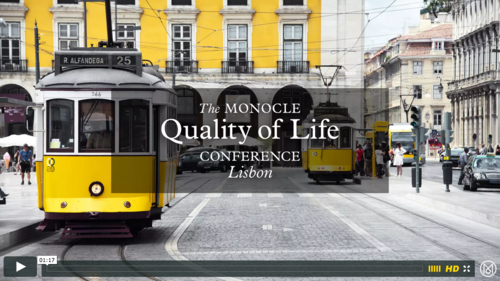
    Monocle magazine is launching their first ever conference this spring in Lisbon and it’s dedicated to quality life in the world’s greatest cities. It’s going to take place Friday, April 17th to Saturday, April 18th, 2015.

    You can click the image above for a video synopsis (there’s great urban eye candy), but if you don’t feel like doing that, here’s the text version:

    MONOCLE invites you to a weekend of peerless hospitality, great debates and in-depth conversations about the forces shaping the world’s great cities. Join our editors, correspondents and key thinkers in discussing topics ranging from architecture to independent retail, city planning to national branding.

    It sounds like a wonderful event and very much inline with some of the topics discussed here on Architect This City. If I had a conference budget that needed to get spent, I would be the first to sign up. If you’re interested, you can “register your interest” by clicking here. Tickets are €1,500.