Daily insights for city builders, delivered every morning at 6 AM ET. I’m Brandon Donnelly — a Toronto-based real estate developer and founder of Globizen. I’ve been writing here since 2013.

Tag: condos

  • Urban migration, household type, and housing supply

    Here is an interesting discussion paper on the Toronto region’s economy, demographic outlook, and its land use. It was recently published by IBI Group and Hemson Consulting to support the 10-year review of our regional transportation plan.

    I wanted to share a couple of charts from the report that I thought were interesting. If you’re not in the Toronto region, I would be very curious to hear how your city might compare in terms of the way it is trending.

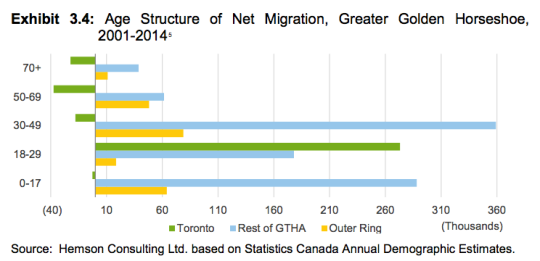
    The first chart is net migration by age group. Like Vancouver – similar chart posted here – people have been moving into the city/Toronto when they’re young and then moving out to the suburbs once they start having families. 

    Will that continue? The oldest Millennials are now hitting their mid-30′s and I am very interested to see if there will be any reversal in this.
    image

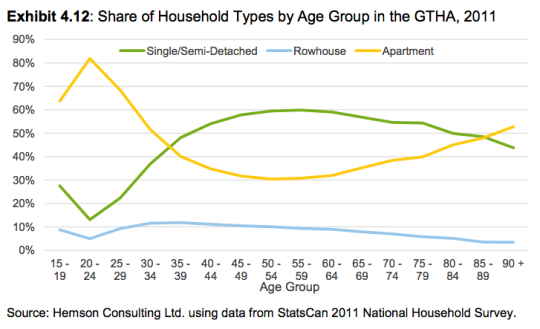
    Given the above trend, people in this region are not surprisingly also swapping apartments for ground-related housing as they get older. The crossover point seems to be (or at least has been) when people hit their mid-30′s. Again, I am curious how this may evolve as the city matures.
    image

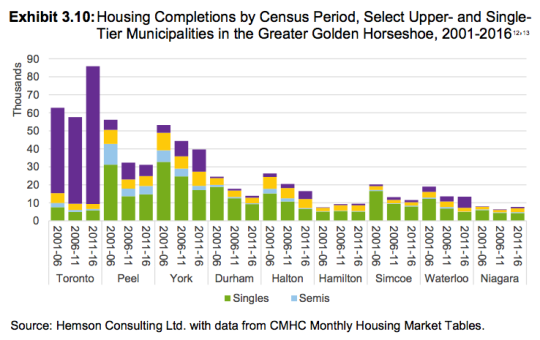
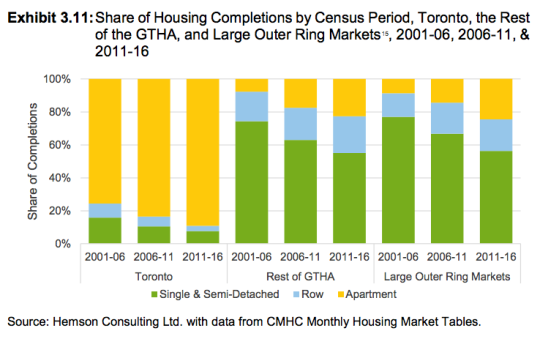
    Because if you look at housing completions from 2001 to 2016 (chart below), the only municipality that was able to meaningfully increase its housing supply was Toronto. 

    Every other municipality – except for Hamilton, which posted modest gains – experienced significant declines in the number of new homes delivered to the market over the last census periods. 

    Of course, the only reason Toronto was able to increase its housing supply was by building up – in other words by building condos and apartments. (Shown in the purple below. For some reason the legend is incomplete in the report.) 
    image

    If you look at the share of housing completions, over 80% of new homes in Toronto are now in apartment form. 
    image

    Intensification is a deliberate policy choice. And we can certainly debate whether it’s a good or bad thing (I believe it’s a good thing). 

    But putting that aside, the above charts are a great answer to the perennial question: “How is it that Toronto is building so many condos?” This is why.

  • What is this a building for ants?

    One of the things you’ll often hear people deride at cocktail parties is the trend toward smaller urban dwellings. They get called “shoeboxes” and “cubby holes in the sky.” So let’s unpack that a bit today and try and better understand the economics behind it all.

    When a new building is being developed, pretty much everything gets normalized to a per square foot (or square meter) number. 

    This is important because saying that building X cost $50 million to build and building Y cost $100 million to build doesn’t tell you much if the buildings are completely different. 

    However, saying that building X cost $500 per square foot to build and building Y cost $475 per square foot to build, tells you that building Y, despite being more expensive in absolute terms, was actually cheaper and/or more efficient.

    The same is true on the revenue side. And typically, developers are looking (struggling) to meet a certain per square foot number in order to make the project financially feasible. 

    For instance, let’s say you’re building a 100,000 sf condo building. Once you subtract the non revenue generating spaces, you might determine that you need 85,000 sf x $600 per square foot in revenue in order to make the project feasible.

    But there’s a back and forth game that needs to be played here. You have to ask yourself: for the product that I’m hoping to build, does $600 psf translate into something that people can actually afford?

    You might think: everyone keeps telling me at cocktail parties that condos in this city are too small. So I’m going to build a bunch of 1,800 sf, 3 bedroom condos. Based on the above, these homes would be priced at around $1.08 million (1,800 sf x $600 psf). Your on-site signage would read: “Condos coming soon. From the low $1 millions.”

    But wait a minute, how many families can afford a condo north of $1 million? Some could, but definitely not the majority. So then you determine through rigorous market analysis that $600,000 would be a better number. That is something that is within reach of more families.

    But then you look at the math and realize that if you build that same 1,800 sf home, your per square foot revenue number now drops to $333 psf ($600,000 / 1,800 sf). 

    Given that you bought the land for $100 psf buildable (market price in the area) and that your construction costs alone are going to be $250 psf, you realize that you’re now underwater ($100 + $250 psf > $333 psf) without even adding in any soft costs (consultant fees, city fees, and so on). If you showed this to your investors on the project, they would throw you out of the room.

    So instead of building that 3 bedroom condo at 1,800 sf, you say to yourself: what if I made it 1,000 sf? You’re confident that your architect could lay out a terrific condo at that size and it now magically gets your per square foot revenue number back up to $600 psf. 

    This solves two problems: it returns the project to positive feasibility and it keeps the total sale price within reach of more people. It promotes greater affordability. So you go ahead and do it. Boom – shrinking urban dwelling.

    All of this is not to say that this is fair or unfair, good or bad. It is simply to say that this is the way it often is.

  • 3 real estate + tech startups

    image

    On Thursday night I spoke at Product Hunt Toronto about the overlap between real estate and tech. My slide deck will be made available online and I’ll be sure to tweet it out and link to it in the comment section of this post.

    What was amazing to see was a room filled with 250 people coming together from almost two different worlds. I’m generalizing here, but you had the real estate people in suits and the tech people in t-shirts. But they were all mixing together to figure out how technology is going to disrupt the real estate industry. That is great to see.

    This was not the case 5+ years ago when I started obsessing about the overlap between these two spaces. I remember pitching at a Startup Weekend here in Toronto where I was pegged as the fringe outlier for wanting to work on a real estate idea. Now I can’t keep track of all the startups who are tackling this space.

    But this is a trend that is happening not only in real estate but in almost every other vertical. Here’s a quote from Fred Wilson that I used last night:

    “One of NYC’s great strengths is the diversity of its economy – finance, real estate, media & entertainment, retail, fashion, health care, education, and now tech. And the reason tech is growing so fast in NYC is that it is embedding itself in all of these other industries.”

    It’s an exciting time.

    In any event, for those of you weren’t able to attend, the 3 startups that presented were Evercondo, PiinPoint, and MappedIn.

    Evercondo is a condo communication and management tool for property managers and boards. PiinPoint is a data-driven tool that helps businesses find the best places to locate within a city. And MappedIn creates digital wayfinding solutions for (primarily) retail stores and venues.

    If you know of any other interesting startups tackling the real estate space, please share them in the comment section below. Early stage companies need all the support and exposure they can get.

  • Should condo reserve fund balances be made publicly available?

    No Need For Love by Michael Muraz on 500px.com

    https://500px.com/embed.js

    I’ve been thinking a lot lately about condominium governance and how things might be improved.

    If you own a condominium, you pay a monthly maintenance fee. Let’s say, for example, you own a 833 square foot condo and your maintenance fee is $500 per month. That works out to be $0.60 per square foot.

    For a lot of people, this fee probably feels like a bit of a black hole. The money goes out every month and that’s the end of it.

    But as I explained here, a portion of that fee goes into the condo’s reserve fund to cover future capital expenditures. This is basically an investment you are making for the future benefit of the building.

    As an example, if you’re paying $500 per month, somewhere around 25% could be going towards your condo corporation’s reserve fund. That’s $125 per month. $1,500 per year. $7,500 over a 5 year period. And $15,000 over a 10 year period.

    Now this is an investment that you’re obliged to make, but one that you might not be around to directly benefit from if you decide to sell before capital expenditures are made using the money you’ve invested.

    Of course, if you’re a savvy buyer, you’re going to scrutinize the reserve fund and the corporation’s overall financials before you buy into a building. And sometimes the unit valuations do get deeply depressed by out of control maintenance fees and/or special assessments. So you could maybe argue (as an owner) that your reserve fund investment ends up getting recaptured in an eventual sale.

    But what I wonder is to what extent a properly funded reserve gets accurately reflected in the valuation of the individual units. I suspect not that well. And as far as I know, there isn’t great data on this metric. (If you know of anything, please share it in the comments.)

    It’s certainly important information to have and consider. Again, when you buy a condo unit you’re not only buying the unit itself, you’re also buying the future investments (and liabilities) that others have left before you.

    So what I really want to know: Why aren’t reserve fund balances and building studies made publicly available? This is not easy information to get today.

    But imagine what would happen if the market had full transparency. Imagine if you could see a map of every condo building in your city and sort by age and reserve fund balance. In theory, unit pricing would become more accurate. But even more than that, there would be significant opportunities for collective intelligence.

    Now all of a sudden buildings would be able to benchmark themselves against other buildings to see if their reserve fund is sufficient, as well as learn from other buildings with respect to their history of capital expenditures. It would also hold the building’s management more accountable and allow owners to easily see if the contracts in place are competitive with the overall market.

    I know that a lot of people get nervous when it comes to sharing information like this. I mean, what would happen if your building is underfunded relative to its peers? Would that pull down property values? It certainly could. But if you’re underfunded and you get stuck with a special assessment in 5 years, then your property values are going to drop regardless.

    So I would love to see a lot more condo information made available to the public for free. In my view the benefits outweigh the potential negatives, particularly if this were to be done at scale. Condo corporations are also non-profit entities, so it’s not as if their balance sheets and income statements are filled with sensitive trade secrets.

    But what do you think? Would you feel comfortable if your condo’s reserve fund balance was made available online to the public? Do you even know off the top of your head what the balance is for your own building? I would be curious to know.

  • Pre-sales, shear walls, and condos, oh my

    Work In Progress 2 by bryan simpson on 500px.com

    Pre-sales are a big part of many condominium markets. The way it typically works is that developers sell suites in their building before construction has even started and then uses those purchaser deposits (which are held in trust) to obtain a construction loan to actually build the building. Part of the reason this is done is that it, in theory, reduces speculative overbuilding.

    Nobody really knows the exact number, but here in Toronto many suites within a new building often end up getting sold to investors. And in some locations and some buildings, it could be most suites.

    On the one hand this is a good thing. Because in a way they provide the short-term money that gets new projects off the ground. And if they end up holding onto their suites, they also become landlords for new rental housing. Here in Toronto condos have been almost the only new rental stock built in this city for decades. (Purpose-built rental is now starting to come back though.)

    But one of the potential negatives is that buildings could be getting designed more around investor needs as opposed to end user needs. And that is happening because many end users – particularly when it comes to larger suites – find it difficult to make such a big life decision 3-5 years out. Doing that means saying to yourself: Okay, I’m going to buy this 3 bedroom condo today because 4.5 years from now when it’s complete I expect to be married and have 1.5 kids. Life doesn’t always work that way.

    We also have antiquated tax policies in Ontario that encourage the building of smaller suites. And I believe they should be modernized. (This topic deserves a dedicated post.)

    So if we are to think of these condo suites as products, then you could say that there are two broad customer segments: the investor and the end user. There are obviously sub-segments within each, but let’s assume that those are the top of the funnel.

    The challenge now facing developers creating new product is that the system we have put in place arguably privileges one customer segment over the other. And it’s a problem that is somewhat unique to the real estate industry because it takes so damn long to bring new supply to the market. (If you sell jets or yachts, maybe you have a similar problem.)

    Now one way to solve this might be to create lots of flexibility in the product. That is, you could allow people to adjust and combine suites to fit their current needs. And that’s what great products do: they meet specific needs and solve problems. In this scenario, perhaps the single person could “add-on” to their suite as they enter a new life phase. And indeed, this is something people are experimenting with by way of things like “knockout panels.”

    But the problems with this are twofold. 

    Firstly, this requires an adjacent and suitable suite to come on the market so that you can buy it. And that may not happen 6 months before the baby comes. 

    Secondly, most Toronto condominiums are built using something called shear walls. These are structural reinforced concrete walls that cannot be removed without compromising the integrity of the entire building. And most purchasers like these walls between them and their neighbors because they’re worried about noise. So combing suites isn’t always as straightforward as we might think. There are many constraints.

    One way to mitigate these problems is through smaller projects. That reduces the lead time between purchase and occupancy. But I am sure there are probably other creative solutions that we could come up with to better align product and customer needs.

  • The Philadelphia (real estate) story

    Real estate is a local business. And this weekend in Philadelphia really reminded me of that.

    Here’s what I mean.

    The real estate story in Toronto is condos. We’re buildings lots and lots of condos. When my friend from Chicago recently visited Toronto for the first time, he told me that it feels very similar to Chicago, except that we have modern glass condo towers going up everywhere and they don’t. That’s our story right now.

    Low-rise housing in Toronto is becoming increasingly unaffordable (the average price of a detached home is well north of $1M) and so high-rise condos are now what many people can afford. When young people in Toronto talk about buying their first place, that now usually means a condo.

    But that’s not the story in Philadelphia.

    In Philadelphia, you can buy a 1,600 square foot, 2 storey, 2 bedroom rowhouse in a respectable neighborhood for sub US$400,000. And in speaking with my friends in Philly this weekend, that’s what young people are buying.

    This doesn’t mean that Philadelphia isn’t building new high-rise condos and apartments. It is. Obviously nowhere near as many as Toronto. But it is building. Far more than when I lived there before the Great Recession.

    However, the condo market is typically more upmarket. The target market isn’t so much first time buyers and the mass market; it’s more people who want full floor apartments in Rittenhouse Square. (I’m exaggerating only slightly.)

    Philadelphia is also building more rental towers than condo towers. (Rental has only recently become fashionable again in Toronto.)

    I’m guessing that a lot of this has to do with the fact that Philadelphia draws in a lot of transient students and academics each year. In fact, the most noticeably changed area from when I lived in Philly was University City. That’s the area that houses the University of Pennsylvania and Drexel University.

    So there seems to be strong demand for new rental housing in the city. I’m told vacancies are very low. But when it comes time to buy, young people don’t look to condos like they do in Toronto. They are looking mostly to rowhouses.

    This is interesting to me because it’s the exact opposite of Toronto. In Toronto, low-rise is expensive and so lots more people are buying high-rise. In Philadelphia, high-rise is expensive and so people are buying low-rise.

    I guess that’s why they say real estate is a local business. What works in one city may not work in another.

  • A few thoughts on Toronto’s rental resurgence

    Photograph Condos in Fog by Richard Gottardo on 500px

    Condos in Fog by Richard Gottardo on 500px

    Earlier today I attended a lunch and learn talking about the renewed interest in rental apartment development here in Toronto. Since this is a topic I’ve written about a few times here on Architect This City, I thought I would summarize some of my key takeaways from the panel discussion:

    • Market fundamentals are strong for purpose-built rental apartments. Vacancy is very low and demand will likely outstrip supply for many decades to come given the barriers to building (land availability, planning/approvals, and so on).
    • As of September 2014, CMHC reported 2,212 purpose-built rental units under construction in the Toronto region. And yet the annual demand for new rental housing is likely somewhere between 10,000 to 30,000 units (clearly some of this demand is being absorbed by condo rentals – the secondary rental market).
    • Millennials and retirees are seen as core markets for new rental apartments. Millennials want to live in urban centers and they like the flexibility that renting provides. Retirees want to know that they won’t be asked to move out because the owner wants to sell their condo unit.
    • It’s almost impossible to compete against condo developers when it comes to buying land (despite the next point). They (condo developers) will pay more. Therefore intensifying our “tower in a park” building stock is going to be a critical component of meeting rental demand in the region.
    • Part of what’s driving this interest in purpose-built rental (on the part of developers) is a softening condo market. So don’t be surprised when some developers flip back to condos when it makes financial sense to do so.

    It was interesting to hear this last point. It’s something that has been on my mind, but for whatever reason wasn’t really being talked about by the industry. That’s not to say that I think the condo market is in trouble though. It has just become more balanced. And ultimately that’s probably a good thing.

    Either way, I think that more rental and more housing options are a positive for the city and for consumers.

  • Learning from boutique hotels

    At the beginning of this year, my friend Amy Bath wrote an interesting post on her blog comparing condos and boutique hotels. It’s called: Could condos be more like boutique hotels? It’s a great read and it touches on something that I think we will see more of going forward.

    The idea is that boutique hotels – many of which invest heavily in things like programming and “cultural engineering” – could serve as a model for condos and developers who want to further differentiate themselves by doing more with their common areas and amenities. I think it’s a great idea. 

    But let’s backup for a second.

    In many cases, I feel that developers tend to privilege the brands of their specific projects over their own corporate brands. This likely has something to do with the entrepreneurial nature of how development projects often come together, but I personally don’t think it’s the best approach.

    It’s the equivalent of a car company downplaying its own brand and instead creating a new one for each and every car model that it comes out with. That’s a lot of work and it’s harder to build brand equity that way. So I think the trend is probably away from this approach.

    But as that happens, developers will inevitably start to wonder how they can differentiate them themselves: How do I make my bricks and mortar less of a commodity? The same way that Apple made computers not about processor speeds and memory, but about something so much more. You create a brand story and an experience.

    And one of the best ways I think you could do that is through exactly what Amy is talking about: programming and cultural engineering.

  • Waterfront Cities of the World comes to Toronto

    image

    This morning I was interviewed for a Montreal-produced TV show called Ports D’Attache. The English version of the show is called “Waterfront Cities of the World” and it airs on Discovery. 

    Here’s a list of all the cities they’ve visited in the first 4 seasons and here are all the shows from the first 2 seasons in English (which you can watch online for free).

    Rather than a travel show, it’s a look at the “spirit and soul” of each waterfront city through the lens of “local personalities.” There’s definitely a lot of fodder for city geeks and so I thought you all might find the series interesting.

    Toronto was the last stop of season 5. The other cities from this season include Philadelphia, Budapest, Rome, Taipei and Kuala Lumpur, to name only a few of them. 

    I’m glad that they decided to come to Toronto and I’m delighted that they invited me to be on the show. The team was great and, if you haven’t already noticed, I love supporting this city.

    The show will first be released in French (with my comments dubbed over), but an English version will follow. Once that version is released, I’ll circulate a link.

  • Art and apartments

    Photograph Vancouver by Marc M on 500px

    Image Source: Vancouver by Marc M on 500px

    According to a recent Bloomberg article, this is where the rich are putting their money today:

    “The two greatest stores of wealth internationally today is contemporary art….. and I don’t mean that as a joke, I mean that as a serious asset class,” said Fink. “And two, the other store of wealth today is apartments in Manhattan, apartments in Vancouver, in London.”

    In case you wondering, Laurence Fink is the founder and CEO of BlackRock Inc., which today is the largest asset manager in the world. They have over $4.77 trillion in assets under management according to their website. That’s a mind boggling number.

    And if you read the Bloomberg article cited above, you’ll see that this interest in both art and apartments represents a shift away from gold as the de facto safe haven.

    “Historically gold was a great instrument for storing of wealth,” the chairman of BlackRock Inc. said at a conference in Singapore on Tuesday. “Gold has lost its luster and there’s other mechanisms in which you can store wealth that are inflation-adjusted.”

    What’s interesting and probably most relevant to the Architect This City community though is this investment focus on apartments.

    When people talk about a possible housing bubble in Canada they often cite house prices to median household income as a key ratio. The question then becomes: How can house prices be such a high multiple relative to local incomes?

    That’s relevant, but it’s not the entire story for cities like New York, London, and Vancouver. That ratio alone assumes that real estate isn’t a global investment vehicle. And for some people people it is exactly that.