Daily insights for city builders, delivered every morning at 6 AM ET. I’m Brandon Donnelly — a Toronto-based real estate developer and founder of Globizen. I’ve been writing here since 2013.

Tag: condos

  • Buying condos with crypto

    If you happen to have made boatloads of money in crypto (which sadly isn’t me), one sensible thing you could do is put some of that money into luxury residential real estate. You know, to diversify your portfolio.

    According to this recent WSJ article, it is already happening, with some developers and some homeowners now accepting cryptocurrencies in lieu of US dollars and other fiat currencies. This is helpful if you’ve managed to accumulate a bunch of crypto and don’t want to convert it. It can also be easier when it comes to moving the funds around:

    Avi Dabir, vice president of business development at FTX US, said he sees real estate as a growing sector for the company because crypto transactions are faster and more efficient than traditional deals, which rely on an often-cumbersome banking system.“If I want to send a wire transfer today using my traditional bank account, it’s got to be banking hours, I need to make sure I hit that wire cutoff time and I can’t do it on the weekends,” he said. “That’s not a problem with cryptocurrency. It’s open 24/7.”

    But of course it is still early days for crypto. The article suggests that most developers and owners are arranging for any crypto received to be immediately converted into US dollars at closing. This is presumably because of how volatile cryptocurrencies tend to be — at least right now.

    To accept crypto, PMG had to partner with a regulated exchange that could quickly convert crypto to U.S. dollars, then convince an escrow agent to accept down payments from the exchange, rather than directly from the developer. Mr. Shear said most escrow agents looked at him like he was crazy, but “20 lawyers, one year later, and a lot of brain damage, everybody got comfortable.”

    There are also tax considerations (that I am really not an expert on). If you bought $100 worth of Ethereum and it is now worth $10 million, you are responsible for paying tax on this gain if/when you sell, trade, or otherwise dispose of the crypto. And it is my understanding that if you were to use this $10 million in Ethereum to buy something like a condo in Miami, it would also be considered a taxable event.

    Maybe all of this becomes commonplace or maybe it doesn’t. But it sure is interesting to see crypto already starting to flow into hard assets like real estate.

  • A survey of vacant condo suites in Toronto

    Last year Jaco Joubert set out to estimate the number of condos in Toronto that are potentially sitting vacant. It was a response to the ongoing speculation that too many investor-owned condos are sitting empty across the city and thereby limiting the supply of housing.

    To accomplish this, he photographed 15 different buildings at night (and at different times of the year) and monitored who had their lights on. He then turned these photographs into heat maps and compared the lighting pattern to the floor plans of each building in order to determine the unit demising.

    This month Jaco published his findings. All in all, he estimates that he surveyed some 1,362 units. And of these units, 76 are believed to be vacant (when in doubt he erred on the side of occupied). So a vacancy of 5.6%. Is that more or less than what you were expecting?

    Now, the buildings he “surveyed” are all located downtown and they are all roughly the same vintage. So you could easily argue that these aren’t necessarily representative of the city’s broader condo stock, assuming that’s where you want to take this. Still, an interesting study.

  • Ground breaking at Junction House

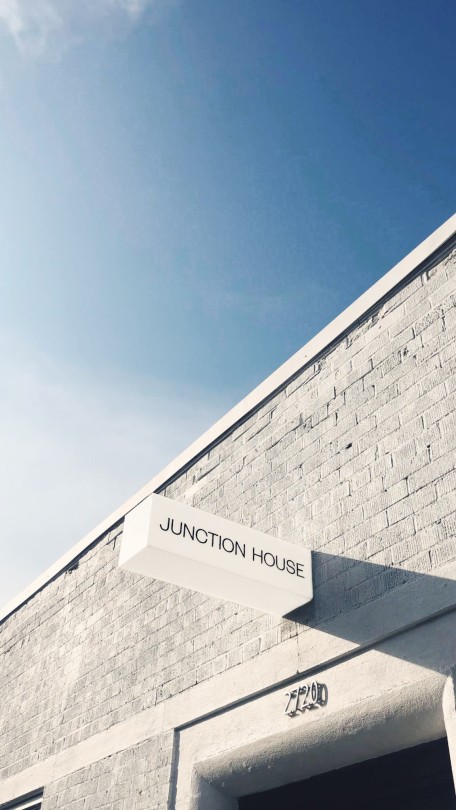
    This morning was the official ground breaking ceremony at Junction House. It was a beautiful sunny day and our FOREVER mural proved to be the perfect — albeit ironic — backdrop for our photos. Photos from the event will be released next week.

    Junction House is a project that we have been working on since 2016. Development doesn’t happen overnight. So it’s important to celebrate these milestones — both for the team and for future residents of Junction House.

    A big thank you to everyone who came out. We’re all looking forward to the next phase of the project: construction.

  • Junction House ground breaking

    The Junction House team is excited to announce that construction will start this fall and that our ground breaking ceremony will be held at 11AM on Saturday, October, 19th. Mark your calendars.

    It will take place at our Sales Gallery — 2720 Dundas St W. This will be one of the last opportunities to see the award-winning Junction House Sales Gallery before it is demolished in preparation for construction.

    There will be photo opportunities for everyone in attendance, and so we encourage you to bring your phones/cameras. You’re welcome to extend this invitation to family and friends, but kindly RSVP by sending an email to info@junctionhouse.ca.

    We look forward to seeing you there.

  • Junction House Sales Gallery — Now Open

    We just received a bunch of photos back of our Junction House Sales Gallery. So today is photo day on the blog. (Thank you Dialogue 38 for coordinating these.)

    Here’s the front “gallery” area. The artwork hanging on the wall is by local artist, Leeay Aikawa. Her work is terrific. You can see this space as you walk along Dundas Street West.

    Here is the model suite pavilion and main reception area (evening shot). The bar area is absurdly long. It was designed to accommodate beers from Indie Ale House down the street.

    Dialogue 38, the designers of the space, really wanted the model suite to be a “pavilion” — something akin to Mies van der Rohe’s Barcelona Pavilion. So here’s the ramp that takes you up and inside.

    Finally, here’s the model suite. The kitchen is by Scavolini. And the backsplash is a penny tile.

    The sales gallery is located at 2720 Dundas Street West and is now open every day of the week except Tuesdays. The hours are 1PM to 7PM during the week and 12PM to 5PM on the weekends.

  • Q4-2018 high-density land sales in Toronto

    image

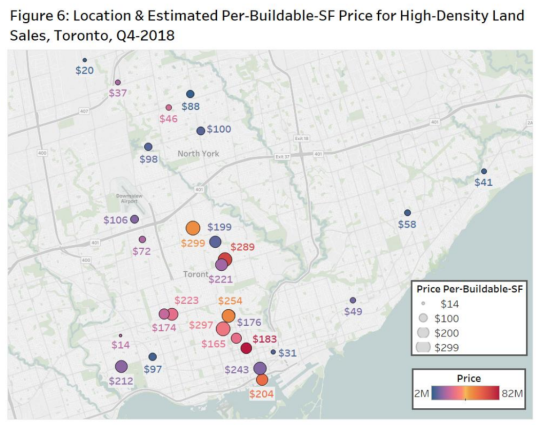
    Bullpen Research & Consulting and Batory Management just published their Q4-2018 High-Rise Land Insights Report for the Greater Toronto Area. 

    Above is a mapping of the estimated per square foot buildable prices for the land that traded hands specifically in Toronto last quarter. 

    The average is $178 per square foot. And the projected average sale (condo) price is $1,097 psf. That sounds right. You basically need that kind of end pricing to make the math work with today’s costs.

    Across the GTA, the average spread between zoned and unzoned land was almost $40 psf. $159 psf versus $120 psf, respectively.

    A full copy of the report can be downloaded here

  • Photoblog: Sunrise at Ten York

    This morning I watched the sun rise from the the roof of Ten York Condominiums, some 735 feet up. This is what that looked like (the sky initially had a purple hue to it):

    It was cold as all hell, but sometimes you have to work for your photos.

    Some of you may also remember that I wrote about this building a few months ago. Tridel, the developer, is calling the project its first “smart condominium.”

    Regular scheduled programming will resume tomorrow.

  • Five year anniversary

    Today is the five year anniversary of this daily blog. That’s over 1800 posts. 

    It’s almost hard to believe that it has been that long. It seems like just yesterday I was on year 2 or 3. But at the same time, it’s almost hard for me to remember a time when I didn’t blog every day. I guess we’re calling it a habit at this point.

    One of the most common questions I get regarding this blog is: “Do you pre-write posts?” The answer is never. Okay, almost never. Sometimes I’ll pre-write a post if I know I’m going to be on a plane for 12 hours and I won’t make the timezone cutoff. But generally as a rule I don’t.

    Part of the reason I don’t is because it breaks the habit. This is something I do every day. And I like that routine. I also want the posts to be timely and I want to be able to write about things that may be on my mind that day.

    Momentum is a powerful thing. And when you’ve been doing something for a number of years, and especially something as public as this daily blog, there’s a powerful incentive to keep doing it. That’s how streaks work.

    However, in the world of development, five years is perhaps not that long. It’s maybe one project. Streaks take a lot longer to establish.

    This summer One Delisle by Studio Gang went public and you’re now starting to see (bright neon) teasers for Junction House. Both of these projects are many years in the making. The Junction House story started in early 2016.

    So I reckon that this blog needs at least another five years so that there’s enough time for the really juicy stories to surface. I’ll endeavor to do exactly that. 

    Thanks for reading and making this community what it is. See you tomorrow.

  • Photogenic neon in the Junction

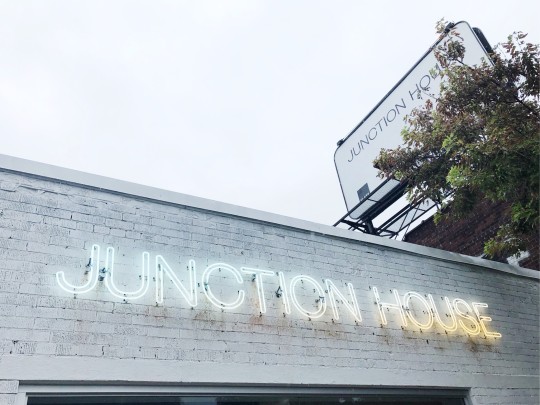
    We just finished putting up some additional signage at the future sales office for Junction House. Clean and minimal, but fun. I am pretty pumped with the way everything turned out. Creative and photos by Vanderbrand. Instagram story mashup and failed neon photo by me.

    This week I learned that properly photographing neon takes a bit of work. The neon “Junction House” sign is actually all white when you see it in person. Apparently it has something to do with the frequency. 

    I’m going to go back one evening with my tripod and Fuji and see if I can do better.

  • New high-rise home prices up 39.5% year-over-year

    February data (2018) for the new home market in the Greater Toronto Area was released this past week by BILD and Altus. I seem to have gotten into the habit of writing about this every month.

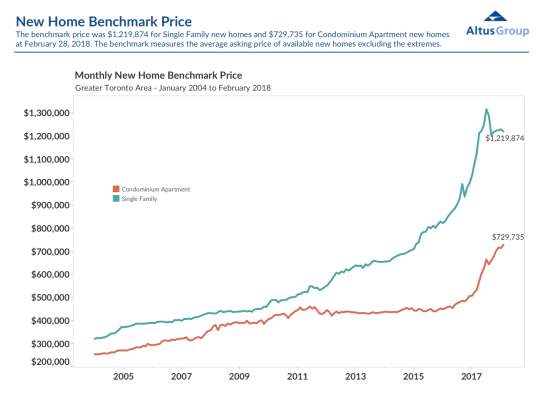
    The benchmark price for new low-rise single-family housing was down slightly from January to $1,219,874, but still up 12.8% from a year prior.

    The benchmark price for new high-rise housing was up a whopping 39.5% year-over-year to $729,735. But part of this is being driven by an equally dramatic increase in average unit sizes.

    Here is the relevant graph:

    image

    The story continues to be about tight supply, historically low developer inventories, and a lack of affordable low-rise product. 

    As I have argued many times before on this blog, I believe these factors — and in particular the last one — are, at least partly, driving this recent pop in high-rise pricing. People are priced out and now searching for substitutes.

    So my prediction continues to be that we will see a convergence (i.e. diminishing spread) between new low-rise and high-rise pricing.

    That will also bring about design and product changes on the high-rise side.