Daily insights for city builders, delivered every morning at 6 AM ET. I’m Brandon Donnelly — a Toronto-based real estate developer and founder of Globizen. I’ve been writing here since 2013.

Tag: condo

  • Bringing laneway suites to Toronto

    This morning I presented and sat on a panel at BILD called “bringing laneway suites to Toronto.” The other participants were Councillor Mary-Margaret McMahon, George Pantazis (Planner at the City of Toronto), Mike Collins-Williams (Director, Policy at OHBA), and Andrew Sorbara (co-founder of Lanescape).

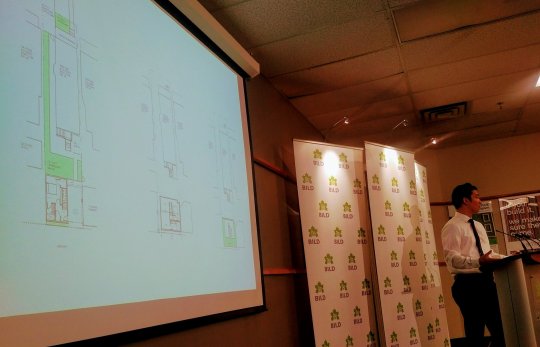
    Here is a photo that Mike took of me while I was talking about my failed laneway house:

    image

    For those of you wondering if/when this will happen in Toronto, here are the key takeaways from this morning: The city is already drafting laneway suite policies specific to Toronto & East York (not the other parts of the city) and they are due to report back to council in Q2-2018. Nothing is 100% certain at this stage, but there’s lots of optimism. 

    Councillor McMahon delivered this morning’s opening remarks and I was impressed by her deep commitment to laneway suites. I was also impressed by her stance on NIMBYISM, saying that education is important and that we can’t let NIMBYs stop what makes sense for the greater city.

    She gave the example of the 6 storey condominium in her ward that faced fierce community opposition a number of years back. If you can’t put a midrise building on a main street in this city, where can you put it? 

  • Toronto’s first Airbnb-friendly condo building

    This week it was announced that the very first condo building in Toronto (and in Canada) has just signed on to Airbnb’s Friendly Buildings Program. The agreement will take effect on November 1, 2017.

    As the name suggests, the program is about bringing greater legitimacy and structure to short-term Airbnb rentals. Here are two key measures from this particular agreement:

    – Building security will now have full transparency with respect to who is hosting and who their guests are at any given time

    – Airbnb will share 5% of the building’s revenue with the condominium corporation (hosts will also need to pay $50/month to cover any additional maintenance costs)

    What’s compelling about the above is that there’s now a bit of a financial incentive for buildings/boards to support Airbnb rentals. 

    At the same time, if something happens, it’ll now be a lot easier to figure out who was responsible and then chargeback any relevant costs. Right now it’s all happening under the radar.

    My view on Airbnb is the same as the one I took (publicly on this blog) on Uber: It’s not going away. Many people clearly want it. An entire building just accepted it. So let’s figure out how to make it work better.

    One regulation that Toronto is currently exploring and that I think will materialize in some form is a limit on short-term rentals when the unit is not your principal residence.

    This is the difference between Airbnb’ing your place when you leave on vacation (or when you have an extra room) and buying a condo strictly as a short-term rental investment.

    It’s interesting to see the evolution of companies like Uber and Airbnb. Both would never have been successful if they started out by first asking for permission. 

    But now they are mature enough that they are being forced to play nice.

  • Locals hate you

    BlogTO recently reported that “snarky anti-condo signs” have been popping up around Toronto. Here is one of them via Instagram. It reads (in all caps): Dear Condo Dwellers: Locals Hate You Go Fuck Yourself

    I find these posters curious, though it is obvious that they are a reaction to growth, intensification, and general change in this city.

    For one, it implies that condo dwellers and locals are mutually exclusive. In other words, “locals” don’t live in condos. Presumably the implication is that they live in low-rise grade-related single-family housing. Or maybe they live in rental housing? Is it a tenure thing?

    According to the latest 2016 Census data, just over 26% of private dwellings in Toronto are condominiums. And about 30% of people live in a building that has 5 or more storeys. If you include “apartments” less than 5 storeys, this latter number jumps to 40%. So many potential non-locals.

    However, it could be that these posters are primarily directed toward new condos and new condo dwellers. This poster seems to have been plastered in front of this recently completed condo building on College Street.

    If that is the case, then I wonder if there is a temporal cut-off for the hate. For example, the condo building that houses (at its base) my regular grocery store was completed in 1983. 

    The units are large and the demographic seems to skew a bit older. Are these condo dwellers – some of which may have been there for over 3 decades – to be hated? Are they non-locals? Or does urban myopia set in after awhile and they become locals?

    At the same time, it wouldn’t be unusual for the residents of an older condo building to oppose a new proposed condo building. So perhaps “local” isn’t about building typology and it’s more about who came first. That’s certainly a tricky one. Better end here.

    A curious poster that could use a bit more specificity. What do you make of it?

  • How to make money with low-risk licensing deals

    image

    This morning the Toronto Star published a detailed autopsy of the failed Trump International Hotel and Tower Toronto. It outlines the players, the investors, and what supposedly went wrong. Of course, the headline is all about how Trump managed to make money from the deal – through his well-publicized licensing business – even though the project went bankrupt.

    At the beginning of this year, the Washington Post reported that Trump’s name had been licensed and linked to over 50 properties and that these contracts have earned him at least USD$59 million in revenue. Outside of the US and Canada, the Trump Organization has (or had) deals in Brazil, Turkey, Azerbaijan, India, Indonesia, the UAE, and so on.

    There would have been more money to be made in the actual development of these properties, but the beauty of these licensing deals – for Trump – is that they are “low-effort, low-risk, high-reward.” In fact, this past summer it was reported that the breakup fee at Trump Toronto – the fee to exit all contracts with the Trump Organization – was at least $6 million (guessing that’s in USD).

    This story is not unique to Toronto. And so I have got to believe that there’s major brand dilution happening here. Does the Trump name really bring credibility to projects in some markets? How sustainable is this licensing business? 

    The only other thing that I would add to the Toronto Star article is that the hybrid condo-hotel model has proven to be difficult in this city. It’s perfectly fine to have residential condos and a hotel in one tower. There are lots of successful examples of those. But when the condo units can be put into a hotel pool (and there’s an IRR expectation on the part of individual owners), many seem to have been disappointed.

    Part of the challenge with this model here in Toronto is that the condo-hotel units typically end up with a commercial property tax rate, which, in this city, is much higher than the residential rate. This can suppress values.

    Photo by NeONBRAND on Unsplash

  • At the Ritz

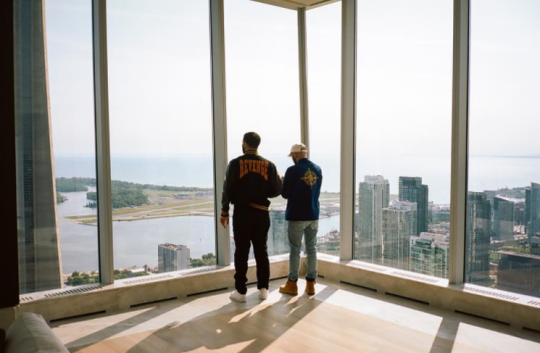
    Over the past few weeks Drake has been posting teasers on social media of his temporary condo in Toronto. It’s temporary because he’s waiting for his 35,000 square foot faux chateau to be completed in the Bridle Path. (See, some Millennials in Toronto are still able to break into the housing market.)

    Here is one of those posts taken from Instagram:

    image

    A lot of fans have been wondering which condo building Drake has been teasing. I like Drake, but my interest was peaked more as an architecture and real estate nerd.

    Given the position of the CN Tower in the above picture, it looks like the building is to the north and just slightly to the east. The other clues are the curtain wall system (SOTAWALL THERMO-3 series, I think) and the perimeter heating at the base of the windows. These are somewhat atypical details for a condo in Toronto. Also, if you look closely at the corner you’ll see that the south facade appears to slope outward.

    So my guess: The Residences at the Ritz-Carlton, Toronto – designed by Kohn Pedersen Fox with Page + Steele as the local architect of record.

  • The year of the condo

    Over the past 5 years or so, real estate headlines in the Greater Toronto Area have often focused on the rapid appreciation of low-rise housing. High-rise housing simply wasn’t appreciating at the same rate – at least in aggregate terms.

    But 2017 has brought a different story. 

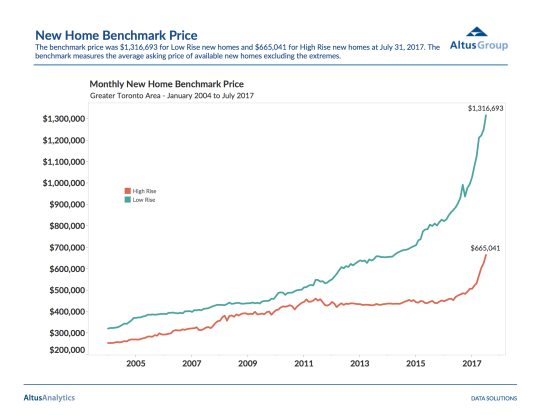
    If you look at BILD’s “New Homes Monthly Market Report” (data provided by Altus Group as of July 2017), you can see that high-rise pricing is now on a similar trajectory to low-rise pricing.

    Here is that graph:

    image

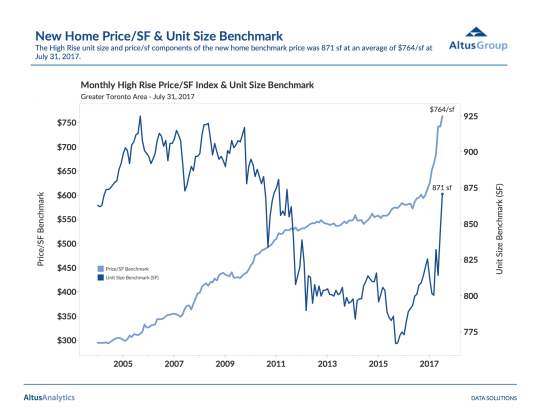
    This sharp uptick in pricing is also apparent when you look at the average price per square foot of new high-rise inventory. As of July, it was $764 psf across the GTA. See below.

    At the same time, average unit sizes have also jumped up to 871 square feet. So not only are new high-rise homes becoming more expensive on a normalized basis, they are also getting bigger, which further increases prices.

    image

    I recognize that we’re only seeing data up to the end of July, but, from the looks of it, 2017 is shaping up to be an extraordinary year for the condo.

    Of course, part of the reason this is happening is because remaining inventory for both low-rise and high-rise product is hitting 10-year lows. We’re back to the topic of supply.

    If you’re curious how some of these numbers have changed from the month prior (June 2017), check out this post.

  • The Hong Kong window ledge

    image

    My friends at the architecture practice Valente Rodgers told me something fascinating about the Hong Kong real estate market last night. Both partners worked as architects in Hong Kong for a number of years.

    In Hong Kong, you’re allowed to deduct certain projecting windows from your calculation of Gross Floor Area

    This is provided they’re a certain height above the finished floor level, they don’t project beyond certain distances from the outer face of the building’s structural elements, and so on. The precise measurements seem to vary depending on things like the building’s use.

    Since space is such a precious commodity in Hong Kong, it shouldn’t surprise you that lots of developers and architects take advantage of this. The result being a proliferation of these projecting window ledges all across the city. 

    It’s a phenomenon that happens in many cities when a perfectly legal loophole is found in the land use policies.

    In Toronto it used to be solariums. You could also deduct these from your overall GFA, which means a lot of them them got built in condos and apartments of a certain vintage.

    In New Orleans it was the camelback house. These were houses with a single storey toward the street and a second storey toward the rear of the property. This was done because property taxes were assessed based on the height of the house as it met the street. Pushing the density toward the rear of the lot meant homeowners weren’t taxed more. 

    I find these outcomes fascinating because they have absolutely nothing to do with architectural intent and everything to do with trying to optimize within a given framework.

    But what’s even more interesting about the Hong Kong example are some of the downstream externalities.

    Firstly, it sounds to me like these projecting windows have become a normal part of underwriting projects in Hong Kong. Meaning, if you don’t factor in these projections, you’re effectively giving up free GFA. (Can anyone familiar with the HK market confirm this?)

    However, building these projections also means you can’t do unmodulated and clean floor-to-ceiling windows. And if that’s the desired aesthetic, somebody has got to be willing to pay for that “luxury.” So arguably there’s a socioeconomic dimension to having and not having this ledge.

    Secondly, because space comes at such a premium, these ledges are fully taken advantage of and furniture makers have responded by designing pieces that can dovetail with them.

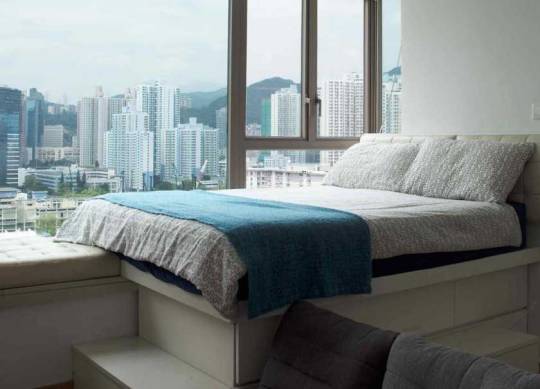
    Below is a photo of a bedroom in Hong Kong that I found on bohemia.life:

    image

    This may be a custom bed and I don’t know how deep that window projection is, but it begins to show you how valuable these ledges can be from a space perspective.

    I think we should try and come up with a name to describe these sorts of built form phenomena. If you have any ideas, please drop them in the comments below. And if any of you are familiar with the HK market, let me know if I’m off the mark with any of the above.

    Photo by Jason Wong on Unsplash

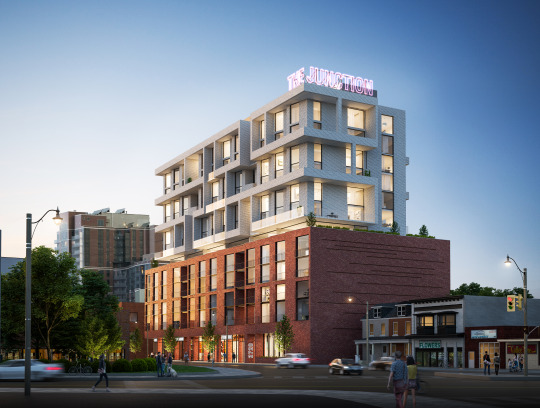
  • Introducing Junction House

    image

    Earlier this week I posted this teaser photo on social (full photo above) and said to stay tuned for a big announcement. Well, that announcement is here and you can read all about it over on the Globizen blog. Please let me know what you think in the comment section below.

  • Only 9% of new homes sold last month were low-rise single-family

    BILD (the Building Industry and Land Development Association) just released its June 2017 data for the Greater Toronto Area’s new housing market. You can read the full release here. But I would like to point out a couple of things:

    About 91 percent of the 6,046 new homes sold last month were multi-family condo apartments in high-rise and mid-rise buildings and stacked townhomes, while only nine percent were low-rise single-family homes.

    The average price of available new condo apartments continued to rise with an increase of more than $22,000 from May. June’s $627,000 average price marked a 34 percent increase from a year ago. The average available unit was 845 square feet with an average price per square foot of $742. A year ago, the average price per square foot was $587.

    From this, it’s once again clear that Toronto is in the midst of an incredible transformation from a low-rise city to a more vertical city. New supply on the low-rise side of the market is heavily constrained.

    I get the sense sometimes that many people in this city, and others, believe that access to a low-rise detached house should be a right. Go to school. Get a good job. And then buy that house with a backyard. 

    The data speaks to a very different reality.

    Photo by Victoria Heath on Unsplash

  • Toward larger condo units

    One of the things that I’ve been following over the years (and writing about a lot on this blog) is average condo/apartment sizes, specifically in Toronto. I’m interested in this topic because I think it tells you a lot about what’s going on in the market and who is buying/renting.

    Developers are often criticized here for building tiny “shoebox condos.” It wouldn’t be unusual to see a building with an average unit size somewhere in the range of 600-700 square feet.

    But it’s important to keep in mind that the pull toward smaller units is largely because of one important reason: affordability. All things being equal, I’m sure that most people would gladly take an expansive 2,000 sf apartment. But how many people can actually afford a place that large? And for those who can afford it, many seem to opt for ground-related housing instead. So for the most part, the market has said: not many.

    But I’ve suspected for awhile that it was only a matter of time before we saw unit sizes start to creep upward. And indeed today there seems to be a trend toward larger units. I can’t tell you the exact percentage increase for average unit sizes across the city, but you don’t have to look very hard to find a proposed project with average unit sizes in the range of 1,000 to 1,500 sf. I spent this morning looking many of them up and going through their data sheets. If any of you have a larger sample size, please share it in the comment section below.

    To me this feels like a maturation of the market. More of us are deciding to move up, instead of out, which is absolutely what we need to do. Affordability, perhaps more than ever, is still a concern. But the confluence of a couple of factors seem to be expanding the multi-family market in this direction.

    One, empty nesters are starting to cash out of their large houses and they still want/need space. Two, the price of low-rise housing has increased so dramatically that it’s now out of reach for many and/or it no longer feels cost competitive on a per square foot basis. Three, Toronto’s status as a global city continues to increase and this is making it more of a magnet for foreign capital. And four, central and transit-adjacent housing is incredibly desirable for a large segment of the population. Horrible traffic is probably helping this one.

    If there’s any truth to my logic, then I wonder if we won’t see a bit of a bifurcation in the market, if we aren’t already. On the one end, there will still be the pull to shrink unit sizes and maximize affordability. See micro-units. But on the other end, there will be a product segment that now acts as a substitute for low-rise housing.

    I’ve said this before, but I’ll say it again: I think more families in condos and apartments would be a positive thing for the city.