Daily insights for city builders, delivered every morning at 6 AM ET. I’m Brandon Donnelly — a Toronto-based real estate developer and founder of Globizen. I’ve been writing here since 2013.

Tag: condo investors

  • Toward smaller condominium apartments

    Statistics Canada recently published some data (from 2022) looking at investors in the condominium apartment market. Here is what they believe to be the share of condominium apartments used as investment properties in Ontario’s 10 largest census metropolitan areas:

    It’s worth noting that this is after excluding condominium buildings where every single suite is owned by a single investor. This is/was most prevalent in London, and it’s the result of there being property tax benefits to registering a condominium (individual unit assessments), even though for all intents and purposes it’s a rental building (building in its entirety assessed).

    The article goes on to rightly suggest that the prevalence of investors, and the way that condominiums are financed, could be leading to the construction of more buildings with smaller suites. Here’s the proportion of new condominium apartments under 600 square feet by period of construction:

    The unsurprising takeaway is that condominium suites have gotten smaller. In the 1990s, the average condominium apartment built in the Toronto CMA was 947 square feet. This is compared to 640 square feet after 2016. And the same thing happened in Vancouver, which went from an average of 912 square feet to 790 square feet.

    Investor preferences certainly have something to do with this. But what the article doesn’t specifically mention is that this phenomenon is also a direct response to rising build costs: making suites smaller was how the market tried to maintain some level of affordability. Put differently, imagine how expensive new condominiums would be if the average size was still 947 square feet.

    But there are obviously limits to this. I was with one of our architects the other week and he made an interesting comment to me. He said, “Brandon, before when build costs used to go up and things got less affordable for consumers, we could just make the suites smaller to offset the impacts. But I don’t see how we can go any smaller now. We’ve reached the limit.”

    This is one of the reasons why I think this downturn is going to ultimately be a good thing for Canada’s housing markets. It’s a reset. It’s forcing everyone out of complacency and, hopefully, it means that when the next cycle begins we’ll be starting from a better foundation.

  • Over-building and then under-building: Is Toronto headed for a severe shortage of new rental housing?

    As we know — because here’s the data — this is the current state of affairs:

    The GTA condo market is in a state of economic lockdown. The math doesn’t make economic sense from both the demand side (investors) and the supply side (developers), leaving the market at a standstill.

    The above excerpt is from a recent CIBC Capital Markets article by Benjamin Tal (CIBC) and Shawn Hildebrant (Urbanation). And what it ultimately means is that the supply of new condominiums in the GTA is falling and will continue to fall for the foreseeable future. Below are two charts, from the same article, that show that.

    Because of this, I actually think that, if you need or want a place to live, right now is a near ideal time to buy a condominium, especially if it’s from developer inventory (in an already completed project) or it’s a resale. Of course, most people won’t want to do this because they’d rather buy when most other people in the market want to buy. This is how markets tend to go.

    It has been a while since the GTA has gone through one of these real estate cycles, but it is typical: developers are prone to both over-building and under-building. It simply takes too long to build a building, and so it is natural for there to be moments when supply and demand don’t exactly line up.

    Pre-selling condominiums is — in theory only — supposed to protect against too much overbuilding. But as we have spoken about many times before, it can be challenging for end users to buy a new home so far in advance. And so the new condominium market has come to rely on investors who want to buy early and then either sell later or rent later.

    According to the above article (and MLS data), the share of newly completed condominiums used as rentals reached a peak of 34% in 2023. So a third of new condos. My gut tells me that the actual number is much higher. Many rentals never reach MLS. Overall, I think it’s very safe to assume that the majority of new condominiums are owned by investors.

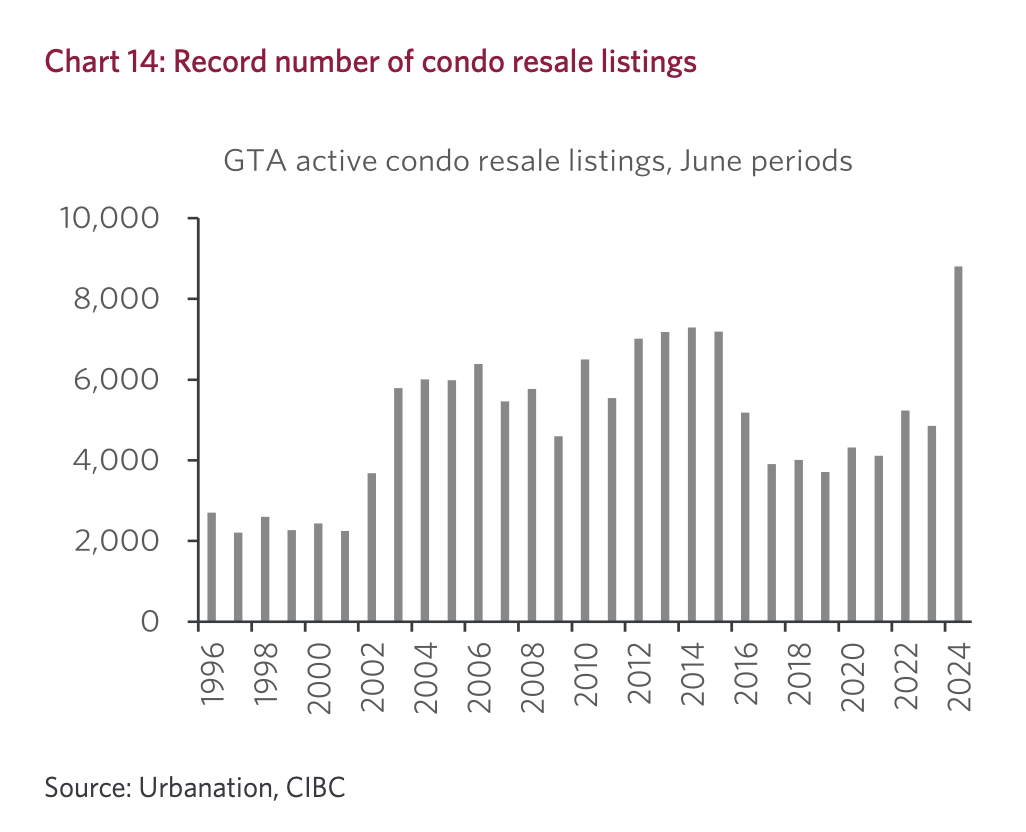
    But right now, fewer investors want to own condominiums, which is why the number of resale listings has spiked this year:

    This is, again, why I think right now is an excellent time to buy a condo. You know, be greedy when others… Regardless, this inventory will need to get absorbed and that will ultimately happen. Some of it will go to end users and some of it will go to investors who can make sense of the rental math and/or want to take a long view on Toronto. But if more goes to the former, we will be losing a lot of new rental housing.

    At the same time, while all of this is going on, construction starts are likely going to remain depressed (chart 3 above). It’s impossible to know how long this lasts, but at some point we will reach a moment in the cycle where we are under-building new housing. Maybe we’re already there. Development simply can’t turn on fast enough when demand spikes. There will almost always be a lag.

    So, since the majority of new condominiums have been serving as new rental housing, there’s a strong case to be made that at some point we will run into a potentially severe shortage of rentals. Condo investors are sometimes vilified in the media, but we will soon find out what happens when you take a big chunk of them out of the housing market.

  • Real estate investors are outbidding people who own strollers

    Here’s a potential scenario:

    “When you have investors competing with first-time buyers who walk in with a couple of [baby] strollers, typically the investor is going to win,” Mr. Pasalis says. “They are well capitalized. They can pay a higher price. And this is why our home ownership rate is declining, because more and more homes are actually going into the hands of investors who rent them out, and amplifying home and amplifying condo prices. We are seeing that.”

    But let’s break this down a little.

    Where are these first-time buyers walking into? Is it a resale home showing or is it a pre-construction showroom? If it’s the latter, then we know it’s going to be difficult / atypical for them to make a buy decision so far in advance. They already have multiple strollers in hand, do they want to wait 4-7 years for their pre-construction home to be ready?

    I would also add that in our current environment — where investor demand for pre-construction homes has waned significantly — the development industry has not seen a marked uptick in end-user demand. Why are they not stepping up now that they’re not being outbid by investors? In my opinion, it’s an ideal time to buy!

    One reason could be that people who own strollers still largely prefer low-rise housing. Maybe it’s for reasons of affordability, maybe it’s a cultural bias, or maybe it’s a genuine preference. Either way, let’s turn our attention to resale homes. In this scenario, who is likely to pay the most?

    If you’re an investor, then you are looking for a specific yield. And so in theory, it should be a mostly dispassionate decision: “Here’s the most that I can pay in order to meet my minimum returns. Do not exceed.” But the question is whether is this is going to be more or less than what a stroller-owning group of people would pay.

    The answer is probably that it depends. However, if the answer is that the investor wins and they then turn around and rent it to people who own strollers, is this actually a problem? And if this same investor happens to own 25 other rental homes and they’re all rented to people who own strollers, is this an even greater problem?

    I suppose it is a problem if you’re worried about Canada’s homeownership rate, which has in fact declined from about 69% (in 2011) to 66.5% (in 2021). But what does this even mean? Is a higher homeownership rate always better? Does Canada have a target number? As of February of this year, the homeownership rate in Switzerland was only about 36.3%. And the last time I checked, it was still a rich country.

    There is nothing wrong with renting. I know wealthy people who have opted to rent their entire life because they enjoyed the flexibility and/or had better places to put their money.

    All of this said, the argument in the above scenario is that, but for investors outbidding people with strollers, these homes would be more affordable and that would in turn increase the homeownership rate. It’s a similar argument to, but for foreign buyers or but for Airbnbs, these homes would be more affordable.

    But in a city like Toronto, we are building very little in the way of new low-rise houses. New supply is virtually non-existent. Similarly in Seattle, they are now building more accessory dwelling units than they are single-family houses. So it is any wonder that demand is constantly outstripping supply and that prices are being bid up?

    In my opinion, a better solution is to rethink how we build our low-rise neighborhoods. And here and here are two good places to start.

  • Most new condominiums are not owner-occupied — is that actually a bad thing?

    Here’s some data (via Jeremy Withers) explaining that a large portion — about 61% — of new condominiums built in Ontario between 2016 and 2021 were not owner-occupied. In the case of low-rise houses, the figure is lower — about 24%.

    Now, the premise of Jeremy’s tweet storm is that non-owner-occupied housing is bad and that the government should be doing more to discourage this. Simply taxing and restricting foreign buyers is not enough (and I agree that this is mostly symbolic).

    But is non-owner occupied really such a bad thing?

    First of all, non-owner occupied implies that somebody else is renting the place. I don’t think that a significant chunk of these homes are being left vacant. So isn’t the fact that somewhere around 61% of all new condominium apartments are becoming rental housing something that is potentially positive?

    One counter argument would be that these investors are bidding up new home prices and squeezing out end users. But that brings me to my second point: small-scale individual investors are a critical ingredient in the delivery of new condominium housing in Ontario.

    This point cannot be overstated.

    The lender requirement to pre-sell suites in order to obtain construction financing means that developers rely heavily on buyers who are willing to purchase many many years before occupancy. And this is generally a lot more challenging for end users, as we have talked about many times before.

    So if it weren’t for investors, I am certain that we would see a lot less new housing getting built. And in turn, that would mean a lot less new rental housing getting built.