Daily insights for city builders, delivered every morning at 6 AM ET. I’m Brandon Donnelly — a Toronto-based real estate developer and founder of Globizen. I’ve been writing here since 2013.

Tag: condo development

  • Junction House Sales Gallery wins “Best of Canada Award” from Canadian Interiors

    Today I’m excited to announce that the Junction House Sales Gallery has just received a Best of Canada Award (2019) from Canadian Interiors. Link, here. Shout-out to Dialogue 38, Vanderbrand, Unique Urban Homes, Superkul, and the rest of the team for making it happen. We are fortunate to have had such a cool space to work with. It was previously occupied by the art studio, Moss & Lam. And so from the very beginning the idea was always to find the right balance between old and new, raw and unpolished, playful and luxurious.

    Some of you may also not be aware that before we converted the above studio into a condo showroom, we donated it to a number of creative groups who were looking for space, but maybe didn’t have a lot of (or any) money. Lost & Gone used it to host an immersive rendition of Romeo & Juliet (video of the performance, here). DJ and designer Steve Aoki used it to launch one of his Dim Mak collections (okay, he has a lot of money). And Secret Walls used it for a live art battle. In fact, Secret Wall’s markings are still present within the Gallery if you look up toward the ceiling.

    Before we came along, the space was used as an art studio. That’s an important part of the Junction House story and we wanted to commemorate that in the build out of the Sales Gallery (the “Gallery” part is meant to reference this past use). It is also one of the reasons why we partnered with Ben Johnston for this “Forever” mural on the outside of the building (yes, we see the irony); why we created a place for artists to showcase their work (currently Leeay Aikawa); and why we commissioned a celebrated local artist (Thrush Holmes) to create a custom piece for the future lobby of Junction House.

    Art matters.
  • Average price of a new condo in Toronto is now above $1,000 psf

    Urbanation released its Q3-2018 condo market results for the Greater Toronto Area earlier this month. 

    Here are a few highlights:

    – The unsold inventory of new condos in development is currently 33% below the 10-year average of 14,806 units.

    – Year-to-date sales of new condominiums decreased to 14,055 units from 25,839 units (same period last year). 2017 was a record year.

    – The average price per square foot for new project launches in Q3-2018 was $1,044 psf. This is the first time the average has broken the $1,000 psf mark. 

    – This is a significant price increase from last year and it is being driven by low supply, stable demand, and rising development/construction costs (my opinion).

    – The average unit size for project launches in Q3-2018 was 714 sf.

    – The average opening quarter absorption rate remains above 55%. It has been this way since Q1-2016.

    For the full press release, click here.

  • A video and some art

    We made a video for our Junction House project. If you can’t see it embedded below, click here. You may have already seen some of the cut-downs on my socials, but this is the full version.

    [vimeo 293178524 w=640 h=300]

    The stickers under our projecting Junction House sign box irk me, but otherwise we’re all really happy with the way the video turned out. We wanted it to feel real and authentic.

    I am also thrilled to announce that we have partnered with a few local artists for this project. 

    The first is Leeay Aikawa. She is a multidisciplinary artist who moved to Toronto from Japan in 2003 and now works and resides in the Junction. We’re excited to have the opportunity to exhibit her work. You’ll find it in our “sales gallery” when that space opens.

    The next artist will remain a secret for now (though that’s a hint). Stay tuned to the blog and the socials.

  • Condo rents in Toronto are up 11.2% from last year

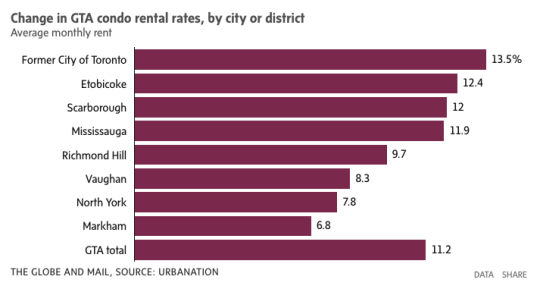
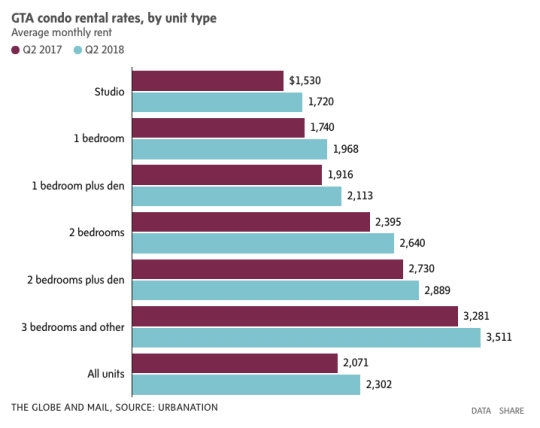
    Yesterday Urbanation released its Q2-2018 rental report for the Greater Toronto Area. It tracks both purpose-built rentals and condominium rentals, the latter being condominium units that are listed for rent on MLS. The average condo rent, for all unit types across the GTA, is up 11.2% year-over-year to a face rent of $2,302 per month.

    Here is a chart from the Globe and Mail:

    The former City of Toronto, which includes downtown, is actually up 13.5%:

    But here are the stats that I really wanted to draw your attention to today (figures from the Globe).

    According to Urbanation, there were some 384,000 condo apartments in the Greater Toronto Area in 2017 and nearly 1/3 of them were rented out. Given that the Canada Mortgage and Housing Corporation pegs the total number of rental apartments in the GTA at approximately 311,596, condo apartments represent about 40% of all our rental housing stock.

    So condo buildings are actually doing quite a bit of heavy lifting when it comes to providing rental housing in this region.

  • 2720 Dundas Street West

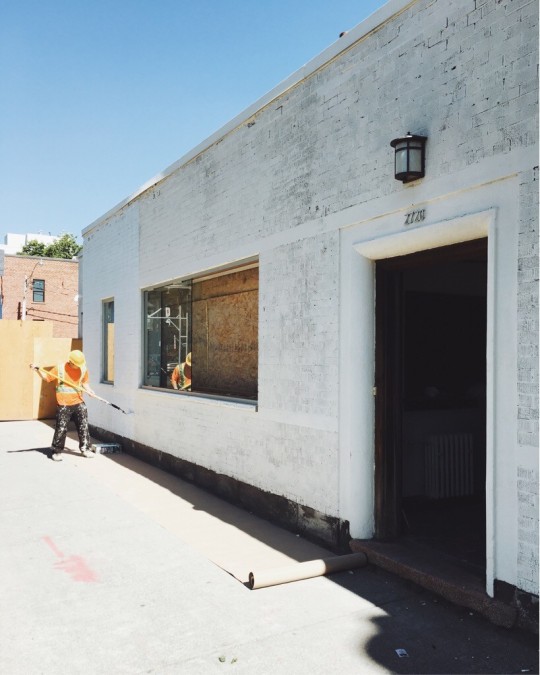
    If you’ve been in the Junction lately, you have probably noticed some activity at the location of our proposed Junction House. Here is a photo that I took this morning of 2720 Dundas Street West. (Sidebar: What an absolutely gorgeous summer day in Toronto.)

    image

    We’re giving the front a coat of fresh white to mark the beginning of the registration phase. Pretty soon you’ll be able to leave your name with us so that we can send you insightful emails and get in touch with you when condo sales begin. 

    At some point 2720 will become home to the Junction House sales office (maybe we’ll even call it something pretentious like a presentation gallery). But that point is not right now. 

    I can, however, tell you that in addition to superkül (architecture), we are working with Paul Johnston / Unique Urban Homes (sales), Dialogue 38 (interior design), and Vanderbrand (creative agency). 

    I am also personally spending a lot of time obsessing over kitchen details and other minutia. I think Charles Eames once said, “The details are not the details. They make the design.”

    If you’d like to be kept in the loop on Junction House, you can follow Slate Developments (nascent account), the Globizen Group, and myself on Instagram. And of course, you’ll also hear all about it on the blog. Have a great weekend friends.

  • Everything delivered on demand

    Last week I had something delivered from Amazon almost every single day. They weren’t necessarily big things though. One day it was a new corn broom for the patio. Another day it was a small set of hooks that I wanted to hang some lights. And the list goes on. 

    This is what Amazon wants us to do. Order every little thing, instantly, as soon as you think about it. And it’s magically convenient.

    Developers and architects are of course thinking about the implications of this shifting shopping habit on new residential developments. Usually it comes in the form of a large “Amazon room” and/or a parcel locker system. 

    I recently measured the package room in my building (geeky, I know). It’s about 10′ x 6′ and it sometimes isn’t enough for the volume of daily packages generated by ~360 units. 

    The other thing that happened last week is that my concierge said to me: “Brandon, we have become a full fledge post office with the amount of packages that come through here every day.” Every evening there’s a lineup of people waiting to collect their packages. 

    That immediately signaled to me that simply providing a larger room probably isn’t enough. This trend is only going to continue. How could we better design and optimize for this shift?

    I am sure that there many companies working on this problem. Hopefully they will surface in the comments and in my inbox following this post.

    Photo by Maarten van den Heuvel on Unsplash

  • A unique taste in buildings

    image

    A condo developer friend of mine once told me something along the lines of this: “Brandon, I have generally learned over the years that if I like something, it probably means the general public [our purchasers] isn’t going to like it. And that’s because if I like it, there’s probably something unique or quirky about it.”

    When he told me this it made perfect sense to me, because there’s a well documented taste divide that seems to exist between architects and design-types and non-architects and non-design-types (whatever this latter categorization means).

    A few years ago The Architects’ Journal published an article referencing a 1987 study that took a group of students – some architecture students and some non-architecture students – and asked them to rate the attractiveness of a series of photos containing both unfamiliar people and buildings.

    What they discovered was that most people had similar views on the attractiveness of the people. I guess hotness is somewhat universal. But when it came to the buildings, the viewpoints were completely opposite. The architecture students’ favorite buildings were what everyone else disliked the most.

    The conclusion in the article: “Professionals are, empirically, the very worst judges available of what people want or like in the built environment.”

    Photo by Simon Goetz on Unsplash

  • RioCan REIT announces new residential group

    On Monday, RioCan REIT announced its new residential brand: RioCan Living. This is the group that will now be responsible for redeveloping the 43 properties within their portfolio that they have identified as having intensification potential. Here’s how they are describing the new brand: “RioCan Living delivers best in class purpose-built rental units and condos along Canada’s most prominent public transit lines.”

    It has been interesting watching RioCan over the last 6 months. In the fall they announced that they would be selling off somewhere around $1.5 billion of their portfolio to rebalance toward Canada’s six largest markets, and in particular the Toronto market. And with this recent unveiling it is clear that they are doubling down on transit-oriented mixed-use communities as a way to future-proof their retail portfolio against disruption.

    Major markets. High-density. Transit-oriented. This shouldn’t surprise any of you. Here is a link to their latest investor presentation in case you’re curious.

  • Locals hate you

    BlogTO recently reported that “snarky anti-condo signs” have been popping up around Toronto. Here is one of them via Instagram. It reads (in all caps): Dear Condo Dwellers: Locals Hate You Go Fuck Yourself

    I find these posters curious, though it is obvious that they are a reaction to growth, intensification, and general change in this city.

    For one, it implies that condo dwellers and locals are mutually exclusive. In other words, “locals” don’t live in condos. Presumably the implication is that they live in low-rise grade-related single-family housing. Or maybe they live in rental housing? Is it a tenure thing?

    According to the latest 2016 Census data, just over 26% of private dwellings in Toronto are condominiums. And about 30% of people live in a building that has 5 or more storeys. If you include “apartments” less than 5 storeys, this latter number jumps to 40%. So many potential non-locals.

    However, it could be that these posters are primarily directed toward new condos and new condo dwellers. This poster seems to have been plastered in front of this recently completed condo building on College Street.

    If that is the case, then I wonder if there is a temporal cut-off for the hate. For example, the condo building that houses (at its base) my regular grocery store was completed in 1983. 

    The units are large and the demographic seems to skew a bit older. Are these condo dwellers – some of which may have been there for over 3 decades – to be hated? Are they non-locals? Or does urban myopia set in after awhile and they become locals?

    At the same time, it wouldn’t be unusual for the residents of an older condo building to oppose a new proposed condo building. So perhaps “local” isn’t about building typology and it’s more about who came first. That’s certainly a tricky one. Better end here.

    A curious poster that could use a bit more specificity. What do you make of it?

  • Only 9% of new homes sold last month were low-rise single-family

    BILD (the Building Industry and Land Development Association) just released its June 2017 data for the Greater Toronto Area’s new housing market. You can read the full release here. But I would like to point out a couple of things:

    About 91 percent of the 6,046 new homes sold last month were multi-family condo apartments in high-rise and mid-rise buildings and stacked townhomes, while only nine percent were low-rise single-family homes.

    The average price of available new condo apartments continued to rise with an increase of more than $22,000 from May. June’s $627,000 average price marked a 34 percent increase from a year ago. The average available unit was 845 square feet with an average price per square foot of $742. A year ago, the average price per square foot was $587.

    From this, it’s once again clear that Toronto is in the midst of an incredible transformation from a low-rise city to a more vertical city. New supply on the low-rise side of the market is heavily constrained.

    I get the sense sometimes that many people in this city, and others, believe that access to a low-rise detached house should be a right. Go to school. Get a good job. And then buy that house with a backyard. 

    The data speaks to a very different reality.

    Photo by Victoria Heath on Unsplash