
Daily insights for city builders, delivered every morning at 6 AM ET. I’m Brandon Donnelly — a Toronto-based real estate developer and founder of Globizen. I’ve been writing here since 2013.

Tag: condo developer

  • To yield or not to yield

    If you’re building a multi-family rental building, you’re almost certainly building it “on spec.” What this means is that you’re building an empty building and, once it’s done, you will then work to rent it out. (Nobody rents an apartment years in advance.) In this scenario, you will know what your costs are once the building is complete, but you won’t really know what your revenue will be until you start leasing. If demand is strong and the market has moved since you started building, maybe your rents will be a pleasant surprise. If the market has moved in the opposite direction since you started building, your rents might be an unfortunate surprise. The laneway house I recently completed is an example of a spec rental building. I built it without a tenant, but I assumed that I could rent it out upon completion. That proved to be true, but mind you it was only one unit. So it was relatively low risk.

    If you’re building an office building, it is bit more common to have some pre-leasing in place. Early on in my career, I worked on an office development where we started construction with about 25% of the leasing complete. This wasn’t enough for construction financing, but we saw that demand was strong and we needed to start right away in order to meet our lead tenant’s occupancy timing. And so we made the decision to go. We ran on equity for the first bit of construction, but once we completed enough leasing we were able to place our construction facility and lower the project’s overall equity requirement. We took a chance and everything ended up working out okay. But it could have not worked out. What would have happened if a pandemic hit after we started construction? Leasing activity would have completely stopped.

    If you’re building a condo building (at least in this city), you’ll likely be pre-selling your suites. You don’t necessarily have to do this. There are examples of well-capitalized condo developers building on spec without any pre-sales whatsoever. (Build, lock in your costs, and then sell.) But generally most developers will pre-sell, secure their construction financing, and then begin construction. In some ways this lowers your risks, as well overall systemic risk in the market. It also lowers your equity requirement as a developer. But it does create another possible risk. Once you pre-sell, you’re effectively locking in and capping your revenues. So you better have a very good handle on your costs. Otherwise you could be exposing yourself to cost escalations without any way to claw back some of your margins.

    The other thing to consider is whether you want to yield or not. Is it better to sell all of your suites as soon as possible (bird in hand) or sell only what you need, holdback the rest, and hope that prices increase going forward? I don’t think there is a right or wrong answer here. Some developers don’t want any market risk and so they take the bird in hand when they can. Other developers prefer to profit maximize and/or safeguard themselves against unforeseen costs, and so they sit on inventory. If you have unsold suites, you can always push revenues. Either way, what is hopefully clear from this post is that development is risky. This is just one example of some of the decisions that need to be made. There are countless others. Sometimes you’ll get it right. And sometimes you won’t. Hopefully the former happens more than the latter.
  • What will our customers think? Condo vs. rental.

    Condo developers are merchant builders. They build a project and then move on. Because of this, there’s a belief that there’s little incentive to build for durability, in comparison to say purpose-built rental buildings where the developer might continue to own over an extended period of time. While it is true that putting on an operations hat will make you hyper-focused on everything from garbage collection to how you’re going to manage all of your suite keys, there are a few things to consider in this debate.

    One, as developers we certainly think and care a lot about our brand and our reputation, both with our customers and with Tarion (warranty program). We ask ourselves: “What will our customers think if we do this?” Irrespective of the tenure we’re building, we want our projects to be carefully considered. And in the case of condominium projects, we would like our customers to feel excited and comfortable about buying in one of our future projects. That’s the goal. This is no different than any other product that you might buy that doesn’t come along with some sort of ongoing subscription.

    Two, there’s often a spread between condominium and rental values. For example, let’s consider a brand new 550 square foot condominium in a central neighborhood of Toronto and let’s say it would cost you $1,300 psf to buy it today. (Obviously it could be more or it could be less depending on the area and the building.) Now let’s start with a rent and back into a value, using some basic assumptions.

    Unit Size (SF)550
    Monthly Rent$2,400
    Rent PSF – Monthly$4.36
    Rent PSF – Annual$52.36
    NOI Margin72%
    NOI$37.70
    Exit Cap3.75%
    Value PSF$1,005

    Here I’m assuming that same suite would rent for $2,400 per month. I’m converting that to an annual PSF rent. And then I’m assuming that if you were managing a whole building of these kinds of units, your operating costs might be somewhere around 28%. Crude back-of-the-napkin math to get to a Net Operating Income (psf). Finally, I’m capping this NOI at 3.75%. We can debate my assumptions and if this were in a development pro forma you might “trend” the rents. But I find this comparison helpful. Here we are getting to a value of around $1,005 per square foot. Less than our $1,300 psf above.

    The point is that the margins are tighter, which helps to explain why for a long time we saw very few purpose-built rentals being constructed in this city. So even though you might argue that the incentives are in place to build for durability, you do have to weigh that against the realities of what you can actually afford to build. Development is filled with all sorts of these tradeoffs. But if you and/or your investors really want a consistent yield, this strategy can work just fine. Personally, I’m a fan of the long-term approach.

    Three, rent control policies can have an impact both on the feasibility of new projects and on people’s ability to actually perform maintenance. If you have a scenario where your operating costs — everything from taxes to utilities — are rising faster than your allowable rent increases, then you’re in a bad situation and you have zero incentive or financial ability to actually invest in the building, despite being a long-term owner.

    Finally, there is nothing stopping a purpose-built rental developer from also being a merchant builder. i.e. Selling the entire rental building once it is done and it has been stabilized. So you could argue that we’re right back at my first point. Whether you’re selling to individual condominium owners or the entire building to one entity, you as the developer have to sit back and ask yourself: “What will our customer(s) think if we do this?”

  • A unique taste in buildings

    image

    A condo developer friend of mine once told me something along the lines of this: “Brandon, I have generally learned over the years that if I like something, it probably means the general public [our purchasers] isn’t going to like it. And that’s because if I like it, there’s probably something unique or quirky about it.”

    When he told me this it made perfect sense to me, because there’s a well documented taste divide that seems to exist between architects and design-types and non-architects and non-design-types (whatever this latter categorization means).

    A few years ago The Architects’ Journal published an article referencing a 1987 study that took a group of students – some architecture students and some non-architecture students – and asked them to rate the attractiveness of a series of photos containing both unfamiliar people and buildings.

    What they discovered was that most people had similar views on the attractiveness of the people. I guess hotness is somewhat universal. But when it came to the buildings, the viewpoints were completely opposite. The architecture students’ favorite buildings were what everyone else disliked the most.

    The conclusion in the article: “Professionals are, empirically, the very worst judges available of what people want or like in the built environment.”

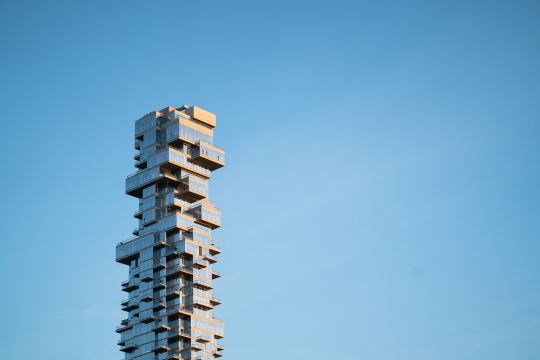
    Photo by Simon Goetz on Unsplash

  • America really is building very few condominiums

    On my way back from Philadelphia
    this past weekend I wrote a post called, The
    Philadelphia (real estate) story
    . It was about how opposite the market is
    in Philly compared to Toronto.

    After writing that post and
    because of a discussion in the comment section, I started thinking about condo
    vs. rental apartment development across the US. Because unlike cities such as
    Toronto and Vancouver, it struck me that – outside of maybe New York and Miami
    – most U.S. cities are really not building a lot of for sale condos. And if
    you’re from Toronto or Vancouver, I bet that feels odd to you.

    But what exactly is that number?

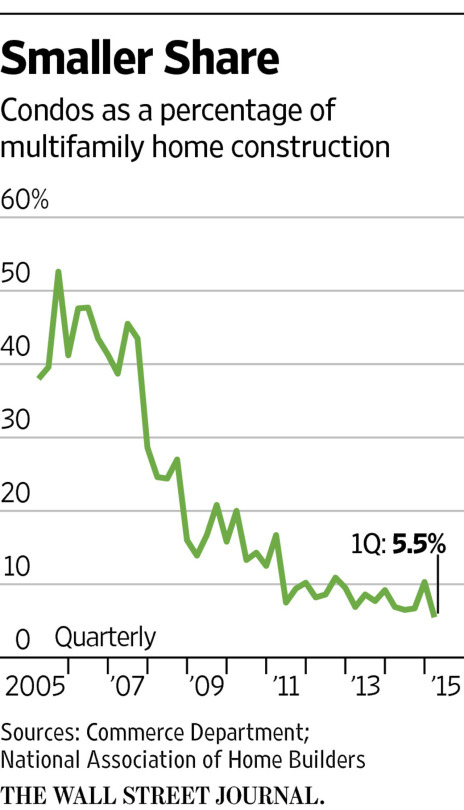
    As of the first quarter of 2015, condos as a percentage of all new
    multifamily (apartment) construction in the US was only 5.5%. That’s a tiny number and is down from
    over 50% before the Great Recession, which means most
    cities in the US really are building mostly rental. Last year the US built 264,000
    multifamily units across 11,000 buildings
    .

    So why is that happening?

    There appears to be a number of
    factors, according to a
    recent article in the Wall Street Journal
    .

    There’s a supply side
    constraint:

    Another obstacle cited by developers: construction loans. Matt
    Allen, chief
    operating officer of the Related Group, a developer based in Miami, said he can
    get a construction loan for roughly 75% of the cost of building an apartment
    complex. But lenders will cover only 50%, on average, of a condo complex’s cost
    because of the greater risk, he said.

    There’s a demand side
    constraint:

    As a result, the Federal Housing Administration, which
    backs mortgages made to low-wealth buyers, tightened its lending standards in a
    series of moves from 2008 to 2012. Under the new rules, in order for the FHA to
    insure mortgages in a given condo complex, at least half of the units must be
    owner-occupied and no more than half can be FHA-insured, among other
    requirements. For condo projects under development, at least 30% of units must
    be under contract for sale before the FHA will start backing mortgages there.
    Mortgage giants Fannie Mae and Freddie Mac tightened
    their standards as well.

    And there are macroeconomic
    factors:

    On the entry-level end, tepid job growth early in the
    recovery and the younger generation’s affinity for flexibility have fueled
    demand for rentals. Apartment rents are up nearly 16% since 2010, according to Reis Inc.

    Notwithstanding
    the above, could this be a post-recession policy pendulum that has swung
    too far in one direction?