Daily insights for city builders, delivered every morning at 6 AM ET. I’m Brandon Donnelly — a Toronto-based real estate developer and founder of Globizen. I’ve been writing here since 2013.

Tag: competition

  • Deal is back on: Amazon to buy stake in Deliveroo

    This is an interesting business story. Deliveroo is a London-based online food delivery company that was founded back in 2013 and today accounts for a big chunk of the online restaurant platform market in the UK. (They are also developing a network of “ghost kitchens” through a subsidiary called Deliveroo Editions.)

    Amazon has been and still is interested in buying a minority stake in the company (Roofoods Ltd). But the Competition and Markets Authority (CMA) has been blocking it out of fear that it would stifle competition. The thinking was that if they blocked this deal, maybe, just maybe, Amazon would enter the market on its own. And more participants means more competition.

    The merger case was opened on July 5, 2019.

    Well, Deliveroo’s business is now struggling amid this pandemic. To deliver food from restaurants and then charge those restaurants a commission, it turns out that you typically need those restaurants to be open for business. So the CMA is now revisiting the case. Is it better to have Amazon invest in Deliveroo or have Deliveroo possibly fail?

    The CMA has decided that the former now makes more sense — at least provisionally.

  • The Olympics are dead. Or are they?

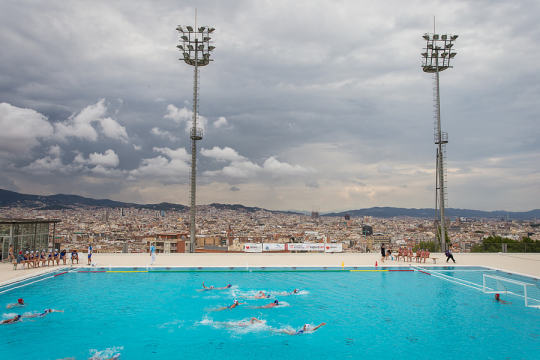
    Olympic Pool – Barcelona, Spain by Tom Weightman on 500px.com

    https://500px.com/embed.js

    Early this morning Professor Robert Wright – who is a regular reader and commenter on this blog – sent me an article from The Guardian called, ‘The Olympics are dead’: Does anyone want to be a host city any more? And that got me thinking.

    With Toronto having just hosted the Pan Am Games (the Parapan Am Games are still going on), there’s a lot of talk and debate happening in this city right now about whether or not we should make a go at hosting the 2024 Summer Games. The deadline for cities to express their interest is September 15th, 2015.

    The supporters (of which I would include myself) say it’s a great opportunity for civic (re)branding and urban renewal. It creates real deadlines to get things done. But the naysayers argue it’s a fiscal disaster waiting to happen. See 1976 Summer Olympics in Montreal.

    But in my view there are ways to host the Olympics and there are ways not to host the Olympics. Montreal (1976) is an example of what not to do. And Los Angeles (1984) and Barcelona (1992) are some of the best examples of what to do.

    The key is to think of the Olympics not as the end, but more as the beginning. In Olympic talk, they refer to this as legacy. Here’s what Los Angeles managed to accomplish as a result of the 1984 Summer Games (via Gizmodo):

    In 1979, the L.A. organizing committee had made a deal. If the games saw any profits, LA84 would give 60 percent back to the U.S. Olympic Committee and keep 40 percent for Southern California. At the end of the games, the total expenditures came in at a respectable $546 million, but even more impressive was the profit: A surplus of $232.5 million, meaning $93 million would stay in the region. This was huge. The only other games at the time which could claim to be financially successful at all were the other L.A. Olympics: The ones held in the city in 1932.

    The profits were used to create an endowment called the LA84 Foundation, which funds youth sporting events, resources, and facilities throughout the area. With smart management, the endowment has grown over the years, and over $214 million has helped an estimated three million children and 1,100 organizations in Southern California. Recently, the LA84 Foundation helped raise money to pay coaches and buy equipment at LAUSD high schools after budget cuts decimated their programs.

    The rest of the above article is definitely worth a read. It’s a great example of fiscal prudence.

    So what I am suggesting is not that we run blindly into hosting the Summer Games. But that we instead open our minds to the opportunities. Let’s great creative. If we could catalyze further city building, turn a profit, and leave meaningful legacies for this region (like what LA did), then why wouldn’t we want to have a go at it?

  • Our economy doesn’t suck

    image

    On Friday my friend Paul Crowe (of BNOTIONS) wrote the following Facebook post (rant) about the retail landscape here in Canada. It was a direct response to the claims that the recent loss of Target, Mexx, and Sony is “a warning sign for our economy.” If the text is too small below, you can also click here to read it on my wall.

    image

    I would say that competition did impact these retailers, but the key message remains the same: there’s nothing wrong with failure and companies going out of business (although success is obviously a more ideal outcome).

    And it shouldn’t necessarily be interpreted as a bad thing for our economy. In fact, a lot of the time it’s something quite healthy. When companies stop being competitive, the market is supposed to punish them. That’s how this game works.

  • Chicago vs. Toronto: Which city has the best skyline?

    Before visiting Chicago for the first time, everybody told me that I was going to love the city. They would tell me that it’s similar to Toronto, except that it has better architecture and a better waterfront. Having now visited the city, I not surprisingly have a lot to say on this matter. But I need another day or so to formulate my thoughts.

    In the interim, I thought it would be fun to host a little competition. Given that both Chicago and Toronto are Great Lake cities of comparable size (and formally sister cities), I’d like to know: Which city, do you think, has the better skyline? Please respond in the comment section below and make sure to include your location (so we all know if you might have a hometown bias).

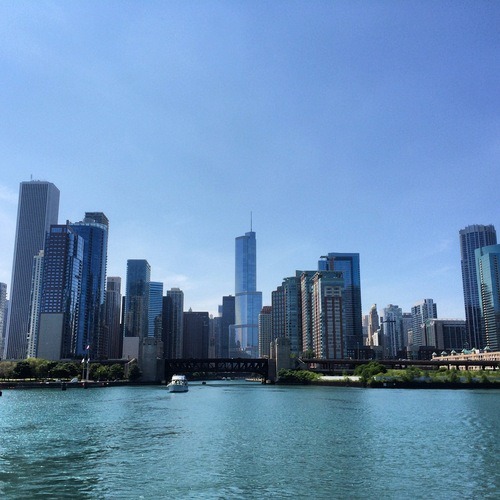
    To help you make your assessment, here are a few photos. Below is one that I took of the Chicago skyline from the architecture boat cruise we went on yesterday afternoon. The building directly in the center is the Trump Chicago.

    image

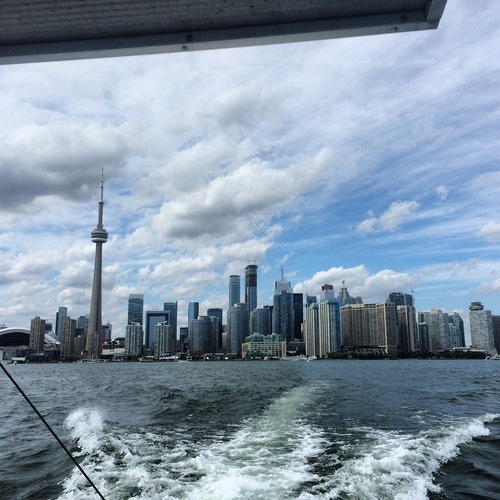
    And here’s a photo of the Toronto skyline that I took from a water taxi earlier this summer.

    image

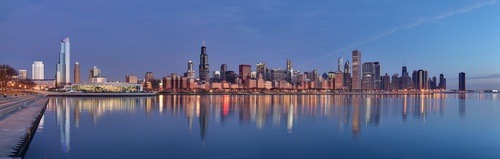
    But since these photos only represent one particular vantage point (me on a boat), here’s a set panoramic photos that I found online (Chicago & Toronto). I want to be as fair as possible.

    image

    image

    I think this one could go either way. But I personally like the variety that the lit up CN Tower and Sky Dome (Rogers Centre) bring to Toronto’s skyline. Overall, it feels a lot more modern and exciting to me. So I pick Toronto. What about you?