Daily insights for city builders, delivered every morning at 6 AM ET. I’m Brandon Donnelly — a Toronto-based real estate developer and founder of Globizen. I’ve been writing here since 2013.

Tag: commuting

  • Cycling to the office

    Right now my typical morning commute consists of a 15 minute walk and a quick stop off for a coffee. I must admit that I’m spoiled. But next year I’ll be moving to the Junction and so that means I’m going to need to make some minor adjustments to my routine.

    I fully expect that on warm summer nights I’ll probably still walk home on occasion. But broadly speaking, my loose plan is a combination of cycling, e-scootering, and taking the Union Pearson Express train.

    Then this evening I was out for drinks with one of our partners and two of the guys were talking about how they cycle to work each morning and compete on Strava to make sure everything gets properly logged. One of them actually lives near the Junction and his regular route is down through High Park and then across along the lake.

    Naturally I got inspired and decided — after two beers — that I too should join this competition. So I have now obligated myself to cycling to the office starting next year. That said, I could probably use a new bike, and I’m hoping that some of you will have recommendations.

    My criteria is as follows: it should look impossibly cool, it should work for a daily commute, and it should be at least somewhat suitable for tight-fitting clothes and long rides through the French countryside (even though I currently have no concrete plans of doing such a thing).

    Any thoughts?

  • Marchetti’s Constant and why commuting actually has positive utility

    @OceanJangda shared a great article with me today about “the psychological benefits of commuting to work.” It is excellent, it cites a lot of psychological research, and I would encourage all of you to give it a read. While it is never fun getting on a packed subway in the morning, the argument is that there are psychological and other positive benefits to commuting. It turns out, we need breaks in our day.

    Here’s an excerpt from the article:

    But here’s the strange part. Many people liberated from the commute have experienced a void they can’t quite name. In it, all theaters of life collapse into one. There are no beginnings or endings. The hero’s journey never happens. The threshold goes uncrossed. The sack of Troy blurs with Telemachus’s math homework. And employers—even the ones that have provided the tools for remote work—see cause for alarm. “No commute may be hurting, not helping, remote worker productivity,” a Microsoft report warned last fall. After-hours chats were up 69 percent among users of the company’s messaging platform, and workers were less engaged and more exhausted.

    It also turns out that there’s kind of a magic commute number. In the mid 1990s, Italian physicist Cesare Marchetti remarked that, all throughout history, humans have tended to cap their commute times at about 60 minutes per day. So a half hour each way. This was the case in ancient cities and it appears to be the case today (ignoring COVID).

    What this mean is that as new technologies became available — such as the automobile — we were able to further decentralize and still only consume about 60 minutes of our day. Apparently the average one-way commute time in America is indeed about 27 minutes. Some people, of course, have much longer commutes, but this is the average. Currently mine is about 12-15 minutes with a coffee stop. Yes, it’s luxurious.

    This 60-minute rule of thumb has become known as Marchetti’s Constant. And there are a number of possible explanations for why this has remained the case. Again, the obvious one is that it helps us detach from work, which is why so many of us have felt burnt out while working from home. We haven’t been shutting off and we need to.

    For more on this, click here.

  • Your own 24/7 chauffeur

    image

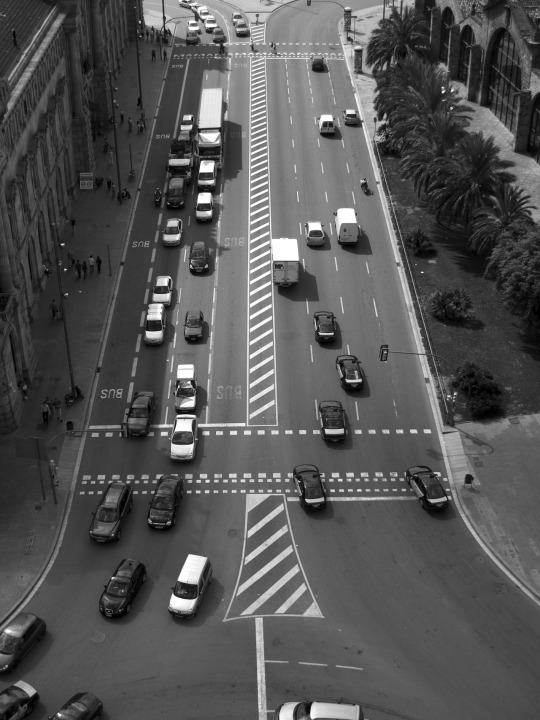
    If you had a free 24/7 chauffeur to drive you anywhere you wanted, do you think that would impact where you lived, worked, and played? 

    Put differently, if you were relieved from actually having to contend with traffic yourself and if you never had to worry about parking and/or drinking and driving, would you be more inclined to live further out of the city to get bigger and cheaper housing?

    This is the question I tried to ask in a Twitter poll this morning:

    //platform.twitter.com/widgets.js

    Personally, I think that this scenario would impact my behaviour, only slightly. I would certainly take advantage of the free chauffeur, but I would not be more inclined to live 1 or maybe even 2 hours of the city.

    Sure, I would be able to get more real estate, but I wouldn’t want to sit in a car every morning – even if I wasn’t the one driving. Maybe I’d be more inclined to have a cottage out of the city, but I can’t imagine a big commute. In my view, minimizing commute times is one of the most effective ways to up your quality of life.

    I’m thinking about all of this because of this TechCrunch article, arguing that technologies such as driverless vehicles and VR (for telecommuting) will soon cause rapid decentralization. This reminds me of what was said during the dot com era. Real estate was out of favor and it was all about tech. 

    Though I am sure that there are technological impacts that you or I cannot foresee right now, I think it’s important to remember that people live in cities for many different reasons. It’s not only for access to a labor market, it’s also for access to a dating market, as well as other things that involve people coming together. I believe that we are inherently social beings. And technology is not going to make that disappear overnight.

    I would be curious to see how you all feel about this topic. Please leave a comment below so we can discuss.

  • How we perceive commuting

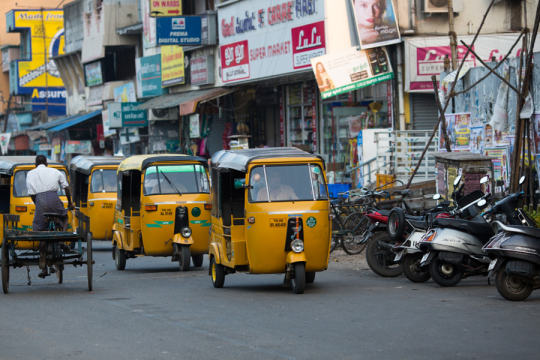
    CHENNAI, INDIA-FEBRUARY 10: Street of Indian city 10, 2013 in Ch by sergemi on 500px.com

    https://500px.com/embed.js

    Wharton real estate professor, Mariaflavia Harari, recently published a paper that looks at the relationship between urban geometry (specifically compactness) and inner city commuting efficiency across 450 cities in India.

    Consistent with previous research done in this space, she finds that people generally prefer compact cities and that they are willing to pay a premium for it. It increases overall welfare. Here’s an excerpt from her paper:

    “My findings are broadly consistent with compact city shape being a consumption
    amenity. All else being equal, more compact cities grow faster. There is also evidence that
    consumers are paying a premium for living in more compact cities, in terms of lower wages and,
    possibly, higher housing rents.”

    So her recommendations for the Indian cities she analyzed was that they should relax land use restrictions to allow for more vertical / compact development and that they should focus on improving urban transport in order to offset some of the negatives externalities associated with sprawl. This is no different than the approach that many cities in the developing world are adopting or looking to adopt.

    One of things that really stood out for me in her paper though is the way people perceive commuting:

    “The loss associated with non-compact
    shape appears to be substantial: a one-standard deviation deterioration in city shape, corresponding
    to a 720 meter increase in the average within-city round-trip, entails a welfare loss
    equivalent to a 5% decrease in income. This is considerably larger than the direct monetary and
    opportunity cost associated to lengthier commutes. Less compact cities also appear to attract
    fewer low-income immigrants, as captured by the share of slum dwellers.”

    What this is saying is that we tend to overvalue the negatives of commuting, beyond the direct costs of gas, insurance, car payments, our time, and so on. We hate it so much that we also want to be compensated for the mental anguish. Here is that same idea said differently:

    The estimated welfare loss from longer commutes appears to be large, relative to the immediate
    time and monetary costs of commuting. This is consistent with the interpretation that
    commuting is perceived as a particularly burdensome activity. The behavioral literature has
    come to similar conclusions, albeit in the context of developed countries. Stutzer and Frey
    (2008) find a large and robust negative relation between commuting time and subjective wellbeing,
    using German data. They estimate that individuals commuting 23 minutes one way
    would have to earn 19 percent more per month, on average, in order to be fully compensated.

    So I guess I’m not the only one who thinks commuting and driving sucks.

  • Uber, commuting, car ownership, and the future of urban mobility

    Earlier this week I wrote a “Tech Tuesday” post talking about Uber’s new Smart Routes functionality, which it is currently testing out in San Francisco. At the end of the post I ended by saying that it’s not just the taxi industry that should be thinking about Uber, it’s also public transit authorities. 

    And that’s because many people in cities rely on multi-modal forms of transportation (I know I do) and in my mind it is clear that Uber is trending away from just “Everyone’s Private Driver” to a service that is starting to look and feel a lot like urban mass transit.

    Then today my good friend Evgeny sent me a post called, “Public Transit Should Be Uber’s New Best Friend.” And it’s one of the best pieces I’ve read on Uber and its impact on urban mobility. I highly recommend you give it a read, particularly if you’re in the city building arena.

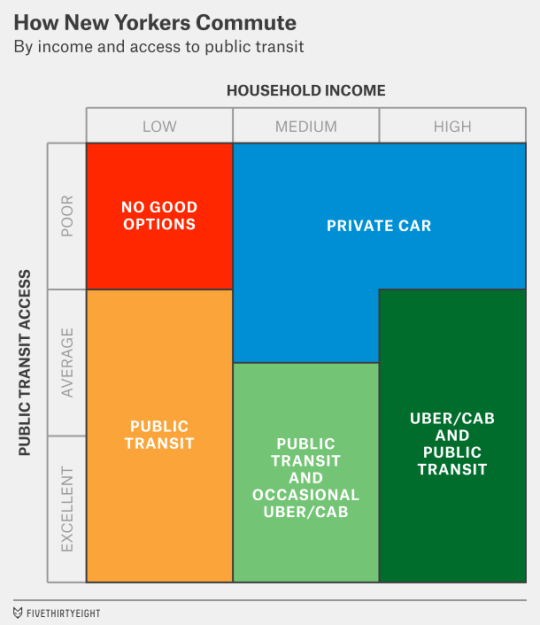
    The article does a deep dive into how New Yorkers commute. Here’s how they broke it down.

    image

    It then talks about what it will take for a company like Uber to make a meaningful dent in car ownership (which is one of the company’s goals) and how the truly big opportunity for Uber is to go more mass market and tap into the public transit market – either by interfacing with or by building its own version of it.

    Here’s their concluding paragraph:

    But there’s a much wider potential audience if Uber can also reach middle-class customers who want to save money. Perhaps in the distant (or even the not-so-distant) future, Uber can build its own version of “public” transit, making rides so cheap that they cost less than the $4 or $5 that Americans now pay, on average, to make a trip in their personal cars. In the meantime, it might have more success among “car-cutting” customers who can use Uber along with public transit. That might mean Uber’s growth is concentrated more in cities like New York, San Francisco and Chicago — and in Europe and Asia — that already have reasonably strong public transit networks.

    It’s definitely worth a full read. Thanks again for sending this over Evgeny.

  • Guest Post: Three minutes that rule the world – Will demolishing the Gardiner East actually make traffic worse?

    Today on Architect This City, we have a guest post by Darren Davis, who is a transport planner in Auckland, New Zealand. He’s a regular commenter on this blog, and I know he’s been following the Gardiner East debate quite closely – as many urbanists around the world are. I appreciate him offering and taking the time to write this piece. Thank you.

    ——————————–

    The decision this month on whether to demolish the Gardiner East Expressway and replace it with a surface boulevard or to rebuild it with a similar elevated structure will be a watershed moment for Toronto, akin to the decision not to have freeways in the urban core of Vancouver in the late 1970s.

    There are numerous good reasons why removing the Gardiner East elevated structure is the right move for Toronto, covered previously by The Globe and Mail and in the Council for Canadian Urbanism’s open letter to Toronto City Council. If you aren’t aware of these, I strongly recommend reading them. 

    Also of note are two things:

    1. Just 3% of Downtown commuters drive on the Gardiner Expressway East, a tiny fraction of the 68% who arrive Downtown on public transit.
    2. The “remove” option does not reduce traffic capacity over the “hybrid” option but could reduce travel speeds in uncongested conditions (read on for why I don’t think that this will happen in real life).

    However, one element of this debate that has not got much airtime is the transportation modelling that claims an additional two to three minutes travel time with the “remove” option over the “hybrid” option which retains the elevated expressway in a slightly modified form. 

    Toronto Mayor John Tory has stated that "I didn’t get elected to make traffic worse. And let’s be clear, removing that piece of the Gardiner will almost certainly make traffic worse.” But is it in fact true that demolishing the Gardiner Expressway East will make traffic worse as the transportation modelling claims?

    The key thing to understand is that transportation modelling, which tries to predict future travel times, is the product of a bunch of assumptions which may not in fact be borne out in real life. 

    For example, the effect of induced traffic, where additional traffic capacity leads to additional traffic being attracted to the route, is reasonably well known but generally not factored into transportation modelling. Induced traffic happens because increased travel speeds attracts traffic that would have otherwise avoided the route at congested times; attracts people to drive where they previously used other modes and encourages trips that would not otherwise have taken place. The effect of induced traffic is to quickly nullify the benefits of adding traffic capacity.

    However, what is less well known is that the reverse happens where there is either a reduction in traffic capacity (not the case in Toronto as the “remove” option retains the same traffic capacity) or speed.

    This is because in this situation, four things happen:

    1. Some travel re-routes. The “remove” option with a widened Lakeshore Boulevard as part of the street grid simply gives more ability for traffic to re-route away from congestion over an elevated expressway structure where drivers are literally trapped until they reach their exit.
    2. Some travel re-times. Some people will retime trips to avoid congested travel times, such as starting and/or finishing work at less congested times.
    3. Some travel changes mode. Some people will be encouraged to change mode by the perceived worsening in traffic conditions.
    4. Some travel is avoided entirely. Some people will choose not to travel at all in the peak of the peak. For example, this could take the form of working from home or shopping on the internet instead of by car.

    Transportation models only take into account the first item but not the others. The modelling is also sensitive to traffic growth assumptions and assumed mode split and trip distribution. Often transportation models assume continued growth in car travel even though per capita kilometres travelled peaked about a decade ago.

    While this may all sound well and good theory, does this actually happen in practice?

    In Auckland city centre, we have extensive experience with the reallocation of road space away from general traffic. Many busy key city centre approach routes have had general vehicle lanes reduced to make way for bus lanes (which generally carry around 65-70% of the people moving capacity of the street). 

    This has involved up to a 50% reduction in private vehicle capacity (whereas in Toronto, the “remove” option retains the same traffic capacity but may slow throughput). Auckland has done two of these in the past twelve months – both involved converting a general traffic lane to a bus lane. 

    Don’t get me wrong: There is sometimes pain at implementation with about a three week period of congestion as car drivers adapt to the new reality – and most likely negative media coverage will accompany this. But after about a month, equilibrium will be restored and life will continue much as it did prior to the change. 

    Part of this is that there will be various “optimisations” during this introductory period where signal timings are adjusted and other tweaks made – the sort of tweaks that can only be fine-tuned in a real world situation. But a bigger part of this is that the four factors above – re–routing, re-timing, mode change and avoided travel – come into play.

    I cannot overemphasise enough that life will return to normal surprisingly soon if the Gardiner East Expressway is demolished and replaced by a widened Lakeshore Boulevard.

    My advice

    When people talk about two to three minutes of extra travel time, take the foregoing into account and take those claims with the very big grains of salt that they deserve. If Toronto makes the right choice and chooses the “remove” option, my bet is that the biggest surprise of all will be how little difference it makes to peak travel times for the 3% of Downtown commuters who used to use the Gardiner Expressway East.

    Disclaimer

    The author of the above post is an employee of Auckland Transport, however, the views, or opinions expressed in this post are personal to the author and do not necessarily represent the views of Auckland Transport, its management or employees. Auckland Transport is not responsible for, and disclaims any and all liability for the content of the article.