Daily insights for city builders, delivered every morning at 6 AM ET. I’m Brandon Donnelly — a Toronto-based real estate developer and founder of Globizen. I’ve been writing here since 2013.

Tag: community meeting

  • Community open house for Project Bench

    This afternoon, the team, including the Town of Lincoln, hosted a community open house for Project Bench. This is our upcoming development project in the Niagara Benchlands.

    This was a follow-up to the pre-application community meeting that we held last November, and it is a precursor to the statutory public meeting that will be held in two weeks on July 8th at 6 PM.

    If any of you would like to attend, this upcoming meeting will be held in the Council Chambers of the Town of Lincoln at 4800 South Service Road in Beamsville, Ontario.

    Overall, the team feels that today went very well. We’re looking forward to continuing the dialogue with the community and further refining our development application.

    Community meetings are a critical part of the development process and, over the years, I have come to learn the following:

    • Open houses, like the one that was held today, are a good format for encouraging dialogue. The typical setup includes presentation boards, representatives walking the floor, and some sort of mechanism for people to provide feedback (post-it notes on a site plan can work well).
    • Part of why this is a good format (compared to a straight presentation followed by a Q&A) is that it humanizes the team and it gives the community an opportunity to ask all of their questions. A lot of concerns can be addressed through clear explanations.
    • The most common concerns are usually (1) height, (2) density, and (3) traffic. There are obviously others, but this is a good high-level list.
    • Many/most people tend to conflate height and density. But as we have talked about many times before on this blog, they are not one and the same. Density tends to be harder to grasp, which is why you’ll often hear people criticize tall buildings, but not cities like Paris and Barcelona, despite being two of the densest cities in the world.
    • A developer’s job is to be creative. You have to manage a myriad of competing interests and then thread the needle as best you can. Community meetings are about listening, learning, and then trying to figure out where the needle might go.
    • The objective should be to make as many people as possible excited about the development. In other words, do great work.

    What else would you add to this list?

  • Living vs. just visiting — do these two things require different built environments?

    Many years ago I was in a community meeting talking about a proposal we had to add retail uses adjacent to a park. Residential was the highest and best use, but we were excited by what retail could do for the project and area. We were imagining something like a Parisian cafe where everyone would sit facing outward toward the park.

    Much to our surprise, the community was vehemently opposed. And when we eventually asked who had been to Europe and sat outside in a nice cafe, the response we generally got was, “yeah, we have, and it’s obviously nice there, when on vacation. But that’s Europe. It won’t work here and it’s not appropriate for the area.”

    Hmm. This raises all sorts of interesting questions. But for today, let’s ask this one here: Why is it that some people choose to live in places that are so different than the ones they visit when on vacation?

    Is it because we, as humans, want fundamentally different experiences when we travel? i.e. We want to escape from our current reality. “Oh look how novel this is.” In this case, I guess you could say that our markets are fairly efficient and people are getting the kind of lifestyles that they truly want, both at home and abroad.

    Or, is it because, for a variety of reasons, we’ve created rules and obstacles that force certain built form outcomes? We think the other ways won’t work. I often find myself in this latter camp, meaning that when I travel, I at some point end up thinking: “This is a good idea. I want to both move here immediately, and steal this idea and bring it back to Toronto.”

    How about you?

    Photo by DAT VO on Unsplash

  • We’re hosting a pre-design community meeting in Hamilton

    This fall Slate acquired a retail center in Hamilton called Corktown Plaza. It is the block bounded by John Street South, Young Street, Catharine Street South, and Forest Avenue. It is just south of the Hamilton GO Centre in downtown.

    It is currently a much used single storey retail plaza with a large surface parking lot facing John Street South. It’s still early days, but the long-term plan is to redevelop it into a mixed-use retail and residential complex.

    Before putting pen to paper, the team is hosting a “pre-design community meeting” this Tuesday, December 12, 2017 at 7pm at the Church of Ascension down the street. Address is 64 Forest Avenue (accessible entrance at 258 John Street South).

    Here is the invite (embedded tweet):

    https://platform.twitter.com/widgets.js

    The purpose of the meeting is to gather feedback from the community before beginning design. We want to know what’s working today, what’s not working today, and what would be ideal for the future. 

    CORE Architects and GSP Group (planning) will be in attendance along with the Slate team. The format will be brief presentations followed by interactive breakout sessions. There will be trace paper on hand so that we can all put pen to paper.

    If you live and/or work in the area or are simply interested in the future of Hamilton, please feel free to join us on Tuesday evening. If you can, send a quick email to rsvp@kga-inc.com letting us know you’ll be coming. But just showing up is also perfectly fine.

  • Positivity at a public meeting

    I’ve been reading the blog 5 Kids 1 Condo for, I think, about a year now. It’s written by Adrian Crook who is a single dad of 5 kids, living in a 2 bedroom condo in downtown Vancouver. And his blog is about just that.

    A few days ago he posted a video of himself speaking at a public meeting in support of a new purpose-built rental building at 18th and Commercial Drive in Vancouver. The proposal includes 110 secured market rental units; 37% of which will be 2 or 3 bedroom apartments. (More information on the project, here.)

    It’s rare to see people come out in support of a project at a public meeting. Usually people only show up when they’re grouchy and upset. So today I’d like to share his speech (click here if you can’t see the video below).

    [youtube https://www.youtube.com/watch?v=q-ENWu__HdM?rel=0&w=560&h=315]

    I’m curious to know what was shouted right at the beginning after he said that he was in favor of the proposal. I listened a few times but couldn’t figure it out. 

    In any event, Adrian’s speech touches on a number of important points that transcend this specific development proposal and that are relevant to many of the topics that we discuss here on this blog.

  • Event: Community Consultation for Mirvish Village

    image

    One June 13, 2016 from 6:30 to 9:00 pm, the City of Toronto will be hosting a community consultation meeting for the proposed redevelopment of Honest Ed’s / Mirvish Village

    The meeting will be held at the Bickford Centre Auditorium at 777 Bloor Street West (across from Christie Pits Park).

    The purpose of the meeting is to present Westbank’s revised development proposal, which was submitted to the city last month. Their first proposal was submitted last summer (July 2015). 

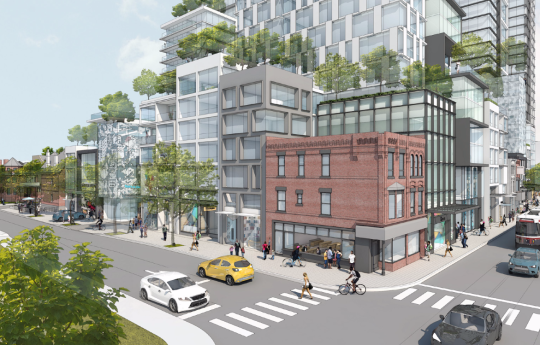
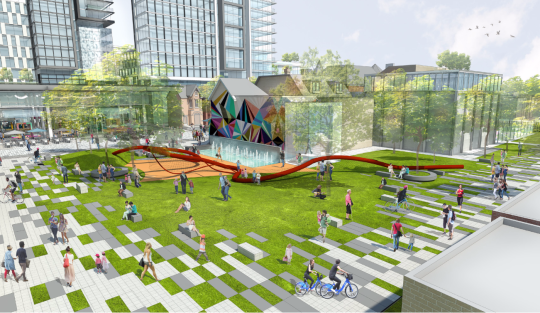
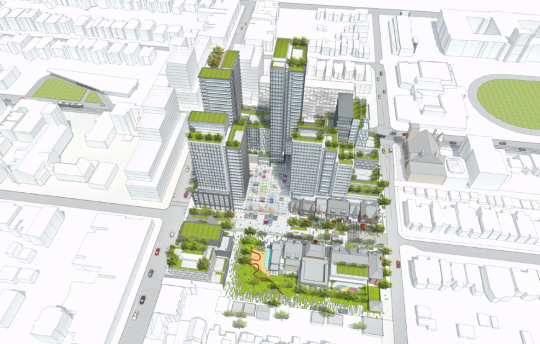
    Some of the key changes include a new on-site public park, the retention of additional heritage buildings (now 21 in total), more pedestrian porosity, and the retention of Honest Ed’s alley in its current location.

    I consider Westbank to be one of the most thoughtful developers in the city and so I’m pretty excited to see this one evolve. I’m planning to attend the community meeting and maybe I’ll see you there.

    Below are a couple of other renderings to give you a taste.

    imageimageimage

  • Public consultation is broken

    Public consultation is broken. And by that, I mean that the way in which municipalities, developers, and other city builders solicit feedback from communities is fundamentally flawed.

    For new developments, the process works more or less like this: The developer makes an application to the city. The city reviews it and then agrees to move towards a public/community meeting (the goal of which is to solicit feedback on the proposal). Once a date is set, notices go out, and the developer secretly hopes that no one will show up. 

    Because what often ends up happening is that it’s only the people with the time or a bone to pick who actually go to these things. Rarely do people go simply to voice their support for a project. That’s why the benchmark for success is usually no community opposition – it’s rarely about support.

    But from writing Architect This City, I know that many of you care deeply about your community and about cities in general. The problem, is that I don’t think most of you get a chance to voice your opinions. How many of you have actually gone to a community meeting in order to show your support for a development project or city initiative? I’d be curious to know, but I suspect most of you haven’t.

    The result is a system whereby the voice of a few (often naysayers) have a disproportionate amount of weight. They set the tone. But that’s not how community input works best. It needs to be representative of a broad and diverse cross section of the population. It needs to be inclusive. Everyone in the community should have a say.

    So today I was thinking that there’s an opportunity for somebody out there to create an online platform for community feedback. Developers would post up their project and then everyone in the community, as well as in the larger city, would have an opportunity to vote on it and provide their feedback.

    To make it fair, you could assign higher weights to people the closer they live to the project. But the idea would be to make it as easy as possible for everyone to provide feedback – whether they’re on their smartphone or at the regular community meeting. 

    Obviously this would require greater openness, but I don’t think that pulling back is the answer to this problem. The solution isn’t to hide from the potential naysayers; it’s to galvanize the supporters. 

    If your community already has a platform like this, please share it in the comment section below. I’d love to see it.

  • Berczy Park and the importance of public art in cities

    image

    Earlier this week a friend of mine was live tweeting a public consultation meeting for the revitalization of Berczy Park in the St. Lawrence Market neighborhood of Toronto. And since I live in the neighborhood, it’s a project that I’ve been following particularly closely–although anything related to the built environmental generally fascinates me.

    As soon as I saw the pictures he was tweeting out, I was immediately excited. And after reviewing the full design package (which you can download here), I must say that I think it’s going to be a brilliant change for the neighborhood. 

    image

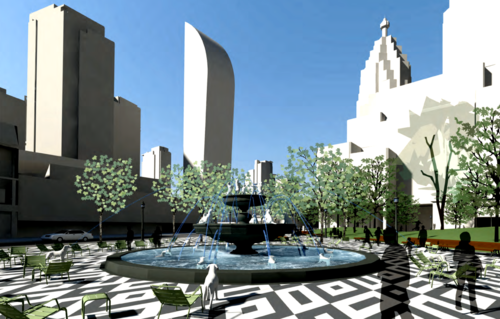
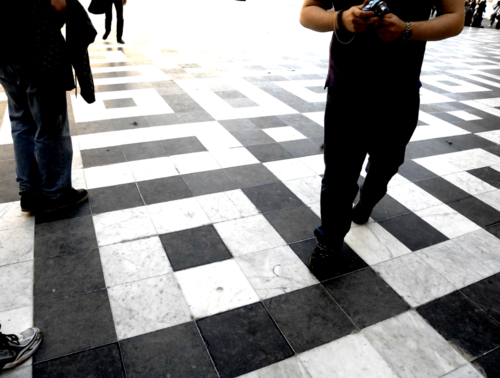
    On an entirely superficial level, I like the paving motif they’ve chosen; even if it does appear to be be a copy from somewhere else (see above photo). I don’t think one should underestimate how small details, like paving, can have a huge impact on how one feels in a space, whether inside or out. It all counts.

    But beyond just cosmetic changes, there are a couple of significant design changes being proposed.

    First, a larger kid-friendly green space is being proposed on the west side of the park. And what was interesting to see was how the community overwhelmingly expressed a need for this play area. I’d like to believe that this speaks to the growing acceptance of raising kids downtown. There are certainly lots of families in the St. Lawrence.

    Second, the south portion of the park is being “opened up” with a much larger hardscape area. The result will be a bigger promenade along Front Street, as well as, what I hope, will become an “urban stage” for people to hang out, breakdance, busk or try and sell me things I don’t need.

    But equally exciting is the fact that along with the revitalization of Berczy Park will come a public art competition. It’s already in the works, but there aren’t any pretty images to share, just yet. Regardless, I think the topic of public art is an interesting discussion.

    In a lot of cities around the world, there are mechanisms in place to encourage or mandate public art. Commonly, it comes in the form of a “Percent for Art” program, which means that, in the case of a new construction project, 1% of the construction costs would or should go to public art.

    But the fact that we, at least in some cities, have programs to mandate it, should immediately signal to you that public art is not something universally believed in. And certainly it’s one of those things where it’s hard to measure the return-on-investment. 

    But that doesn’t mean it doesn’t or can’t exist.

    In fact, I would argue that in today’s information and digital age it’s only going to become more important. We are living in a world of too much information and too little time. We’re living in a noisy world and, whether you’re a corporation or a city, the only way to stand out is to be remarkable. You need to bring delight to people.

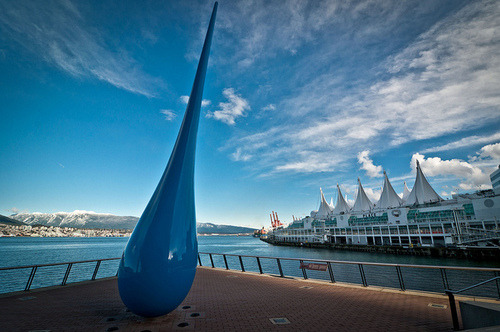
    Because when you do, you get noticed (and probably shared on Facebook, Twitter, Instagram, Tumblr, Snapchat, Vine, 500px, Flickr and maybe even Google+). As one example, how many of you recognize the public art piece below? It’s in Vancouver and I’ve seen it pop up a number of times in my social news feeds. It’s something that brings delight to people. 

    image

    But at the same time, it’s something that speaks to and creates a sense of place. What could be more Vancouver than a giant blue raindrop along the waterfront? And that’s really one of the ironies of today’s digital world. Despite the fact that, no matter where we are, we’re all hyper connected through technology, more and more of us are gravitating back towards cities. We want to live close to other people and we want to feel a sense of place.

    When done properly, public art can help cities achieve that. Whether it’s the famous LOVE sculpture or Richard Serra’s controversial Tilted Arc, public art can make you stop and take notice of your environment. It can give you that sense of familiarity or it can take you by surprise. Either way, it gives you a sense of place.