Daily insights for city builders, delivered every morning at 6 AM ET. I’m Brandon Donnelly — a Toronto-based real estate developer and founder of Globizen. I’ve been writing here since 2013.

Tag: communication

  • Google Maps for the Roman Empire

    Okay, this is neat. Stanford has created what is effectively Google Maps for the Roman Empire.

    What it shows you is the principal routes of the Roman World: the road network, the main navigable rivers, and the hundreds of sea routes that crossed the Mediterranean, the Black Sea, and the coastal Atlantic.

    The tool then attaches both time and expense to these routes (which would have been used for the transportation of goods and people, but also for general communication across the Roman Empire).

    So if, for example, you are curious about how many days and how many denarii it would have cost you to deliver an important dinner invitation from Roma to Alexandria during the summer months of antiquity, you now have an online tool. It’s about 14 days.

  • In support of simplicity

    “Everything should be made as simple as possible, but not simpler.” I’m not exactly sure who this quote is attributed to — maybe Einstein — but regardless, I love it. I’m a big fan of simplicity.

    I have a cookbook in my kitchen by Jamie Oliver where each recipe contains no more than 5 main ingredients. There’s a picture of the 5 ingredients, a picture of the final product, and a short explanation about how to make it. It’s my favorite cookbook (and also my only cookbook).

    When I go to a restaurant I prefer to see a short menu rather than a long menu. Not only because it’s easier to make decisions that way, but because I have little confidence that a restaurant with an interminable menu can make that many terrific dishes all at once.

    And in architecture school, I remember being taught that every design project should really only have one principal idea. If you have two ideas, that’s probably one too many. Distill it down. Clarify the idea that you’re trying to communicate.

    Because here’s the thing about simplicity: it’s usually more work to make things as simple as possible, but not simpler. It takes effort. It takes iterations. Whether that be in cooking, design, or in writing.

    But once you’ve got it, simplicity is a beautiful thing. And it also greatly increases the chance that somebody will actually remember the message that you’re trying to get across. Five ingredients. A short menu. And one architectural idea. That’s all it might take.

    Photo by Jakub Dziubak on Unsplash

  • Preferred method of communication

    I was “on site” this morning for the installation of the helical piers for my laneway suite (that will be the topic of a separate post). More often than not, I’m in the office. But I like going on site because, well, building things is fun. One of the things that I find interesting about being on site, though, is that my preferred method of communication always seems to change. When I’m in the office, I have a bias toward emails. That is the case for two reasons: 1) I’m usually focusing on something and I find that calls can be disruptive, and 2) emails can be a highly efficient way to communicate. Tell me what you need (in the shortest email possible) and I’ll try and respond as succinctly as I can. However, when I’m on site, all of a sudden I don’t want to do emails. I would rather talk on the phone. That becomes the most direct way to deal with things. I am mentioning this because communication is paramount. And many of us have different preferences for how we like to do it. Knowing those preferences can be helpful when you’re trying to get things done.

  • The double opt-in introduction rule

    image

    I am a fan of the double opt-in introduction. I am guilty of not doing it, but I’ve been hearing of this approach from a few people and I think it makes a lot of sense. And it is probably only going to make more sense as we all become even more connected.

    The way the double opt-in introduction works is that before you make a cold introduction, you simply ask both parties if they would like to be introduced to the other party. If one party doesn’t opt-in, then you don’t make the introduction. Simple.

    The reason this is so valuable is because, without this double opt-in framework, it can be easy to get sucked into a call or meeting that you may not want to be a part of, which in turn means that you’re not in control of and managing your own schedule. Somebody else is doing that for you.

    This may seem harsh, but as we’ve discussed before on the blog, there’s a ton of value in saying no. We all need filters, especially today. And if we don’t say no often enough, we’re all bound to run out of time for the things that really matter and that we should be focusing our attention on.

    The underlying principle behind the double opt-in introduction is that it’s a lot easier to say no to an introducer than it is to a person you have just been introduced to: “Sorry, I have no interest in talking and/or meeting you.” Now that’s not very nice.

    Photo by Andrew Neel on Unsplash

  • A Spanish social media town

    I am a big fan of Twitter.

    I use it more than any other social network and any other app on my phone (according to my battery usage). In fact, I’m such a fan that I recently started buying shares. I don’t own a lot and the Canadian-US exchange is awful right now, but I do plan to continue buying (I like dollar cost averaging).

    Twitter isn’t the darling of Wall Street like Facebook is. And I think the biggest weakness of Twitter is that it’s difficult for new users to really “get it.” Facebook solved this problem early on by recognizing that new users had to connect with X number of friends right away so that they received value immediately and the next time they visited.

    But I digress. That’s not the focus of this post.

    This morning a friend shared a Medium article with me that was written by the Laboratory for Social Machines at MIT. The article is about a small town in Spain called Jun (pronounced “hoon”) that has transitioned to using Twitter as the dominant platform for communication between government and citizens.

    The initiative first launched in 2011 and since then the mayor, José Antonio Rodríguez Salas, has been trying to get every resident onto Twitter. All 3,500 residents are even encouraged to go into the town hall to have their Twitter accounts verified. This way government employees know for sure that they’re dealing with an actual resident of the town.

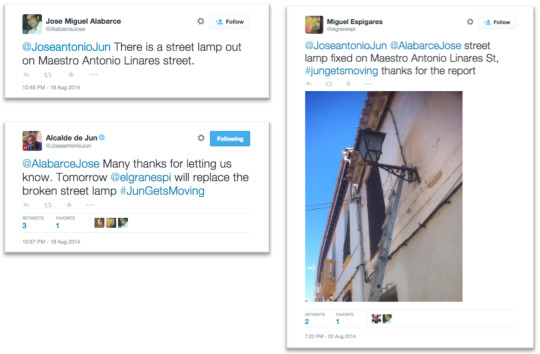
    Here’s a simple example of what this means for government-citizen relations (the folks at MIT translated everything to English):
    image

    In the above example, a citizen tweeted the mayor informing him that a street lamp was out. The mayor then responded, tagged an electrician, and said it would be fixed the following day. Sure enough the electrician went and fixed it the following day, and then tweeted out a photo of the lamp.

    This is great. And Twitter was made for these kinds of interactions. Facebook was not.

    Here in Toronto we have @311Toronto, which I have tweeted many times before with problems and they do respond quickly (far quicker than if you try and call them). But I still think there’s room for us to improve transparency and engagement across the board.

    All of this is a perfect example of how technology and cities are colliding in a big way. In today’s world I really think you need to be able to think across disciplines.

  • The importance of storytelling

    Last night I was out for drinks with a friend of mine who runs an architecture firm in the city called Reflect Architecture. We started talking about the importance of marketing and storytelling in city building and then got onto the topic of Danish architect Bjarke Ingels and his firm BIG.

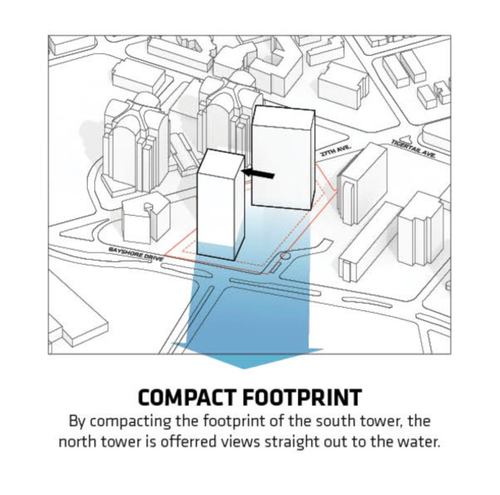
    At only 39, Bjarke Ingels has become a celebrity architect at a relatively young age. He’s working on projects all over the world from Vancouver to New York to Shenzhen. And he describes his work as a combination of “shrewd analysis, playful experimentation, social responsibility and humour.” But what has always interested me about BIG is their use of dead, simple, diagrams (see above for an example).

    A diagram is just a graphic way of communicating information. And lots of architects use them as a design tool. But what BIG does is use them to create a narrative around each and every project. If you look at their website you’ll see that every project is presented using a series of diagrams that outline the process used to arrive at the final design. You’ll never just see the final product. You always see the steps involved. Click here for an example from Vancouver.

    What’s powerful about this approach is that it demonstrates that there’s a logic behind every design outcome (even if sometimes it might be contrived or done after the fact). It’s not form for the sake of form; it’s form as a result of the uses in the building, the urban context, and so on. 

    But at the same time, I think it taps into a deeper psychological phenomenon: people love stories. In fact, research shows that when we’re told stories, our brains actually become more active. We pay closer attention.

    I mean, just think about how much people enjoy hearing about rags-to-riches stories. Nobody likes to talk about some rich person who was born rich. That’s not an exciting or interesting story. And it changes how we perceive that person. We want to hear about that guy or girl who came over from a war torn country and built an empire from nothing. Now that’s a good story.

    What I’m getting at is that I think a big part of Bjarke’s success has come from his ability to masterfully storytell and market both himself and his projects. Architecture schools don’t usually teach you how to market and sell; they teach you how to design. But the reality is that you need to sell. And storytelling is a great way to do that.

    If you liked this post, I recommend you check out this TED talk by Bjarke Ingels and this short interview with marketer Gary Vaynerchuk where he talks about how he used storytelling to sell wine.