Daily insights for city builders, delivered every morning at 6 AM ET. I’m Brandon Donnelly — a Toronto-based real estate developer and founder of Globizen. I’ve been writing here since 2013.

Tag: commercial real estate

  • How are you attracting and retaining top talent?

    Yesterday I received a comment on my post about service and product companies with a suggestion to check out an interesting Fast Company article talking about the future of work (thank you Amy). The article was based on a research report – commissioned by CBRE and a real estate developer in China (Genesis) – called Fast Forward 2030: The Future of Work and the Workplace.

    This is a topic that’s getting a lot airtime right now because Millennials are starting to impact work in a big way. But what’s interesting about it is how broad these impacts will be. Changes in how we work will affect the way we design our cities; the way architects and developers build and lease space; the type of people and roles companies will need to hire and create; and so on.

    Here’s a snippet from the report:

    “Providers of commercial buildings and places to work will need to develop new, sometimes counter intuitive, business models and work with partners who understand service and experience in order to compete with emerging workplace competitors. Successful providers will work with tenants to unlock ‘win win’ solutions that reduce occupier costs, increase flexibility, and simultaneously provide enhanced levels of community, amenity and user wellbeing. Cities will have a role to lead and nurture changes that will support the changing landscape of work.”

    I plan to go through the report in more detail this weekend, but I did want to point out one thing. When business leaders from around the world were asked what their biggest competitive advantage would be by the year 2030, the top choice was: the ability to attract and retain top talent. This topped organizational vision and even the ability to innovate.

    This might not come as a surprise to some of you, but it’s worth repeating. And in many ways, it’s a chain that begins first with cities. 

    If you’ve ever watched The Startup Kids documentary, you’ll know that when Alexander Ljung (CEO of Soundcloud.com) was about to found his company, he actually started by first traveling around Europe looking for the coolest city in which to base his company. The last city on his trip was Berlin and that just so happened to be the team’s favorite. So that’s where Soundcloud was founded.

    My point with that story is simply that the “workplace” of today – forget the future – means so much more than just your rentable area. Yes, that’s important. But there’s a lot more to consider when trying to get the best people. Cities play a huge role.

  • Thanks for visiting Canada, Target. Now what?

    image

    The big news in the (Canadian) retail world this morning is that Target has confirmed that it will be shutting down its entire Canadian operation. That means 133 stores will close and about 17,600 employees will soon be out of work. Here’s what the CEO had to say:

    “After a thorough review of our Canadian performance and careful consideration of the implications of all options, we were unable to find a realistic scenario that would get Target Canada to profitability until at least 2021,” said Brian Cornell, who became the new chief executive officer last summer.

    I can already hear the keyboards typing as business schools across Canada and the world prepare this case study: Why did Target Canada fail after not even 2 years?

    I don’t really want to focus on that in this post, but my initial sense is that they came in too big and too undifferentiated. Maybe they underestimated the particularities of the Canadian market and shopper, but they certainly didn’t come in lean.

    They bought up over a hundred Zellers leases and used that platform to obtain a critical mass quickly. But the problem with this approach is that it meant lots of upfront costs and fewer opportunities to adjust as they gained real feedback from the market.

    Regardless of what happened, I’m more interested in what the impact will be to the retail real estate industry going forward. Remember, Target is an anchor. And when it entered Canada, it was viewed as an opportunity to refresh some of our tired malls – many of which were already showing signs of dying.

    So what happens now? Who comes in to fill their shoes?

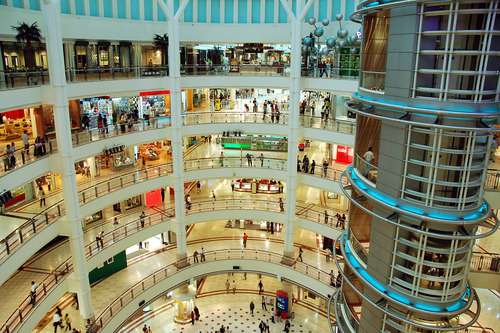
    Image: Flickr

  • Introducing Polyform Labs

    image

    A few weeks ago I had coffee with a friend of mine who is a partner at a Toronto-based enterprise software company called Polyform Labs. Their products are geared towards the commercial real estate industry and, since I’m a big proponent of introducing more technology into the real estate space, I thought I would share a little bit about them with you all today.

    The first of their 4 main products is called Lingo, which is a machine learning tool that helps companies quickly review legal documents and contracts. In the case of commercial real estate firms, the most obvious use case is leases. These documents are often hundreds of pages long and, if you have a big portfolio of properties, I’m sure you can imagine how quickly these pages add up.

    What’s neat about Lingo is that you basically upload a lease and then the tool interprets and summarizes all of the clauses for you. It then tells you where you’re potentially exposed and where your risk factors are. And if by chance it gets it wrong, you can correct it and the system will actually get smarter – hence the machine learning part.

    I’m not going to go through their entire product line, but I did also want to mention one more called Aura. They call it a “location-aware loyalty engine”. And you may have heard of similar products out there in the marketplace. What it does is use the MAC address on mobile phones (which is a unique, but anonymous, identifier) to track how people and crowds move through spaces.

    The most common use case I’ve come across is within shopping malls and retail spaces. It’s used to determine which stores have the most foot traffic, which departments and aisles draw the most people, how long people stay in each store, where they buy, and so on. So even if you didn’t already know about this technology, you may have already been giving up your location data. There are lots of mall landlords using it.

    And it’s producing some interesting data. For example, as soon as somebody buys one thing in a mall, their propensity to buy something else grows exponentially. This is what the data tells us and I can certainly relate to it from my own experience. So as a mall landlord and tenant, you are obviously trying to figure out ways to encourage people to make that first purchase. 

    The other use case that (obviously) came to my mind was with respect to city planning and urban design. How could we harvest anonymous location data to improve the way we design both our private and public spaces? Imagine if we had this data for subway stations, public parks, public plazas, and so on. I bet we would discover all kinds of ways to improve the experience within our cities. I’d like to see the location data for Trinity Bellwoods Park in Toronto on a sunny summer day.

    But I digress.

    If you’d like learn to more about Polyform Labs and their real estate products, click here

    Image: WPC

  • Target is coming to Toronto’s South Core

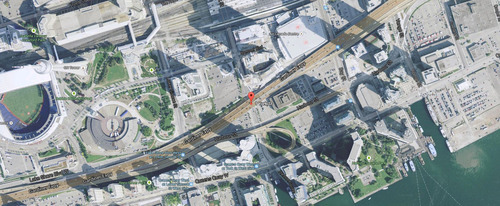
    Yesterday news broke that Target is opening a two-storey, 145,000 square foot store at the base of a new mixed-use development in Toronto’s emerging South Core neighborhood. The site is at the north east corner of York Street and Harbour Street. And the larger development, called Harbour Plaza, will include a 35 storey office tower and 2 residential condominium towers at 65 and 69 storeys.

    Here’s the location map:

    image

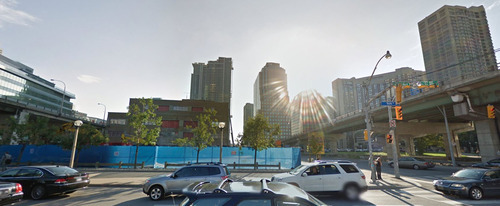
    And here’s the site looking east from York Street:

    image

    This is going to be huge for Target. The amount of current and proposed density within a short radius of the site is mind boggling. In addition to Harbour Plaza itself, look at what’s planned for 1 Yonge Street.

    Plus with Union Station next door, I dare you to try and find a better connected mobility hub in the region. Now all of a sudden that retail radius gets even bigger. I can easily imagine suburbanites picking up a few things before they hop on a GO train (our regional rail system) and head home.

    As of right now, they’re also the only game in town, as far as big box stores in the central core are concerned. But I wouldn’t be surprised if we see a competitor emerge alongside the 1 Yonge project. The site is big enough for one and Walmart isn’t going to want to get shut out of the area.

    My only hope is that, from an urban design standpoint, the project is able to enliven and give back to Harbour Street. Right now it’s an arterial road with really no redeeming urban qualities. But with the York Street off-ramp being relocated and the park underneath it being expanded, now is the time to really transform the area.

    Let’s hope Harbour Plaza does that.