Daily insights for city builders, delivered every morning at 6 AM ET. I’m Brandon Donnelly — a Toronto-based real estate developer and founder of Globizen. I’ve been writing here since 2013.
One common way to measure affordability is to look at the cost of things relative to local incomes. But the world is getting increasingly more complicated than this. Here, for example, is an interesting article talking about the “nomadification” of cities such as Medellín.
What this is referring to is digital nomads who might work for and draw a salary from a company in say the US, but who work fully remotely in places like Medellín, Buenos Aires, and Mexico City. It’s like working from home all the time, except home is some exciting city in Latin America.
The appeal of this work arrangement is obvious. You get to both live in an exciting city and you get to arbitrage between a US or other similarly high salary and a place where the cost of living is significantly less.
But the point of the above article is that this can distort a local economy and make locals feel like they’re getting priced out. When you take enough software developers making $150k a year and you drop them into a place where the minimum wage is $350 per month, that additional income starts to have an impact.
Though, many countries seem to think it’s a positive one. Last year, both Portugal and Colombia introduced new digital nomad visas, which presumably means they want more of them. And I certainly think that we will see more and not less of this kind of working.
But in a way, isn’t this really just an extreme form of tourism? I mean, unless these nomadic cities are collecting additional income taxes (or deriving some other benefits), aren’t we just talking about foreigners renting Airbnbs and spending money that is earned and taxed elsewhere?
This month’s issue of Monocle Magazine has a feature on a new masterplanned community to the north of Cartagena called Serena del Mar. Currently under construction, the entire 971 hectare community is slated to be finished by 2030. When complete the developers believe it will house upwards of 200,000 people — effectively an entirely new city.
It will also be entirely self-governing. There will be no mayor or city council. Revenue to operate the community will be collected through a mandatory monthly fee, though low-income residents will be exempt from paying it. As I understand it, large projects in Colombia have historically been mired in corruption issues, and so this is probably a response to that.
But the approach has naturally caused a bunch of skepticism. Does this bifurcate the city between public and private? Is this a vote of no confidence on Cartagena’s current governance structures? Building a city from scratch is also exceptionally difficult (there’s a quote in Monocle from Toronto’s own Shawn Micallef on this). Cities usually take time to evolve and settle in.
I don’t know enough (or anything, really) about Colombia, Cartagena, and this development project to comment specifically. And so I won’t. But these are the questions that are being asked of contemporary masterplans. There’s a reason most (or all) of the tech companies involved in large scale masterplans have banned the word “campus” from their lexicons.
One of the challenges that self-driving vehicles present is not about technology per se, it is about ethics. The typical example scenario is this one: If a pedestrian were to step out in front of an autonomous vehicle illegally, should the car be programmed to hit the pedestrian or veer off the road at the risk of potentially harming its passengers?
I believe that self-driving vehicles will ultimately result in fewer accidents. Statistically they will be safer. But self-driving vehicles, particularly early on, are going to get a lot of attention when they do get into accidents, even if they are still safer as a whole. And that’s because they will make for good headlines.
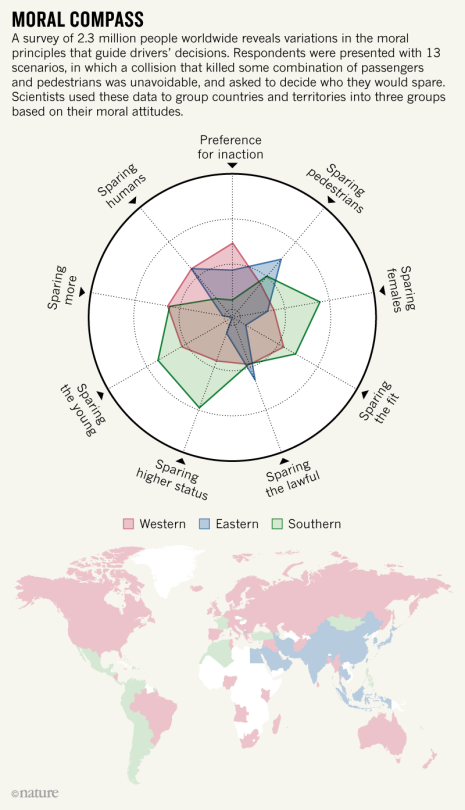
Safety and statistics aside, in turns out that the answer to the above moral question could depend on where you’re from. Nature recently published what they are calling the largest ever survey of “machine ethics.” And out of this survey they discovered some pretty distinct regional variations across the 130 different countries that responded.
The responses were able to be grouped into 3 main buckets: Western, Eastern, and Southern. Here is the moral compass that was published in Nature:
And here are a few examples. In North America and in some European countries where Christianity has historically dominated, there was a preference to sacrifice older lives for younger ones. So that would guide how one might program the car for the case in which a pedestrian steps out in front.
In countries with strong government institutions, such as Japan and Finland, people were more likely to say that the pedestrian – who, remember, stepped out onto the road illegally – should be hit. Whereas countries with a high level of income inequality, often chose to kill poorer people in order to save richer people. Colombia, for example, responded this way.
Also interesting is the ethical paradox that this discussion raises. Throughout the survey, many people responded by saying that, in our example here, the pedestrian should be saved at the expense of the passengers. But they also responded by saying that they would never ever buy a car that would do this. Their safety comes first in the buying decision. And I can see that.
There’s an argument that these are fairly low probability scenarios. I mean, the last time you swerved your car, you probably weren’t driving on the edge of a cliff where any deviation from the path meant you would tumble to your death. But I still think that these are infinitely interesting questions that will need to be answered. And perhaps the answer will depend on which city you’re in.
This is an interesting working paper by a team of researchers at NYU’s Marron Institute of Urban Management. The paper examines the relationship between urban density and organized violence, first in Colombia and then within a sample of 200 global cities.
The finding is that organized violence actually increases the population density of the surrounding areas within a city because it creates a kind of “invisible wall” – effectively a no-go zone.
This makes perfect intuitive sense, but it’s not something I ever considered. Geography and other natural constraints typically drive density. Think about the island of Manhattan. But so too can invisible walls.
I just discovered a new video series by TVO called, The Life-Sized City. It’s all about the “anatomy of the modern metropolis.” The first episode – which was released on Sep 13 – is on Medellin and is just under an hour long. I have a feeling that many of you will like this video series.
Whenever I watch videos like this, it makes me think that I should be starting a city building-focused vlog. I am a big fan of this format. I follow a handful of vloggers. And I think it could be a lot of fun. But sometimes you just have to say no.
For those of you who aren’t longtime readers, I would also like to point out that my good friend Alex Feldman wrote a guest post on this blog over 3 years ago following a trip to Medellin. It’s about what cities could learn from Medellin’s extraordinary turnaround. If you missed it, click here.
I’ve been talking with my good friend Alex Feldman for a few months now about him doing a guest post on Architect This City. Alex and I went to Penn together and he’s now VP at a real estate advisory firm called U3 Advisors. The firm is based in Philadelphia, but they do work in many other cities including Detroit. I hope you enjoy his post. Happy Monday everyone.
Guest post by Alex Feldman
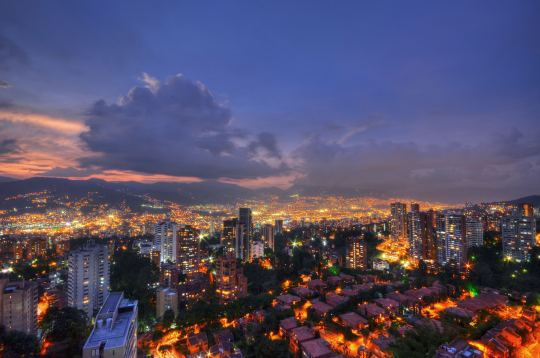
Two weeks ago, I had the privilege of traveling to Medellin, Colombia to attend the World Urban Forum – a non-legislative UN Habitat led gathering that is widely regarded as the premier conference on Cities. Over 10,000 people attended the bi-annual gathering, which felt like a cross between a World’s Fair, a Trade-Show, and a political summit. While the conference proved to be a melting pot of topics, ideas, and people, I came away from my 3 days in Colombia more captivated by the city itself.
For those of you familiar with Medellin, you may be aware of its infamous past as the center of Pablo Escobar’s drug cartel. The city was once considered one of the most dangerous in the world with 6,300 homicides in 1991. Escobar was killed in 1993 and the city has been dramatically transformed over the last 20 years. Today, Medellin is much safer, very clean, and incredibly friendly (as someone who speaks very little Spanish, I met complete strangers who went out of their way to help me get around the city).
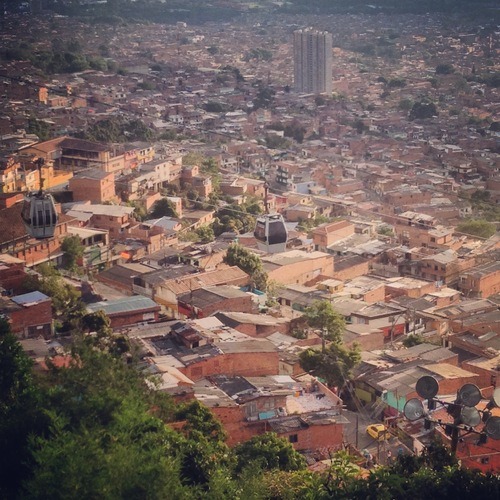
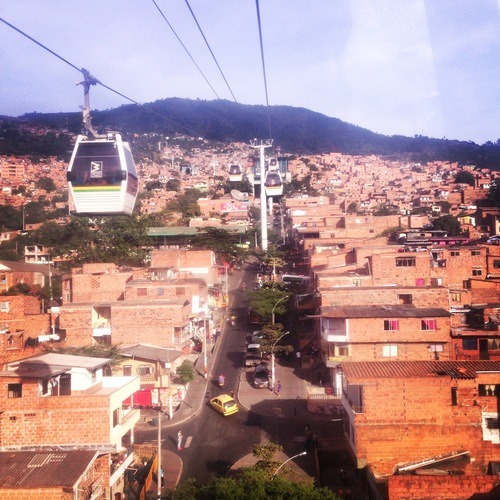
Medellin’s resilience has not gone unnoticed and the city has been recognized as one of the most innovative in the world. Part of Medellin’s transformation has been its focus on inclusion and equitable development. I spent Sunday traveling on the city’s modern Metro system to visit Santo Domingo – a hillside neighborhood that was once the center of Escobar’s drug cartel. The steep topography of the neighborhood makes it difficult for cars or buses to reach the low-income residents – and requires a long walk up-hill for anyone returning from a long day of work or school in the central city. As part of Medellin’s Social Urbanism platform, a public-private partnership constructed Line K of the Medellin Metro – a 1.8km gondola or Metrocable that provides seamless connections to the city’s Metro.
I rode the Metrocable to the top of the hill – the Santo Domingo stop. I was worried that the ride up the hill would feel like a tourist attraction, with hundreds of visitors staring down at the low-income neighborhoods below. Instead, the Metrocable proved to be both a useful public transport system and a point of pride for local residents – offering some of the best views in the city from the compact, glass enclosed cars.
At Santo Domingo, I wandered through a vibrant street fair to the Biblioteca Espana – a modern library designed by Colombian Architect Giancarlo Mazzanti that represents another aspect of urbanismo social: placing the city’s “most beautiful buildings” in the city’s poorest areas – a declaration of former Mayor Segio Fajardo. Despite the fact that the building’s exterior is temporarily covered in scaffolding due to leaks, it represents a significant investment in a neighborhood that was once the most dangerous in the city.
On the ride back down the mountain, I couldn’t help but reflect on how a city could be transformed in such a short period of time. The lessons of Medellin’s urban makeover are relevant to many cities (including my hometown of Philadelphia which despite a recent transformation still suffers from a poor global reputation). Visionary leadership, innovative transportation models, and progressive urbanism have re-made Medellin’s reputation. In turn, this has benefited Medellin’s citizens both in quality of life and local pride. When citizens begin to love their city again, the ripple effect can be exponential. More cities should take-note of this Latin American comeback kid.