
Daily insights for city builders, delivered every morning at 6 AM ET. I’m Brandon Donnelly — a Toronto-based real estate developer and founder of Globizen. I’ve been writing here since 2013.

Tag: colliers

  • Land prices can be weird

    Jeremiah Shamess of Colliers made the claim this week that land values in some areas of the Toronto region are down 25%. He then shared a chart from Alan Leela showing how various factors have increased or decreased land values since 2020.

    Broadly speaking, a revenue increase and/or more development density should increase land values; whereas something like inclusionary zoning, which is a cost to the project, should decrease land values. Indeed, this is one of the arguments in favor of inclusionary zoning: “Don’t worry about the additional cost to the project because landowners will simply pay for it through reduced land prices.”

    In theory, all of this is correct.

    Land is (or should be) the residual claimant in a development pro forma. Start with your revenue, subtract your costs, and then see what is left over for the land. (Though keep in mind that what is left over for the land could be $0 or even a negative number.)

    But as I have argued before in the context of inclusionary zoning, I don’t think things always play out so neatly in the market. Put differently, if the cost impact of inclusionary zoning is something like $44 psf, I don’t think all landowners suddenly drop their prices accordingly — especially in a rising market where developers are competing fiercely for land.

    They don’t care about your residual value model. Many or most will just hang on to their number and wait for someone to pay it.

    So what I am saying with all of this is that, yeah, there are factors that put either downward or upward pressure on land values. But how it all actually plays out in the market tends to depend on the macro environment and what else is going on at the time. And right now we are at a point in the cycle where there is clearly downward pressure on land values.
  • The negative externalities of Toronto’s “yellow belt”

    My friend Randy Gladman, of Colliers Strategy & Consulting, recently published this important opinion piece in Urbanize Toronto. In short, it is about how little of our land we dedicate toward high-density housing (about 5%), what that results in, and why it should change:

    TenBlock’s efforts are appreciated; more homes are desperately needed in Toronto, especially near transit. Intensification in all forms should be welcome. But there should be a better way to create the homes we need that minimizes demolition of the ones we have. We don’t have a shortage of low-density land near transit infrastructure in our city. Rather, we have a shortage of the political will needed to combat the calcified forces aligned against intensification. Looking at the development process in Toronto, we can see just how inefficient and confused our system of land planning has become when we consider how we treat low-density areas compared to the very small percentage of the city where greater density is accepted. 

    I think there’s growing awareness in this city and others about why this approach to land use needs to be modernized. And there is certainly positive change underway. But there’s still work to be done. So I’m happy that Randy decided to write about it.

    For the full article, click here.

  • The redevelopment of Toronto’s residential market

    Somehow — even after I sarcastically put out the above tweet — I ended up on a BISNOW panel next week about the impact of COVID-19 on Toronto’s residential real estate market.

    When I was asked if I would do it, I replied with: “Does this mean I will need to put on pants?” That was interpreted as a, “yes, I will join the panel.” And so here we are.

    It’s on Wednesday, May 13 at 2:30pm. Steve Keyzer of Gin & Sonic fame (Colliers International) and Kevin Stark (Trinity Development Group) are also speaking on the panel. To register, click here. I’ll do my best to be as controversial as possible.

  • When everyone thinks you’re wrong

    Sunset by Paolo Mastrogiacomo on 500px.com

    https://500px.com/embed.js

    I was recently talking to my good friend Jeremiah Shamess about the current state of development land sales in Toronto (he does this for a living) and he said something to me that I found really interesting.

    He said that because the market is so competitive, you can really only win development sites in one of two ways. Either you’re willing to spend the most money or you see something and have a vision that nobody else sees.

    And it was this second piece that really stood out to me because it reminds me of one of my favorite investing frameworks.

    Warren Buffet is famous for saying that you should be fearful when others are greedy and you should be greedy when others are fearful. And what I’m about to talk about is really that same core philosophy.

    Here’s how venture capitalist Fred Wilson put it (reiterating something that Bill Gurley said):

    I saw Bill Gurley say that you can only make money by being right about something that most people think is wrong. His logic was that you can’t make money by being wrong. And you can’t make money by being right about something everyone else knows. So you have to be right about something that most people think is wrong. I really like that framework.

    But this doesn’t just apply to technology companies or stocks. It applies to city building, most industries, and probably most things in life if you think about it.

    If all you’re doing are things that everyone else is doing, then how can you expect to outperform? You’re going to revert to the mean.

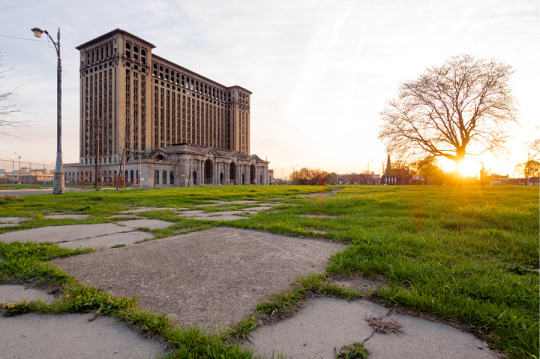
    Take, for example, billionaire Dan Gilbert and Detroit. Not everyone believes that Detroit will come back. In fact, I suspect there are probably more people who think it won’t come back, than people who think it will. Otherwise, it would already be back.

    But Gilbert is unquestionably long on Detroit (via Forbes):

    As you’ve likely heard, over the past four years Gilbert has become one of Detroit’s single-largest commercial landowners, renovating the city with the energy and impact of a modern-day Robert Moses, albeit bankrolled with his own money. He’s purchased and updated more than 60 properties downtown, at a total cost of $1.3 billion. He moved his own employees into many of them–12,000 in all, including 6,500 new hires–and cajoled other companies such as Chrysler, Microsoft and Twitter to follow.

    If/when Gilbert proves to be right about Detroit, then he will have been right about something that most people thought was wrong. And because of that, he will no doubt make a lot of money.