Daily insights for city builders, delivered every morning at 6 AM ET. I’m Brandon Donnelly — a Toronto-based real estate developer and founder of Globizen. I’ve been writing here since 2013.

Tag: college street

  • Locals hate you

    BlogTO recently reported that “snarky anti-condo signs” have been popping up around Toronto. Here is one of them via Instagram. It reads (in all caps): Dear Condo Dwellers: Locals Hate You Go Fuck Yourself

    I find these posters curious, though it is obvious that they are a reaction to growth, intensification, and general change in this city.

    For one, it implies that condo dwellers and locals are mutually exclusive. In other words, “locals” don’t live in condos. Presumably the implication is that they live in low-rise grade-related single-family housing. Or maybe they live in rental housing? Is it a tenure thing?

    According to the latest 2016 Census data, just over 26% of private dwellings in Toronto are condominiums. And about 30% of people live in a building that has 5 or more storeys. If you include “apartments” less than 5 storeys, this latter number jumps to 40%. So many potential non-locals.

    However, it could be that these posters are primarily directed toward new condos and new condo dwellers. This poster seems to have been plastered in front of this recently completed condo building on College Street.

    If that is the case, then I wonder if there is a temporal cut-off for the hate. For example, the condo building that houses (at its base) my regular grocery store was completed in 1983. 

    The units are large and the demographic seems to skew a bit older. Are these condo dwellers – some of which may have been there for over 3 decades – to be hated? Are they non-locals? Or does urban myopia set in after awhile and they become locals?

    At the same time, it wouldn’t be unusual for the residents of an older condo building to oppose a new proposed condo building. So perhaps “local” isn’t about building typology and it’s more about who came first. That’s certainly a tricky one. Better end here.

    A curious poster that could use a bit more specificity. What do you make of it?
  • The great balcony debate

    I snapped this picture on College Street near Spadina Avenue (Toronto) yesterday:

    image

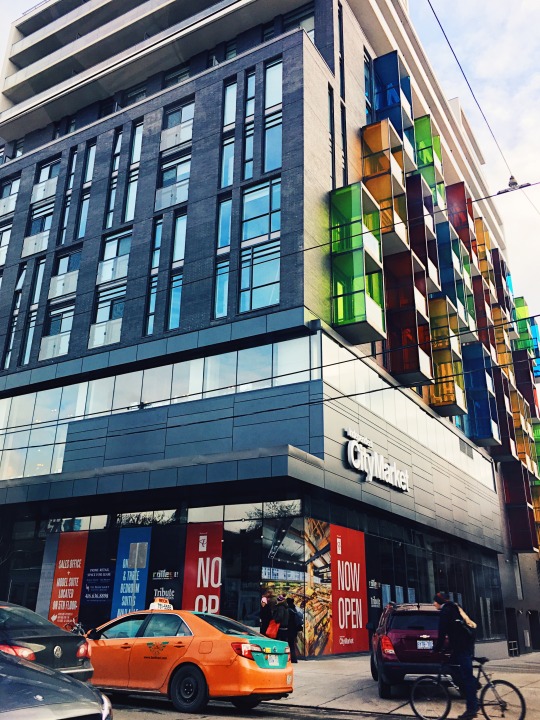
    It’s a picture of “The College” by Tribute Communities. What you’re looking at is the northwest corner of the building and a 20,000 sf grocery store fronting onto College Street.

    I took a picture of the building for really two reasons. 

    1. The colored balcony enclosures on the west elevation (right side of the picture) are not something I’ve ever seen done on a Toronto condo before. I like color. I also wonder if they create interesting interior lighting effects and greater privacy when you’re outside.

    2. I have been noticing more Juliet/French balconies on new builds as of late (could be an availability bias). Here they’re on the north elevation fronting onto College Street. Once the building steps back, you get conventional balconies. 

    I think Juliet balconies create a much nicer streetwall, particularly when used on a building’s lower floors. But I would be curious to get end-user thoughts on this. If you were looking for a place, would you rather more interior space + Juliet balcony or less interior interior + conventional balcony? Are balconies a deal breaker?

    This is something that a lot of people in the industry debate. And it varies by city. In Toronto, conventional wisdom dictates that you need to provide balconies of any size, even if nobody ends up using them, other than to store a bike.

    In other cities – sometimes because of liability and sometimes because exterior balcony space gets counted as part of the building’s overall Gross Floor Area (GFA) – balconies can be a real rarity.

    What are your thoughts? Please leave a comment below. Thanks!

  • A brief history of T. Eaton Co.

    image

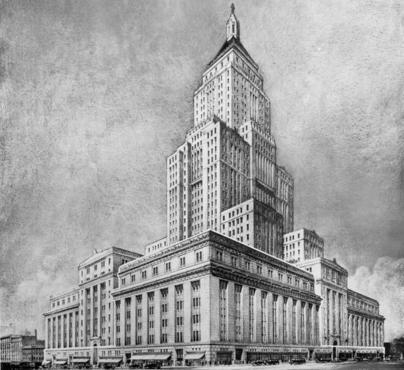
    I was out last night near Yonge and College for a friend’s going away party and the topic of the College Park building came up (originally an Eaton’s department store). We talked about how in the 1920s it was planned as a 38-storey Art Deco tower (see above photo), but that the Great Depression forced Eaton’s to scale back their plans. They ended up building a 7-storey building, albeit an impressive one.

    Then today, thinking about that discussion, I became curious about the story of Eaton’s. Where exactly did it start and how did they get to a point where they were planning the largest retail and office complex in the world?

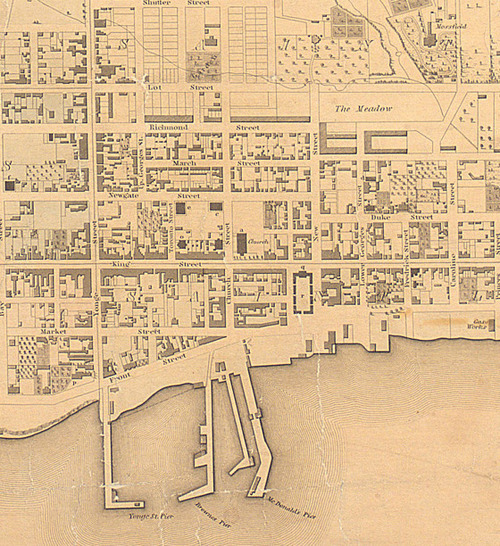
    Well, as many of you probably know or can guess, the first Eaton’s store was opened where the Toronto Eaton Centre mall currently sits today. The exact address was 178 Yonge Street, which is just north of Queen Street. But what was interesting about this location is that, at the time, it was considered to be far removed from Toronto’s center of fashion and retail. That was King Street East. Below is a map from 1842.

    image

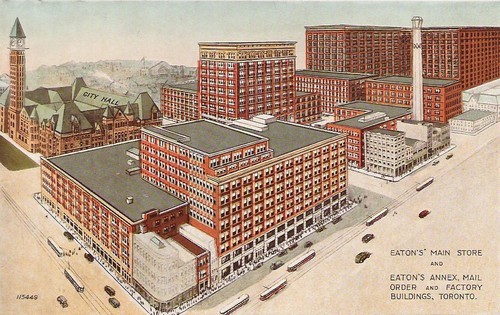
    In 1869 when Timothy Eaton opened his first store, the heart of Toronto was what is today known as Old Town (although most people would probably just refer to it either as King East or as the St. Lawrence Market). People shopped along King Street between Yonge and Jarvis, and Queen Street probably would have felt out of the way.

    image

    But Eaton’s succeeded at Yonge & Queen, along with rival store Simpson’s, and retailing shifted northward. With Eaton’s College Street, the company was once again looking north. In fact, they wanted to move their entire operation from Queen Street up to College Street, and they even tried to get Simpson’s department store to do the same (somebody clearly understood agglomeration economies).

    But since the full build out of Eaton’s College Street never actually happened, both stores were kept in operation and a customer shuttle bus was run between the two of them (until the Yonge subway line opened up in the 1950s). With the opening of the Toronto Eaton Centre mall in the 1970s, Eaton’s closed both Queen and College Street locations, and consolidated operations near Dundas Street.

    In 1999, after 130 years of operation, the company went bankrupt.

    What I find interesting about this story is that it speaks to how dominant the department store business model was at the time and how it was shaping the city around it. If Eaton’s had achieved its vision for the corner of Yonge & College, Toronto might look a lot different today. Perhaps we’d all be shopping for fashion along College Street.