
Daily insights for city builders, delivered every morning at 6 AM ET. I’m Brandon Donnelly — a Toronto-based real estate developer and founder of Globizen. I’ve been writing here since 2013.

Tag: co-living

  • The “hotelization” of housing

    When I was younger and looking for any excuse to travel (I’m not sure this has changed), there were periods of time where I “lived” for weeks and months in hotels and in spaces that today we would characterize as co-living. I always liked the idea of living in a hotel. It was carefree. There were amenities. And you got to meet people from all around the world.

    Well it turns out that these kinds of living arrangements aren’t just attractive to poor university students. We have seen a proliferation of different living and hospitality concepts over the years, and I don’t see this trend slowing down. A recent example, which I just learned about via Globetrender, is “the Other House”. Their first location, pictured, above, is scheduled to open this spring in London’s South Kensington.

    The founder refers to it as a “residents’ club”, and the idea is for it to sit somewhere between a hotel, a serviced apartment, and your typical long-term apartment rental. Each “Club Flat” will have a separate living area and bedroom, as well as a kitchenette for cooking. And guests will be able to stay for as long as they would like — anywhere from one night to more than a year.

    Why this is potentially innovative is that the company is looking to combine the best of a few different worlds here. For example, hotels are great because they offer flexibility, amenities, and a carefree lifestyle, but they’re often missing the sense of belonging/home that you get from more conventional longer-term housing.

    The Other House hopes to fix this through what you might call the “hotelization” of residential real estate. They’re investing in design and in creating the right experience, but they’re also doing things like offering storage facilities for their residents. The idea here is that if you need to travel somewhere else for a few weeks, there’s a place to store all of your personal belongings so that everything is waiting for you when you return “home.”

    Pricing is still TBD. But supposedly the average room rate is anticipated to be around £250 per night, with rates obviously coming down for longer stays. I am curious to see how this concept does in London. While it is not entirely novel, it is decidedly urban. It is an another example of design, location, and experience being privileged over raw square footage.

    They don’t have much up on their website just yet. But if you’d like to follow them on the socials, you can do that over here.

    Image: The Other House
  • The “jobs” of co-living

    Earlier this week I wrote about the age groups that are most likely to live in an urban neighborhood in the United States. It was people in their 20s and, to a lesser extent, baby boomers. The data I was relying on used population density to measure urbanity.

    Interestingly enough, the demand for co-living seems to mirror this. (Feel free to disagree.) From what I’ve been told, the fastest growing co-living segments are young people recently out of school and retirees. Intuitively this makes sense to me.

    If we think back to teachings of Clayton Christensen (another recent post), we “hire” products and services because we have “jobs” that need to be done. In the case of a McDonald’s milkshake that job might be a breakfast that’s appropriate for a long and boring commute.

    In the case of co-living, and in urban neighborhoods in general, one of those jobs has got to be social connections. (Again, feel free to disagree.) We do also know that single person households are increasing in many cities. Are these phenomenons related? How big could co-living get?

    Note: This post was written on my phone on a flight, which is why there are no links or images.

  • San Jose approves 800-unit co-living project

    Earlier this year, an 800 unit co-living project was approved in downtown San Jose. The developer is Starcity. And it is said to be the largest co-living project in the pipeline in the United States right now.

    A few months later (presumably because of this project), San Jose also created a new “co-living” land-use classification. It is similarly thought to be a first for US cities.

    I think it still remains to be seen how broad the market can be for co-living. Do older generations also want to go back to dorm-like living? Or is this a housing solution mainly for twenty-somethings?

    At the same time, it’s not an entirely new housing idea. I like the parallel that Sarah Holder of CityLab draws between today’s co-living and yesterday’s single room occupancy buildings (SROs).

    There are, of course, many differences, including the amount of space dedicated to common areas (the community aspect). But in both cases, part of the value proposition is about affordability.

    Where do you see co-living going?

  • One becomes four

    The New York Times posted an interesting article today talking about how roommates in the city are dividing and conquering expensive rentals using temporary walls. This is obviously not a new practice. But it’s a good case study in what people will do in order to make living in a specific location affordable – in this case, Manhattan.

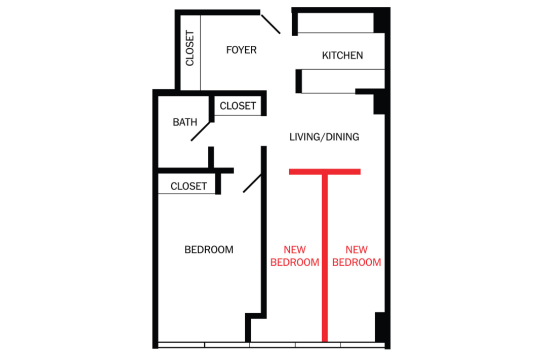
    The first example is a one bedroom apartment that was converted to a 4-person apartment. Here is the floor plan (from the New York Times):

    image

    The living/dining room was divided up using a T-shaped partition wall – which is required to stop 2 feet shy of the ceiling – to create two additional bedrooms. The original bedroom is then shared via two twin beds. Et voilà. Now you have an apartment where the $3,750 per month rent becomes less than $1,000 per person.

    Probably the most annoying thing about this setup would be the lack of acoustic privacy. Since the partition walls don’t go all the way up to the ceiling (photo here), you’d obviously hear everything. One person in the article described it as living in the same room as all of your roommates, but not being able to see anyone.

    Of course, there’s also a space consideration:

    Mr. Meyer, 23, has the smallest room by far. “It kind of feels like you’re living in Harry Potter’s cupboard,” said Mr. Meyer, who is in his freshman year at Columbia after serving for three years in the Israel Defense Forces.

    The roommates, three of whom grew up together in Toronto, don’t mind the close quarters or the lack of privacy. “It’s definitely not for everyone,” Mr. Meyer said. “When you live with your best friends, it couldn’t be better. We hardly spend time in our rooms.”

    I saw a lot of this here in Toronto while I was in undergrad. 55 Charles Street West was always a great candidate for these sorts of hacks because the units are large and because the building is filled with solariums. Inevitably, they became additional bedrooms. 

    (Sidebar: My understanding is that there was a period of time in Toronto where solariums were excluded from gross floor area calculations. So developers used to always put them in to capture more area. That’s why buildings of a certain vintage always seem to have them.)

    In any event, the above certainly makes the case for more micro units and co-living arranagements. Many people seem willing to deal with a variety of living situations in order to live where they want to live. Urban affordability is certainly a global concern.

  • WeWork launches first co-living space in New York

    I’ve written about co-living spaces before – here and probably elsewhere on this blog.

    Well this morning, WeWork (the co-working startup currently valued at a cool $16 billion) unveiled its inaugural co-living space on New York’s Wall Street. It’s called WeLive and Vanity Fair describes it as “Soho House meets Airbnb meets a tricked-out Restoration Hardware storeroom, but for the Slack Set.” 

    Got it?

    Ultimately, this location at 110 Wall Street will have 600 fully furnished WeLive apartments, but they’re coming online in tranches. This first release includes 200 units. Here’s a bit of information on pricing from Fast Company:

    “There are 200 units available—ranging from $1,375 per person in shared apartments to $2,000 for an individual studio—all with the option of either a month-by-month or yearly lease (a $125 monthly fee covers amenities). The apartments are about 450 square feet on average, with the largest units topping out at 1,000 square feet (one-bedroom apartments in the area, by comparison, range in prices from about $2,850 for 451 square feet to $3,500 for 700 square feet). Each apartment comes fully furnished, minimally decorated, and set up with cable and Internet at move-in.”

    But this is not just about price. The WeLive concept is about creating a strong sense of community within the building. Every floor, for instance, has some sort of common area to foster interaction – a space for yoga classes, a laundry room with a big pool table, and so on.

    I am interested in seeing how this concept pans out because I’ve had discussions before with people in the industry about how condos/apartments might be programmed to feel a bit more like hotels. Years ago, I even spoke to a major European company about trying to pioneer a model like this.

    Because there’s something very social about being in a hotel – something that I really like. You can walk down to the lobby bar by yourself and you never know who you might meet. That’s not really the case in many multi-family buildings.

    Now, part of that might have to do with the fact that people tend to be more open when they travel. But maybe WeLive can help create that kind of social interaction within the apartment building. I think that would be a positive thing.