Daily insights for city builders, delivered every morning at 6 AM ET. I’m Brandon Donnelly — a Toronto-based real estate developer and founder of Globizen. I’ve been writing here since 2013.

Tag: cn tower

  • Which building or structure would you say best symbolizes Toronto?

    I tweeted this out last night:

    https://twitter.com/donnelly_b/status/1473880198256934918?s=20

    blogTO then picked it up and it got quite a bit of engagement.

    Some people, okay a lot of people, used it as an opportunity to be tongue in cheek and respond with things like: cheaply built condos, boarded up Starbuckses, Hooker Harvey’s, Drake’s house in the Bridle Path, the crumbling Gardiner Expressway, and that McDonald’s at the northwest corner of Queen and Spadina (this one is no longer a contender for me now that they’ve gotten rid of their walk-up window).

    Of course, there were also a lot of the usual suspects: The Sky Dome, The Gooderham Building (our miniature Flatiron Building), Casa Loma, The Royal Ontario Museum (specifically the expansion by Studio Libeskind), “New City Hall”, The Royal York Hotel, Honest Ed’s, The St. Lawrence Market, Robarts Library (University of Toronto), and a bunch of others that you might find displayed on the seat screen on your next Air Canada flight.

    But I’d like to unpack the initial question a bit more. Because what does it really mean for something to be a symbol of a city? And is there an important distinction between the symbols that resonate with locals on a personal level and the symbols that get exported around the world as a city’s brand and identity? Indeed, one of the criteria in most global city rankings is a prominent and recognizable skyline. Icons are important.

    Let’s consider an example. I agree entirely with Sean Marshall that “New City Hall” is a deeply symbolic building. Built in the early 1960s after decades of work, New City Hall was the outcome of an international design competition. And it was decidedly modern at a time when Toronto really wasn’t that modern. Montréal was the biggest and most global city in the country and multiculturalism hadn’t yet become a federal mandate. And so New City Hall symbolized our genuine ambitions to becoming something more.

    But does the rest of the world care? If you were to ask somebody my question on the streets of Rio de Janeiro or Tokyo, what would they say? What would they remember? The thing about most tall buildings or other city symbols is that they become abstractions. They turn into pictures on social media — like logos of a company. But maybe that’s all we can reasonably ask of the world. Maybe all that really matters is that a symbol has local significance; it’s then up to us to export it and tell that story to the rest of the world.

  • A few observations from Paris

    The last time I was in Paris was in 2006. That’s a long time ago and so it was great to be back in the city earlier this week. I don’t know the city as well as I do many other cities, but I speak enough French to be dangerous and we spent a good amount of time on this trip just exploring. On average, we clocked about 20,000 steps a day. So here’s a list of some of the things I was reminded of or learned of on this visit. If any of you are more familiar with the city, please feel free to speak up in the comment section below.

    • I love Paris.
    • The Parisian art of people watching is alive and well. One of my favorite things about Paris is how so much of the cafe seating faces out toward the street. That’s what you’re supposed to be watching: urban life.
    • Most cities have a clear message. In Los Angeles, it’s probably that you should be more famous. In Boston, it’s arguably that you should be smarter. And in New York, it is perhaps that you should be richer. In Paris, the message feels loud and clear: You should be more fashionable.
    • Compared to Toronto, the center of Paris feels far more static. Less construction. Less change. Less that is new. That’s not such a bad thing given how beautiful the city is. But in my view, cities are about balancing preservation and progress. From what I could tell, a lot of the new construction seemed to be happening in the suburbs and in the outskirts of the city.
    • That said, COVID feels much further along in Paris. The city was very open and everyone seemed to be back in the office. Locals said that the city was operating at maybe 80%. It felt busy.
    • Dress shoes are dead in Paris. Everyone wears cool sneakers no matter how young or old. Think business suits with Nike Air Maxes. My hypothesis is that it’s just far more practical given how much people walk in Paris. I plan to adopt this strategy immediately.
    • In addition to walking, everyone seemingly bikes and/or uses an electric scooter. Again, it didn’t seem to matter how young or old. Paris also seems to have solved the scooter clutter problem, as has many other cities. There are designated spots (painted lines next to on-street car parking) and that’s where you’ll find the scooters. Toronto needs to get on board.
    • Traveling at 300 km/h on a train is a highly civilized way to move between urban centers.
    • There’s nothing wrong with having a picnic and drinking a bottle of wine (or two) in a park. In fact, it is probably something that should be celebrated. Let people be grown-ups.
    • When you purchase a baguette, you should immediately take a bite out of it to see how fresh it is.
    • The Eiffel Tower, much like the CN Tower, looks far better when illuminated.
    • Balconies of any size can be wonderful. We had a small Juliet balcony off of our hotel room in Nice and we used it every day for croissant eating and to dry our bathing suits. In a more permanent situation, I am sure we would have started growing things on it.
    • Midrise buildings do indeed create nice urban street walls. But it’s important to keep in mind that Paris’ midrise blocks are also deep and dense and with lots of courtyard conditions. That’s how the city is able to house so many people at such low building heights.
    • Facing conditions between buildings is less of a concern when you employ less glass. Smaller punched windows allow you to better manage privacy. I would go so far as to argue that if Paris were an all-glass city, much of its current built form would be fairly unlivable.

    What did I miss in this list?

    Photo by Alexander Kagan on Unsplash

  • Photoblog: Sunrise at Ten York

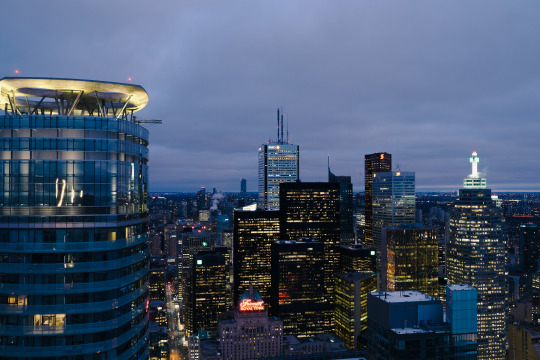
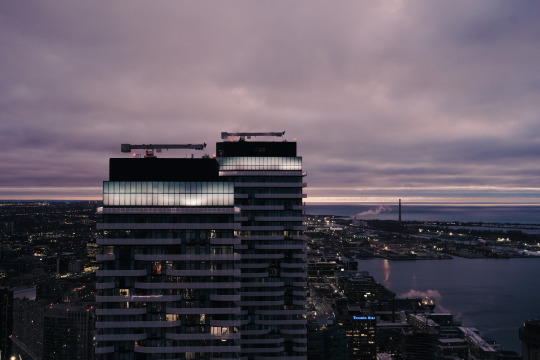
    This morning I watched the sun rise from the the roof of Ten York Condominiums, some 735 feet up. This is what that looked like (the sky initially had a purple hue to it):

    It was cold as all hell, but sometimes you have to work for your photos.

    Some of you may also remember that I wrote about this building a few months ago. Tridel, the developer, is calling the project its first “smart condominium.”

    Regular scheduled programming will resume tomorrow.

  • Canada Day and Moving Day

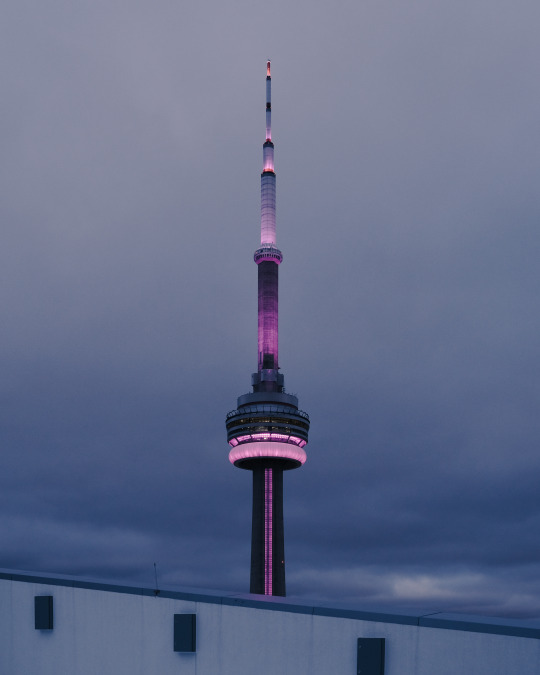
    Happy Canada Day to the Canadian readers of this blog. Here is a picture that I took of the CN Tower a few weeks ago just after sunset from Billy Bishop Toronto City Airport (YTZ). It also symbolizes Canada for me. 80mm f/1.2 in case you’re wondering.

    In some parts of this country, July 1st has another, perhaps more laborious, significance: It is “moving day.” In 18th century Quebec it was forbidden for les seigneurs to evict farming tenants during the winter, a law that was simply inherited from France at the time.

    As time went on, this evolved into a law – baked into the Civil Code of Lower Canada (1866) – requiring that all residential leases run from May 1 to April 30. May 1 was “moving day.”

    In 1973, it was determined that May 1 was too disruptive to children in school and so an extension was granted on all leases, automatically pushing the date to July 1. It also meant moving in the summer, as opposed to in the spring when weather can be unpredictable in Quebec.

    The requirement of fixed lease terms was also removed at this time (1974 onward), but tradition has persisted and July 1 remains known as “moving day.” This seems to me like a logistical nightmare and a highly impractical way of allocating resources, but perhaps I’m just missing some of the nuances.

    In any event, whether you’re sitting on a dock reading the Canadian Constitution Act of 1867 with a Brickworks cider, moving all of your belongings (in what is a hot weekend), or doing something completely different, I hope you’re having a good one. Happy Canada Day.

  • Photography heli tour

    Tonight I went a photography heli tour with @normandthegang

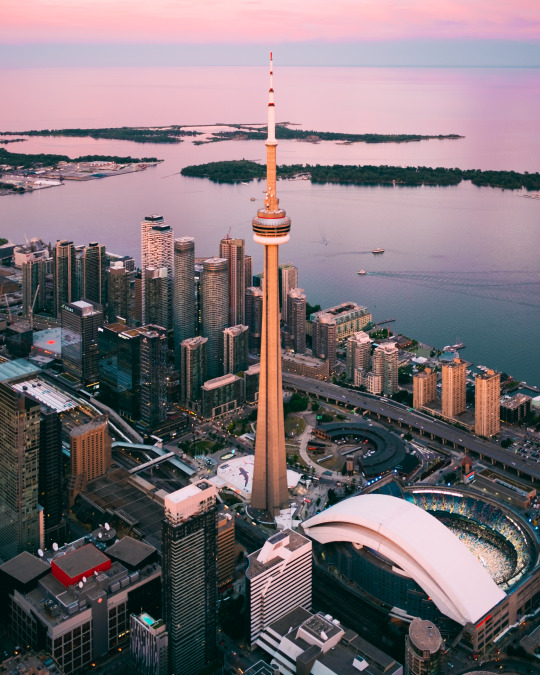
    I took almost 500 photos, including a bunch of aerials of our development sites. And we got lucky with a pretty spectacular pink sunset. 

    Here is a photo that I took of the CN Tower with my Fuji X Series (35mm prime lens):

    Lake Ontario actually looked like that. This is not post-production chicanery. Follow me on Instagram to see the rest of the photo series.

    Thanks again for the invite Norm. That was a lot of fun. 

  • The value of urban lighting

    image

    This week I picked up the Philips Hue lighting system. For those of you aren’t familiar with it, it’s a connected home lighting system. All you need are a Philips Bridge (which hooks up to your wireless router); a smartphone; and whatever bulbs, lightstrips and fixtures you want to use with it. It also works seamlessly with the Apple Home app.

    At first I was a bit nervous that it would turn my place into a cheesy nightclub. But as soon as I powered it on and started messing around with the Hue app, I was blown away by the quality of the light and the options. There are settings for reading, to simulate a sunset, and so on. You can schedule routines, such as a bedtime lighting scheme, and you can even color match a photo to find exactly the light you want.

    After playing around a bit, I then sent out an obligatory tweet saying that I was now hooked on and obsessed with the Philips Hue lighting system. Trust me, it’s really cool. My friend Andrew then responded saying that he doesn’t get it. Why would anyone want a color of light besides “white?” To me, this is like asking: Why would anyone want to see a beautiful sunrise or sunset? The sun should just appear or disappear using one consistent color.

    In a city like Toronto where most of us in the winter will wake up when it’s dark and come home from work when it’s dark, I have always believed that we should be more creative and daring with the way we light our city, our buildings, and our public spaces. We don’t want to be kitschy about it, but there’s an opportunity to maximize our darker months and enhance the overall urban experience.

    The CN Tower is a perfect example. Its night lighting has completely changed how we view it and has become a beacon for what is going on in this city. I can see it clearly from my elevator lobby and I always look to see what color it is. I’m not great at picking out when it’s Rett Syndrome Awareness Month, but I can usually tell when there’s a game going on.

    Now my place is certainly not the CN Tower. And there’s only one CN Tower in the world. But that doesn’t mean we can’t get fun and creative in other ways within the shared walls of the public realm. We should do that. Let’s not be so conservative.

    If any of you have great examples of urban lighting, please share it in the comments below. Perhaps we can all use it as inspiration to make a change.

  • Global street artist paints 8-storey mural in midtown Toronto

    This morning

    (Friday, July 8th)

    at 11AM eastern time, the global street artist Phlegm will start work on a giant 8-storey mural at the corner of Yonge + St. Clair in midtown Toronto. It’s going up on the west elevation of 1 St. Clair West.

    Here’s what it will look like when it’s complete:

    image

    The piece is intended to be experienced at two different scales. From afar, you read it as a human figure embracing itself. (See it?) Once you get closer, you are then drawn into an intricate interpretation of the Toronto landscape – both built and natural.

    Embedded within are depictions of the Royal Ontario Museum (including Daniel Libeskind’s Crystal), the SkyDome (yes, the SkyDome), the St. Lawrence Market (my hood), the CN Tower (obligatory), as well as other landmarks in the city. It’s going to be awesome.

    The project is a STEPS Initiative and it is being supported by the City of Toronto, Slate Asset Management, CBRE, CIBC, and a few others. They have also setup a great website with a live webcam, so that you can follow along as the artist works.

    At the time of writing this post, nothing yet has happened. But by the time it reaches you (email subscribers) it should be well underway. The hashtag for all of this is #PHLEGMPAINTS

    Big things are starting to happen at Yonge + St. Clair.

  • Blue, white, and red

    I had a few ideas bouncing around in my head today for things I could write about after I got home from the office and the gym. But now, I don’t feel like writing about any of them.

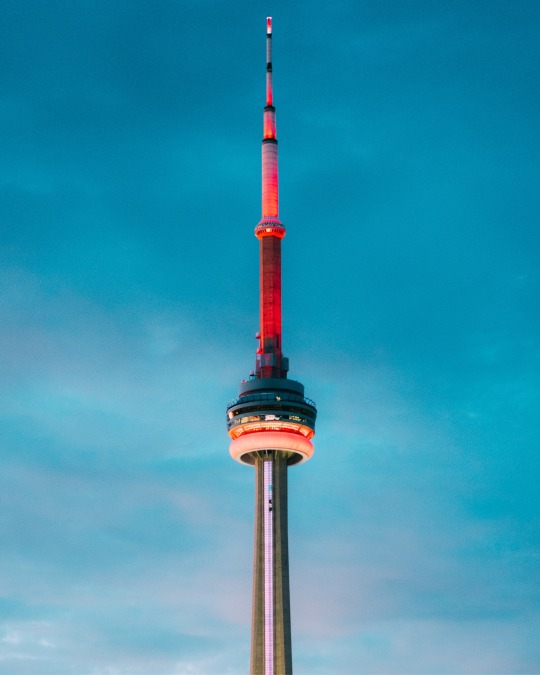
    So instead, I’d like to share this photo that I took around 9:00pm eastern time on Friday, November 13th, 2015. It’s a picture of the CN Tower lit up as the French flag.

    image

  • Chicago vs. Toronto: Which city has the best skyline?

    Before visiting Chicago for the first time, everybody told me that I was going to love the city. They would tell me that it’s similar to Toronto, except that it has better architecture and a better waterfront. Having now visited the city, I not surprisingly have a lot to say on this matter. But I need another day or so to formulate my thoughts.

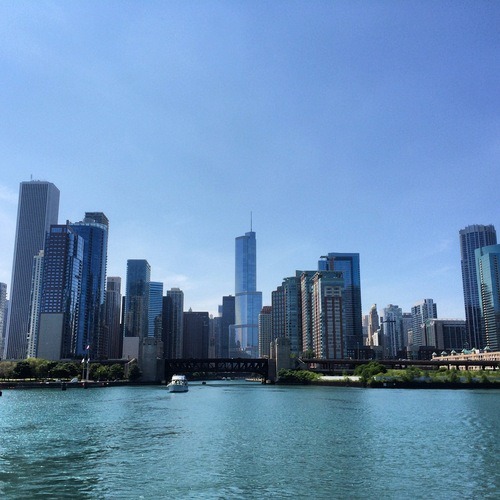
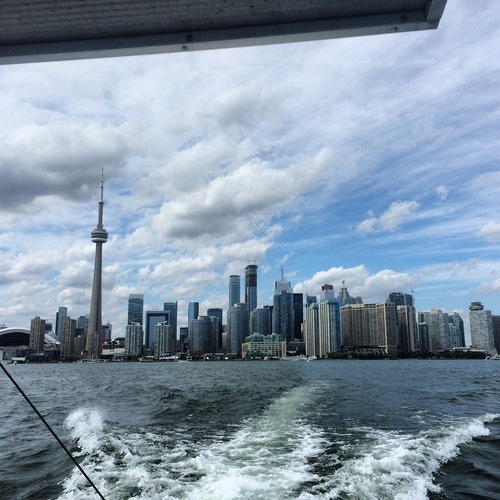
    In the interim, I thought it would be fun to host a little competition. Given that both Chicago and Toronto are Great Lake cities of comparable size (and formally sister cities), I’d like to know: Which city, do you think, has the better skyline? Please respond in the comment section below and make sure to include your location (so we all know if you might have a hometown bias).

    To help you make your assessment, here are a few photos. Below is one that I took of the Chicago skyline from the architecture boat cruise we went on yesterday afternoon. The building directly in the center is the Trump Chicago.

    image

    And here’s a photo of the Toronto skyline that I took from a water taxi earlier this summer.

    image

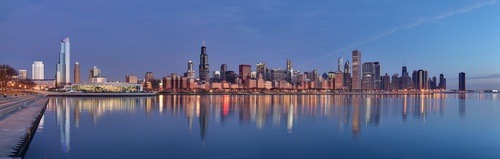
    But since these photos only represent one particular vantage point (me on a boat), here’s a set panoramic photos that I found online (Chicago & Toronto). I want to be as fair as possible.

    image

    image

    I think this one could go either way. But I personally like the variety that the lit up CN Tower and Sky Dome (Rogers Centre) bring to Toronto’s skyline. Overall, it feels a lot more modern and exciting to me. So I pick Toronto. What about you?