Daily insights for city builders, delivered every morning at 6 AM ET. I’m Brandon Donnelly — a Toronto-based real estate developer and founder of Globizen. I’ve been writing here since 2013.

Tag: clubs

  • New ideas like buildings people don’t want

    There is a very common story that plays out in cities. It starts with an area that has seen disinvestment and is probably a little seedy and/or dangerous . This creates an environment where rents and real estate as a whole are relatively inexpensive. New, cool and creative businesses start to move in (attracted by said inexpensiveness) and the area begins to turn around. Eventually it becomes suitable for institutional-type investors, and this ultimately leads to everything becoming expensive as a result of demand outstripping supply. Gentrification complete.

    The great irony of this story is that you sometimes, or oftentimes, lose the very things that made the area cool and interesting in the first place. Here is an example from Miami:

    The result has been a property speculation boom that, when combined with the city’s relatively low wages, put many businesses and residents on the street. Asking rents for industrial space, for instance, went up by 53 percent in the last year alone. Nobody can afford to buy, let alone rent, adequate space for a music venue because so much land has been snapped up by outside investors with a predilection for grand, “world-class urban” designs

    And for some areas, it is arguably the result of a careful and deliberate plan that was put in place nearly two decades ago:

    Teele’s commissioner district in the early 2000s included both Park West and the historically Black neighborhood of Overtown. At the turn of the millennium the area was blighted and crime-ridden thanks to years of racist, regressive policy decisions from segregation to redlining. His plan was simple but incredibly effective. He spearheaded a campaign to revitalize the area by granting a limited number of 24-hour liquor licenses to clubs like Space. Dozens of venues rose up on and around 11th Street, including vast, multi-room clubs like Metropolis, live venues like Studio A and Grand Central, and more intimate spots like Vagabond. Sporadic police raids also gave the area a druggy, dangerous reputation, inadvertently raising its allure. 

    This reoccurring arc has led some people to conclude that cities and/or areas seem to want to follow a kind of binary outcome: they’re either dying or they’re too successful. Why can’t we just have urban homeostasis? I don’t think this is necessarily always the case. Cities go through cycles just like any other market. I also know that it’s complicated. But I do feel strongly that we need to be mindful that part of what makes cities such wonderful places is that they are factories for new ideas and creativity.

    I can’t remember when or exactly how he said it, but YouTuber Casey Neistat once described New York City as an incredible island (Manhattan?) where misfits from all over the world come to do whatever the hell they want. And that part of the reason for this is that nobody cares what you do, because everyone is just so damn busy. You could certainly argue that New York isn’t what it used to be. But the lesson here remains the same: Cities are at their best when they allow humans to create, build, experiment, and express themselves.

    And oftentimes a great place for that is in a space that nobody else wants.
  • The geography of gyms

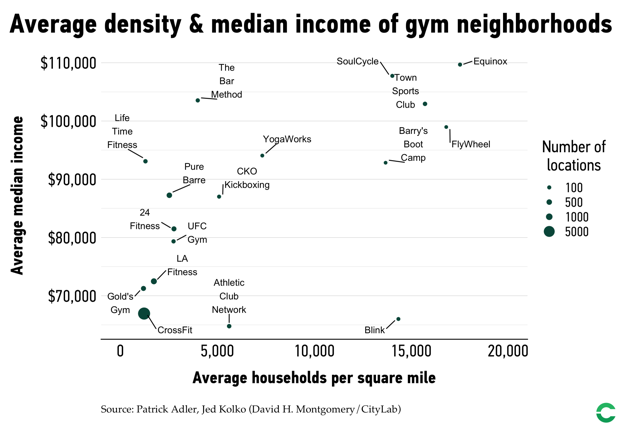
    Richard Florida and Patrick Adler recently looked at the geography of gyms across the United States. They analyzed 17 different fitness chains, over 10,000 gyms, and nearly 5,000 zip codes. Full article over here at CityLab.

    image

    The findings probably won’t surprise you, but it’s still interesting to see some of the data. Gyms and fitness studios tend to concentrate themselves in affluent neighborhoods with a high number of college graduates.

    The median household income of the average zip code with a gym or fitness studio is $72,720. This is compared to $56,694 for all zip codes. And when it comes to zip codes with an Equinox, SoulCycle, The Bar Method, or Town Sports Clubs, the median income jumps to over $100,000.

    Above is from the second post in the two part series they are doing on “the geography of fitness.” For the first one, click here.

  • Why what happens after dark matters to creative industries

    I have been very vocal on this blog about the importance “nighttime economies” for cities and for its creative industries. So I continue to be encouraged by all of the attention that this topic is getting over the last year or so.

    Recently, the Creative Industries Federation released a report called: Because the Night – Why what happens after dark matters to the creative industries. It’s a look at creative industries in the UK and the role that nightlife plays in supporting them.

    Here are some of their takeaways:

    Creative industries in the UK have been growing faster than any other sector since 2008. CIF estimates that 1/11 people now work in this space, with the number being much higher in London: 1/6.

    The value of restaurants, clubs, bars, pubs, live music venues, and theaters, is that they are places to connect, showcase talent, develop ideas, and so on. They are also critical in attracting top talent because, well, people not surprisingly like to have fun.

    In the span of one decade (2005 to 2015), it is estimated that the UK lost roughly half of its nightclubs. The total went from 3,144 to 1,733. From 2007 to 2015, London lost 35% of its “grassroots music venues”, which, historically, have served to support emerging artists.

    Arguably, some of this may be due to changes in consumer preference and broader shifts in terms of the way people discover/consume music. But it’s also thought to be because of rising urban rents, concerns around noise and revelry, and so on.

    Still, the nighttime economy in the UK is thought to be worth £66 billion per year and to employ some 1.3 million people. It’s an integral part of our urban economies and so it’s time we acknowledged and celebrated it as such.

  • Not zoned for dancing

    Yesterday, when I was reading up on Toronto’s “TOcore” initiative, I came across a report from 2014 called Not Zoned For Dancing: A Comprehensive Review of Entertainment in Downtown Toronto

    It was prepared by five graduate planning students at the University of Toronto: Anna Wynveen, Brenton Nader, Carolyn Rowan, Chris Hilbrecht, and Kyle Miller. 

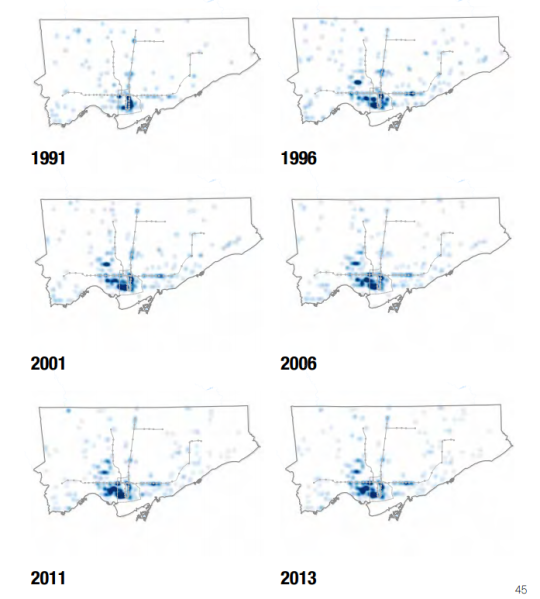
    The entire report is fascinating, but here’s one diagram that stood out to me:

    image

    It shows the migration of bars, clubs, and lounges westward, away from the downtown core, from 1991-2013.

    This migration doesn’t surprise me at all. I saw it happening and I understand the market forces at play here. There’s also the simple fact that nightlife is often viewed as a nuisance.

    But it’s worth calling this out. 

    Because I don’t think enough city builders appreciate the value of nightlife. It can and has served as a valuable catalyst for urban regeneration and I believe that it should form part of any city’s economic development strategy.

    A lot of cities are focused on things like bike lanes, public spaces, and on becoming the next Silicon Valley. And don’t get me wrong, those are all important things (though we could debate the Silicon Valley part). 

    But let’s not forget about nightlife.

  • Amsterdam is about to host the first Night Mayor Summit

    Canal Reflections by Peter Elliston on 500px.com

    https://500px.com/embed.js

    What is a night mayor, you might ask?

    Well, just as the name suggests, a night mayor is the chief executive officer of a city’s nighttime activity. And in 2014, Amsterdam became the first city ever to have one.

    Why is this important, you might ask?

    Well, for most cities the night is a blindspot. It’s viewed as something that needs to be carefully controlled as opposed to something that is celebrated and leveraged. Amsterdam saw this opportunity and, in my opinion, is now at the forefront of rethinking the night.

    Here’s an example of the kind of changes that this has meant for the city (via CityLab):

    “Until recently, Amsterdam enforced what by continental European standards is a fairly strict curfew: nightclubs had to close by 4 a.m. on weekdays and 5 a.m. on weekends. The city often had problems with noise and disorder at the exact moment when all the clubs closed, filling narrow inner city streets with rowdy people.

    To solve this problem, the night mayor suggested not less, but more time for people to go clubbing. He has helped push through the granting of 10 24-hour licenses for nightclubs. Crucially, all of them were located not in the dense city center but in thinly populated districts around Amsterdam’s outer ring road. The result was a marked reduction in street noise.”

    Some of you are probably feeling skeptical as you read this. Especially since 4AM and 5AM hardly seem strict when compared to other cities (Toronto’s last call is at 2AM). 

    But I would not underestimate the importance of what Amsterdam is doing. We are living in an era of the 24-hour global city and it’s about time that governments woke up to that. I’m sorry Toronto, but 2AM is an absolute joke.

    The night can be your competitive advantage in attracting human capital. As the CityLab article cited above suggests, a big part of what transformed Berlin into a capital of cool was its nightlife. 

    I wholeheartedly believe that and I have no doubt that the night will start to become a greater focus in city building.

    If you’d like to learn more about the Night Mayor Summit, click here.