Daily insights for city builders, delivered every morning at 6 AM ET. I’m Brandon Donnelly — a Toronto-based real estate developer and founder of Globizen. I’ve been writing here since 2013.

Tag: climate

  • Climate lessons from 16th century England

    We don’t like coal today, but it certainly transformed Victorian-era architecture:

    “It is the biggest transition in the history of our species, with the possible exception of starting to use fire at all in the first place,” says Barnabas Calder, author of the groundbreaking study “Architecture: From Prehistory to Climate Emergency.” Fireplaces had to be redesigned for coal, smaller, and more efficient, and could now be distributed throughout the house, warming a sequence of smaller rooms that contained heat more efficiently. Brick, which also requires substantial amounts of energy to produce, became affordable. And glass, too, was accessible to ordinary people. “Coal affects the way you can achieve comfort conditions in a building, and it is a very affordable way of producing a significant amount of warmth, which allows for bigger windows. Even more significant is that it opens up a series of new building materials.”

    But as new technologies transformed how we thought about it architecture, they also transformed how we thought about climate. Buildings used to have to be carefully “tuned” to their local environment. You had to think about where the sun was coming in, how you were going to trap it during the winter months, and how you were going to release it during the summer months, among many other things.

    Eventually though, this stopped mattering.

    We had building systems that could take care of these matters, which then meant that we were free to aspire to build the exact same architecture in Phoenix as in London. But we now know that that this doesn’t make much sense. And this recent architectural tour from the Washington Post, which starts in 16th century England, is a good reminder that the lessons learned many centuries ago are in fact still relevant today.

    Maybe even more so.

  • Climate and economy

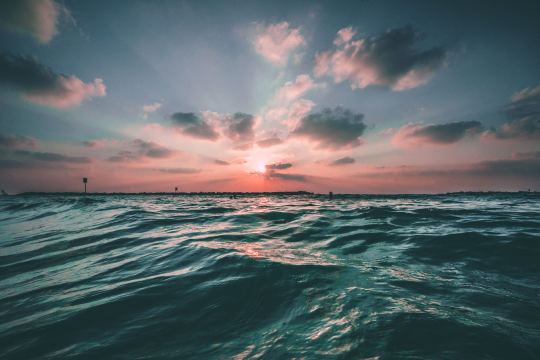
    I have long been interested in the possible relationships between climate and economy. Because my unproven hypothesis is that, given the choice, most city dwellers would probably prefer to hang out on Ipanema beach and drink caipirinhas in the sun than sit in a windowless cube farm toiling away on cover pages for TPS reports.

    Well it turns out that there is some science to support this theory. A 2012 study by professors at Harvard and the University of North Carolina did in fact discover that people tend to work a little harder and focus a bit more when the weather is crappy outside and they’re not distracted by the promise of glorious sunshine.

    This Scientific American article from 2013 also argued that there are physiological reasons for why we’re maybe not as sharp in extremely warm weather. The possible science is that excessive heat is more taxing on our body (compared to the cold) and so more energy is required to maintain homeostasis. That leaves less mental capacity for TPS cover pages.

    Of course, these sorts of ideas aren’t all that novel. For centuries, economists as well as many others have posited that climate could be one of the reasons why geographies like northern Europe have historically had a higher standard of living than the south. It instilled work ethic and an awareness of deadlines. If you didn’t plan accordingly, you would starve to death in the winter.

    But we also know that climate alone won’t do it. There are many examples of tropical cities with advanced economies and high-functioning societies. (The invention of air conditioning surely played a meaningful role.) And on the flipside, there are many examples of cold shitholes. So it’s complicated. But all this being said, doesn’t a caipirinha on the beach sound nice right about now?

    Photo by TAIS HELENA DE CARVALHO on Unsplash

  • A new agricultural frontier in Canada and Russia

    Last year over the holidays, I attended a virtual wine tasting event that was put on by one of our partners. It was with a vineyard / winemaker in Spain and so it was evening for us and some ungodly hour for him.

    At the end of the tasting — which was exceptional, by the way — I asked him what he thought about the Niagara region. Some of you may know that I love to support local Ontario wines. His response was hilarious and something along the lines of: “When we think of Niagara wines, we think of a part of the world that shouldn’t produce wine but somehow does.”

    Ouch.

    This was maybe the case before. But I think the region, vines, and industry have all matured. We also have some exceptional winemakers, some of which have come from the Old World because our startup-y wine region affords them far more creative freedom.

    But you might also argue that things are changing because our climate is changing. The Financial Times recently published an interesting “big read” about how agricultural production and crop types are shifting around the world in the face of climate temperatures.

    It turns out that wine grapes are a pretty good leading indicator. A canary in the coal mine if you will. Because climate matters a great deal if you’re trying to make exceptional wines. And if you’ve been harvesting a particular thing at a certain time for the last 5 decades and you’re now doing it several weeks earlier, it might be a sign that something is changing.

    It also turns out that two countries, in particular, stand to disproportionately benefit from this shifting agricultural landscape: Canada and Russia. As temperatures change, a new agricultural frontier is going to be created. And it is expected that more than 50% of this land will be in these two countries. See image at the top of this post.

    Of course, there’s a flipside to this change. Countries on the other end of the spectrum with marginal growing climates and/or low production yields, could be severely impacted by higher temperatures. So perhaps it is a good idea to stay on top of what’s happening in the world of wine. Might I recommend something from Niagara?

    Image: FT

  • How temperature impacts the transmission of COVID-19

    The Financial Times published the following chart last night. It shows the cumulative number of COVID-19 cases around the world, across the number of days since the 100th case in that particular country. The message here is that most western countries appear to be on a similar trajectory. (The grey dotted line represents a 33% daily increase.) Whereas in Asia, and in particular Hong Kong and Singapore, they have seemingly managed to slow the spread.

    Now, there are a number of possible explanations for the outliers; everything from stricter quarantine rules to more rigorous testing. There’s also an argument that Hong Kong and Singapore were better prepared as a result of the SARS outbreak in 2002. (More on these explanations, here.) But the other factor at play seems to be climate.

    A recent study (by Jingyuan Wang, Ke Tang, Kai Feng, and Weifeng Lv) has concluded that, like the flu, the transmission of COVID-19 appears to be significantly impacted by both air temperature and relative humidity. In their research, they looked at the reproductive number (R), or the severity of infectiousness, for all Chinese cities with more than 40 cases between January 21 to 23, 2020. (Large-scale government interventions began on January 24, 2020 and would have therefore skewed the numbers.)

    What they found was that for every one degree Celsius increase in temperature and every one degree Celsius increase in relative humidity, the reproductive numbers drop by 0.0383 and 0.0224, respectively. Air temperature, in other words, has more of a positive impact on containing spread than relative humidity — which feels right. That is also apparent when you look at the above charts. Take note of Korea, Iran, and Italy near the top left corner of the temperature chart.

    If you’d like to download a full copy of the research paper, click here.

  • Impact of temperature on economic production

    In 2015, Marshall Burke, Sol Hsiang, and Ted Miguel published a paper in Nature that looked at the relationship between temperature (climate) and economic output. They examined the historical impact of temperature changes (1960-2010) on 166 countries and then used this data to try and predict the potential future impacts of climate change on GDP per capita.   

    What they discovered is that temperature has a non-linear impact on economic production. Put differently, there’s an optimal annual average temperature. And it turns out to be 13 degrees celsius. If a country sits below this average number, then warming increases productivity. But if a country sits above this number, then warming has a negative impact on productivity. And the impact gets worse (stronger negative correlation) at higher temperatures.

    Some of you are probably wondering whether the correlations they found should be interpreted as causation. For what it’s worth, the study tries to correct for non-temperature related economic changes (such as a recession or policy changes) and it also looks at how individual countries perform against themselves during temperature fluctuations. So the control and treatment groups are arguably pretty tight.

    All of this suggests that there are a number of countries that stand to benefit from climate change (at least from this perspective). They are the ones that are cold today. 

    For more on the study, click here.

  • Thoughts on California’s wildfires

    What is happening in California right now is both sad and scary. I woke up to these photos in the New York Times. So I spent the morning reading up on wildfires and what causes them. 

    I am sure many of you are thinking: Is climate change doing this?

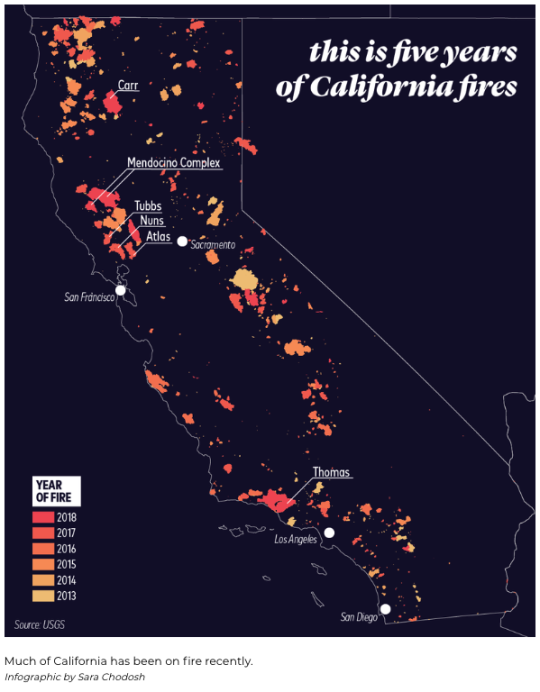
    It’s important to note that California is designed to burn. The characteristics that make the state a highly desirable place to live – mild winters and hot and dry summers – also make it a highly flammable place.

    Below is a map from Popular Science showing how much of California has burned over the last 5 years. Most of California’s hottest fires (13 of the top 20) have occurred since 2000.

    image

    But these naturally occurring fires are actually important for the regeneration of its forests. So one argument is that the current policy of “total fire suppression” is actually partially responsible for this increase in severe wildfires.

    Low-intensity forests aren’t burning like they used to and it is creating more densely packed forests for even larger wildfires. In other words, through our actions we could be exchanging smaller and more frequent fires for bigger and more severe ones.

    The other concern is development. 

    California had a population of about 24 million people in 1980. Today it is closer to 40 million. And much of that growth has occurred outside of existing urban areas (too hard to build). This has meant more people living in suburban and rural areas – adjacent to wildlands.

    Ed Glaeser has repeatedly argued that the best way to respect nature is to actually stay as far away from it as possible. Humans are a destructive species. Living in a dense city is good for the planet.

    Now let’s address the climate change issue.

    Daniel Swain, who is a climate scientist and author of the Weather West blog, published this popular thread on Twitter about a day ago. At the time of writing this post, it had been retweeted and liked over 10,000 times.

    From his perspective as a climate scientist, this is not all about climate change. That’s the wrong question to ask. It’s more complicated and nuanced than that. But climate does indeed act as a “threat multiplier” to the other factors we’ve already discussed.

    Fire season typically begins and ends with rain. When the fall rainy season starts, the fire season ends. One of the biggest risk factors is a dry fall, particularly after a hot and dry summer (or after multiple hot and dry summers, as has been the case in California). 

    Because according to Swain, fall means the start of “offshore wind” season, which can help to stoke these wildfires. 

    Unfortunately, one of the projected outcomes of climate change for California is more precipitation concentrated in the “winter” months, at the expense of precipitation in the shoulder seasons (spring and fall). So that means a longer fire season.

    Swain believes that if Northern California had received close to its typical amount of rain this fall, it is almost certain that this tragedy would have been avoided. 

    That, however, makes me wonder about the relative importance of all the factors we have discussed today.

    For Daniel Swain’s full thread, click here.

  • Cities with perfect climates

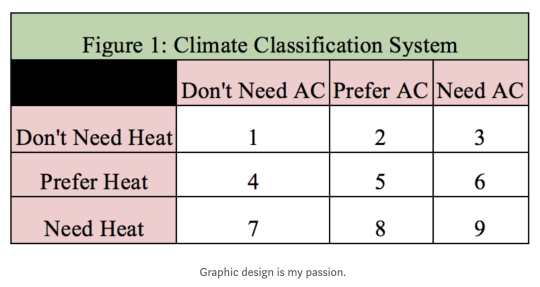
    Last year Nolan Gray mapped out “the cities of the world where you don’t need AC or heat.” And just recently he updated his data with the help of Guardian Cities for their “sweltering cities” series. As part of the study, they projected out average temperatures, in both the summer and winter, to 2059, showing which cities may become more dependent on air conditioning. The answer looks to be many.

    In his original study, Gray had 9 climatic categories, all of which were based on average high and low temperatures throughout the year. Category 1 was you definitely don’t need AC or heat. These cities are essentially perfect year round. And category 9 was you definitely need heat and AC. These cities are basically the worst places on earth to occupy from a climate perspective.

    Here is that climate classification system in lovely chart form (note his caption):

    The climatic utopias ended up being places like Bogotá, Guatemala City, Lima, Mexico City, San Diego, São Paulo, and Sydney. The worst places were the southeastern United States, Central Asia, and northern East Asia.

    But one factor that is not included in the study is humidity, which Gray rightly points out has a meaningful impact on comfort. Toronto, for example, is classified in his system as category 7. Heat needed. But AC definitely not needed. Personally, I would bump us up to category 8: AC preferred, but not needed.

    Still, this is an interesting study. There are relatively few cities with so-called perfect climates. And I have always found these sorts of climates fascinating because they empower a very different kind of relationship to outside spaces.

  • Random thoughts about climate change

    One of the things that I have been wondering lately with all of the devastation caused by hurricanes Harvey and Irma is if we need to be viewing these catastrophic incidents as the result of climate change or if we’re being too quick to apply the availability heuristic.

    The latter being: “Look at all of these horrible hurricanes. Climate change must really be here and happening right now.”

    Albert Wenger is covering this topic on his blog right now through his “Uncertainty Wednesday” series and has also written similar posts in the past. The current series is still ongoing, but a few things stood out to me as I was going through the archives. I’ll mention 3 of them today.

    Firstly, it’s important to understand the difference between weather and climate. Weather is what’s happening at any given moment. Climate, on the other hand, is the statistics of weather. Albert proposes the following definition for climate, which I like:

    “Climate is the probability distribution of possible weather events.”

    Secondly, the data is clear: We have gotten far better at forecasting weather over the years. Accuracy has greatly improved. 

    But we’re still pretty bad at it, particularly over longer periods of time. According this graph, we’re about 97.5% accurate for 3 day forecasts, but only about 40% accurate for 10 day forecasts. So by “longer periods of time”, I’m really talking about forecasts that go out beyond one week. That’s not very far into the future.

    Thirdly, Albert has this post from last year where he talks about the flooding we saw on the U.S. east coast and also the slowing down of the Gulf Stream

    This is fascinating, and also frightening, because the Gulf Stream is a vital ocean current. Among other things, it warms western and northern Europe – likely making it warmer than it otherwise would be – and, according to some models, it lowers the sea level along the U.S. east coast by as much as 3 feet

    The frightening part is that as the Gulf Stream slows it also stops pulling away the same amount of water from the coast, which is arguably why mean sea level is increasing.

    I say “arguably”, but the data clearly suggests an acceleration in the rate of rise. Here are two charts that Albert prepared. And there’s more: The U.S. east coast may also have it worse in terms of sea level rise precisely because of this phenomenon.

    This is an interesting and, of course, important topic. This post obviously doesn’t do it justice, but I am trying to learn as much as I can. Writing always helps with that.

    Photo by Joseph Barrientos on Unsplash

  • Hot to cold

    Architect Bjarke Ingels will be in Toronto next week to talk about how architecture can create communities and about a new project that he is working on with developers Westbank and Allied REIT here in the city.

    The last time I heard Bjarke speak was when I was in undergrad and he had recently started a firm called PLOT with Julien De Smedt. That was over 10 years ago. So I am looking forward to this talk. If you’re also going to be attending, tweet me and let’s try and connect at the event.

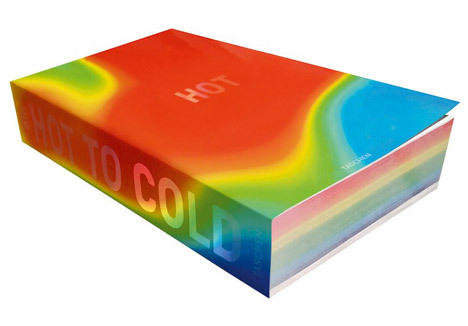
    In anticipation of that, I thought I would share a book that his firm published about a year ago called, BIG, HOT TO COLD: An Odyssey of Architectural Adaptation

    What’s interesting about the book is that all of the projects are organized according to climatic location – literally hot to cold. That’s why the pages themselves start as red and end up in dark blue.

    It’s a direct response to the fact that modern architecture and modern building systems largely did away with regional and climatic variations. Buildings were designed, no matter their location, to look exactly the same. 

    To a certain extent, globalization makes this somewhat inevitable. But climate is climate. And I believe that architecture is stronger when it responds to local context.

    If you were in Toronto this past weekend – perhaps for the NBA All Star Game – you’re probably well aware that Toronto sometimes gets cold. So it will be interesting to see what kind of strategies they employ for their upcoming project.

    If you want to hear Bjarke talk about this book and some of their projects, check out this video from the Architectural Association in London.

  • It’s too cold for that

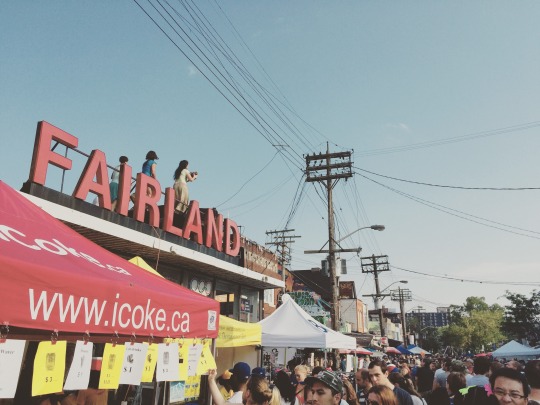
    This past Sunday I spent part of the afternoon in Kensington Market (Toronto) for Pedestrian Sundays. 

    If you’ve never been to a Pedestrian Sunday, you’re missing out. The entire neighborhood – which happens to be a National Historic Site of Canada – gets closed to cars, and filled with street vendors, musicians, bands playing on roofs (see above), and so on. It’s pretty wild. And it feels very Toronto to me.

    It happens the last Sunday of the month from May to October. But every time I go I wonder why the area isn’t this way more often or even all the time. It’s a natural candidate. But after 12 seasons of Pedestrian Sundays, it still hasn’t happened. It’s only 6 days throughout the year. 

    I remember being in a meeting early on in my career when I brought up the idea of a pedestrian mall in Toronto for a project I was working on. And I got completely shut down. I was told they don’t work here in our climate and that we should just forget about it. I was told to look at the failure of Ottawa’s Spark Street Mall.

    But I’m still not convinced that’s the case. In fact, I feel even stronger at this point that it could and would work in Toronto. I’ve been to the Distillery District in the dead of winter for the Toronto Christmas Market and I could barely move because of all of the people. 

    Acknowledging climate is important. But it shouldn’t become an excuse for not doing things.