The New Yorker recently published a “daily shout” on Instagram called, How You Know You’ve Made It, by City. It is essentially a series on city stereotypes, and it’s pretty funny. Sorry Cleveland. If you can’t see the embed below, click here.
Tag: cleveland
-
The biggest challenge in revitalizing the Rust Belt

Jason Segedy, who is the Director of Planning and Urban Development for the city of Akron, Ohio, recently penned a two-part series in the American Conservative about urban revitalization in the Rust Belt. Part two is specifically about the importance of new housing in “cities left for dead.”
As I was reading through the piece, my first thought was that it would be a good follow-up to yesterday’s post on “winner-take-all-urbanism.” The contrast between alpha cities like San Francisco and Rust Belt cities like Akron is stark.
The former city can’t build housing fast enough. And the latter city was forced to implement a citywide, 15 year, 100% residential property tax abatement program just to induce new investment. Any and all new housing is eligible.
But as I got further down the article, I was struck by something else. I was surprised to hear Segedy say that, rather than market forces, community opposition is “perhaps the biggest challenge of all” when it comes to delivering new housing in these markets.
Here is a longish excerpt that I would encourage you to read:
Although you might think that people living in neighborhoods with a large number of abandoned houses and vacant lots would be thrilled to see new houses being built, you might be surprised to learn how often this is not the case. Sometimes neighbors prefer to have the vacant lot remain as green space. Sometimes they worry that the new housing will not be expensive enough, and will bring their property values down. Other times, they worry that the new housing will be too expensive, and will bring their property values (and taxes) up.
When it comes to new housing, everyone is a critic. I have heard people complain that housing which they will never live in is too dense; that housing which they will never purchase is too expensive; that housing which they will never be inconvenienced by will generate too much traffic; and that housing which they will never look at is not architecturally appealing.
After 23 years as an urban planner, I can honestly report to you that, contrary to popular belief, most people are strongly in favor of heavy-handed and draconian government regulation of private property—as long as it is someone else’s private property, and not their own.
Residents and community activists who are opposed to new housing often demonize the real estate development profession as being “greedy”, overlooking the fact that their own home was developed by a developer, built by a builder, and sold by a realtor—most likely for a profit. This isn’t to argue that every development professional is a white knight, but it is important to remember that the vast majority of people who work in the real estate and construction sectors are not the enemy of neighborhoods. Without them, there would be no neighborhoods.
According to Segedy, Akron has lost 32% of its peak population. Cleveland has lost 58%. And Detroit has lost 64%, leaving almost 1/3 of its land parcels vacant. (These are 2017 figures.) Surprisingly, this doesn’t appear to change how many people feel about new development.
No more new housing. We’re full. Unless, of course, that housing is for me.
Photo by Nolan Issac on Unsplash
-
Hypervacancy in America’s legacy cities

I was reading Aaron Renn’s post this morning on America’s vacant housing challenge and I was reminded of the stark contrast between what we are experiencing here in Toronto and what the US is experiencing in a lot of its coastal cities, compared to what is happening in many legacy cities in the US. The former industrial centers. In this latter case, the discussion is around neighborhoods reaching a tipping point in terms of vacant homes and then spiralling out of control. Below is an excerpt from a study that Renn cites in his post. It is from the Lincoln Institute of Land Policy and it’s called “The Empty House Next Door.” The above chart should also tell you a lot about the magnitude of this problem.
Hypervacancy has been rising steadily in legacy cities since the 1990s. Although only one out of sixteen census tracts in Cleveland was hypervacant in 1990, by 2010, one out of two tracts in that city had reached hypervacancy. When vacancies rise above approximately 20 percent of an area’s total properties, the number of vacant buildings and lots may continue to grow indefinitely. Although vacancies rarely reach 100 percent—because even the most distressed neighbor- hood may have a few long-term owners—the market effectively ceases to function. Houses sell, if they sell at all, only to investors at rock bottom prices while the neighborhoods become areas of concentrated poverty, unemployment, and health problems.
-
Land use restrictions and upward mobility
Throughout US history, economic growth has typically spurred an “enormous reallocation of population.” Here is a graph from a recent New York Times article called: What Happened to the American Boomtown?
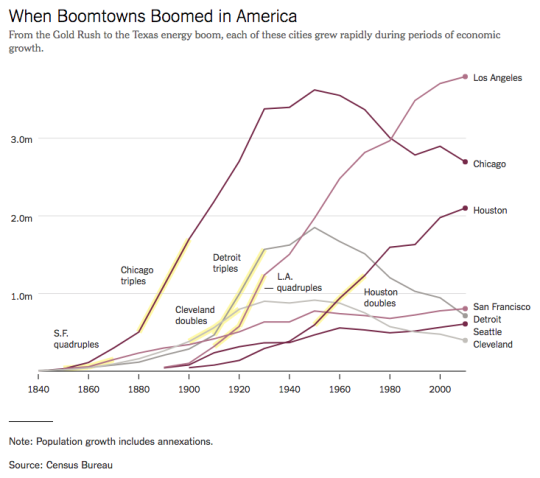
The argument, here, is that restrictions on development have made it so that the most prosperous cities are actually the slowest growing cities in terms of population. Here is a chart, from the same article, comparing population growth to average annual pay:
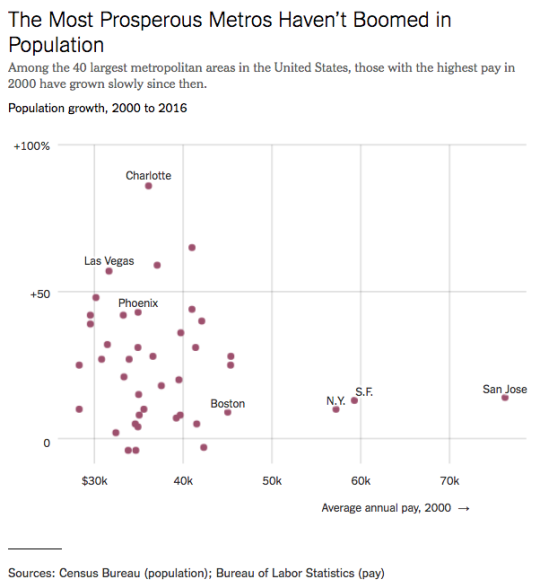
And here is an excerpt:
But these productive places aren’t growing as fast now as economists believe they should — and as they would if they didn’t impose so many obstacles on new development. Since the 1970s, land use restrictions have multiplied in coastal metros, making it harder to build in, say, San Jose, Calif., than in Phoenix. And the politics of development have become tense, too. In the Boston suburbs, the Bay Area, Brooklyn and Washington, people who already live there have balked at new housing for people who don’t.
We often talk about the impact of land use restrictions on supply and overall housing affordability. But here is an argument that it could also be impacting upward mobility.
-
Planning for the unplanned

I was listening to The Urbanist (Monocle Radio) last night while I was making dinner and there was a segment on Moscow’s “illegal retail kiosks.” These are small scale retail structures that were built without formal planning permissions and so the city decided to demolish them.
There was lots of backlash. Photos here.
Now, I’ve never been to Moscow. So I can’t really comment on the attractiveness and usefulness of these kiosks. But I suspect that these illegal retail kiosks, many of which seem to have been located around metro stations, contributed quite a bit to the city’s urban vibrancy. Retail is hard to get right. It doesn’t work everywhere.
All of this got me thinking about our tendency to sterilize and overplan cities. I’m not saying that planning is bad. It’s not. But I do think we should acknowledge that we don’t know everything about the future and that human ingenuity will undoubtedly unlock new things we never thought would be beneficial.
So how do we plan for the unplanned? Perhaps it starts with accepting the off-center. Here’s a quote from Anthony Bourdain (it’s all over the internet, but I can’t seem to find the original blog source):
I think that troubled cities often tragically misinterpret what’s coolest about themselves. They scramble for cure-alls, something that will ‘attract business,’ always one convention center, one pedestrian mall or restaurant district away from revival. They miss their biggest, best, and probably most marketable asset: their unique and slightly off-center character. Few people go to New Orleans because it’s a ‘normal’ city — or a ‘perfect’ or ‘safe’ one. They go because it’s crazy, borderline dysfunctional, permissive, shabby, alcoholic, and bat shit crazy — and because it looks like nowhere else. Cleveland is one of my favorite cities. I don’t arrive there with a smile on my face every time because of the Cleveland Philharmonic.
There’s value at the margins.
-
Young, educated, and urban
The Wall Street Journal recently published this article talking about how the young and educated are flocking to high-density urban areas all across the United States. Here’s a set of charts from the article:

There are many people who will point out – probably rightly – that despite the “return to cities” that we are currently seeing, the world is still suburbanizing. But, it doesn’t appear to be suburbanizing in quite the same way as it did for prior generations. There’s also a socioeconomic shift taking place.
As an example, and to drive home the point that it’s not just the expensive coastal cities that are seeing rising home prices, the WSJ article focuses quite a bit on Ohio City – a neighborhood in Cleveland. Here’s what has been happening:
In the Ohio City neighborhood, the median income skyrocketed to $93,000 from $23,000 since 2006, according to Ohio City Inc., a local nonprofit development group. Median home values shot up 800% since 2000 to $270,000, according to Ohio City Inc. Median rental prices in downtown Cleveland as a whole jumped 47% from late 2010 to late 2015, according to the Center for Population Dynamics at Cleveland State University.
These are pretty dramatic increases – though $270,000 feels cheap to someone from Toronto. Still, it speaks to a trend. You and I both know that Ohio City isn’t the only neighborhood seeing those sorts of numbers.
-
#WeTheOther
We may not all agree on things like bike lanes and transit, but if there’s one thing that can generally unite a city it’s playoff sports.
I love the solidarity that it creates. You may have nothing else in common with the person sitting next to you at the bar, but suddenly you’re best friends because your team is winning.
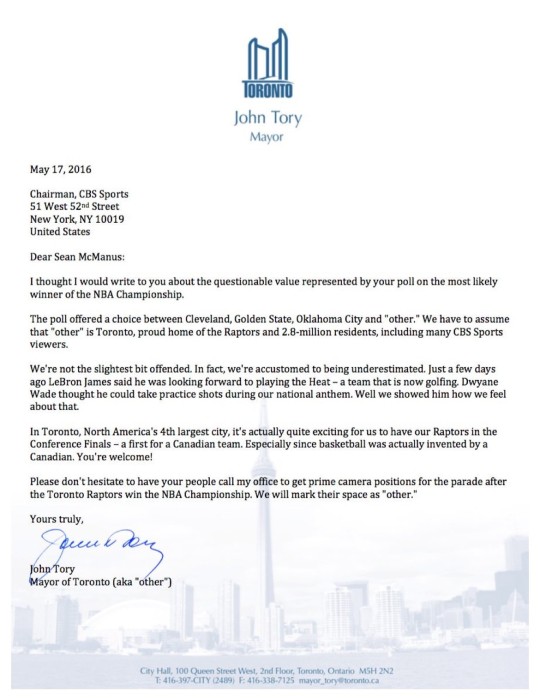
As I write this post, #WeTheOther is currently breaking the internet after CBS Sports ran a cheeky online poll asking: Who will win the NBA title? The four options were:
- Warriors
- Thunder
- Cavaliers
- Other
For those of you who don’t follow basketball, there are only 4 teams left in the NBA playoffs right now! So in what was likely a deliberate snub to the Toronto Raptors, CBS conveniently obfuscated them in their poll.
Here’s how Mayor John Tory quickly responded:
What would sports be without the trash talking?
-
Toronto is at the center of an emerging megalopolis
With the recent talk around downtown Cleveland’s resurgence, I am reminded that for those of us living near the Great Lakes, we are living in one of the most important urban agglomerations in the world: The Great Lakes Megalopolis.
In 1962, French geographer Jean Gottmann wrote a seminal book called, Megalopolis: The Urbanized Northeastern Seaboard of the United States. And in it, he described the remarkable clustering of cities in the northeast, running from Boston in the north to Washington D.C. in the south. He called this the Northeast Megalopolis.
The term megalopolis simply refers to a clustering or chain of generally adjacent metropolitan areas.
Then in the 1960s and 1970s, architect and planner Constantinos Doxiadis started writing about the emergence of what he called the Great Lakes Megalopolis. In his mind, a contiguous urban region was forming that stretched all the way from Chicago in the west to Quebec City in the north east. And at its economic center was the city of Detroit.
More recently, Richard Florida, as well as others, have been referring to these urban clusters as mega-regions. And in the case of the Great Lakes, Florida broke the area down into two distinct regions: Chi-Pitts in the west and Tor-Buff-Chester in the east. (I think you can guess how the names were derived.)
According to his research, these two mega-regions have a combined population of almost 60 million people and an economic output equivalent to almost $3 trillion. That places it in line with the Northeast Megalopolis. But according to the Brookings Institution, the output coming from the Great Lakes could be closer to $4.5 trillion.
Whatever the case may be and whatever you want to call it, the Great Lakes Megalopolis is unquestionably an economic and cultural powerhouse. But this has me wondering whether or not we’re doing enough to unleash its full potential.
When I attended Joe Berridge’s talk last week on Toronto as a global city, I asked him how he thought we should be organizing our cities and regions. Do city-states make sense? Should we be rethinking the relationship between provinces/states and cities?
His response was that we should be creating agencies and entities with regional authority (as opposed to fighting to make any constitutional changes). For example, the Toronto region should not have an array of competing transit agencies (as it does today). It should have one regional transit authority that blankets the region. People, ideas, and capital don’t follow borders.
So with that in mind, what opportunities are there for us to unite the metropolitan areas within the Great Lakes Megalopolis?
The first idea that comes to my mind is a high speed rail network that seamlessly connects to each city’s local transit network. Imagine a Great Lakes bullet train that could zip you across the region. It would completely reorganize the spatial landscape.
Here’s an excerpt from a recent report by the Independent Transport Commission called, Ambitions & Opportunities – Understanding the Spatial Effects of High Speed Rail:
There has been a global shift of economic power and influence from nation states to cities and city-regions. Today’s successful cities collaborate across existing boundaries to form polycentric metropolitan regions. As a result cities function in a much less self-contained manner than they did fifty years ago. Longterm trends in the pattern of urban settlement reflect the interplay between opportunities for dispersal afforded by greater mobility, and economic and social forces promoting concentration.
But what else could we be doing to empower the Great Lakes Megalopolis?
I would love to hear your thoughts in the comment section below. I think there’s a strong case to be made for thinking at the scale of the megalopolis and not just at the scale of our own backyard.
-
Two thoughts on reviving post-industrial cities
Yesterday Adam Radwanski of the Globe and Mail published an interesting article called, Rust Belt revival: Lessons for southwest Ontario from America’s industrial heartland.
The article talks about some of the things that the Rust Belt is doing to revitalize their cities and the lessons that many cities in Ontario – which are facing similar fates – could learn from. It’s worth a read.
I’m not going to summarize his article, other than to say that some of the key points were around tax increment financing, tax incentives, University connections, a DIY/entrepreneurial culture, and the American tradition of philanthropy – which Radwanski points out is probably the least imitable for Canada.
And it’s this last point that I would like to focus on first. The US has a deep history of people getting rich and then giving back – certainly more so than in Canada in my opinion.
If you think about the resurgence of cities such as Detroit, you’d be hard pressed not to think of people like Dan Gilbert. He has become the poster boy for Detroit’s resurgence by moving his companies to downtown and buying up most of the office buildings. If and when Detroit comes back (I think it’s a when), Gilbert will easily be one of the biggest beneficiaries.
Now, you could argue that this is made possible because of greater income inequality, but there’s something to be said about powerful individuals acting on intrinsic passion. Gilbert is investing in Detroit because he personally wants to see his home city come back. And that’s hard to replace.
The second point I would like to focus on has to do with this snippet:
With oil’s current slide, Canada really can’t afford for it to remain a drag – and in fact there is some expectation that Ontario will instead reclaim its old role as the leader of Canada’s economic growth. Its premier, Kathleen Wynne, recently expressed optimism that plummeting oil prices and a sinking dollar will prove a boon to manufacturing. “I don’t wish for low oil prices and a low dollar for Alberta,” she said earlier this month. “But at the same time, we want our manufacturing sector to rebound. So if that [low oil price] helps, then that’s a good thing.”
I don’t know what context this was said in, but I continue to feel strongly that we cannot rely on low oil prices and a low Canadian dollar for Ontario’s competitiveness. That is a terrible business model, and an unsustainable one. We need to figure out ways to create value and grow the economy without relying on currency differentials and other macroeconomic factors. Radwanski is right to point that out in his article.
So let’s hope we don’t let any short term benefits go to our head. There’s lots of exciting work to be done.
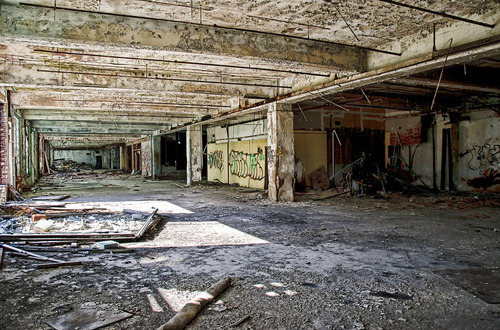
Image: Old Detroit auto factory via Flickr
-
Civic leaders, here’s why people need to love your city
I was planning to write about something else today, but then I saw Fred Wilson’s post on revitalizing urban cores and I had to switch topics, because I think he makes a great point about turning around declining cities:
I’ve been asked by civic leaders from places like Newark, Cleveland, Buffalo, and a number of other upstate NYC cities that have suffered a similar fate how they can do the same thing. They all talk about tax incentives, connecting with local research universities, and providing startup capital. And I tell them that they are focusing on the wrong thing.
You have to lead with lifestyle. If you can’t make your city a place where the young mobile talent leaving college or grad school wants to go to start their career, meet someone, and build a life, all that other stuff doesn’t matter.
It’s exactly the same point I made in my post entrepreneurship as economic development strategy. You can throw as much money as you’d like at startups, but if young people don’t want to live in your city then you have a serious problem.
Fred goes on to talk about Tony Hsieh’s (founder of Zappos) initiatives in downtown Las Vegas:
When Tony moved Zappos from the suburbs to the former City Hall in downtown Vegas a few years ago, he decided to invest $350mm in a massive urban revitalization project. He set aside $200mm to purchase land at bargain prices and the other $150mm to invest in three areas, arts and culture, small businesses (restaurants, cafes, bars, markets, boutiques, etc), and tech startups. $50mm is going into each area.
It’s an example of leading with lifestyle, urbanism and city building, rather than purely economics. And I think it’s the way to go. But to be clear, I’m not suggesting that the focus should be on large capital projects, such as stadiums and infrastructure. I’m not convinced those are the most effective catalysts. There’s no silver bullet here.
Instead, I think the answer is in building, from the ground up, a real sense of community and place. People need to love your city. That’s easier said than done though.