Daily insights for city builders, delivered every morning at 6 AM ET. I’m Brandon Donnelly — a Toronto-based real estate developer and founder of Globizen. I’ve been writing here since 2013.

Tag: city of london

  • In-person spending in Britain’s commuter towns

    As I understand it, there is now something called hybrid work. The way this works is that on some days you go into the office and on some days you work from home, or from some “third space” near to your home. As a result of this, there are now more people, at least for the time being, that seem to be willing to live further out from large urban centers. And this is reflected in the data that the Financial Times recently published in an article about “how the pandemic transformed Britain’s commuter towns“:

    In-person spending in the City of London has yet to fully recover. It remains below 2019 levels. Whereas a number of places that I am generally unfamiliar with (see chart) are now above where they were pre-pandemic. This, again, makes intuitive sense: more decentralization, more time at home, and less time in the City of London. Though we could also be seeing some low base effect here. Either way, my gut continues to be that a lot of people are still underestimating the stickiness of cities and the importance of in-person interactions.

  • How much money a traffic camera can collect

    Most of us are aware that most of our cities have traffic cameras, which are setup to photograph us doing bad things and then to send us bills in the mail. I can’t say I’ve ever wondered how effective these camera systems are or how much they actually collect, but in case you’re curious, here is one example from the City of London.

    The camera is setup in the busy Bank Junction, which from 7AM to 7PM on weekdays has been off limit to any vehicles other than buses and cyclists since 2017. If you disobey the restrictions, you’re hit with a £130 penalty, although if you pay within 14 days, the penalty drops to £65.

    Between 2019 and 2021 (so during COVID, when traffic volumes were less), total penalties paid were £15.2 million. I don’t know how many people paid on-time or paid late, but based on these numbers, the number of delinquent incidents over the past three 3 years was anywhere from 116k (everybody paid late) to 233k (everybody paid on-time).

    I also don’t know how many repeat offenders there where, which is why I said incidents and not drivers, but I’m guessing that there were more than a few repeat offenders. I wonder how many were taxi and Uber drivers.

  • From office to residential in London

    It was recently announced that the City of London — the historic town center and primary CBD of the region — is aiming to create at least 1,500 new residential units in the Square Mile by 2030. Part of its strategy is to convert disused office buildings into residential. Currently, the City has about 7,850 residences, which is a drop in the bucket and whole lot smaller than its 19th century population of 125,000.

    Tony Travers, director of LSE London, is quoted in FT saying that the City is really facing “twin challenges.” You’ve got Brexit, which caused prime office cap rate rates to stagnate in the UK, and you’ve now got the whole work from home thing. Nobody really knows how this latter piece will fully shake out when it’s all said and done, but we shouldn’t forget the power of agglomeration economies. It’s what powers cities.

    Calgary is another example of a city that is looking to encourage change. Last month a $1-billion plan was approved to help convert office buildings into housing. (Shout out to Steven Paynter of Gensler who is quoted in the article talking about what makes for a suitable office conversion project.)

    What’s interesting about these announcements is that oftentimes cities cling to their non-residential spaces out of fear that once that supply gets converted it will never come back. That is certainly the case here in Toronto with its office replacement policies, although many years ago when downtown living wasn’t nearly as cool, there was a similar push to encourage more residential development in the core. Looks like that idea worked.

    We know that office space isn’t going away. Zoom is an awful substitute for in-person interactions. People need to congregate (and tend to like doing it). Urban agglomeration economies drive innovation. Bigger cities with higher population densities tend to create more wealth for their inhabitants. So perhaps the takeaway from these announcements should be that, yeah, office space is vital, but it’s okay to do a little rebalancing once in a while.

  • Economies of agglomeration in London

    The Financial Times is running a series right now on the future of the City of London. In their latest article, they looked at “How London grew into a financial powerhouse,” while at the same time comparing it to other global financial centers. It’s interesting to see how much of a banner year this was for companies going public. Companies listing on the Nasdaq and the NYSE raised a record $150 billion in 2020. This is compared to about $6 billion raised in London (both the London Stock Exchange and AIM). But what I really want to draw your attention to are the below maps from FT showing the clustering of banks, hedge funds, asset managers, insurers, and professional services firms in London. This is what urban agglomeration economies look like.

  • The City as a Place for People

    The City of London Corporation recently published a report called “The City as a Place for People”, which talks primarily about itself and how great London is as a magnet for talent. 

    But as self-serving as it may be – the report is timed to be ahead of this year’s MIPIM – there appears to be some data and interviews backing up the claims.

    58% of “institutional investors” said that London is the best European city for business. Dublin was next at 22%. 

    A separate survey of 2,568 “corporate decision makers” in Europe revealed that 21% of respondents felt that London was the best European city for business, followed by Paris (13%) and Frankfurt (7%). When asked which city had the best talent pool, the responses were fairly similar.

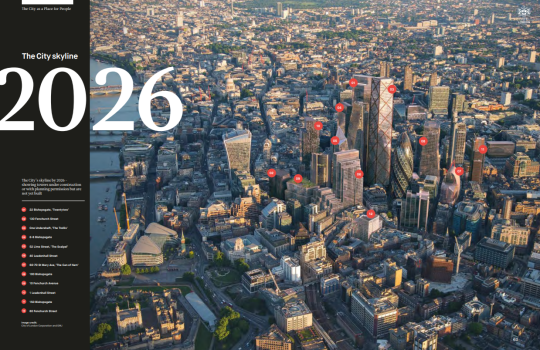
    Also included in the report is a rendering of the City’s skyline by 2026. These are always fun to see. Here is a screen grab:

    image

    It is showing all towers under construction and all towers with their planning permissions in place. If you’d like to download the full report, you can do that here.