Daily insights for city builders, delivered every morning at 6 AM ET. I’m Brandon Donnelly — a Toronto-based real estate developer and founder of Globizen. I’ve been writing here since 2013.

Tag: city center

  • The mighty bollard

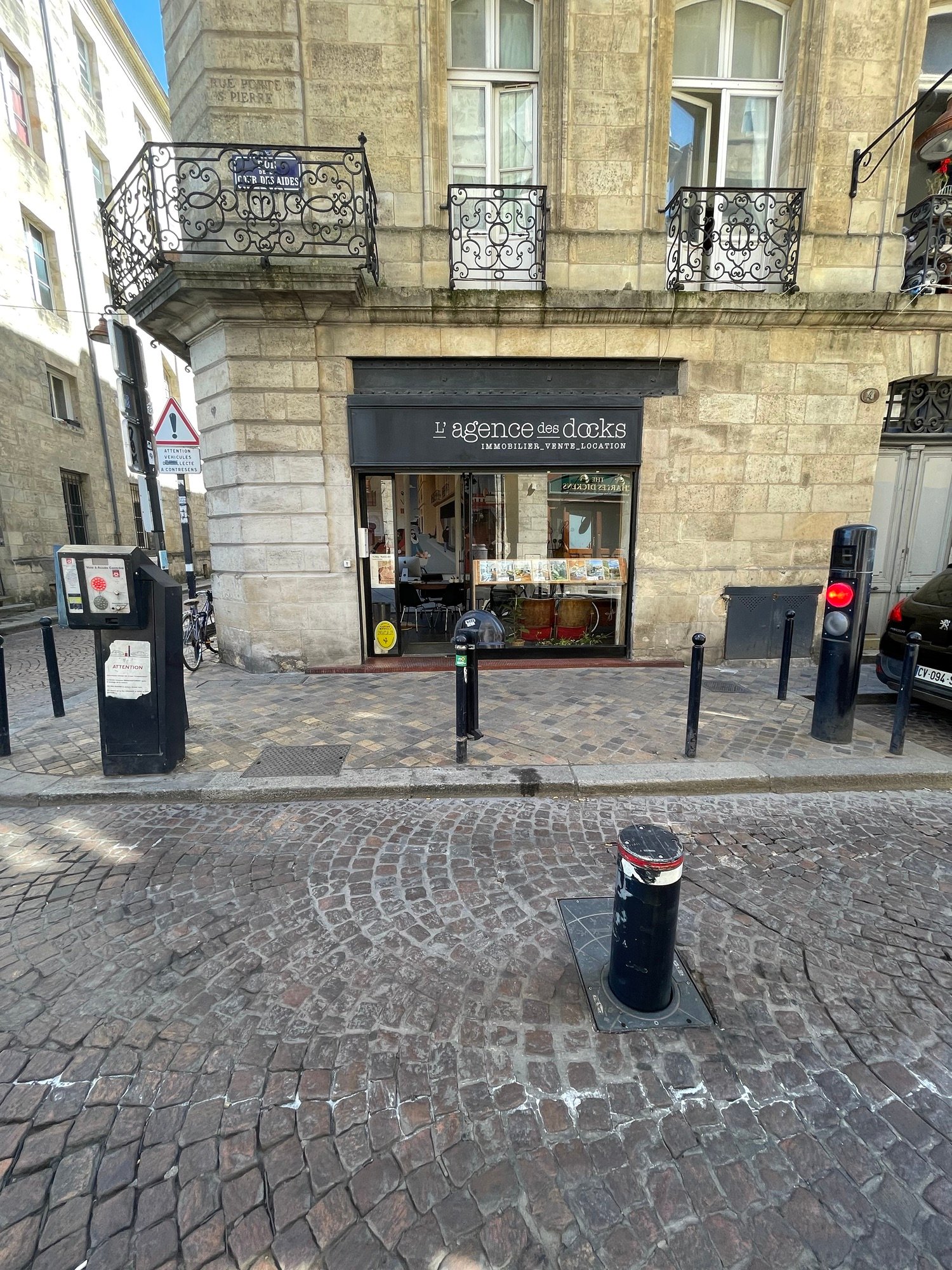
    The mighty — and automatic — bollard is an important city-building tool that isn’t employed nearly enough in North America. It’s typically used to control car access to small pedestrian-only or pedestrian-first streets. But I guess if you don’t have any of these, then you may not feel the need to install such a device. The above photos are from Bordeaux. And if you want to gain access, you need to hit the intercom button and explain why you’re local traffic. Can you think of any streets in your city that could use a system like this? I can think of many in Toronto.

  • The new donut

    Years ago Aaron Renn coined an urban paradigm that he labeled “the new donut.” The old donut, of course, is one that many of you will know well: poor downtown (hole in the donut) and wealthy suburbs (ring around the hole in the donut). This is a well documented phenomenon in many American cities.

    The new donut reflects today’s return to city centers. It is the filling in – albeit only partially – of the middle of the donut. The reason I say only partially is because the data clearly suggests that, in many cases, there’s now a trough between the immediate core and the outer suburbs. 

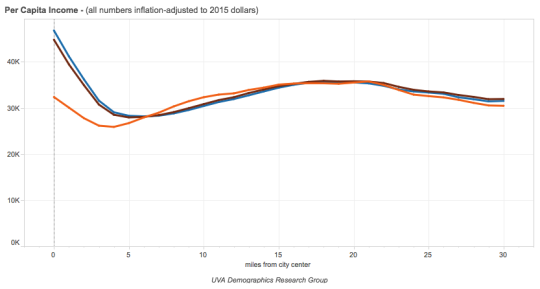
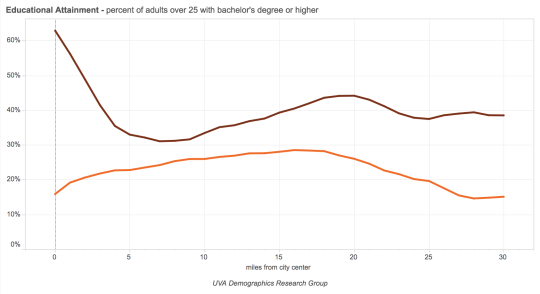
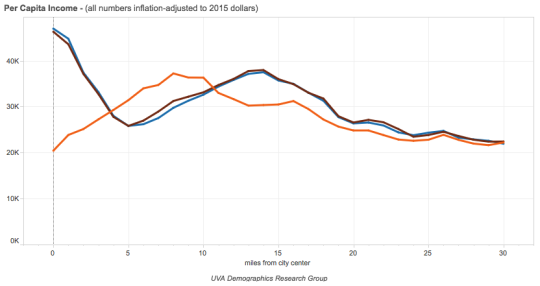
    In 2015, the University of Virginia published a study called The Changing Shape of American Cities. It looked at things like educational attainment and per capita income in 1990 and then compared it to more recent 2012-2015 data. But most significantly, it plotted this data against “miles from city center.” (I discovered this study via City Observatory.)

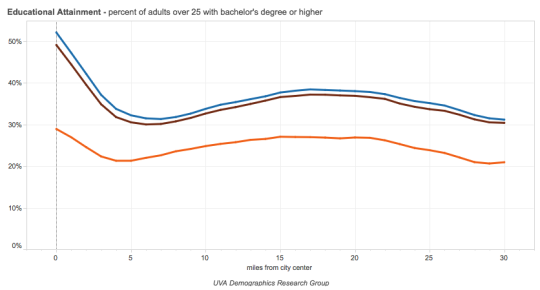
    Here are educational attainment and per capita income for the 50 largest metro areas in the US. The orange line is 1990 data. The brown line is 2012 data. And the blue line is 2015 data. The x-axis is “miles from city center.”
    imageimage

    Compared to 1990, it is clear that there has been noticeable spike in education and income in city centers. For the above composite index, more than 50% of adults over 25 now have a bachelor’s degree. But it has also accentuated the trough that appears to sit, on average, about 5 miles out from the center. 

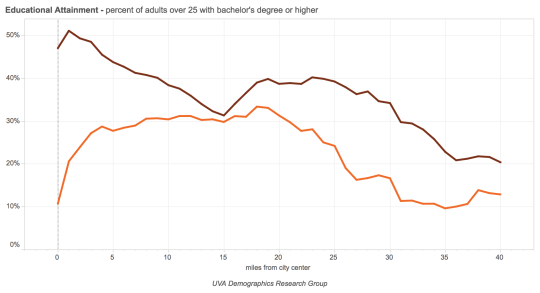
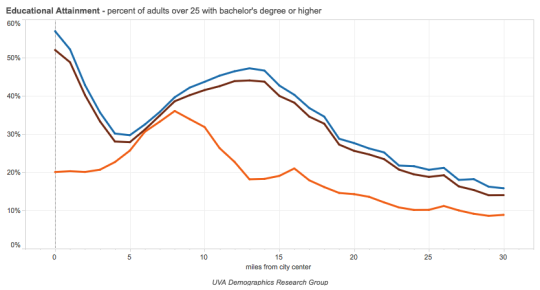
    In some metro areas, such as Charlotte (shown below), there has almost been a complete inversion. Education and income were highest 5 to 10 miles out from the center, but that has since flipped, along with a dramatic spike right in the center.
    imageimage

    This is the new donut. If you’d like to see the graphs for all 66 American cities that form part of the study, you can do that here

  • Below the surface

    Later this month the new 9.7 km North-South metro line in Amsterdam will start service. Like most large scale infrastructure projects, its opening has been delayed many times. 8 times according to this source. But this post is not about that. It’s about a byproduct of the line’s construction. 

    The excavations required for the line meant that two sections of the Amstel River – namely the Damrak and Rokin sites – had to be drained. This took place from 2003 to 2012 and gave archaeologists unprecedented access to the bottom of a river in the middle of a historic city center.

    Amsterdam started as a small trading port along the banks of the Amstel River some 800 years ago. So not surprisingly, they found a few things. Over 17,000 objects were found and all of them have been catalogued online according to time period, use, material, and location found.

    For the full catalogue of objects, click here. Screenshot of the catalogue shown above. And to learn more about the entire project, start here. There’s a lot of good stuff in there for city nerds.

  • Has there been a “great inversion?”

    Urbanist Richard Florida has spoken a lot about a “great inversion.” This is about poverty moving to the suburbs and the core of cities becoming a kind of “gated suburb.” (i.e. wealthy)

    In response to this narrative, City Observatory recently published a post where they call this a new mythology. Joe Cortright argues that it is simply an exaggeration that sounds good in media headlines. And indeed, if you look at some accounts of poverty, the swings haven’t been that dramatic.

    However, if you dig into this study by Luke Juday at the University of Virginia (cited in the City Observatory article), there have been some interesting changes. 

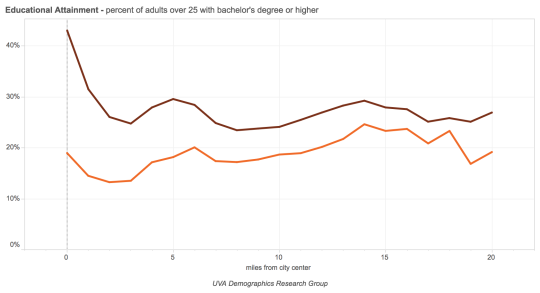
    Below is a chart that shows the percentage of adults (over 25) with a bachelor’s degree (or higher) sorted by distance from the city center. This particular chart is a composite of 7 northeastern (US) cities. The brown line is 2012 and the orange line is 1990.

    As you can see, there has been a huge spike in educated people living in city centers – at least in the northeast.

    Here is that same chart for Atlanta:

    New York:

    In the case of New York, it looks like the entire city just became more educated.

    Miami:

    Educational attainment is often the single biggest determinant of income. So there is something to be said about highly educated people concentrating themselves in city centers. We may not want to call it an inversion of great proportions, but it’s a meaningful shift.

  • The urban wealth pendulum

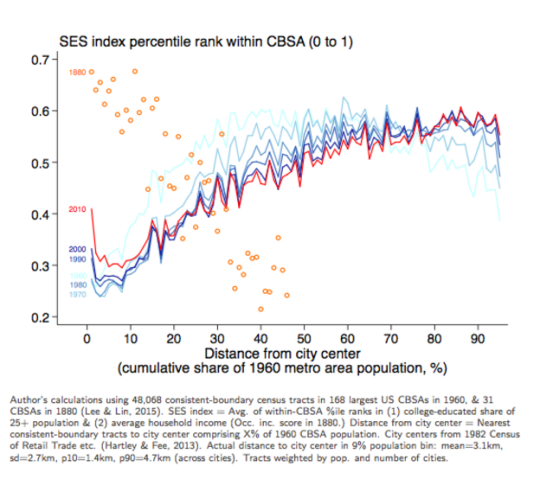
    Jeffrey Lin, who is an economist at the Federal Reserve Bank of Philadelphia, recently published the following chart:

    image

    I found it in this Washington Post article. And it’s packed full of fascinating information.

    The chart compares the socioeconomic status in US cities (y-axis) against “distance from city center” (x-axis) in 1880 and then in recent years (1960 to 2010 census data). The orange circles represent the 1880 data and the red and blue lines represent the recent census data.

    What this chart and research tells us is that in 1880, rich people overwhelmingly lived in the center of cities. And as you moved further away from the city center, socioeconomic status fell off pretty precipitously. This makes sense given that, at the time, it was hard to get around and travel long distances.

    However, in the post-war years, the exact opposite became true. We began driving and wealth decentralized. This should surprise no one. 

    But what’s interesting is how this appears to be reversing. In 2010 (the red line), there’s a sharp increase in socioeconomic status for people living basically right in the center of cities. And for the 30 – 60 km range, there has been a decrease in socioeconomic status essentially from the 1960s onwards. 

    The important takeaway here – which is spelled out in the Washington Post article – is that the neighborhoods which appear to be in high demand today are also in very short supply:

    “We have 80 years of essentially zero production of neighborhoods with these qualities,” Grant says. “We’ve spent the last 80 years building car-oriented suburbs. Then when the elites decide they want to go back into the city, there’s not enough city to go around.”

    This is one reason why supply matters.

  • The suburbs, they are a changing

    Earlier today, a good friend of mine shared this New York Times article on my Facebook wall. It talks about how some suburbs are taking action to try and curb the exodus of young people to cities. They’re doing things like making themselves more walkable and building bike lanes. I thought it was an interesting article.

    Of course, it’s not just young people moving from the suburbs to the city. It’s also a case of young people living in the city and never leaving for the suburbs–which they have traditionally done. 

    I’ve talked about this topic a lot here on ATC, but I wanted to share this article because I think it’s one thing to talk about how city centers are on the rise and it’s another thing to talk about how suburbs are starting to take notice and take action to curb their (potential) decline.

    I say potential because some would argue that the suburbs aren’t necessarily on the decline–we just have a scenario where young people are delaying that period of their life, either for economic reasons or for personal/lifestyle reasons.

    I, however, would disagree. I think the growing preference for cities is a real societal shift. That doesn’t mean I think the suburbs are going to die though. There will likely always be a segment of the market that prefers that housing type (or some variation of). I just think the suburbs aren’t going to be what they once were to previous generations.