Daily insights for city builders, delivered every morning at 6 AM ET. I’m Brandon Donnelly — a Toronto-based real estate developer and founder of Globizen. I’ve been writing here since 2013.

Tag: city branding

  • On-street EV charging stations are the next street light

    On-street electric vehicle charging points are starting to roll out across Toronto. Here is one that I came across this morning in the Junction on Annette Street. The stations are from Flo.

    At its core, this is, of course, a great thing. Ubiquitous charging points are a critical component of overall EV adoption. But at the same time, it was a good reminder that (1) above-grade electrical wires are ugly (this is the typical Toronto approach) and that (2) on-street EV charging is a design challenge that is going to need to be solved.

    In the above example, the charging stations were mounted to an existing electrical pole and two bright yellow bollards were installed on either side to make sure nobody smashes into said charging stations while they’re parking and/or trying to watch TikTok videos on their phone.

    But what happens when nearly everyone has an EV? There are only so many electrical poles, so we will need to move on to standalone stations at some point, and that is obviously already being done. But if we’re going to have charging points practically everywhere, how should they work and what should they look like?

    I am sure that lots of very smart people are already thinking about this. But as someone who is not directly involved in this space, it feels like we need to think about these in a similar way to street lights. Because they are going to be just as ubiquitous, if not more so. That means there is a strong cause for making them both functional and beautiful.

    In fact, this feels like a real city branding opportunity.
  • How cities get branded

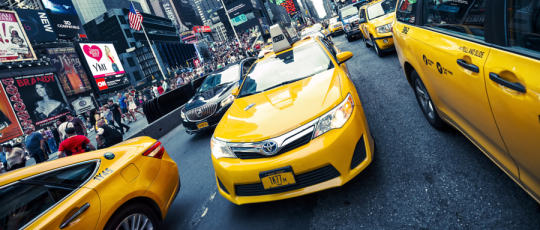
    Taxi on Times Square by frederic prochasson on 500px.com

    https://500px.com/embed.js

    I have been thinking a lot about city branding lately. It’s a topic I’m interested in to begin with, and all of the Blue Jays mania going on in Toronto right now has got thinking about our own brand.

    Because at the end of the day, yes, it’s baseball. But it’s also something much larger. It’s about civic and national pride, and it’s about who we are as a city. That’s why city branding has become a global industry and why it’s so closely connected to tourism, media, sports, and entertainment.

    Still, great city branding is incredibly difficult to do. Lots of cities have tried and lots of cities – from Adelaide to Toronto – have failed. Anyone remember the “Toronto Unlimited” brand of the mid-2000′s? It had absolutely zero stickiness.

    But in reality, cities are brand building all the time whether they realize it or not. Here in Toronto, our biggest brand builder right now is probably Drake. That might sound silly to some, but I believe it to be true. And next to that, you have people like Jose Bautista with his bat flips and his support of local brands like Peace Collective. In addition to their day jobs, these people are helping to shape the identity of the city.

    What, then, is professional city branding supposed to do?

    Well, in my opinion, it is their job to mine a city for the things that already exist. A city brand, no matter how great it may be, cannot be expected to create something from nothing. There has to be something there to begin with.

    But once you identify that something, a great city brand can tie it all together; create a cohesive and collective identity; and serve as a guide for future decision making. And when that’s done effectively, you actually begin to enhance the things that you initially started out with. The associations become even more powerful.

    So today I thought we could have a discussion in the comments about city brands. How would you describe the brand of your city in one sentence?

    For me, I would describe Toronto along the lines of being the most livable and multicultural 24/7 global city. And when you think of it this way, you can probably see why I think a 2AM last call at the bar is laughable.

  • What food is your city famous for?

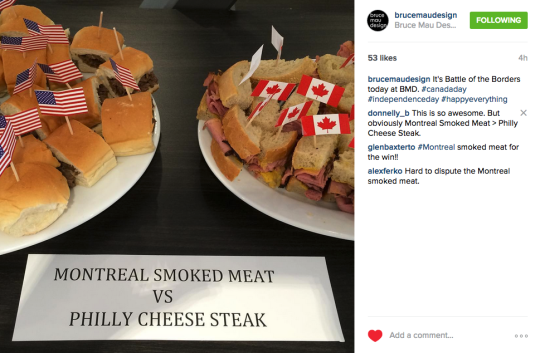
    Yesterday I came across the above Instagram post by Bruce Mau Design, which pitted the Philadelphia Cheese Steak sandwich against the Montreal Smoked Meat sandwich in a “battle of borders.” It was to celebrate both Canada Day and American Independence Day.

    I thought this was an awesome idea, so I tweeted out the photo. Then Daniel Kay Hertz – who is a Senior Fellow at City Observatory and from Chicago – asked me: “Is there a Toronto equivalent?

    And that got me thinking. 

    Montreal has smoked meat, bagels, and poutine. Philly has the cheese steak. Chicago has deep dish pizza. Quebec City has maple sugar and tourtiere (a kind of meat pie). New Orleans has po’boy sandwiches. Boston has clam chowder. Austin has tacos. Seattle has crab. And the list goes on.

    But what is the quintessentially Toronto dish? Asian fusion food? Peameal bacon sandwiches from the St. Lawrence Market? I really don’t know. So I think we should decide on one right now. Think of it as an exercise in city branding.

    Leave your suggestion in the comments below and we’ll have a vote.

  • 10 ways that cities can take advantage of the urban manufacturing revival

    image

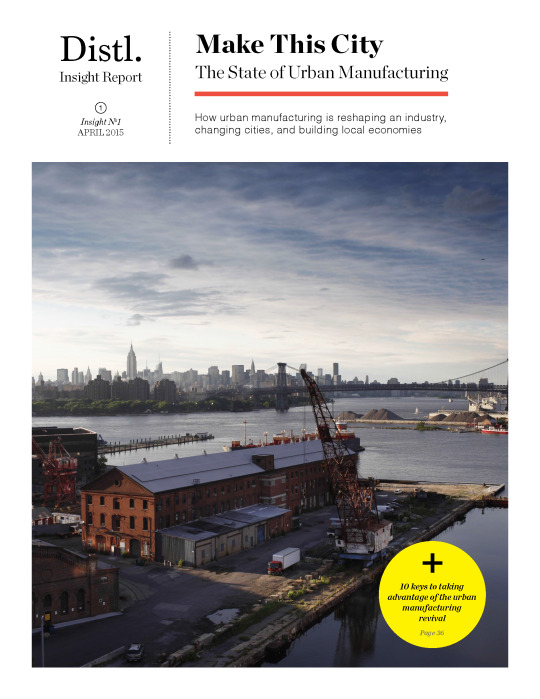
    My good friends over at Distl here in Toronto have recently published their first Insight Report. It’s called, Make This City: The State of Urban Manufacturing, and it’s available via free download here. I like the title 😉

    The report is 39 pages and is really well put together. There’s research, case studies spanning San Francisco to Toronto, and some great takeaways for city builders.

    Since the internet likes listicles, here’s a preview of some of those takeaways – 10 ways that cities can take advantage of the urban manufacturing revival: 

    1. Preserve urban industrial areas
    2. Focus on the niche
    3. Public investment is a good investment
    4. Think mixed-use
    5. Diversify learning
    6. Redefine industrial assets
    7. Connect supplier & retailer
    8. Leverage your city’s brand
    9. Form supportive organizations
    10. Leverage partnerships with both the private and public sectors

    But it’s definitely worth a complete read and I plan to do exactly that this weekend. Click here to download Make This City.

  • A self-fulfilling prophecy in the 6

    [soundcloud url=”https://api.soundcloud.com/tracks/190951409″ params=”auto_play=false&hide_related=false&show_comments=true&show_user=true&show_reposts=false&visual=true” width=”100%” height=”450″ iframe=”true” /]

    More so than any other genre of music, there seems to be a longstanding tradition in hip hop of promoting the city in which you’re from. From Los Angeles to Atlanta to New York, I’ve always admired the way that hip hop artists promote and showcase their cities.

    For a long time in Toronto we didn’t have that. Our hip hop scene was too embryonic and we just didn’t have artists who were both big enough and willing to take the lead. Or at least, that’s what I was lead to believe as an outsider who candidly doesn’t really follow the scene.

    But all that has changed.

    Earlier this month, Pitchfork published an interesting article by Jamieson Cox called: Views From The 6 – Inside Drake’s Toronto. It talks all about Drake’s love affair with this city and it even has a map of all the areas of Toronto that have been featured in his videos.

    But at one point in the article Jamieson argues that – like many hip hop cities – Drake’s depiction of Toronto is more fantasy than reality:

    His mythological Toronto is a metropolis where everyone knows your name and exes are always lurking around the corner, a forest of penthouses with a panoramic view, a park-studded playground where the skies are free of ambient light and the highways are always clear. Like many hip-hop locales, it’s a city closer to the realm of theory—and fantasy—than reality. 

    However, at the end of the day, I don’t think that matters. Similar to how your mind actually believes that wine tastes better out of an expensive glass, I think a big part of city branding has to do simply with how you’re supposed to feel. What is Toronto supposed to be like? How am I supposed to experience this?

    I love what Drake is doing. Because if everyone thinks it’s supposed to be a certain way, eventually that becomes a self-fulfilling prophecy.

  • The branding of places

    image

    Most people would agree that branding is a powerful and important exercise in the world of business. We recognize that brand equity is something that pays dividends in the future.

    When you walk around a city with a Starbucks, Tim Hortons, or some other coffee cup in hand, you are sending signals about who you are as a person and consumer. So, you could argue that you’re consuming the cup, as much as you are consuming the coffee.

    But one area that still feels like it’s in its infancy is place branding. That is, the branding of nations, regions, cities, and places. I’ve talked a lot about the business of cities and how impressions are created around cities, but I’ve never explicitly talked about place branding.

    However, it is an area on the rise. Monocle has written extensively about the importance of nation branding and there are firms, such as Vancouver-based Resonance, that now specialize in the strategy and branding of places.

    Here’s a short 5 minute video that they prepared talking about place branding and their approach to it. If you can’t see the video below, click here.

    //player.vimeo.com/video/66920801

    But at the same time, there are more grassroot ways in which a place brand can emerge. Think about the number of times Jay-Z has referred to himself as the Brooklyn boy or Drake has promoted Toronto in one of his videos. It’s hard to measure the impact of these sorts of things, but I am sure there is one.

    Here’s another example – a 4 minute video of Drake talking about why he loves Toronto. Click here if you can’t see it below.

    [youtube https://www.youtube.com/watch?v=M3TrbGEJbio?rel=0]

    Recently, you may have heard that Drake is about to give Toronto a new moniker: The 6. Some think it is in honor of our two main area codes 416 and 647, and I think that’s probably a good guess.

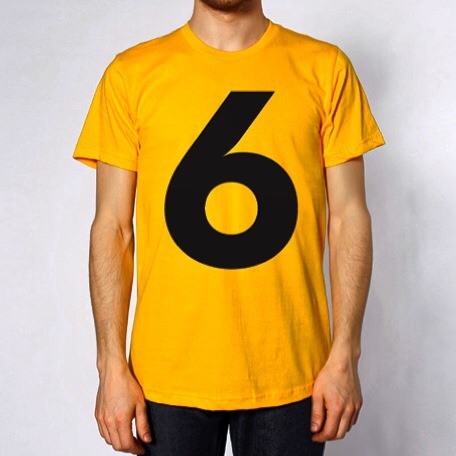
    But whatever the reason, I thought it was an interesting exercise in place branding. So I decided to partner with Toronto-based design firm Badd Press and make a “The 6” t-shirt (shown at the top of this post). You can get yours for $30 by visiting shopATC.