Daily insights for city builders, delivered every morning at 6 AM ET. I’m Brandon Donnelly — a Toronto-based real estate developer and founder of Globizen. I’ve been writing here since 2013.

Tag: city brand

  • Branding is part of city building

    Below is a good discussion with Aaron Renn about how to brand a city. I fully agree with two of the points he makes: (1) Not enough cities are thinking holistically about this topic and (2) tech startups, bicycle lanes, and craft breweries aren’t going to cut it as a strategy. Every city is focusing on that sort of stuff these days. Zero differentiation. Find something germane to your city and start building on it. If you can’t see the embedded podcast below, click here.

    [soundcloud url=”https://api.soundcloud.com/tracks/436104924″ params=”color=#ff5500&auto_play=false&hide_related=false&show_comments=true&show_user=true&show_reposts=false&show_teaser=true&visual=true” width=”100%” height=”300″ iframe=”true” /]

  • World’s best city brands

    Resonance Consultancy – they do brands and strategies for places and products – has just released a new report called: World’s Best City Brands – A Global Ranking of Place Equity.

    With all of these sorts of rankings, it really depends on the research methodology being used and the rigor in which it is being applied. In this case, they evaluated each city based on “six pillars of equity”:

    1. Place: Perceived quality of a city’s natural and built environment
    2. Product: A city’s key institutions, attraction and infrastructure
    3. Programming: The arts, culture and entertainment in a city
    4. People: Immigration and diversity of a city
    5. Prosperity: Employment, GDP per capita entertainment in a city and corporate head offices
    6. Promotion: Quantity of articles, references of a city and recommendations online

    What’s perhaps unique about this study is that it combines measurable statistics with “visitor perception metrics” – data that they mined from social media. Here’s an excerpt from the methodology page:

    “Our team became interested in the way visitors and citizens themselves influence the identity and perception of cities. Increasingly, they do it through their evaluation of experiences on social media and via the comments, images and reviews they share with family, friends and people around the world. These opinions and attitudes, much more than traditional marketing, influence the way people perceive places today.”

    This is a fascinating shift for city brands and is something that we have discussed before on this blog. All of us are now involved in telling the story of the places in which we live and visit.

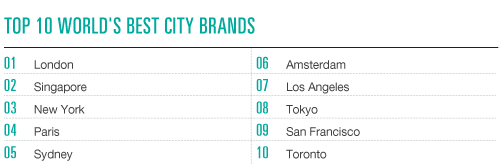
    The entire report is well done and worth a read. It’s also a free download (you’ll need to enter your contact info). But below are the top 10 world’s best city brands. Not really any surprises for me. What about for you?

    image

  • The city is the brand

    Oslo Barcode I by Michel Krämer on 500px.com

    https://500px.com/embed.js

    I was reading the internet this morning and I stumbled upon an interesting urban blogger from Oslo named Erling Fossen. Most of his writing is in Norwegian, but he does have a section called “City Notes” that is in English.

    I enjoyed this paragraph titled, "The city is brand.” It is taken from a post called, “7 lessons from Oslo Urban Arena.”

    As cities compete to attract talents, companies and investment, many cities have branded themselves as either the most creative city in the world, the smartest or the most liveable. In many occasions cities develop slogans to go with the message. But as brand expert Martin Boisen said: No one has ever moved to a city due to a logo. Action speaks louder than logos. Branding cities can actually be helpful. The world is a stage, and your city has a role to play. The first message is to avoid being a copy cat and focus on your own uniqueness. It is also just as important to involve a larger community to make branding work. It takes a village to brand a place. Equally important is to have strong leadership communicating the message. Strong leaders can rock the boat.

    I’ve written about city branding quite a bit here and this has always been my message. An excellent city brand must stem from some form of reality. If you want to be the most creative or the greenest city in the world, then you have to live and breathe that philosophy.

    I also feel strongly about not copying other cities. You might think that having (insert thing here), which was pioneered in (insert city here), will make you world-class. But that’s a pretty banal way of going about things.

    Instead, to reiterate Fossen, focus on your own uniqueness. Then market the hell out of it.

  • How cities get branded

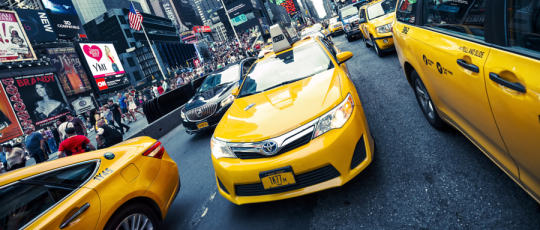
    Taxi on Times Square by frederic prochasson on 500px.com

    https://500px.com/embed.js

    I have been thinking a lot about city branding lately. It’s a topic I’m interested in to begin with, and all of the Blue Jays mania going on in Toronto right now has got thinking about our own brand.

    Because at the end of the day, yes, it’s baseball. But it’s also something much larger. It’s about civic and national pride, and it’s about who we are as a city. That’s why city branding has become a global industry and why it’s so closely connected to tourism, media, sports, and entertainment.

    Still, great city branding is incredibly difficult to do. Lots of cities have tried and lots of cities – from Adelaide to Toronto – have failed. Anyone remember the “Toronto Unlimited” brand of the mid-2000′s? It had absolutely zero stickiness.

    But in reality, cities are brand building all the time whether they realize it or not. Here in Toronto, our biggest brand builder right now is probably Drake. That might sound silly to some, but I believe it to be true. And next to that, you have people like Jose Bautista with his bat flips and his support of local brands like Peace Collective. In addition to their day jobs, these people are helping to shape the identity of the city.

    What, then, is professional city branding supposed to do?

    Well, in my opinion, it is their job to mine a city for the things that already exist. A city brand, no matter how great it may be, cannot be expected to create something from nothing. There has to be something there to begin with.

    But once you identify that something, a great city brand can tie it all together; create a cohesive and collective identity; and serve as a guide for future decision making. And when that’s done effectively, you actually begin to enhance the things that you initially started out with. The associations become even more powerful.

    So today I thought we could have a discussion in the comments about city brands. How would you describe the brand of your city in one sentence?

    For me, I would describe Toronto along the lines of being the most livable and multicultural 24/7 global city. And when you think of it this way, you can probably see why I think a 2AM last call at the bar is laughable.

  • Laneways and ravines

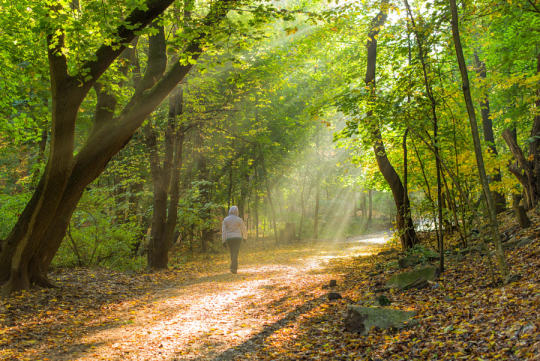
    Solitude by Lionel Linton on 500px.com

    https://500px.com/embed.js

    I have a new mission for this summer: To explore more of Toronto’s ravines.

    Last week I had a fascinating conversation with Steve Heuchert of the Toronto and Region Conservation Authority (TRCA). Most developers in this city would probably cringe when they hear those words. Because often when the TRCA gets involved it means your project is about to get more complicated.

    But if you take a step back and look at the larger city building equation, our ravines are a remarkable and unique feature of the Toronto area landscape.

    And unless you live near one or are fortunate enough to have a home that backs onto one, I suspect that for many of us this city’s ravines are a somewhat forgotten layer of the urban fabric. We drive by them. We pass through them on the subway. But they don’t really register in the way that they should.

    And so if you think about it, our ravines actually share many similarities with our laneways (alleys). We know they exist, but we could be doing a lot more to truly celebrate and integrate them into the rest of the city. They are missed opportunities.

    The challenge with our ravines though is finding the right balance between preservation and increased usage. But this isn’t something that a great landscape architect couldn’t help solve.

    So today’s thoughts are: How do we increase ravine awareness? How do we improve access and expand their uses? How might we craft our ravines to become an interconnected open, green, and cultural network within the city? And how do we better position the ravines as part of Toronto’s overall city brand?

    If you’re interested in this topic, check out this talk that Steve Heuchert did last year. It was part of an event that Megan Torza of DTAH organized called RavinePortal.