Daily insights for city builders, delivered every morning at 6 AM ET. I’m Brandon Donnelly — a Toronto-based real estate developer and founder of Globizen. I’ve been writing here since 2013.

Tag: cities

  • Why do more people in Quebec sell their home without an agent?

    If you ask most people, they’ll tell you that real estate agents will never ever disappear. 

    Despite the internet, mobile phones, social networks, and companies (here in Canada) such as comFree and PropertyGuys, the bulk of the market still employs an agent when it comes time to buy and/or sell a home. This is true both in Canada and the United States. And it may always be true.

    But there are lots of entrepreneurs and people in the real estate community experimenting with different models. OpenDoor and Open Listings are two new startups out of the US that I’ve been following closely.

    At the same time, there is a certain fraction of the market that is willing to go at it alone. By some estimates this number could be as high as 25% in Canada. Of course, this is a hard number to measure accurately since there isn’t just one method of selling a home privately and many transactions likely go untracked.

    But one thing that I’ve been wondering for awhile now is why the percentage of private home sales is seemingly so much higher in the province of Quebec. According to Wikipedia, this number might be greater than 50%. And a quick search on comFree (duProprio in Quebec) seems to suggest that this may indeed be the case.

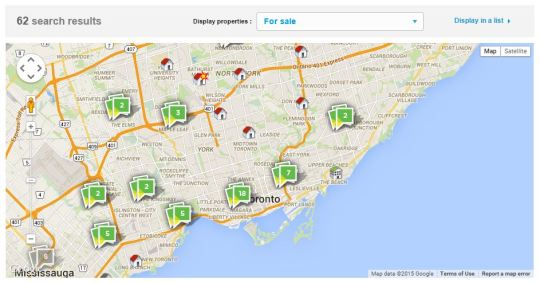
    Here are the comFree search results for downtown Toronto. There are 62 properties.
    image

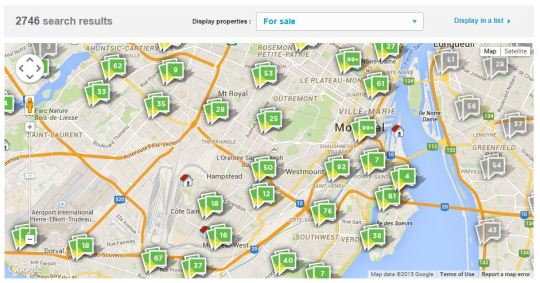
    And here are the duProprio search results for downtown Montreal (notice I tried to maintain the same zoom level). There are 2,746 properties.
    image

    If anyone has any insights on this phenomenon, I would love to hear from you in the comment section below. I don’t know why this is the way it is.
  • The high cost of poor land use

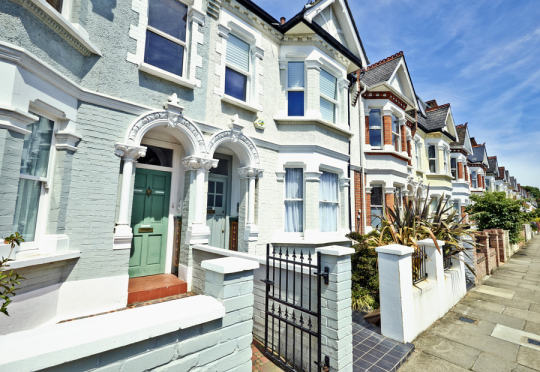
    Photograph London street of early 20th century Edwardian terraced houses by Bombaert Patrick on 500px

    London street of early 20th century Edwardian terraced houses by Bombaert Patrick on 500px

    Over the weekend The Economist published an interesting article called, Space and the city: Poor land use in the world’s greatest cities carries a huge cost. The argument is that land isn’t scarce. It’s the land use policies we have created that are artificially limiting supply and driving up real estate values.

    In fact, land is not really scarce: the entire population of America could fit into Texas with more than an acre for each household to enjoy. What drives prices skyward is a collision between rampant demand and limited supply in the great metropolises like London, Mumbai and New York. In the past ten years real prices in Hong Kong have risen by 150%. Residential property in Mayfair, in central London, can go for as much as £55,000 ($82,000) per square metre. A square mile of Manhattan residential property costs $16.5 billion.

    And part of the reason this has become so prevalent is because of the shifts we’ve seen in our economy and the great return back to cities.

    In the 20th century, tumbling transport costs weakened the gravitational pull of the city; in the 21st, the digital revolution has restored it. Knowledge-intensive industries such as technology and finance thrive on the clustering of workers who share ideas and expertise. The economies and populations of metropolises like London, New York and San Francisco have rebounded as a result.

    So how do we get better at meeting real estate demand in our cities? The Economist has two suggestions.

    One:

    First, they should ensure that city-planning decisions are made from the top down. When decisions are taken at local level, land-use rules tend to be stricter. Individual districts receive fewer of the benefits of a larger metropolitan population (jobs and taxes) than their costs (blocked views and congested streets). Moving housing-supply decisions to city level should mean that due weight is put on the benefits of growth. Any restrictions on building won by one district should be offset by increases elsewhere, so the city as a whole keeps to its development budget.

    Two:

    Second, governments should impose higher taxes on the value of land. In most rich countries, land-value taxes account for a small share of total revenues. Land taxes are efficient. They are difficult to dodge; you cannot stuff land into a bank-vault in Luxembourg. Whereas a high tax on property can discourage investment, a high tax on land creates an incentive to develop unused sites. Land-value taxes can also help cater for newcomers. New infrastructure raises the value of nearby land, automatically feeding through into revenues—which helps to pay for the improvements.

    These recommendations will probably be unsettling for a number of people. 

    I would imagine that many communities would prefer to have planning and growth decisions happen bottom up, as opposed to top down. But I think there’s some truth to this recommendation and I don’t think it has to mean completely excluding bottom up feedback. Communities and individuals are naturally going to look out for their own self-interests. And so I think many would agree that there’s value in having a holistic urban strategy in place.

    Recommendation number two pertaining to land value taxes is a loaded one. So I’m going to save my specific comments for a dedicated post on LVTs. 

    But I will say that I don’t think trying to squeeze landowners into development via taxes is the most efficient and immediate way to address supply shortages. In advance of this, we should be examining the current barriers to development. Because we’re talking about hyper competitive global cities with perpetual supply deficits. And I don’t believe the problem is incentive-based. The problem is finding sites. The problem is finding ways to build.

    What do you all think? This is an interesting topic of discussion.

  • From seigneurial land tenure to condominium plans

    One of the things I noticed this past weekend when I was on my Porter Escape in Quebec City was that there’s still evidence of the seigneurial land use system. I saw it on île d’Orléans.

    Established in 1627 in New France, the seigneurial system was a feudal way of distributing land and creating subsistence farming for those who occupied it. It was ultimately abolished in 1854, but you can still see vestiges of it.

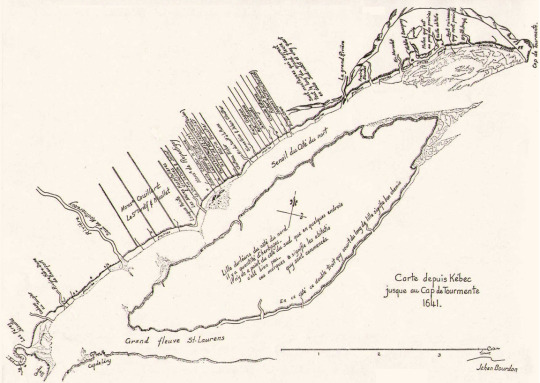
    With the seigneurial system, a typical farming lot was a long and narrow strip of land emanating from the water, which in this particular case was the St. Lawrence River. Here’s a map from 1641 showing what that looks like:

    image

    The reasoning behind this spatial arrangement was rather simple. By having long narrow lots, it meant that you could maximize the number of farmers who had direct access to water. This was needed for navigation, but also for many other obvious reasons. This was an efficient layout.

    At the same time, the long strips meant that each farmer had access to a broad cross section of different kinds of land. They had fertile land for growing, land for their home, and frequently land with trees so that they had material to build, fuel to burn, and so on. It also meant that, despite the overall lot sizes, people actually lived fairly close to each other. It created communities.

    Of course, there’s a lot more to the seigneurial system than just its physical form and there are reasons it was eventually abolished. But today I just want to focus on spatial layout. Because I think there are parallels to how we continue to plan our communities.

    If you live in a city you’ve probably come across a narrow rowhouse, a narrow townhouse, and/or a long and narrow condominium – which many people like to pejoratively refer to as a “bowling alley” plan. In these cases, the width of the home could be somewhere between 10 and 13 feet.

    If you stop and think about this, it’s exactly the same spatial principles as the seigneurial land use system. But instead of maximizing the number of people with access to the St. Lawrence River, it’s about maximizing the number of people who front onto the street and who have access to natural light.

    In tight urban conditions, it’s not uncommon to have no “side yard windows.” In my case, I live in a condominium with 20′ feet of windows on one side only. The other 3 sides of my box have none. And that’s a fairly common urban condition.

    I find this interesting because as much as the world is rapidly changing, some things don’t actually change all that much.

    Image: Wikipedia

  • Amazon Dash — foolish joke or disruptive innovation?

    [youtube https://www.youtube.com/watch?v=NMacTuHPWFI?rel=0&w=560&h=315]

    Earlier this week on the day before April Fools’, Amazon launched two new services. The first was called Amazon Dash (see above video) and the second was called Amazon Home Services. The entire internet seemed to think that Dash was actually an April Fool’s joke, but it turns out it’s not. In fact, it’s actually an incredibly smart product.

    The way it works is simple. Each branded Dash Button is about the size of a pack of gum. You mount it in, on, and near things that you replace on a regular basis, such as laundry detergent, coffee refills, and so on. Then all you have to do is push the button and your order gets sent to Amazon. Shortly after the product arrives at your door. I say “shortly” because you can be certain that Amazon’s goal is to make that time frame as short as physically possible.

    I don’t know about you, but I could definitely see myself using this product. There are a number of essentials – such as laundry detergent and toilet paper – that I just hate shopping for. I have to create reminder appointments in my calendar just so I don’t forget. In fact, I did that today and I still forgot to pick everything up on my way home (my phone died).

    But what’s even more interesting about Dash, I think, is that it increases the threat to brick-and-mortar retailing and, more specifically, big box stores. Because if same day and same hour delivery is a big threat to big box stores, just imagine one button and same hour delivery. And, is it only a matter of time before something like this comes to Apple Watch? It seems like the right medium for it.

    Isn’t it interesting how something that most people believe is a silly joke could actually turn out to be a huge innovation? I try to always remain open minded. Sometimes it’s hard. But it’s good practice.

  • “Project Snowball” cracks down on UberX drivers in Toronto

    https://500px.com/embed.js

    This afternoon I saw on Twitter that Toronto Police are now starting to crackdown on UberX drivers in the city. The investigation is called “Project Snowball” and they have already charged at least 11 people. The fines are anywhere from $200 to $20,000.

    My response on Twitter was the following:

    I get that Uber is a highly disruptive company. I’ve written about it many times before. But at the end of the day, this is not just about Uber. This is about a larger shift in the economy.

    The buzz term is “sharing economy.” But one of the ways I like to think about it is like so: Facebook doesn’t produce any of its own content, and yet you could define it as a media company. Airbnb doesn’t own any rooms, and yet it is disrupting hotels. Uber doesn’t own any cars or plates, and yet it is disrupting the taxi industry.

    What’s happening is that the internet and mobile phones are allowing for peer-to-peer connectivity and more decentralized forms of marketplace supply.

    What does that mean?

    It means that instead of having a fleet of cars or a centralized hotel building, anyone with an extra car or an extra room (and an internet connection) can plug themselves into the market. And that represents an entirely different cost structure for businesses.

    It’s worth noting that prior to Uber, Travis Kalanick founded a peer-to-peer music sharing company called Scour (1998). Its closest equivalent would have been Napster. Remember Napster? This is not a new trend.

    That said, I still think we’re at the early stages of this shift. I predict that many other industries will see disruptors similar to Airbnb and Uber. And so when I look at it in this context, I have a hard time believing that fining UberX drivers is the most enlightened way forward.

    I believe we should instead be taking a leadership position and trying to figure out how to adapt our rules and regulations to this changing economy. Toronto is not alone in this battle. But we could certainly be the one to lead the way out.

  • From suburban houses to downtown condos

    Last Friday the Financial Post published an interesting article talking about Mattamy Homes and the new office that its founder, Peter Gilgan, is in the process of opening up downtown in the Toronto-Dominion Centre (which just so happens to be my favorite office complex in the city).

    At 64 years old, Peter recognizes that his company has changed and the world has changed. He he himself recently moved downtown and now he’s bringing his company with him.

    “Our Oakville office [a western suburb of Toronto] is a reflection of what our business was 25 years ago,” he says. “We were a local, west-end Toronto builder. Now we’re the largest home builder in Canada and we’re the largest private home builder in all of North America.”

    Come September he will move his finance, legal, IT, human resources and strategic marketing team —  about 100 of Mattamy’s 1,100 staff — into the new downtown digs. He wants to attract “the absolute best talent.”

    “The young people seem to really want to work down here. So that’s one reason. The other thing is to make sure the business has the capital to move forward and expand. Well, where’s the capital? It ain’t in Oakville.”

    This of course isn’t a new thing for suburban homebuilders. Many in Toronto have made the switch – or at least expanded – from suburban houses to downtown/urban condos. And I’m assuming that’s what is going to happen here.

    Still, it’s fascinating to see this trend continue. Young people really do want to live and work “down here.”

  • Day 1 in Quebec City

    I just checked into the Chateau Laurier Quebec after a busy day touring the city. I don’t have a ton of time to write this post before dinner (though I have a few post ideas brewing). I did however want to share some of the day’s events and some of my photos.

    After I landed I went straight to Île d’Orléans. I had never been there before so I’m glad I got the opportunity. It’s about twice the size of Manhattan and it has a population that hovers somewhere between 7,000 and 10,000 people depending on the season.

    The first stop was a “sugar shack”, which is apparently a big deal in Quebec and in the springtime. The place was packed. Here I had a traditional Quebec lunch (which was great) and I learned that all of the Canadian stereotypes are actually true. We really do put maple syrup on everything.

    After lunch I then asked if we could stop at a few of the local wineries. I love wine and I love wine culture.

    imageimageimage

    I picked up one bottle of “wine” from Cassis Monna & Filles. It’s actually made from black currants though, which I was told was illegal to grow in North America for a long time. It’s far more popular in Europe.

    The winery is run by a father and his two daughters. And I thought they did a great job with their brand story and their overall identity.

    After leaving the island, I then went to the Montmorency Falls. I had no idea Quebec had falls, but they do. And the vertical drop is bigger than that of Niagara Falls.

    image

    Finally, I finished the afternoon with a quick tour of downtown and the OMA designed expansion to the fine arts museums. It has one aggressive cantilever.

    Here’s a video of the project. Click here if you can’t see it below. 

    [vimeo 111133943 w=500 h=281]

    If you’re interested, you can also follow my social posts on the Porter Escapes website by clicking here.

  • Architect This City x Porter Escapes (in Québec City)

    Towards the end of last year I received a one line email from a reader asking me what I thought about Porter (the airline that operates out of Toronto’s island airport downtown).

    I followed suit and responded with one line: “I’m a big fan.” I then pasted a few links to posts I had written where I talked about Porter, the island airport, and why I think they are good for Toronto.

    It turns out that was the right answer 😉

    Because today I’m excited to announce a fun collaboration between Architect This City and Porter Escapes. This weekend I get to explore Québec City and do something I love to do, which is photograph cities, think about cities, and write about cities. (And eat poutine.)

    Here are my travel essentials for the weekend (I wish it was a better photo):

    image

    The first thing I should tell you though is that Porter Escapes is different than simply Porter. Porter Escapes is their “packaged vacation” company, so it’s designed for people who want a simple way to book entire getaways (flight, hotel, activities, and so on).

    In my case, I’m going to be staying at the Château Laurier. I also have a bunch of activities planned out for Saturday during the day. Stay tuned.

    I had initially planned to squeeze in some snowboarding at Le Massif and try out the nicely branded train that goes from Québec City right to the mountain. But my back and shoulder are still tender from my spill in Banff.

    Still, I hope you’ll follow along on Twitter, Instagram, and Snapchat, and using #PorterEscapes. And if you happen to be in Québec City this weekend, let’s grab a pint and poutine.

    I’ve also been told that Porter Escapes will be launching a special promotion over the next few days for escapes specifically to Québec City.

    Note: I’m supposed to tell you that it’ll be at a price point that you should never expect to see again (i.e. it’ll be a steal).

    Happy Friday 🙂

  • Morphosis proposes tallest building in Europe — in the Swiss Alps

    image

    A controversial design proposal for the tallest building in Europe has been making the rounds online over the past few days. Designed by Morphosis Architects, the 381 meter-tall tower is being proposed in Vals in the Swiss Alps. 

    And pretty much everyone seems to hate it.

    When I first came across the design, I truthfully had to do a double take to see if it was actually a real proposal. But it seems to be. Everyone is writing about it.

    Clearly there are some interesting tensions at play here. You have a hyper-urban building typology in a mountain town setting, but with materials that are intended to make it dematerialize into the landscape.

    So I thought we could have a discussion about it in the comments.

    Is a small mountain town the right place for the tallest building in Europe? Could it work as a one-off tower?

    Image: Morphosis Architects via ArchDaily

  • I’m giving away a free Architect This City t-shirt

    I’m giving away a free t-shirt on April 1st, 2015 exclusively to Architect This City subscribers. There’s no catch. And no this is not an April Fool’s joke! I just want to say thanks to the people who read ATC on a regular basis. It’s that simple.

    So how does it work?

    1. You need to be an Architect This City email subscriber (either daily or weekly). If you’re not yet a subscriber, you have until midnight on Tuesday, March 31st, 2015 to make that happen. You can do that by clicking here. It’s free.
    2. You need to visit architectthiscity.com and pick the t-shirt you want. There are currently 5 different ones to chose from (the original ATC tee comes in both ATC orange and black).
    3. Finally, you need to leave a comment at the bottom of this post telling the community 2 things: which t-shirt you want and your favorite thing about your own city. That’s it.

    On April 1st I will randomly select somebody from the comments, check to see if they’re a subscriber, and then send them a free t-shirt.

    Simple, right? I’m really looking forward to giving away a t-shirt.