Daily insights for city builders, delivered every morning at 6 AM ET. I’m Brandon Donnelly — a Toronto-based real estate developer and founder of Globizen. I’ve been writing here since 2013.

Tag: cities

  • Houston, the global city

    Houston doesn’t often get a lot of love in urbanist circles.

    Though since Ed Glaeser published Triumph of the City and declared Houston’s unfettered sprawl the secret sauce for housing affordability, it is now frequently held up as the shining example of why housing supply matters.

    But this is a hotly debated topic. 

    Ed Glaeser would argue that increased supply is the key to housing affordability. But Richard Florida would likely be quick to point out that Houston is also one of the most unequal and segregated cities in America. It is not the model we should be following.

    But let’s be positive today on the blog.

    At the bottom of this post is a great talk by Stephen Klineberg called: Houston, The Global City. Klineberg is a Professor of Sociology at Rice University and the founder of the Kinder Institute for Urban Research.

    In this hour long talk, he outlines, among other things, the remarkable transformation of Houston from a one-industry town (oil) comprised predominantly of white people to a mixed economy where every major ethnicity is now a minority.

    He also argues that Houston is at the forefront of the demographic shifts happening all across the country and that, without this inflow of immigrants over the past couple of decades, Houston today would probably look a lot like a decaying rustbelt city.

    It’s a good watch.

    If you can’t see the video below, click here.

    [youtube https://www.youtube.com/watch?v=SJdWYXIr_qE?rel=0&w=560&h=315]
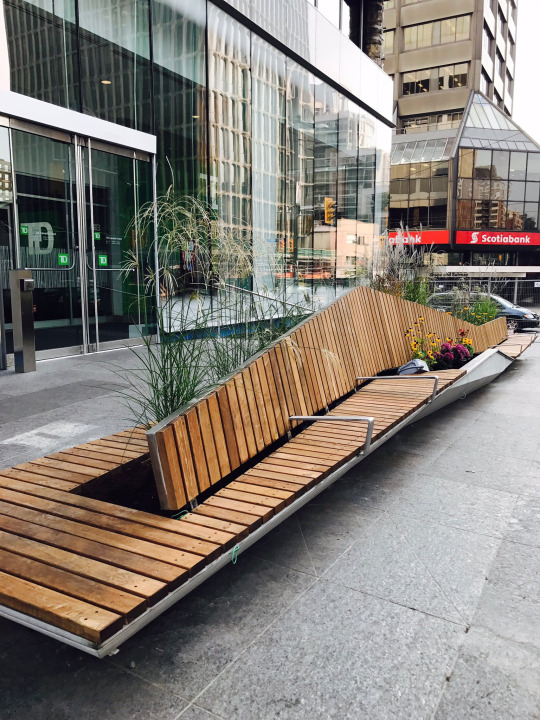
  • Celebrate the sidewalk (at Yonge + St. Clair)

    I have two quick announcements to make regarding Yonge + St. Clair in midtown Toronto.

    The first is that Slate has just unveiled a new “ravine bench” at the northeast corner of the intersection. 

    Here’s a photo:

    And here’s another photo with people sitting in it. #SitTO

    Designed by Gensler (the same firm behind the renovation of 2 St. Clair Ave East), the design is all about celebrating both the sidewalk/public realm and the extraordinary ravines that cut through the area. Some people may not even be aware of these natural features, so perhaps this bench will help with that.

    The second announcement is the launch of our Yonge + St. Clair Pop-up Store at 1470 Yonge Street. I know this is short notice, but the launch party is on Thursday, September 21 from 6 – 10pm (drop in whenever). That’s tonight if you’re reading this post via email subscription.

    At the party we’ll be introducing 8 exclusive t-shirt designs from Toronto artist, Lucas Young. All of the tees will be screen-printed for you right on the spot and 50% of all proceeds from the opening night will be going to The Canadian Cancer Society. 

    Wine, beer, and snacks will be available. If you come find me at the party, I’ll give you some drink tickets. So if you’re around on Thursday night, come by for some drinks, a Toronto tee, and to check out the new ravine bench on Yonge Street.

  • My old Philly apartment

    I’m in Philly right now for a good friend’s wedding. 

    I always feel nostalgic when I come back to this city. Some of my most memorable years were spent here. I grew a lot in those 3 years. I also think that Philly is a highly underrated city – such an intimate urban scale.

    I’m staying at the newly renovated Warwick Hotel in Rittenhouse Square. The lobby is beautiful, as are the corridors, but the rooms already feel a bit a dated to me. However the Barcelona Chair in my room is a welcome addition. That thing will never go out of style.

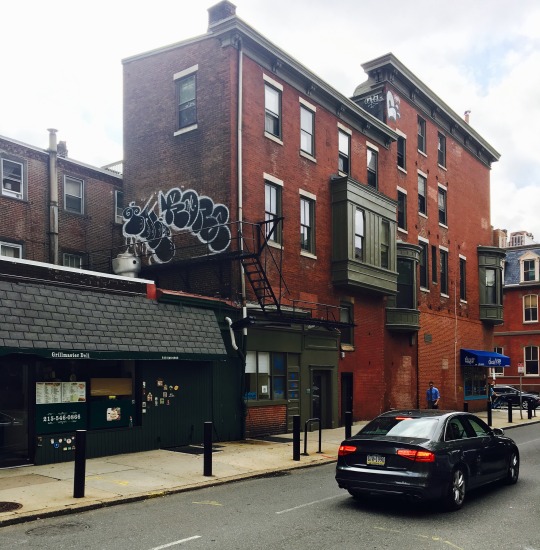
    My hotel happens to be two blocks away from my old apartment at 17th and Spruce. So I decided to do a walk-by while I waited for my room to be ready. My roommate and I had the entire second floor of this building:

    It was palatial, especially given the bargain price and its location in Rittenhouse Square

    The graffiti you see above is located on the north wall of the kitchen. I think that’s a recent addition. The fire stair you see provided access to the roof of the building (as well as the street, I hope). I’m not sure we were supposed to go up there, but we obviously used it for parties.

    Grillmaster Deli is still next door. They kept me fed when I was studying at home and too busy to cook. That was often. And across the street is the Italian restaurant with its sidewalk patio that I used to look out onto from my bedroom.

    This walk-up apartment was by no means fancy. Though it did have ensuite laundry, which was a nice improvement from my previous place. But it was unabashedly urban. My kind of place.

  • The 10 most promising Hyperloop routes (and thoughts on the naysayers)

    image

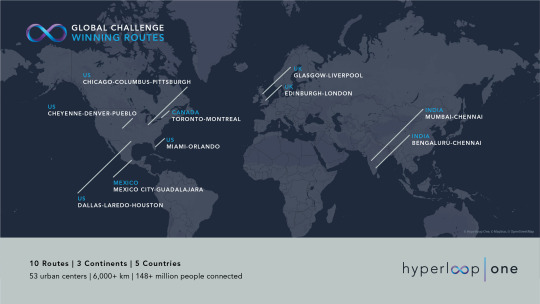
    On September 14, 2017, Hyperloop One announced the 10 winners of its Global Challenge. These are the world’s “most promising” Hyperloop routes; selected through a process that began in May 2016 and involved more than 2,600 registered teams.

    The winners:

    1. Canada | Toronto-Montreal
    2. India | Bengaluru-Chennai
    3. India | Mumbai-Chennai
    4. Mexico | Mexico City-Guadalajara
    5. UK | Edinburgh-London
    6. UK | Glasgow-Liverpool
    7. US | Chicago-Columbus-Pittsburgh
    8. US | Miami-Orlando
    9. US | Cheyenne-Denver-Pueblo
    10. US | Dallas-Laredo-Houston

    If you aren’t familiar with what Hyperloop One is trying to accomplish, here is a quick video explaining the basics. Their goal is to have the world’s first operating Hyperloop by 2021.

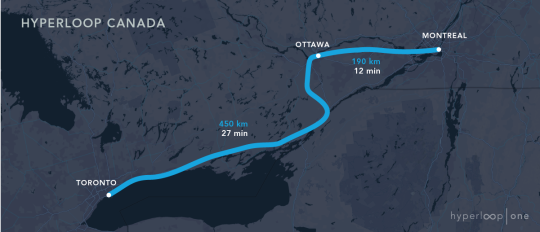
    If you happen to live in one of the above regions (about 148 million of us do), then you are probably already seeing the headlines in your feeds. For Canada, the promise is of connecting 25% of our country’s population with one single Hyperloop route.

    It would mean Toronto-Montreal in just 39 minutes:

    image

    This is shorter than many morning commutes. So it’s not hard to see why this is a tantalizing proposition. It would mean a union of our two biggest cities and our capital. More accessible Montreal bagels. And maybe, just maybe, a strengthened sense of bilingualism in this country. 

    But there are also critics who believe that all of this Hyperloop hype is simply a distraction. Why not focus on proven technologies as opposed to some fanciful pipe dream that may never materialize? This is about stroking political egos as opposed to real progress.

    My views are pretty simple on this one.

    Will Hyperloop Canada happen? Maybe. Maybe not. I sure hope it does. But it may not. It’s easy to draw lines on a map. It’s much harder to actually execute on those lines. And of course, logistics aside, the technology is still being developed.

    But if all we ever focused our energy on were things that have already been “proven”, we likely wouldn’t create many new things. Things that today are proven, were once unproven. But they became proven because there were folks who didn’t let that minor detail deter them from trying. They went for it.

    So if a private company would like to go out and raise $160 million from private investors to try and figure out how to sustainably connect Canada’s two largest cities in 39 minutes, I am more than happy to cheerlead. Because I’m not the one trying. Who am I to naysay? 

  • The Life-Sized City

    I just discovered a new video series by TVO called, The Life-Sized City. It’s all about the “anatomy of the modern metropolis.” The first episode – which was released on Sep 13 – is on Medellin and is just under an hour long. I have a feeling that many of you will like this video series.

    Whenever I watch videos like this, it makes me think that I should be starting a city building-focused vlog. I am a big fan of this format. I follow a handful of vloggers. And I think it could be a lot of fun. But sometimes you just have to say no.

    For those of you who aren’t longtime readers, I would also like to point out that my good friend Alex Feldman wrote a guest post on this blog over 3 years ago following a trip to Medellin. It’s about what cities could learn from Medellin’s extraordinary turnaround. If you missed it, click here.

  • Fall event roundup

    image

    It’s still sunny and beautiful outside, so I don’t mean to be the one who prematurely calls fall. But I would like to get 3 Toronto events on your radar for the coming two months. 

    Full disclosure: These are all events that I support and/or my company supports in some way. 

    If you’re not based in Toronto and you don’t plan to be here this fall, you can stop reading right now and check back tomorrow. I promise to will try to be less Toronto-centric.

    1. EDIT: Expo for Design, Innovation and Technology, September 28 – October 8

    This is a 10-day immersive experience that will showcase how the intersection of design, technology and innovation can change the world. Think exhibits by Bruce Mau and Carlo Ratti; talks by David Suzuki and Scott Dadich (former editor-in-chief of WIRED and creator of the Netflix series The Art of Design); and projects spanning 3D-printed prosthetics to indigenous housing solutions. 70 speakers. 40 workshops. And over 150,000 sf of exhibits. Too much to write about here, but all topics and themes we frequently explore on this blog. Ticketing information here.

    2. NXT City Public Space Symposium, October 13 – 14

    This is a two day symposium about public space on a global stage. Talks. Public space tours. Round table sessions. And an epic after-party. Some of the speakers include Jeff Risom (Partner at Gehl Architects); Enrique Norten (Founder of TEN Arquitectos in Mexico City – and one of my grad school professors); and Mirik Milan (Amsterdam’s Night Mayor and someone who has gotten quite a bit of airtime on this blog). If you click here to grab your tickets, you’ll get 15% off. If for whatever reason that doesn’t work, use the code BDONN15.

    3. lost&gone: Romeo & Juliet, October 19 – 21 and October 27 – 28

    This is, I think, Toronto’s first truly immersive theater experience. For those of you who aren’t familiar, immersive theater is about turning the audience into participants of the production. It eliminates the “fourth wall” that traditionally divides audience and performers. I’ve heard great things about similar productions elsewhere in the world. The venue is a secret, so the show starts today with you having to try and figure out where it is in the core of Toronto. When you buy your tickets, you’ll also have to let them know if you’re a guest of the Capulets (Juliet’s family) or a guest of the Montagues (Romeo’s family). 

    Enjoy 🙂

    Photo by Brxxto on Unsplash

  • Transit advertising according to the numbers

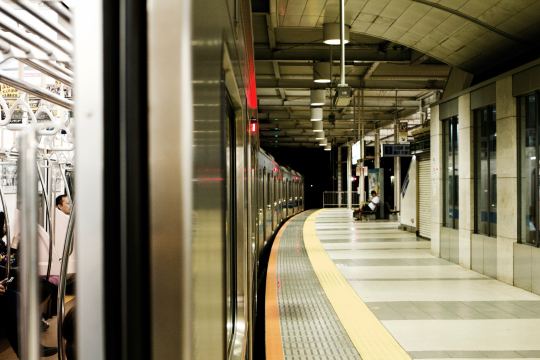
    This morning I saw this tweet about Toronto streetcar advertising. The author has a “big problem” with public transit being fully wrapped in ads and so she decided to tweet her local Councillor to see if these could be somehow limited in size.

    My first thought was: I wonder how many people would accept higher fares in exchange for fewer/no advertising. Is this something people care about? Because personally, I’ll take the lower fares in exchange for someone trying to monetize my attention. I mean, every social network I use is already selling my attention off as their product.

    But then this got me thinking about what the actual numbers look like. So let’s look at some of those for not only Toronto, but also for Hong Kong, since many people view that as the gold standard as far transit authorities go.

    For the year ending December 31, 2016, the Toronto Transit Commission (TTC) posted a total operating revenue of $1.204 billion. This represents about 41% of total revenue – the rest comes from subsidies.

    If you drill down into operating revenue, advertising makes up $28 million or about 2.33% of total operating revenue. So a pretty small number. If you tried to shift this number over to “passenger services” revenue (transit fares), it actually wouldn’t increase fares by that much. But presumably fares are already at some profit maximizing number.

    Switching to Hong Kong’s MTR Corporation, their numbers have to be unpacked a little differently because the group has a number of diverse business lines, including property development.

    For the year ending December 31, 2016, total revenue from Hong Kong Transport Operations was HK$17.655 billion (almost all fare revenue). Advertising falls within the Hong Kong Station Commercial Businesses group and that company posted revenues of HK$5.544 billion for the same time period.

    To try and create some sort of comparison, I’m ignoring all of the other segments within MTR.

    Within Station Commercial Businesses, advertising revenue alone makes up HK$1.09 billion or about 20% of that group’s total revenue. The rest comes from station retail rent (the biggest chunk), telecom, and some miscellaneous station income. 

    If you add up Transport Operations and Station Commercial Businesses, total revenue was HK$23,199 billion for the year ending 2016. Advertising comprises about 4.70% of this – so more than double that of Toronto.

    It’s also worth noting that MTR’s station retail rental revenue is about 3.4x that of its advertising revenue. In the case of Toronto, the TTC actually makes more money off advertising than it does from “Property Rental.” I’ve always thought this was a missed opportunity. Transit and land use go hand in hand.

    In any event, I’m far less fussed about advertising on transit. But what are your thoughts? Let me know in the comment section below.

    Photo by Tomo Nogi on Unsplash

  • Morning bagel run

    image

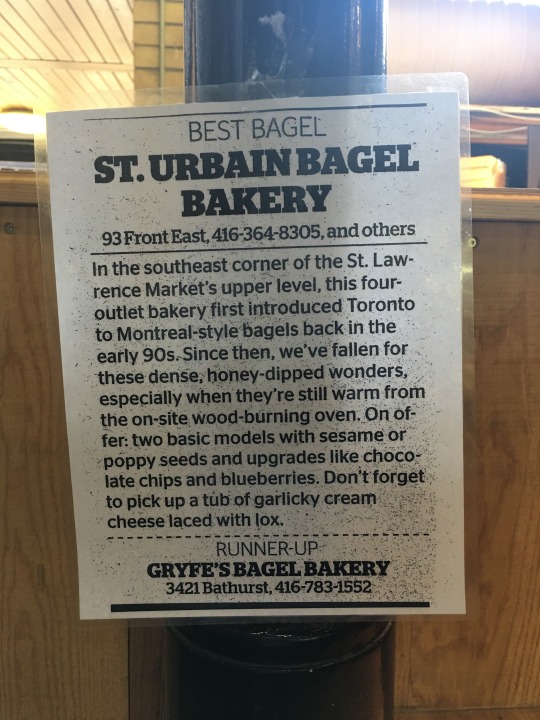
    This morning I woke up and decided that I could go for a bagel with lox and cream cheese. I figured, it’s the weekend, I’m going to treat myself. So I walked across the street to St. Urbain Bagel Bakery (see above photo).

    My Montreal friends reading this are probably thinking that this is no substitute for a Fairmount or St-Viateur bagel. But I enjoy St. Urbain. They are my go-to place for breakfast in the market.

    What I really value, though, is the ability to walk across the street and grab a bagel for breakfast. It’s a pretty simple action. Nothing complicated about it. 

    But in our world of constant traffic jams, cars that should soon drive themselves, and near-instantaneous online delivery, it can be easy to forget that there’s still something really nice about just walking down the street in the morning and saying hello to a human.

    I feel lucky that my neighborhood allows me do this. Not all do.

  • Educational attainment and urban success

    We know that educational attainment matters a great deal for the economic success of our cities. In fact, by some measures, it is the single most important factor.

    City Observatory found that 60% of the variation in per capita income across large U.S. metro areas could be explained simply by the percentage of the population with a 4-year college degree.

    So education matters a lot.

    Many of you have probably seen this entertaining TED talk by Sir Ken Robinson called: Do schools kill creativity? It has almost 47 million views at this point. 

    Well, he was recently interviewed by Ingrid Peritz of the Globe and Mail and I have to share the following quote, because I think it’s terrific (particularly the part in bold):

    “We need to recognize that children have a huge range of natural abilities and they all have them differently. Our education systems are designed to focus on a small band of those. If you have a narrow conception of ability, you end up with a very big conception of disability or inability.”

    More people with a college degree seems to be a pretty good thing. But the solution doesn’t start there. Logically, it starts much earlier – with children. 

    All of this matters not just because people with a degree should, on average, make more money and have a higher quality of life. 

    But because it’s heartbreaking to think that some young child with incredible talents might be being mislabeled as inept simply because we have a system that is, well, inept.

    I recommend you read the interview with Ken.

    Photo by Christian Fregnan on Unsplash

  • REM

    image

    “A building has at least two lives – the one imagined by its maker and the life it lives afterward – and they are never the same.” -Rem Koolhaas

    Tonight I went with a developer friend to see the documentary REM at the Hot Docs Cinema on Bloor Street. It’s a documentary about the Dutch architect Rem Koolhaas, directed by his son Tomas Koolhaas. Trailer here.

    The film is essentially 75 minutes of introspection on the part of Rem. It’s him ruminating over a continuous piece by the American composer Murray Hidary. At times it was hard to hear what Rem was actually saying.

    If you’re looking to learn the specifics of his designs and process, then this movie is not for you. Though there’s lots of footage of his buildings. It also does not make clear just how much influence he has had professionally. I mean, everyone from Bjarke Ingels to Jeanne Gang once worked at his firm.

    The film is really about getting inside the mind of Rem as he travels the world. What struck me is Rem’s profound curiosity for seemingly everything. He really is obsessed with analyzing, documenting, and reporting. He refers to it as a compulsion.

    I also like the idea put forward that architecture represents a particular moment in time. If you’re precise about things, you may be right the moment the building is complete.

    But from that point onward, everything begins to change around it and you will be wrong. That’s what the quote at the top of this post is getting at.

    So I enjoyed it – but probably because I’m an architecture geek and Rem is arguably the most influential living architect today. But I’m not going to tell you that this film is a must-see.

    P.S. Who knew, Rem Koolhaas flies economy.

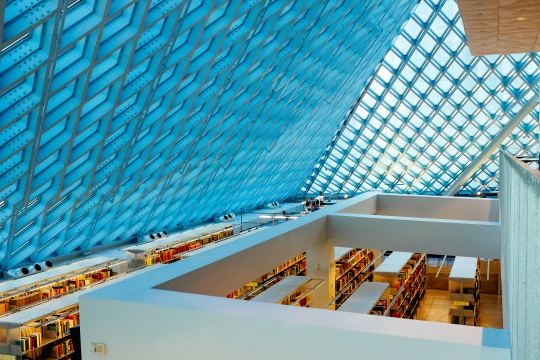
    Photo by Pavan Trikutam on Unsplash