Daily insights for city builders, delivered every morning at 6 AM ET. I’m Brandon Donnelly — a Toronto-based real estate developer and founder of Globizen. I’ve been writing here since 2013.

Tag: cities

  • Good morning Hong Kong

    image

    It’s about 6:30 am on new year’s eve day and I’ve been awake since around 4:00 am because of jet lag. I initially resisted, but now I am up and starting my day. 

    The coffee shop downstairs doesn’t open for another hour so this is coming to you live from my surprisingly spacious hotel room. (I’ve been in far smaller both here in Hong Kong and in New York.) There’s a wide array of teas available in this room, but sadly no coffee. I could go for a coffee right now.

    I took the express train in from the airport last night, which is what I did the last time I was in Hong Kong over a decade ago. It takes just over 20 minutes and it is a great way to get into Central. It immediately signals to you that this city thinks and cares about efficiency.

    The experience of landing and getting into a city is an important, but often neglected, consideration. For many people this is their first impression of a place and so it only makes sense to pay attention to it. 

    Think of it like fine dining. Most nice restaurants will greet you at the front, take your coat, and show you to your table. Few expect you to come in the backdoor and wander bewildered through the kitchen. But that’s what some cities ask you to do after you land.

    Come to think of it, I left Toronto aboard our own airport express train. That’s standard practice for me. And so I started and ended my 2-day journey on efficient rail. I’m good with that.

    Before signing off for today, I would like to apologize for missing yesterday’s post. I was in the air for over 19 hours without internet. I also didn’t have much to say. As always, you should expect me to show up here every day. But expect more travel-related posts over the next week to go along with my Instagram posts.

    I would also like to point you toward this tweet storm by Shawn Micallef (discovered during jet lag haze). Please do me a favor and check it out. It is a hilariously accurate satire about many of the city building challenges that cities face today, told by way of a miniature “Dickens Village.”

    https://platform.twitter.com/widgets.js

    And with that, I wish you all a happy new year. See you on the other side. Bring on 2018.

    Photo: Night shot of Gloucester Road from pedestrian overpass

  • 2017 year in review

    I just finished going through my list of 2017 goals. I didn’t accomplish everything I wanted to, but I did manage to check off a number of professional and personal goals.

    Some of the remaining goals have been pushed to 2018. But there are also items that I have since realized aren’t worth pursuing and so I have dropped them from the list.

    All that said, it was a great year. Here is a rapid-fire summary of 2017 told through posts from this blog.

    Thanks for reading. Onward my friends.

  • Waste and efficiency

    Here are a couple of cut-up snippets from a recent post by Seth Godin titled: “Waste and the new luxury.”

    Luxury goods are built on a foundation of waste.

    The front lawn is a luxury good, a sign that you don’t need to graze your cows on every square inch, and that you’re willing to waste the lawn.

    There’s a new luxury that’s occurring, though, one that’s based on efficiency.

    A luxury that’s based on investing in renewables, in resources that might be seen as endless, in smart design, in the satisfaction of knowing that others are benefitting, not paying, for the experience or the object you’re buying.

    Waste vs. efficiency.

    (Above is a photo I took this week in Dundas Square.)

  • Merry Christmas

    I took the above photo on Christmas Eve in Toronto’s Distillery District (one of my favorite neighborhoods in the city). It was before the snow had really started falling. We got a white Christmas this year – the best.

    This is one of the first photos with my new Fujinon 23mm f/2 (35mm equivalent) lens. I have come to realize that if I’m not photographing people, 35mm is the right focal length to have on my camera for the types of photos I seem to gravitate toward.

    And now back to eating. Merry Christmas everyone. If you’re reading this post in your inbox and it feels late, then: Happy Boxing Day 🙂

  • The impact of inclusionary zoning on development feasibility

    image

    After my recent post on inclusionary zoning in Ontario, I was asked to provide my comments on the draft regulation and on how inclusionary zoning could and will impact development feasibility. So I will endeavor to do that today.

    It’s important to first understand the costs and inputs that go into a development pro forma and how overall project feasibility is determined. For simplicity, let’s breakdown the costs as follows:

    – Land

    – Soft Costs

    – Financing Costs

    – Municipal Fees/Charges

    – Hard Costs

    All of these costs buckets are significant. For a project to be feasible, you obviously need the revenues of the project to be greater than the above costs. There also needs to be a remaining profit margin that is commensurate with the risk profile of the project and that meets your investor’s return expectations. Most developers rely on outside equity and debt to finance their projects.

    One of the misconceptions that I often hear is that people seem to think that the profit margin on projects is so great that developers could simply build affordable housing (or do many other things) if they weren’t so greedy. The reality is that development happens on the margin. It’s not easy to find sites and projects that make any sort of financial sense. More often than not they don’t.

    The other reality is that in a growing market all of the above costs are also continually increasing. If revenue (i.e. rents and condo prices) is also growing, as has been the case here in Toronto for many many years, then developers can generally absorb reasonable increases and continue building. But if revenue stops growing, grows at a slower pace or, worse, shrinks, then feasibility could disappear and development would stop.

    Now let’s talk specifically about inclusionary zoning. IZ is typically an incentivized or mandated requirement to provide a certain number of below-market housing units as part of new developments. Affordable housing is important. That’s why a number of cities already have inclusionary zoning policies – though it remains a fairly controversial tool.

    From a development feasibility standpoint, a mandatory inclusionary zoning requirement represents a decrease in revenue. There’s now a percentage of the units that can no longer be rented or sold at market prices. And so to maintain the project’s feasibility – because remember development happens on the margin – something has got to change.

    There are a few options.

    Option One: You could simply try and pay less for the land. As we have talked about many times on this blog, land is supposed to be the residual claimant. Work backwards from revenues and your other costs to determine what can be paid for the land. The problem with this option is that land prices tend to be sticky.

    Many or most landowners don’t give a shit about your development pro forma. They often have a number in mind and if you try and tell them that development charges just went up and you can’t pay as much for their land, they’ll simply sit on it and wait for someone else – even if that means waiting for the market to catch up (i.e. waiting for rents to go up).

    Option Two: Charge more for the remaining market units. If the market is sufficiently robust, perhaps this is an option. This is one of the reasons why inclusionary zoning often produces more units in markets where there’s already strong demand for new housing.

    But it’s also one of the reasons why IZ is controversial. You’re asking the other renters/buyers in the project to effectively subsidize the below market units. And there is research out there (previously posted on this blog) suggesting that in some instances IZ policies have created additional upward pressure on market rents and home prices.

    Option Three: Incentives are provided by the municipality to offset some or all of the additional burden placed on the project. This could come in the form of a density bonus, financial contribution, a waiving of other municipal charges/fees, and so on.

    Though I have questions about the details, this is something that was proposed in Ontario’s draft regulation (albeit not to the extent that the industry wanted). Now you know why I said and why I believe that these offsets are important to the industry and to overall housing affordability.

    My hope with this post was to provide the developer’s perspective, but also take a very matter of fact approach to inclusionary zoning. Most people recognize the importance of affordable and accessible housing. The question is how best to execute.

    Photo by Toa Heftiba on Unsplash

  • Great things that happened on transit

    Elon Musk’s apparent distaste for public transit and random strangers prompted a Twitter battle last week. Though for the record, Musk later clarified that he loves trains, most subways and London buses.

    Transit planner Jarrett Walker retorted that Elon’s views are the “essence of elite projection”. What’s good for Elon Musk may not, in fact, be good for the broader society. Elon responded by calling him an idiot.

    All of this prompted Brent Toderian – city planner and former chief planner of Vancouver – to initiate the hashtag: #GreatThingsThatHappenedOnTransit. It then took off and the transit stories started pouring in.

    Not surprisingly, this has been getting a lot of attention. It’s Elon Musk after all. But billionaire celebrities aside, it does serve as a good example of the two sides of this debate.

    Some people seem to think that I am anti-car. I can see why some people might think that, but I am not anti-car. I love nice cars. And I love nice trains. What I value first and foremost is the city. 

    The kind of city you can build on the backbone of transit is very different than the kind of city that gets built around the car. And as a rule of thumb, I prefer the former over the latter.

    But this is not to say that the public transit model is perfect. It’s far from perfect for many reasons. And it can get even more imperfect when we don’t pair it with the right land use policies.

    Deploying heavy rail through low density areas – that are by design inhospitable to car-less humans – will not magically flip the modal split. Public transport alone cannot solve that problem.

    At the same time, if you’re a regular reader of this blog you’ll know that I am enamoured by the possibilities of autonomous electric vehicles. I am not assuming that the “car” of tomorrow will look and perform anything like the car of today.

    Mobility is such an exciting space right now.

  • Inclusionary zoning is coming to Ontario

    On Monday the province of Ontario posted a draft regulation intended to establish a framework for inclusionary zoning. It builds on a bill that passed last year allowing municipalities – should they choose – to require affordable housing in new developments and redevelopments.

    Below are some, but not all, of the things that are being considered in the draft regulation. Some of these items were recommendations made by the development industry through the Ontario Home Builders’ Association (OHBA) and the Building Industry and Land Development Association (BILD).

    – The total number of affordable units or gross floor area dedicated to affordable housing units would not exceed 5% of the total units or 5% of the total gross floor area (excluding common areas). This number increase to 10% in high density transit station areas.

    – The affordable period would be a minimum of 20 years but no greater than 30 years.

    – There may be opportunities to provide the inclusionary zoning units off-site.

    – The policies would only apply to developments / redevelopments with 20 or more units.

    – The affordable component could not be used to determine community benefits under Section 37. Section 37 would also not apply if the proposed development (with IZ) is in a location where a development / community planning permit is used.

    – Municipalities would be required to offer incentives to help offset the IZ cost burden, but only if the development is not subject to a development / community planning permit. The incentives could include a waiver or reduction in application fees, parkland dedication fees, development charges, and so on. These offsets are very important to the industry and the affordability of the market rate units. But interestingly enough, increases in height and/or density are not being contemplated as a possible incentive or financial contribution.

    – The financial contribution would be based on the following formula: (A – B) x 0.4. A is the total sum of the average market price for all of the affordable housing units and B is the total sum of the affordable price for all of the IZ housing units. In other words, the intent is that municipalities would be required to offset 40% of the costs associated with providing the affordable units.

    Click here for the rest of the draft regulation. The OHBA also published this media release following the draft. They like the “partnership model” but were advocating for a 50/50 public/private cost share on all government-mandated units.

    If you’re looking for more reading on inclusionary zoning, check here, here, and here.

    Photo by Omair Khan on Unsplash

  • The Canada mission

    It’s the Christmas and holiday season, which means two very important things. 

    One, it’s time for the latest rendition of Urban Capital’s annual Naughty or Nice party. That was last week and it was #7. Here are the obligatory photo booth snaps to prove it happened.

    And two, the latest issue of Site Magazine (from Urban Capital) is now out. 

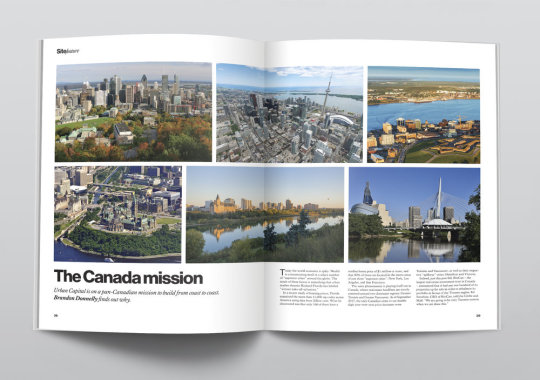
    This year I wrote a piece called “The Canada mission”. It’s all about Urban Capital’s pan-Canadian mission to build from coast to coast. How it happened. The challenges. What’s driving it. And what have been the results.

    The article includes case studies from Urban Capital’s two newest markets: Saskatoon and Winnipeg. 

    One of the things that I didn’t fully appreciate until I started researching for the article was just how pioneering these projects were. At the time, there were no proof points to suggest that the pro formas would work. And this is a leap of faith that Urban Capital has had to make on many of its projects.

    Click here to download a PDF of the full magazine.

  • Urban vs. suburban home prices

    Aaron Terrazas, who is a Senior Economist at Zillow, recently gave this presentation about the US and Virginia Beach housing markets. (I discovered it through City Observatory.)

    There are a bunch of interesting graphs/stats in the presentation. Home values in Virginia Beach, for example, have yet to fully recover from the 2007-2008 financial crisis. They are still 8% below their pre-crisis peak, which was in July 2007. (I presume the presentation is dealing in nominal dollars.)

    I’ll give two more examples. 

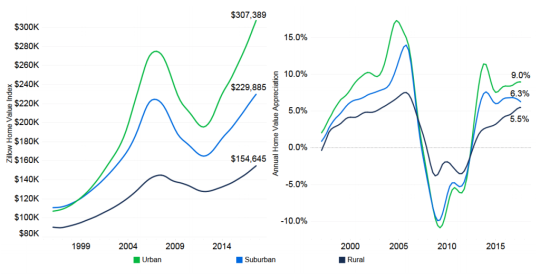
    Below is a chart comparing average home prices for rural (dark blue/purple), suburban (blue), and urban (green) homes. In the late 90′s, suburban and urban homes were roughly equal in terms of average prices. But since then, urban homes have shown greater appreciation. The spread also appears to be widening.

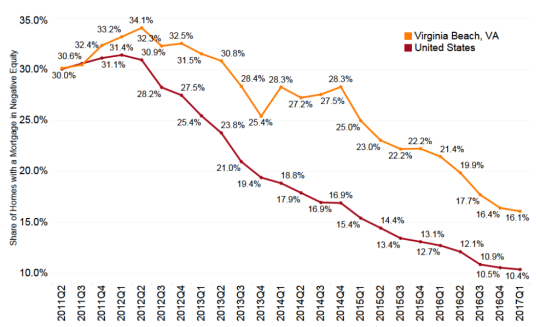
    And here is a graph showing the share of mortgage borrowers in a negative equity position. That is, the value of the home is less than the outstanding balance of the mortgage.

    Now this is only covers people who have a mortgage. According to this Washington Post article, about 34% of all US homeowners don’t have one. Either they have paid it off or they never had one.

    Still, the above numbers stood out to me. They speak to the severity of the financial crisis. At the end of 2011 and the beginning of 2012, over 30% of borrowers were in a negativity equity position. And in Virginia Beach it was more than 1/3 of all borrowers at the peak.

    For the full presentation, click here.

  • 50th year anniversary of Playtime

    This month is the 50th year anniversary of the Jacques Tati film, Playtime. Initially released in December 1967, Playtime is a French comedy that is often considered to be director Tati’s most notable work. Apparently it was commercially unsuccessful at the time of its release. But it has since become recognized, at least by some, as one of the greatest films ever made.

    The film is a satire of modern society. And so it’s also a funny critique on modern architecture and the prevailing ideologies at the time. Watch the trailer below and you’ll very clearly see this relationship: a Frenchman lost in a new, modern Paris. I remember watching one of his earlier movies – Mon Oncle – in one of my undergraduate architecture classes.

    If you can’t see the trailer below, click here:

    [youtube https://www.youtube.com/watch?v=zrYB8hgyq4s&w=560&h=315]