Daily insights for city builders, delivered every morning at 6 AM ET. I’m Brandon Donnelly — a Toronto-based real estate developer and founder of Globizen. I’ve been writing here since 2013.

Tag: chris dixon

  • How to make the internet more like our cities

    I am halfway through reading Read Write Own and I can confidently say that you want to read this book. If you’re already a believer in this “next era of the internet” (like I am) it will make you a true believer. And if you’re not a believer, maybe it will make you one. Or not. Either way, I am thoroughly enjoying it.

    One chapter that will be particularly interesting to all of you is the one where Dixon makes a comparison between the internet and cities. Cities, he argues, work because of a delicate interplay between public and private interests. And the private side works because, among other things, we have the rule of law and the construct of ownership.

    If I own an asset, like a piece of real estate, I’m only going to be confident to invest in it if I know that someone won’t take it away from me (or dramatically change the rules on me), which is why if this prerequisite doesn’t exist, you typically see a lack of investment.

    The same is true on the internet. But currently, the dominant form of networks are centralized corporate networks. In city terms, you can think of these like an amusement park. Once you enter through the gates, you’re in their world. You could maybe rent some space, but at the end of the day, the owner makes the rules. And if they don’t like what you’re doing, they can remove you.

    It’s a pretty stark contrast when you think of it in these terms, which is why it’s hard not to feel compelled when you consider that similar dynamics are playing out on the internet right now. Cities thrive because we have rules, ownership, and the freedom to innovate on top of the foundations laid by government.

    So I’m all for making the internet more like our most successful cities.

  • Difficult work

    There is an old saying that if you can find something you love to do, you’ll never work a day in your life. But this is probably bad advice.

    Here is a simple graph, from Seth Godin, to help explain:

    The problem with fun things (y-axis) is that they’re fun. So lots of people want to do them. And if there’s a small or no market for said fun thing, then it’s probably a hobby. (Hobbies are still important.)

    Sometimes you can be fortunate where something that previously had no market eventually has a big market. Take, for example, tinkering with computers in the early days.

    This is what Chris Dixon was getting at when he said that what the smartest people do on the weekend is what everyone else will do during the week in ten years.

    But if this doesn’t happen or if a big market already exists — and you do want to be successful at something fun — it’ll likely follow a power law.

    Meaning, you’ll need to be the very best in the world and it’s almost certainly going to be a “slog”. (Bottom right quadrant.) One example of this would be the phenomenon of “starchitects.”

    And that’s pretty much it for the fun stuff. The rest of this graph is for things that are difficult, which means that 3 out of these 4 quadrants are difficult and/or a slog.

    This is not nearly as much fun as not ever working.

  • Read, write, own

    I have been following Chris Dixon for many years and, yesterday, I learned that he has written a new book called, Read Write Own: Building the Next Era of the Internet. It is a book about web3 (crypto things) and the title is based on thinking about the evolution of the internet in terms of these three phases:

    The first act, called the “read era”, circa 1990-2005, democratized information. Anyone could type a few words into a browser and read about almost any topic through websites.

    The second act, the “read-write era”, roughly 2006-2020, democratized publishing. Anyone could write and publish to mass audiences on social networks and other services through posts.

    The third act, the “read-write-own era”, 2020-present, is democratizing ownership. Anyone can become a stakeholder in a digital service or network, gaining power, governance rights, and economic upside previously reserved for only a small number of corporate affiliates, like stockholders and employees.

    The book won’t be out until March 2024, but if you’re interested, maybe you want to pre-order it or at least get it on your radar. I immediately put this in my queue and I’m looking forward to welcoming it to the pile of books next to my bed.

    Full disclosure: I don’t get anything if you pre-order this book. I’m only putting this out there because I have a high degree of conviction about this coming shift and because, in the future, I want to be able to look back at posts like this one here. I think they’ll age well.

  • Happiness vs. satisfaction

    I have heard from some of you that you don’t like it when I write about crypto and NFTs. This personal blog is supposed to be largely about city building after all. So today I thought I would write about crypto and NFTs. More specifically, this podcast episode, which I watched last night.

    It’s with Marc Andreessen and Chris Dixon of the venture firm a16z, and it’s actually less about specific things like NFTs and more about the reinvention of the internet in general. Why I found it particularly interesting is that Marc co-invented the first widely-used web browser. Anyone remember Netscape?

    So he was around for what we are now calling web 1 and he is around for what we are today calling web 3. And there are lots of parallels between then and now. Similar to today with crypto, the early internet had lots of critics and lots of people who thought it was dumb and that it would never amount to much.

    Oops.

    Here are a few other thoughts and ideas from the podcast that I found interesting (some of them even relate to city building):

    • No matter how many times we have seen the same movie, humanity seems doomed to repeat the same mistakes when it comes to, among other things, embracing new ideas and innovations. I agree with Marc in that part of this is generational. Younger people are often more open to new ideas because they view it as a way for them to establish themselves and make their mark on the world. Whereas older people (established people) often view new ideas and change as a threat to their current position in the world.
    • Marc drops a number of books throughout the talk and one of them is The Mystery of Capital — Why Capitalism Succeeds in the West and Fails Everywhere Else. This is a well known book by Hernando De Soto and the big idea is that property ownership and property rights are really the fundamental ingredients in our modern world. People need to know that if they hold title and invest money into something, it’s not just going to get taken away by someone. And it is this underlying legal structure that has allowed people to leverage property into wealth.
    • This is a fascinating observation in its own right, but it also relates to crypto. Hear me out. Chris Dixon makes the argument in the episode that web1 democratized information (anyone can search for stuff), and that web2 democratized publishing (anyone can share stuff through platforms like Twitter or the blogging platform I’m writing on right now). He then goes on to argue that the promise of web3 and crypto is really to democratize ownership of the internet. Anyone can buy crypto tokens.
    • Why might this be a big deal? Well if property rights in our offline world are a fundamental ingredient to modern society, it seems logical to me that property rights in our digital world(s) might also be equally transformative. And this is precisely one of the things that blockchain technologies enable for the very first time.
    • Finally, on a mostly unrelated note, I liked Marc’s comparison of happiness vs. satisfaction in life. Happiness, he explains, is like getting an ice cream cone on a hot summer day. The first and second feel great, but after that you move on. Satisfaction on the other hand is enduring. It’s the feeling you get from working on something really challenging and then finally succeeding. And that’s exactly how I feel about real estate development. There are lots of shitty days and lots of grinding. But in the end, I do feel very satisfied.
  • The tricks with masterplanning

    Alex Bozikovic of the Globe and Mail recently made a good point in one of his articles about how challenging it is to properly “placemake” when it comes to large-scale masterplanned projects. This blog post is not at all intended as a commentary on any one project, but I would like to acknowledge that, for a variety of reasons, places do often need time, layers of history, and some patina on them in order to really settle in. When you build big, it can be easy for things to end up feeling sterile.

    It is also true that tastes can change over time (as we have talked about before), though you could argue that this change is driven by the settling in process. Spaces start to get rethought, reconfigured and recast, and that can make them more desirable.

    But it’s not just about time. What else is going on here that makes masterplanning so tricky? Four things immediately come to mind. If you have any others, please share them in the comment section below.

    One, a lot of the old stuff that we love is now illegal and no longer possible. Here is a great example from Paris that I wrote about. But there are countless others. Another example from Toronto might be the corner retail stores that used to dot our residential neighborhoods. In my opinion, these are wonderful additions. They create urban vibrancy. But today they are generally legal non-conforming uses.

    Two, great urban experiences often happen at the micro scale. Things like the perfect patio with a great view of the street and full afternoon sun. Or that intimate side street lined with beautiful homes. These are some of the moments that make cities great. But when you’re masterplanning at the master scale, it is perhaps easier for more of these intimate details to get lost.

    Three, any new community needs to be seeded. Cities and communities are nothing without people. And so what will be the anchors? What will bring people here? How are we going to animate its streets and public spaces? These can be tricky problems to solve and they often take time (and density).

    Four, masterplanning likely equals fewer feedback loops. I recently came across this great line from Chris Dixon: “Composability is to software as compounding interest is to finance.” Composability is the ability to mix and match software components. And the idea here is that open source software allows new software to get built on top of existing stuff (just like interest on top of interest). This way the world never needs to solve a problem twice.

    I’m not sure what the pithy line should be for city building, but cities also compound. We are constantly building on top of the efforts of others, except when we’re largely not, and we’re designing a whole bunch of new stuff all at once, as is typically the case with masterplanned projects. This isn’t inherently wrong, but building a community from scratch will always be more difficult than adding on to one that is already successful.

  • Dwelling in peace

    These “aesthetic monsters” are part of a new NFT collection that I recently bought into. They’re called Angomon (supposedly “ango” translates from Japanese into “dwelling in peace”). And they can be purchased on the Magic Eden NFT marketplace. At the time of writing this post, the floor price is about 1.15 SOL.

    The ultimate plan is for these characters to live in some sort of 3D world that will be called the Angoverse (which is an obvious play on metaverse). The team is also planning to provide NFT holders with the original 3D files for these Angomon so that owners can 3D print their own real-world figurines. Longer term, the hope is that there will be official Angomon collectible figurines available for purchase.

    All of these things are of course future plans. They could happen or they could not. These NFTs could have tremendous value or they could not. I just thought these monsters looked cool and fashionable, and so I bought a few. Right now the plan is to frame them and display them all at Parkview Mountain House.

    But it is also interesting to note how go-to-market strategies are changing in this new world of crypto and web3. Fred Wilson recently wrote about this over on his blog. In web2 (think the Facebook/Instagram era), most consumer applications started out with a tool. The network came after.

    Chris Dixon called this strategy, “come for the tool, stay for the network.” In the case of Instagram, the tool was initially photo filters. People used it to apply those filters that made every photo look brown and hipster-like. But eventually network effects took over and that became more important. There are were lots of people using it.

    In web3, everything now seems to start with some kind of asset or token. People buy in and then become invested in the project, which is interesting because they then begin to market out of self-interest. This post is not about that and is more about sharing something that I think is cool.

    Fred Wilson has proposed a new slogan for this. It is: “come for the assets, stay for the experience.” So these Angomon are now assets of mine. If the experience does eventually come, I guess I’ll stick around. Hello web3.

  • Toronto is missing out on one of the biggest economic development opportunities right now

    Wired published a great article last week talking about “the 10,000 faces that launched an NFT revolution.” What they are of course talking about are the CryptoPunk NFTs that I think most people would agree are one of the “OGs” of NFT art. Initially minted in 2017, they are usually credited with starting the NFT craze that we are all living through today. CryptoPunk #7523, for example, sold for $11.75 million. I think this is the most expensive CryptoPunk in the world. Either way, it is one of the most expensive NFTs out there.

    But as I was reading through the article I was reminded of something. Toronto is doing an awful job celebrating the fact that an immense out of crypto innovation has and continues to come out of Toronto. CryptoPunks, which is Larva Labs, was started by two guys from Toronto who met at the University of Toronto. I know that it is still early days for crypto and web3, but why are we not telling this story to the rest of the world and using it to continue to attract the smartest and most ambitious people to our great city?

    This is a missed economic development opportunity. And the door won’t be open forever. If any of our city leaders are reading this post (which is unlikely), I would encourage you to give this some serious thought and take action.

    On a related note, the above article is great evidence for Chris Dixon’s argument that, “what the smartest people do on the weekend is what everyone else will do during the week in ten years.” Larva Labs was started by two software developers who worked during the day and used their evenings and weekends for new passion projects. CryptoPunks wasn’t their first initiative, but it has obviously come to define them. Smart people need room to play and experiment. Often that happens after hours.

  • How we make the decisions that matter most

    I’m listening to the below podcast right now with Sonal Chokshi, Chris Dixon, and Steven Johnson. Steven recently published a new book called, Farsighted: How We Make the Decisions That Matter Most. If you can’t see the embedded podcast below, click here.

    [soundcloud url=”https://api.soundcloud.com/tracks/497128947″ params=”color=#ff5500&auto_play=false&hide_related=false&show_comments=true&show_user=true&show_reposts=false&show_teaser=true&visual=true” width=”100%” height=”300″ iframe=”true” /]

    It is about the big and meaningful decisions that we make as individuals – such as where to live or who to marry – as well as the big and meaningful decisions that we make as a collective – such as how to plan a city or fight climate change. But most importantly, it is about how we can get better at them.

    Supposedly, part of the science (and art) behind deliberative decision making is using tricks to get our minds to see problems and their complexities differently. That could involve scenario planning and even considering the weirdest possible outcomes. In fact, Steven finds a lot of value in fictional storytelling.

    There could also be implications for city building. Tech is allowing us to collect a lot more data about the ways in which our cities operate today. But as we get better at running complex simulations, we should also get a lot better at understanding the long-term implications of our decisions.

    I may just have to get Steven’s new book.

  • Attract and extract

    Chris Dixon’s recent piece on why decentralization matters is currently making the rounds online. It clearly explains the first two eras of the internet and how the third era is developing as we speak. Cue decentralized cryptonetworks.

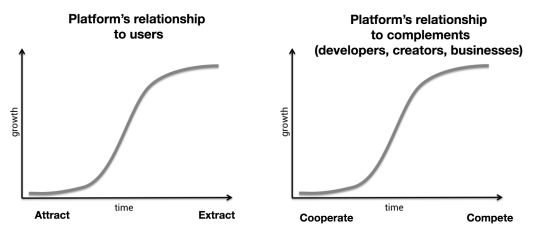
    I particularly like how he describes the relationship that centralized platforms – like Facebook – have to their users and to their complements (other businesses, software developers, creators, and so on). 

    Here are two graphs from his article:

    In the early days it’s all about cooperation and doing everything you can to attract users. The platform gets more valuable the more users are on it and so the immediate goal is to build up the network effects and lock people in.

    But as the platform grows, the relationship flips (top of the S-curve). In Dixon’s words, it becomes a zero-sum game whereby to continue growing the platform starts extracting data from its users and competing with its complements.

    The promise of cryptonetworks is that they will do away with many of these negative externalities, but at the same time empower the kind of sophistication that we see today with centralized platforms.

    The venture capitalists are circling because a fundamental shift in the architecture of the internet will mean disruption. I’m following it because I want to understand how it may apply to real estate and the built environment.

  • Pushing and pulling

    image

    Venture capitalist Chris Dixon recently published an interesting post called, Two eras of the internet: pull and push. In it, he describes two patterns that have emerged within the internet over the past decade and a half.

    Pull (2000s):

    Pull is when you are seeking information, usually an answer to a question. You want to know the closing time of a restaurant, the description of a hotel where you are thinking about staying, the details of an historical event you heard about, etc. You go to your computer and pull the information. The killer app for pulling information was Google.

    Push (2010s):

    Push is when you are using the internet in a more passive way and content comes to you. The killer app for push is social networks, the most popular being Facebook. Information is pushed from user to user via likes, shares, tweets, etc. People tend to push things they find funny, interesting, moving, outrageous, etc.

    Now let’s think about this for a second, because it’s a pretty significant change.

    Google’s mission is to organize the world’s information. And they have certainly made it easier for us to get the information we want. Instead of physically searching for something, you just type in a few keywords and it pops up. But, it still involves us deciding we want something and then pulling the information.

    What’s fascinating to me about push is the idea that content and information comes to you. And it’s one of the reasons that I’ve always found Foursquare more interesting than Yelp – even though Yelp is far more popular as a tool to help you find somewhere to eat, drink and so on.

    When I walk into a restaurant or bar now, oftentimes I’ll see a Foursquare notification popup on my phone showing me a tip that somebody has left: “Try the meatballs – they’re to die for”. I didn’t search for that. I didn’t ask for a recommendation. But Foursquare knew where I was and presented me with that information.

    Now, there are obviously potential downsides to constant interruption, but let’s focus here on the opportunities. How could these same principles to be applied to other industries such as, say, real estate?

    I think there’s a pull and push parallel.

    Today MLS operates in a way like a search engine for homes. You decide you might be interested in buying a home and so you go online and start pulling listings.

    Of course, the vast majority of people also work with a real estate agent. And in a way they’re kind of like your push. They get to know you, they figure out what you’re looking for, and then they push relevant listings and information to you.

    And maybe that’s why nobody has killed off real estate agents – despite the numerous attempts. Everybody has been focusing on new pull platforms (listing platforms) as opposed to a new push platform.

    Who knows.

    But I think it would be naive to think that these emerging push platforms won’t reach far beyond social media.