Daily insights for city builders, delivered every morning at 6 AM ET. I’m Brandon Donnelly — a Toronto-based real estate developer and founder of Globizen. I’ve been writing here since 2013.

Tag: chinese

  • A language map of Toronto

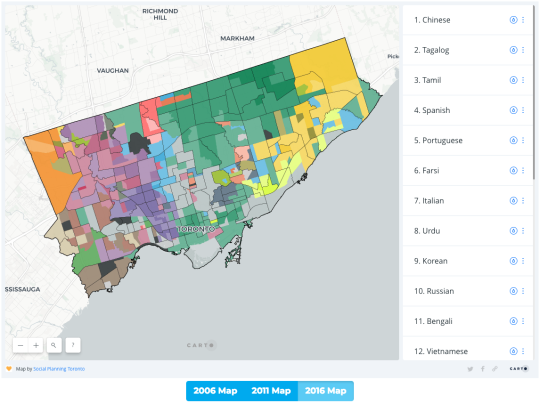
    This is a language map of Toronto showing the most commonly spoken non-official languages at home. (It only counts individuals who reported speaking a single non-official language most commonly at home, as opposed to multiple ones.) The map you see below is based on 2016 census data, but if you’d like to check out the previous census years, as well as an interactive version, you can do that here at Social Planning Toronto.
    image

    The top languages are also listed on the right of the map, with the exception of the gray areas. These areas indicate census tracts where English > 90%. I don’t know why French shows up as #13, since this map is supposed to be non-official languages.

    In any event, green represents Chinese (includes Cantonese, Mandarin, and so on). Sky blue is Tagalog. And yellow is Tamil. I’ll let you play around with the map to explore the others. There shouldn’t be many surprises if you know Toronto well, but it’s still interesting to explore the clustering and the percentages. Some of the census tracts have a single non-official language representing 90%+ of the responses.

    The biggest gains over the last decade – following the same methodology as the above mapping – were Tagalog, Farsi, Bengali, Arabic, and Pashto. And the biggest declines over this same time period were Italian, Tamil, Urdu, Punjabi, and Polish. But this data is only for the City of Toronto and so I suppose that a decline could also be because of people relocating to other parts of the region.

    A big part of Toronto’s strength comes from exactly what you see in this map: the world in a city.

  • Lo Mein Loophole

    Maria Godoy of NPR recently published an interesting piece called Lo Mein Loophole: How U.S. Immigration Law Fueled A Chinese Restaurant Boom.

    The article starts by talking about how rising anti-Chinese sentiment in the late 19th and early 20th century eventually lead to the U.S. passing new immigration laws. These laws explicitly restricted Chinese laborers from moving to the U.S. and even made it difficult for legal residents to return after a visit home to China.

    However, embedded in these laws was a small loophole:

    But, as MIT legal historian Heather Lee tells it, there was an important exception to these laws: Some Chinese business owners in the U.S. could get special merchant visas that allowed them to travel to China, and bring back employees. Only a few types of businesses qualified for this status. In 1915, a federal court added restaurants to that list. Voila! A restaurant boom was born.

    “The number of Chinese restaurants in the U.S. doubles from 1910 to 1920, and doubles again from 1920 to 1930,” says Lee, referring to research done by economist Susan Carter. In New York City alone, Lee found that the number of Chinese eateries quadrupled between 1910 and 1920.

    This is fascinating on so many levels. 

    For one, it’s always interesting when small loopholes have unintended consequences. It is doubtful that anyone could have predicted a Chinese restaurant boom.

    Secondly, despite the U.S. being a nation of immigrants, you see here a long history of trying to keep immigrants out. In the early 20th century, the fear was Chinese laborers who worked for low wages. Today, it’s Mexican laborers who work for low wages.

    Finally, it’s amazing to look back at the foundation that these early Chinese entrepreneurs no doubt created. Today, Asian Americans are often considered a “model minority.” The Pew Research Center refers to them as “the highest-income, best-educated and fastest-growing racial group in the United States.” 

    When it comes to Ivy League admissions, they’ve even been called the “New Jews” – referring to the fact that many believe that top tier schools have systematically biased admissions against both Jews and Asians because of their tendency to overachieve relative to “white Americans.”

    And to think that this may have all started, at least partly, with a Chinese restaurant boom.

  • #donthave1million

    Tiny Park by David Brookfield on 500px.com

    https://500px.com/embed.js

    After I wrote this week’s post about Chinese homebuyers in Vancouver, I was surprised to learn about the racism debate that flared up in the city / on Twitter. I guess this really is a touchy subject. (See: #donthave1million)

    My reaction to the research was: Great to see someone (Andy Yan) putting in the time to try and better understand a market phenomenon. It’s painful how opaque real estate markets can be. Let’s get even more data so that we can make even better policy decisions. I didn’t read it as: let’s deliberately single out a race.

    Because the reality is that we all knew this was happening.

    Bloomberg recently published an interesting and related article that talks about China’s money exodus and how the Chinese logistically get their money out of the country. There are restrictions in place. 

    But first, here are two snippets from Bloomberg that describe the order of magnitude we’re talking about:

    This flood of cash is being felt around the world, driving up real estate prices in Sydney, New York, Hong Kong and Vancouver. The Chinese spent almost $30 billion on U.S. homes in the year ending last March, making them the biggest foreign buyers of real estate. Their average purchase price: about $832,000.

    In total, UBS Group estimated that $324 billion moved out last year. While this year’s numbers aren’t yet in, during the three weeks in August after China devalued its currency, Goldman Sachs calculated that another $200 billion may have left.

    Now here’s how it is being done:

    It works like this: Chinese come to Hong Kong and open a bank account. Then they go to a money-change shop, which provides a mainland bank account number for the customer to make a domestic transfer from his or her account inside China. As soon as that transaction is confirmed, typically in just two hours, the Hong Kong money changer then transfers the equivalent in Hong Kong or U.S. dollars or any other foreign currency into the client’s Hong Kong account. Technically, no money crosses the border – both transactions are completed by domestic transfers.

    And here’s a snippet that stood out for me because it shows how easy this has become:

    While the first exchange has to be set up face-to-face, customers can place future orders via instant-messaging services such as WhatsApp or WeChat, and money changers set no limit on how much money they can move.

    Given the scale and complexity of this issue – housing affordability – I have to believe that cities and policy makers would be far better off with more, rather than less, information. I hope we can work towards that.

  • Fun Friday: Your ancestry

    People often ask me about “my background”. When I’m feeling cheeky, I usually just say that I’m Canadian or that I was born in Toronto (because that’s what I culturally self-identify with). But that’s not what most people want to hear.

    The short answer I usually give is Eurasian (European + Asian) or Chirish (Chinese + Irish). Although I recently learned that Chirish means something else to people from Chicago.

    But now, thanks to 23andMe’s DNA test, I can give a much more specific answer. Here’s the full chart:

    Now I can say that I’m 50.6% East Asian & Native American and 49.2% European. 

    More specifically, I can say that I’m 43.7% Chinese, 2.0% Broadly East Asian, 2.1% Southeast Asian, 1.5% Native American, 1.4% Broadly East Asian and Native American, 16.5% British & Irish, 6.0% French & German, 11.5% Broadly Northern European, 1.7% Iberian, 1.7% Italian, 6.9% Broadly Southern European, 1.5% Eastern European, and 3.4% Broadly European.

    But the interesting thing is that I don’t really feel any cultural affinity towards any of the regions or countries listed above (except for maybe France since I grew up going to a French school based off the French schooling system). For me, I identify as being Canadian. That’s more than enough for me.

    Now it’s your turn. 

    What’s your “background” and how do you self-identify? I think this is an interesting discussion given that we are now an incredibly mobile world. What your DNA says and how you feel about yourself, could be two totally different things.

  • From bicycles to cars in Beijing

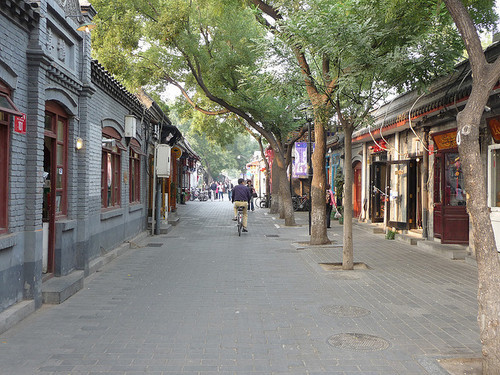
    image

    Earlier this week, a friend of mine shared this TED talk on my Facebook wall talking about the state of climate change in the world. The talk is by Nicholas Stern. And at one point he talks about the incredible urban transformation that has taken place in Beijing over the last couple of decades; specifically, the shift from a bicycle oriented city to a now automobile oriented city.

    I knew that this was the case, but it got me thinking. Because alongside this mobility change, there’s also been – not surprisingly – pronounced changes to the urban fabric of the city. The most significant is perhaps the demolition of the city’s hutongs and siheyuan. Hutongs are basically narrow alleys (see above photo) and siheyuan are the traditional Chinese courtyard houses.

    For centuries, these alleyways and courtyard houses have defined Beijing. And while I realize that not all of them were as glamorous as Melbourne’s laneways, only about 1,000 of Beijing’s original 6,000 hutongs remain (according to Time). Which makes me wonder: Is China making the same mistakes that we made in the 20th century?

    Because as the developed world moves toward transit oriented development, bike lanes, heritage preservation, and compact urban living, China has seemingly gone and done the exact opposite. They got everyone off bicycles and into cars, and they went and erased a scale of urbanism that has been in place for centuries.

    This is not to say that China doesn’t deserve to have the same standard of living as the developed world. It absolutely does. It just seems a bit ironic to me that the things we’ve become sharply critical of, are exactly what China seems to want to recreate.

    Image: Flickr