Daily insights for city builders, delivered every morning at 6 AM ET. I’m Brandon Donnelly — a Toronto-based real estate developer and founder of Globizen. I’ve been writing here since 2013.

Tag: chicago

  • Things that are quintessential

    One of the things I think is important for cities to have are things that are quintessential. I’m talking about a quintessential behaviour, a quintessential experience, a quintessential accent, a quintessential architectural style, or whatever. I’m talking about the things that make people say: “Oh, that’s so New York.”

    What I’m essentially talking about is brand equity for cities. For better or for worse, when somebody associates something with a particular city, you could argue that that city effectively owns a trademark. (Definition of trademark: “…a recognizable sign, design or expression which identifies products or services of a particular source from those of others.”) In this case, the source is a simply a city.

    Sometimes these trademarks are an informal understanding amongst people in the know, but in other cases they can become quite legitimate. Take for example Chicago’s distinct architectural style known simply–at least within architectural circles–as the “Chicago School.” This is a style that Chicago clearly owns. And if another city were to adopt it, people might say: “Hey, that building reminds me of Chicago.”

    All of this is important because, just like companies, cities are increasingly in the position of having to compete for “customers” in a mobile and interconnected world. And if you ask some marketers, they’ll tell you (perhaps self-servingly) that brand is the most valuable asset a company has. But if you believe this to be at least somewhat true, then statements like, “Oh, that’s so (insert city name here)”, are actually pretty powerful.

    Is there anything about your city that you could say is unequivocally yours?

  • Mies

    image

    If you’re into architecture, specifically epic modernism, then I would encourage you to pick up this new monograph on Mies van der Rohe–simply called Mies. It was written by the late Detlef Mertins, who was the Chair of the Department of Architecture at the University of Pennsylvania from 2002 to 2007, but is originally from Toronto.

    Detlef was one of the most brilliant, but also nicest, people I’ve ever met and unquestionably the leading scholar on all things Mies. He passed away in the midst of working on this publication, but it was completed by his partner Keller Easterling–another powerful architecture mind–and a few other contributors.

    For those of you unfamiliar with the work of Mies, here’s a brief description from the book publisher:

    Ludwig Mies van der Rohe is one of the twentieth century’s most influential architects. His most well-known projects include the Barcelona Pavilion in Spain (1929); the Seagram Building in New York (1954-56); the Farnsworth House (1945-50), 860 and 880 Lakeshore Drive (1945-51) and the IIT Campus (1939-58), all in and around Chicago, and the New National Gallery in Berlin (1962-68). These are only a few of Mies’s pavilions, houses, skyscrapers and campuses, which all epitomized a radically new structural and spatial clarity. 

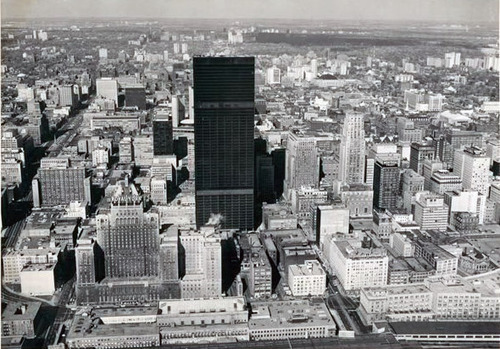
    For readers in Toronto, Mies’s biggest contribution is the Toronto Dominion Centre, which is a beautiful example of the International Style. The complex was designated under the Ontario Heritage Act in 2003. But in addition to it being great architecture, its construction in the late 60s really coincided with Toronto’s rise as a modern metropolis. Here’s a photo of the first tower from blogTO.

    image

    The TD Centre introduced not only a new architectural language into Toronto’s urban fabric, it also introduced a new and bolder way of how we thought of ourselves as a city. Remember this was a moment in time where Toronto was just about to overtake Montreal as the most populous city in Canada.

    We were reimagining our city with Mies.

  • Is Chicago’s zoning code broken?

    This may sound crazy, but I’ve never been to Chicago. It’s on my list, but I just haven’t gotten around to it and I’ve never had a specific reason to go. Hopefully I can make it this summer.

    Lately though, I’ve found myself reading more and more about the city. Given that it’s also a Great Lakes city and it’s of comparable size, Chicago is an interesting case study for Toronto. But one thing that seems to keep coming up, is the need for zoning reform.

    About a month ago I wrote a post called “The tale of 2 Chicagos”, which was inspired by the blogging of Aaron Renn (The Urbanophile) and Daniel Hertz (City Notes). The discussion was around the prevalence of single-family zoning in most parts of Chicago and how it’s creating a supply constrained market (driving up prices).

    But there’s another outcome. Here’s what Daniel Hertz recently argued:

    When places in and around downtown become more desirable, developers build more housing, and more people get to live there. But when non-downtown neighborhoods become more desirable, developers can’t build more housing: it’s against the law. So instead, they profit by tearing down old two-flats and building mansions in their place. And as a result, fewer people get to live in those neighborhoods, even as more and more people want to.

    Effectively, his argument is that gentrification leads to a loss of housing units. Developers can’t build more housing, so they replace housing. And it all stems from a restrictive zoning code that aims to maintain the character and scale of established neighborhoods. I get that, but you could easily argue that it exacerbates the negatives of gentrification.

    It strikes me that Toronto and Chicago are in somewhat similar places in terms of their growth. Without any real natural barriers, both cities had the luxury of being able to develop through horizontal sprawl when they were younger.

    But with people now returning to city centers, we’re faced with a series of difficult decisions: How do we balance preservation and growth? How do we balance low-density with high-density? How do we maintain the character of what people love while still creating an inclusive city?

    It absolutely can be done, but it’s going to mean embracing a certain amount of change. And that’s not always an easy sell. 

  • The tale of 2 Chicagos

    Over the long weekend I wrote a post called “On medium density development.” My argument was that Toronto has gotten exceptional at building infill towers, but not so great at midrise and other medium density infill solutions. Though to be fair, we are starting to see more and more of that today.

    Well it turns out that Chicago is in a similar, if not worse, position. According to Aaron Renn of the Urbanophile blog, most of the city (outside of the city center) only allows for single family homes. Though in some cases you may be allowed a duplex or triplex.

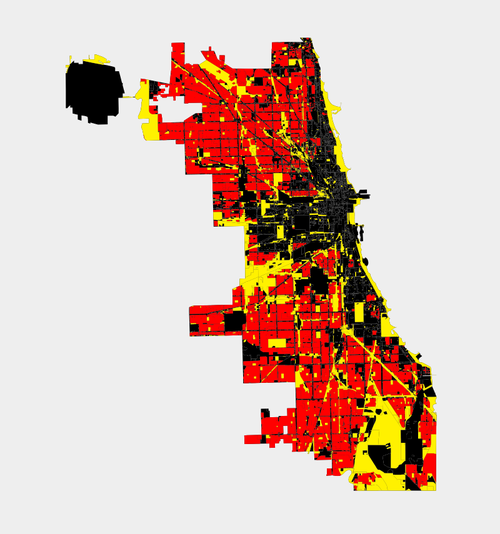
    Here’s a map:

    image

    The red is where you’re only allowed to build single family homes. The yellow represents non-residential uses (parks, industry and so on). And the remaining black is where you’d see high density development. Note how it runs all along Lake Michigan. Both Toronto and Chicago are developing in a similar “T” formation.

    Now, some of you may be saying to yourself: So what? But it’s important to remember that this type of zoning effectively creates a supply constraint in the market, which, as I’ve argued before, will drive up prices. Chicago may as well be surrounded by mountains, because that red area seems almost untouchable from a development standpoint.

    With so many people rushing back to cities today, a lot of them are struggling to create the same market environment that our parents enjoyed. You know the one where you finish school, get a job, and then you’re able to buy a house. But I think it’s because many of our cities are at a turning point, and yet are clinging to outdated principles of city building, such as single-use zoning.

    But I’m certainly no expert on Chicago, so if you are, please speak up in the comment section below.

  • Am I supposed to like this city?

    Marketer Seth Godin just wrote a typically short blog post called, “Am I supposed to like this?

    In it he talks about the fact that we are, for example, more likely to enjoy the food at a fancy restaurant. And we’re also more likely to enjoy a bottle of wine if it’s expensive or if we believe it comes from some desirable wine region and it’s supposed to be good (you can even just switch the bottle).

    He then sums up this idea in one line that I really like: “Judgments happen long before we think they do.”

    Now, I’ve thought about this same idea with respect to cities. Take New York, for example. New York is famous. If I had to pick a capital for the world, it would probably be New York.

    You watch it in movies and shows (even if it’s actually filmed in Toronto, Chicago or some other stand in). We read about it. We hear about it. We generally form judgments without the actual experiences. That builds brand equity. We’re supposed to like New York. Sex and the City told us so. And that makes it all that much better when we eventually get there.

    Of course, it’s a bit of a catch-22. You have to be an awesome city for people to want to make movies and songs about you. But in this era of global connectedness, I think everyone, from citizens to economic development agencies, can fake it until that city makes it by investing in “supposed to.” Am I supposed to like this city?

  • The Toronto font

    Susan Kare was the screen graphics and font designer for the original Apple Macintosh computer in the 1980s. Being from Philadelphia’s affluent Main Line, she initially proposed that the various fonts be named after the railroad stops along it.

    However, when Steve Jobs asked where the names had came from, he contested that, if the fonts were to be named after cities, they should be named after “world-class cities”, rather than small ones that nobody had ever heard of.

    image

    And since that’s what Jobs wanted, that’s what Jobs got. The fonts were renamed: Venice, London, Athens, Toronto, Chicago, New York and Geneva. Some of these font names you’ll probably still recognize but some, including Toronto, were eventually abandoned. 

    The Toronto font was removed from System 6 onwards. So from 1988 onwards.

  • A Third Coast Megaregion

    The distance between Chicago and Quebec City is roughly 1,000 miles (or 1,609 km). There are 6 major cities and a population of over 25 million people. You have the 4th and 5th largest cities in North America (Chicago and Toronto); the largest city in Canada; the capital of Canada; 2 different languages; 2 different countries; and 5 different states/provinces.

    image

    Now imagine if all of these 6 cities—Chicago, Detroit, Toronto, Ottawa, Montreal and Quebec City—were effortlessly connected through a high speed rail network, allowing you to travel from one end to the other in just over 5 hours. How would that impact the movement of people, goods and services across the region? How would it change our economies if you could wake up in Detroit and, without any lead time, travel 1 hour and 15 minutes to Toronto for a meeting?

  • You can go wrong with real estate

    One of the things I often hear people say to me is that “you can never go wrong with real estate.” And indeed, if you’re talking about Toronto real estate over the past decade, then yes, it was fairly difficult to go wrong.

    But that’s not a universal truth – either here or elsewhere. Real estate is very much an imperfect market and it has always been prone to protracted market cycles.

    Furthermore, if you’re in the wrong city or part of town, there could be absolutely no market for your property. Take this example from Business Week:

    Helene Pearson’s belief in homeownership was shattered in Roseland, the mostly black Chicago neighborhood where President Obama got his start as a community organizer. Pearson, who bought her two-bedroom, red-brick bungalow on South Calumet Avenue for $160,000 in 2006 with a high-interest loan, put it on the market a year ago for $55,000—and didn’t attract a single offer. Her bank has agreed to take it back in exchange for canceling her remaining mortgage debt. “I was so excited to buy my first house right down the street from my mother, but they got me good,” says Pearson, a 35-year-old guidance counselor and mother of two girls. “This scarred me so badly that I never want to buy again.”

    Here you have a case where the value of the property (whatever it may be – clearly it’s not even $55,000) is below the replacement cost. That is, the value is well below what it would cost to actually go out and build a similar property. When you have a scenario like this, it intuitively translates into very little new investment.

    And this is the case in many places, which is why when I hear somebody say “that you can never go wrong with real estate”, I secretly cringe inside.