Daily insights for city builders, delivered every morning at 6 AM ET. I’m Brandon Donnelly — a Toronto-based real estate developer and founder of Globizen. I’ve been writing here since 2013.

Tag: chicago

  • Population growth across North American cities

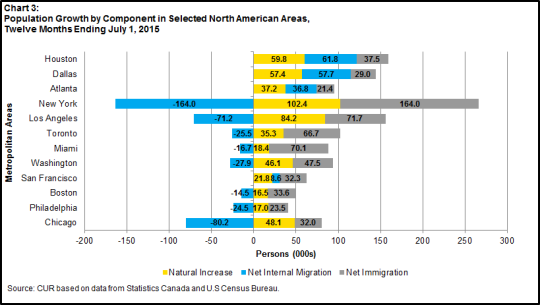
    The Centre for Urban Research and Land Development at Ryerson University recently published the following chart on their blog:

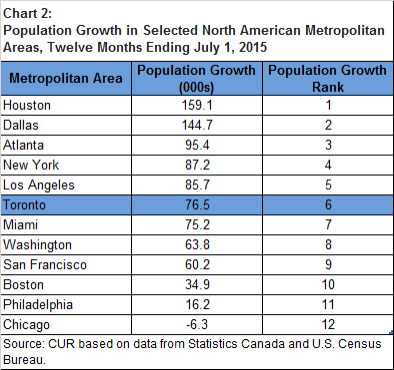
    It’s a look at population growth across a few North American cities, broken down according to natural increases, net internal migration from other parts of the respective country, and net immigration from outside of the respective country.

    When you sum up the pluses and minuses shown above, you get to population growth numbers that look like this:

    Houston, Dallas, and Atlanta are monsters in terms of population growth. They’re obviously smaller than New York and Los Angeles, and so on a percentage basis they are really adding a lot of people. Much of this has to do with the ease in which housing can be added in those cities and their relative affordability.

    Toronto is competitive with New York and Los Angeles in terms of an absolute number, but again our base is smaller so on a percentage basis we are growing faster. The big story with Toronto is our dependence on immigration to grow.

    The one city on this list that might surprise some of you is Chicago. Toronto and Chicago share many similarities and are often compared. But when you look at how the Chicago metropolitan area is shedding people, you see that, at least in this regard, it’s in structural decline.

  • The value of a millisecond

    I’m reading a book right now called Flash Boys: A Wall Street Revolt

    One of my graduate school buddies recommended it to me on one of our annual ski/snowboard trips and I’m finally getting around to reading it. I’m only about half way through it, but I’m enjoying it so much that I have decided to write about it today.

    One of the protagonists in the book is a Toronto-native by the name of Brad Katsuyama. That’s probably one of the reasons I like it – although Michael Lewis makes all Canadians out to be overly polite and well-behaved. Is that what we’re like?

    The other reason I like the book is that a lot of it actually has to do with geography. Technology and the internet were supposed to make cities and location irrelevant. But as Flash Boys argues, location and physical connectivity matter a great deal in the world of high-frequency trading. Each millisecond matters.

    To illustrate this point, the book starts by describing the construction of a $300 million, 827-mile cable running as straight as humanly possible from Chicago to New Jersey in order to reduce data travel times from 17 to 13 milliseconds. That’s how much the milliseconds matter.

    This is also not a topic that I know a lot about and so it’s eye opening (and a bit disappointing) to learn about the sorts of things that happen in our financial markets. If any of you would like to borrow the book after I’m done (and are located in Toronto), leave me a comment below.

  • Our urban history in 50 buildings

    At the time of writing this post, it’s still 2015 – at least here in Toronto. But by the time you (subscribers) get this post in your inbox, it will be 2016. So happy new year! I am thrilled about getting this year started and I hope you feel the same way.

    To kick things off, I thought I would share a great interactive post from Guardian Cities called, A history of cities in 50 buildings. It’s a look at our urban history through 50 important and pivotal buildings. Buildings such as Southdale Center, which was the first fully enclosed, climate-controlled shopping mall, and Chicago’s Home Insurance Building, which was a building that really set the stage for the modern skyscraper that we know today.

    Not all of these buildings have left a positive legacy on our cities. I am sure that some of you would argue that the creation of the suburban shopping mall, with its corresponding “sea of parking”, was not a step forward for cities, but a step backwards. The architect behind Southdale Center, Victor Gruen, has even gone on record saying that he refuses “to pay alimony for those bastard developments.” He hated the shopping mall.

    But like them or not, these buildings are part of our urban history, and I think it’s not only interesting but important to understand their impacts. If you want to see which important buildings were missed, at least according to Guardian readers, click here. I have to say that I was happy to see both Montréal and Toronto represented in the original list, as well as a few other buildings that I’ve written about here.

    On that note, happy new year to you all, again, and many thanks for reading Architect This City. If you have any suggestions for content you would like to see on this blog in 2016, please leave it in the comment section below. This may be my personal blog, but my goal is to make it valuable for all of you. Hopefully I achieve that sometimes.

  • Uber, commuting, car ownership, and the future of urban mobility

    Earlier this week I wrote a “Tech Tuesday” post talking about Uber’s new Smart Routes functionality, which it is currently testing out in San Francisco. At the end of the post I ended by saying that it’s not just the taxi industry that should be thinking about Uber, it’s also public transit authorities. 

    And that’s because many people in cities rely on multi-modal forms of transportation (I know I do) and in my mind it is clear that Uber is trending away from just “Everyone’s Private Driver” to a service that is starting to look and feel a lot like urban mass transit.

    Then today my good friend Evgeny sent me a post called, “Public Transit Should Be Uber’s New Best Friend.” And it’s one of the best pieces I’ve read on Uber and its impact on urban mobility. I highly recommend you give it a read, particularly if you’re in the city building arena.

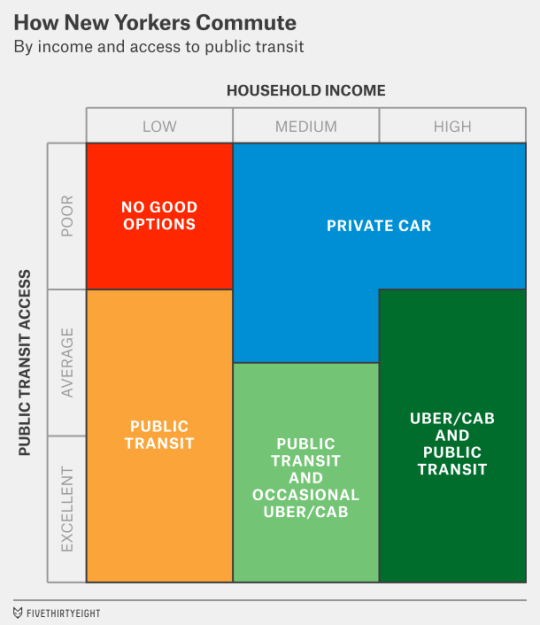
    The article does a deep dive into how New Yorkers commute. Here’s how they broke it down.

    image

    It then talks about what it will take for a company like Uber to make a meaningful dent in car ownership (which is one of the company’s goals) and how the truly big opportunity for Uber is to go more mass market and tap into the public transit market – either by interfacing with or by building its own version of it.

    Here’s their concluding paragraph:

    But there’s a much wider potential audience if Uber can also reach middle-class customers who want to save money. Perhaps in the distant (or even the not-so-distant) future, Uber can build its own version of “public” transit, making rides so cheap that they cost less than the $4 or $5 that Americans now pay, on average, to make a trip in their personal cars. In the meantime, it might have more success among “car-cutting” customers who can use Uber along with public transit. That might mean Uber’s growth is concentrated more in cities like New York, San Francisco and Chicago — and in Europe and Asia — that already have reasonably strong public transit networks.

    It’s definitely worth a full read. Thanks again for sending this over Evgeny.

  • Cities with the most single men and women

    There are thousands of people who read this blog via email or by following on Tumblr. The rest of the readership just stops by on the web and visits periodically.

    But of the thousands of regular readers, I know that many do not click through to the comment section. And that’s a shame. Because oftentimes I find the comments more interesting than my actual post.

    Take for example yesterday’s post on The Millennial Dream

    The initial post was about Millennial housing choices (and some stats on marriage and fertility rates). The comments provided some additional color on the trends, but they also got into mobile dating apps and whether or not it’s easier or harder to meet people in cities, today. It was a fun discussion.

    This got me thinking and reminded me that people come to cities not only because of labor markets, but because of dating markets. 

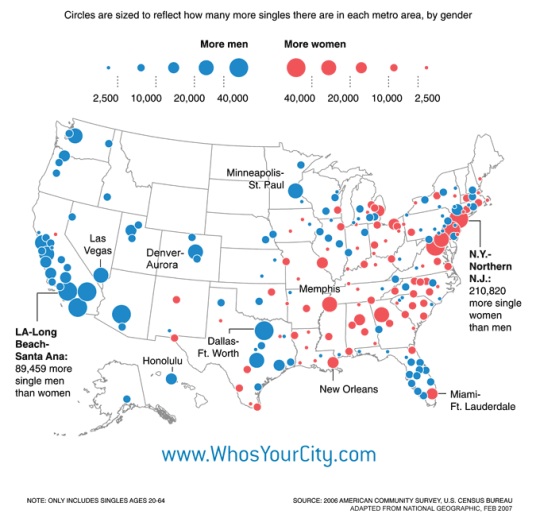
    So for today’s piece, I thought I would post the following diagram from Richard Florida’s book, Who’s Your City? It shows how many more singles (aged 20-64) there are – according to gender – in the largest US metro areas.

    I couldn’t find an equally detailed map for Canada, but based on this, it looks like Toronto is slanted towards single women and Calgary is slanted towards single men.

    Does the above look right to you?

  • The global pyramid of wealth

    Every year the London-based property consultancy Knight Frank publishes something called The Wealth Report. And it’s one of those reports that I could go through for hours. 

    It includes a ton of really fascinating stats that speak volumes about where in the world wealth is being created and how it’s moving around. And of course there are a lot of connections between wealth, real estate, and city building.

    Below are 3 diagrams that really stood out for me in the 2015 version. 

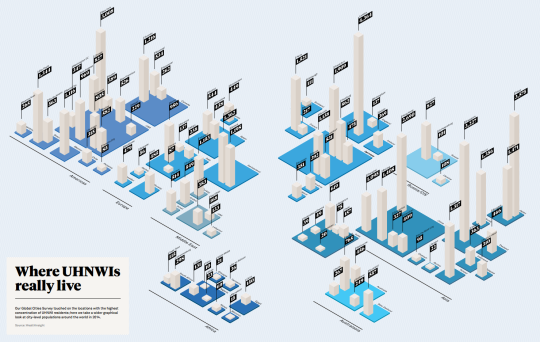
    The first diagram shows which cities have the most Ultra High Net Worth Individuals (UHNWIs). An UHNWI is defined as an individual with assets exceeding US$30 million, but excluding personal assets and property (such as one’s principal residence). Click here to see the full size image (I know the numbers are small).

    image

    Not surprisingly, London (4,364), Tokyo (3,575), Singapore (3,227), New York (3,008), and Hong Kong (2,690) are at the top of the list. But I was a little surprised – albeit happily surprised – to see Toronto (1,216) come in at #2 in North America, beating out Mexico City (1,116), Los Angeles (969), and Chicago (827). 

    The second diagram shows you how many square meters of luxury property (apartment) you can buy for US$1 million in a bunch of different cities around the world. 

    In Monaco (top end), that’ll buy you 17 square meters (183 square feet) and in Cape Town (bottom end), that’ll buy you 208 square meters (2,196 square feet).

    image

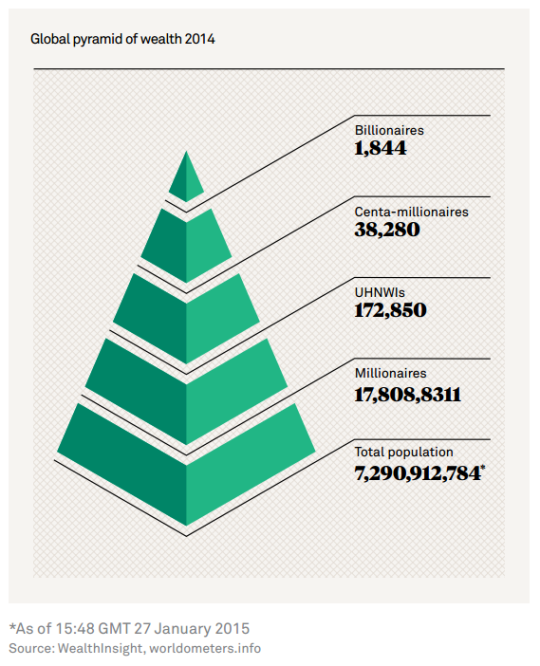
    The third and last diagram is what they call the global pyramid of wealth. It’s a pyramid of everyone in the world and then the number of millionaires, UHNWIs (see above), centa-millionaires, and billionaires. And if you do the math, the top of this pyramid comes nowhere close to 1% of the global population.

    image

    It’s fascinating (and exciting) to see where and how global wealth is concentrating. But it should also make you think about rising income inequality. I know it does for me.

  • A site-specific light installation on Wabash Avenue

    A Kickstarter project called The Wabash Lights has just reached its funding goal of $55,000 to implement what it is calling the beta version of its project. 

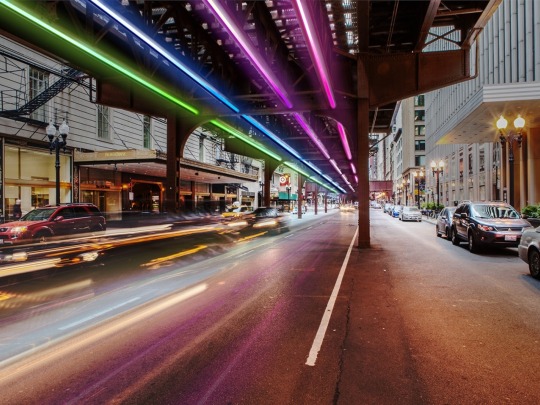
    The project is a site-specific and interactive LED light installation on the underside of the elevated train tracks that run along Wabash Avenue in Chicago.

    The lights are completely customizable (color, patterns, pulses, and so on) and they will be controllable via web and mobile. So anyone walking down the street will be able to have some fun with the lights.

    Here’s a video from the creators explaining more about the project:

    [vimeo 131322692 w=500 h=281]

    It’s a clever idea and I can see the lights becoming just as recognizable as Chicago’s bean.

    But the true success measure will be whether or not it draws people to the area and it changes the composition of the street. Elevated structures aren’t great for street life. That’s why I fought (unsuccessfully) to have the elevated Gardiner Expressway East removed here in Toronto.

    It’s interesting to hear the one woman in the above video talking about how Wabash isn’t really a street you go to. It’s just the street between Michigan and State that you have to pass through. That’s how I feel about most parts of Lake Shore Blvd in Toronto.

    Here’s how CityLab described it in their writeup about the project:

    “While the L tracks are as iconic to Chicago as some of its skyscrapers, their presence overhead doesn’t necessarily bring in the foot traffic compared to other nearby streets.”

    But something like The Wabash Lights could really make a difference.

  • Toronto is at the center of an emerging megalopolis

    https://500px.com/embed.js

    With the recent talk around downtown Cleveland’s resurgence, I am reminded that for those of us living near the Great Lakes, we are living in one of the most important urban agglomerations in the world: The Great Lakes Megalopolis.

    In 1962, French geographer Jean Gottmann wrote a seminal book called, Megalopolis: The Urbanized Northeastern Seaboard of the United States. And in it, he described the remarkable clustering of cities in the northeast, running from Boston in the north to Washington D.C. in the south. He called this the Northeast Megalopolis.

    The term megalopolis simply refers to a clustering or chain of generally adjacent metropolitan areas.

    Then in the 1960s and 1970s, architect and planner Constantinos Doxiadis started writing about the emergence of what he called the Great Lakes Megalopolis. In his mind, a contiguous urban region was forming that stretched all the way from Chicago in the west to Quebec City in the north east. And at its economic center was the city of Detroit.

    More recently, Richard Florida, as well as others, have been referring to these urban clusters as mega-regions. And in the case of the Great Lakes, Florida broke the area down into two distinct regions: Chi-Pitts in the west and Tor-Buff-Chester in the east. (I think you can guess how the names were derived.)

    According to his research, these two mega-regions have a combined population of almost 60 million people and an economic output equivalent to almost $3 trillion. That places it in line with the Northeast Megalopolis. But according to the Brookings Institution, the output coming from the Great Lakes could be closer to $4.5 trillion.

    Whatever the case may be and whatever you want to call it, the Great Lakes Megalopolis is unquestionably an economic and cultural powerhouse. But this has me wondering whether or not we’re doing enough to unleash its full potential.

    When I attended Joe Berridge’s talk last week on Toronto as a global city, I asked him how he thought we should be organizing our cities and regions. Do city-states make sense? Should we be rethinking the relationship between provinces/states and cities?

    His response was that we should be creating agencies and entities with regional authority (as opposed to fighting to make any constitutional changes). For example, the Toronto region should not have an array of competing transit agencies (as it does today). It should have one regional transit authority that blankets the region. People, ideas, and capital don’t follow borders.

    So with that in mind, what opportunities are there for us to unite the metropolitan areas within the Great Lakes Megalopolis?

    The first idea that comes to my mind is a high speed rail network that seamlessly connects to each city’s local transit network. Imagine a Great Lakes bullet train that could zip you across the region. It would completely reorganize the spatial landscape.

    Here’s an excerpt from a recent report by the Independent Transport Commission called, Ambitions & Opportunities – Understanding the Spatial Effects of High Speed Rail:

    There has been a global shift of economic power and influence from nation states to cities and city-regions. Today’s successful cities collaborate across existing boundaries to form polycentric metropolitan regions. As a result cities function in a much less self-contained manner than they did fifty years ago. Longterm trends in the pattern of urban settlement reflect the interplay between opportunities for dispersal afforded by greater mobility, and economic and social forces promoting concentration.

    But what else could we be doing to empower the Great Lakes Megalopolis? 

    I would love to hear your thoughts in the comment section below. I think there’s a strong case to be made for thinking at the scale of the megalopolis and not just at the scale of our own backyard.

  • Most people still want to raise kids in a house (not an apartment)

    https://500px.com/embed.js

    Yesterday I ran a quick 3-4 question survey on ATC called homes for families. The objective was to get a sense of people’s preferences for apartment vs. ground-related housing (house or townhouse) when it comes time to raise a family.

    The results are public so anybody can take a look at the data. At the time of writing this post there were already 70 responses. That’s not a huge data set, but the data is more or less what I expected to see. 

    Here’s what I found (if the data set was larger, I would have made charts):

    The vast majority of respondents were from Toronto. No surprise there. That reflects the readership of this blog, which itself can be quite Toronto-centric at times. (I’ve been trying to branch out more, I swear.) That said, I was thrilled to also see respondents from cities like Seattle, Denver, Chicago, Porto, and Sydney.

    Of the people who specified that they have kids, 11% live in an apartment. 17% live in a townhouse. And 72% live in a house. If you add houses and townhouses together, you get 89% of people with kids living in some kind of ground-related dwelling.

    Of the people who specified that they don’t have kids, 61% live in an apartment. 6% live in a townhouse. And 33% live in a house. This is the kind of split that I generally expected to see for Toronto.

    For the people who specified that they don’t have kids, they were then asked where they plan to move if/when they do have kids. 13% plan to move to another apartment. 8% plan to move to a townhouse. 33% plan to move to a house. 23% don’t plan to move (i.e. they are planning to stay put). And 23% don’t plan to have a family.

    Interestingly enough, 100% of the people who said that they were not planning to move, were already living in a ground-related housing unit (a house in almost all of the cases). So in reality – and if you exclude the people who don’t plan to have kids – about 83% of respondents expect to raise their kids in a house or townhouse.

    Again, this isn’t a big sample size, but the trend appears more or less flat. 89% of respondents who already have kids are already living in a ground-related unit. And when people were asked to project where they would like to be living once they have kids, 83% said they want a house or townhouse.

    Do you think these numbers accurately reflect consumer preferences in your city?

  • Top 10 freeways without a future

    https://500px.com/embed.js

    Last year The Congress for the New Urbanism (CNU), which is based out of Chicago, published a report called, The 2014 Freeways Without Futures. It listed the top 10 freeways across North America that are in need of removal, replacement, and revitalization. You can download the full PDF report by clicking here.

    Here’s an introductory snippet from the report:

    The 2014 Freeways Without Futures Report lists the top opportunities in North America for replacing aging urban highways with boulevards or avenues that connect to the networks of streets. They are presented in no particular order of rank. As in previous reports, the criteria for the 2014 list is based on a number of factors: the age and design of structures, redevelopment potential, potential cost savings, ability to improve both overall mobility and local access, existence of pending infrastructure decisions, and community support.

    And here’s the list of freeways without a future:

    1.  I-10/Claiborne Overpass, New Orleans
    2.  I-81, Syracuse, New York
    3.  Gardiner Expressway, Toronto
    4.  Route 5/Skyway, Buffalo
    5.  Inner Loop, Rochester New York
    6.  I-70, St. Louis
    7.  I-280, San Francisco
    8.  I-375, Detroit
    9.  Terminal Island Freeway, Long Beach
    10.  Aetna Viaduct, Hartford

    Not surprisingly, the Gardiner Expressway is on the list. CNU is in agreement with the “remove” option currently being contemplated by Toronto City Council and will be doing their part to support the Gardiner East petition that Stephen and I created. Thank you for that 🙂