
Daily insights for city builders, delivered every morning at 6 AM ET. I’m Brandon Donnelly — a Toronto-based real estate developer and founder of Globizen. I’ve been writing here since 2013.

Tag: charles baudelaire

  • Planning dinner, smart cities, and privacy

    image

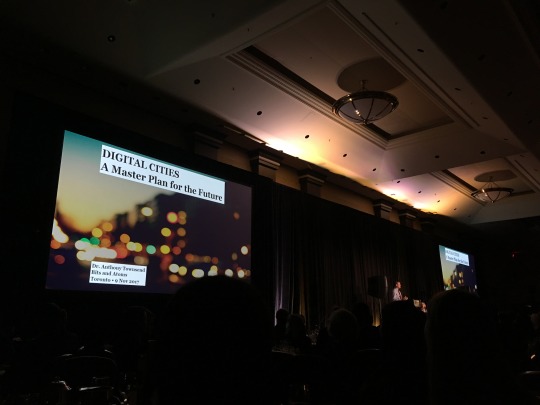
    This evening I attended the 27th Annual Toronto Planning Dinner. It’s an annual dinner for people in planning and development, put on by the University of Waterloo Planning Alumni of Toronto. Thank you Wood Bull LLP for the invite.

    The keynote speaker was Dr. Anthony Townsend. He is the author of SMART CITIES: Big Data, Civic Hackers, and the Quest for a New Utopia. I haven’t read it (yet), but his talk offered a preview of it and I think it would be of interest to all of you.

    It deals with many of the topics that we discuss on this blog, one of which is the interrelationship between our physical environment and the networks and software layers that we are now building on top of it.

    These layers have the potential to augment and enhance our cities (maybe make them smarter), but they also have the potential to do us harm. One important issue that Townsend brought up is that of privacy.

    Cities used to enable anonymity. 

    When essayist and art critic Charles Baudelaire wrote about “modernity” in 19th century industrializing Paris, it referred to an ephemeral and fleeting kind of urban environment. Pass someone on the street and you may never see them again. That must have felt sad at the time.

    Today we live in a fish bowl. 

    Networks connect us, check us in, ping us when we are nearby people we know, and help us find people to meet and date. And we already have devices, like Alexa, that spy on us in our homes so that companies can serve us targeted ads. (This is deplorable by the way.)

    Will the city of the future endeavour to do the same as we equip it with more “smarts”?

    I guess that’s why Townsend believes that privacy will define a big part of 21st century urbanism. There’s no doubt that it will be very important.
  • That hustle and bustle

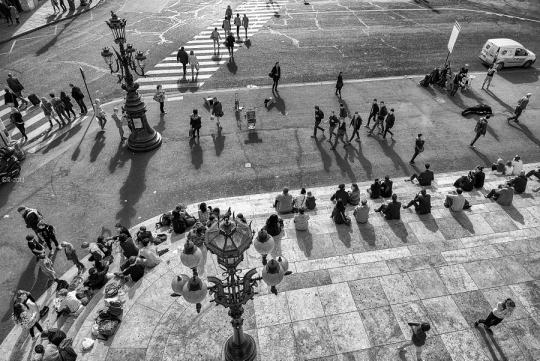
    Street Scene(s) by Olivier Rentsch on 500px.com

    https://500px.com/embed.js

    One of things I love about cities is the hustle and bustle of people. 

    I would rather eat at a busy restaurant than a quiet or dead one. I would rather workout at a busy gym than one with nobody there. And I would rather work in an office or at a coffee shop than work at home by myself. Working at home actually drains me if I do too much of it.

    The reason for that is because I derive a lot of my energy from the outside world. Urban life energizes me. To Swiss psychiatrist Carl Jung, that is the defining characteristic of an extrovert. I am focused on the “outside world of objects.”

    But because of this, I can’t help but slowdown during the holidays. Once the city dials down and the streets become emptier, my mood actually changes. I don’t feel as energized.

    It’s fascinating to think about the connection that many of us have with urban life. Since the first cities were established there has always been some kind of centralized place, market, or agora (in the case of ancient Greek cities) where people came together to exchange goods and ideas.

    But one of the most interesting turning points for modern urban life, as we know it today, came in 19th century France with poets and writers such as Charles Baudelaire.

    At the time that Baudelaire was active, Paris was undergoing Hussmannization. It was being transformed from a medieval city with cramped narrow streets into a modern metropolis of broad avenues.

    And essential to these new streets and urban spaces was the flâneur. At the time, the flâneur was an important literary and artistic figure. He was a man about town. A man of leisure. An urban explorer in the new modern metropolis.

    Here is how Baudelaire defined the flâneur in his Painter of Modern Life:

    The crowd is his element, as the air is that of birds and water of fishes. His passion and his profession are to become one flesh with the crowd. For the perfect flâneur, for the passionate spectator, it is an immense joy to set up house in the heart of the multitude, amid the ebb and flow of movement, in the midst of the fugitive and the infinite. To be away from home and yet to feel oneself everywhere at home; to see the world, to be at the centre of the world, and yet to remain hidden from the world—impartial natures which the tongue can but clumsily define. The spectator is a prince who everywhere rejoices in his incognito.

    One of the central themes at the time was that of anonymity. The modern city had grown to such a scale that a paradox had emerged. Despite all its density and physical proximity, urban life had an isolating effect. It had become easy to just be a number in an ephemeral crowd.

    But fascinating to me is this idea that urban life – with all its ebbs and flows – could bring “immense joy” to the flâneur. In fact, the very definition of a flâneur was someone who did nothing. They weren’t capitalists on the pursuit of new material possessions. Their sole focus was urban life and nothing else.

    And while most of us probably don’t routinely wander around our own cities as tourists without purpose, I suspect that many of us can appreciate the impact that urban life has on us. I know I do. It gives me energy.