Daily insights for city builders, delivered every morning at 6 AM ET. I’m Brandon Donnelly — a Toronto-based real estate developer and founder of Globizen. I’ve been writing here since 2013.

Tag: change

  • Thinking about the things we’re used to

    This is a powerful perspective:

    We evolved to be wary of change. Our attention is limited, new things can be a threat and the status quo feels comfortable.

    As a result, we spend a lot of time and energy being afraid (and arguing about) the upcoming changes in our lives, but almost no time at all thinking about the things we’re used to.

    As an example of this tension, check out this “exit interview” with Toronto’s former chief city planner, Gregg Lintern. The underlying theme is change and why it’s desperately needed.

    But of course, that’s not easy.

    The interviewer, Victoria Gibson, mentions this survey stat: nearly half (47%) of all Torontonians think the city is building too little housing, and yet only about a quarter (27%) think their area could handle more.

    We need this, but not here. Probably because we’re used to the way things are.

    But if you read the interview, you’ll see that the answer, or at least one answer, is to make the conversation personal, and ultimately think critically about, you know, the things we’re used to.

    Change starts with not giving the benefit of the doubt to the status quo.

  • The Eiffel Tower and the awful tower

    It was explained to me this week that Paris has two principal towers: The Eiffel Tower and the awful tower. The awful tower is, of course, the Tour Montparnasse. Completed in 1973, the Tour Montparnasse is tall, brown, monolithic, and seemingly out of place with the rest of Paris’ urban context. At the time of its completion it was the tallest building in Paris and it remains the tallest building outside of La Defense (business district).

    But the Eiffel Tower is also tall. In fact, it’s taller. So how is it that the Eiffel Tower became such a symbol for Paris and the Tour Montparnasse became the “awful tower?” Both were intended to represent modernity (at their respective times) and both were controversial at the time of their construction.

    Today people respond to these two towers very differently. Is it because the Eiffel Tower is set in a beautiful park and more separated from its urban context? Or is it because the Eiffel Tower has had almost another 100 years to settle in. It’s not exactly clear. But we do know that as humans we have a bias toward the status quo. And so I like to think of change in the following way:

    – There’s change that people immediately like

    – There’s change that people hate and will always hate

    – And there’s change that people initially hate but will eventually like

    The Eiffel Tower, you could argue, falls into category number three. It was big, modern, and alarmingly different when it was built at the end of the 19th century. But now people seem to like it. I know this based on the number of street vendors selling little replicas. For the record, I have yet to see little replicas of the Tour Montparnasse sitting on blankets on the street. I’m a buyer if I do come across one though.

    But is it really right to place Montparnasse into category number two? Could it be that it just needs more time to settle in and then it will ultimately move into number three? Maybe. In 2017, an international design competition was held to find an architect for the redesign of the tower. Studio Gang submitted an entry. But Nouvelle AOM was ultimately selected.

    I wasn’t part of the selections committee, but I think a good way to evaluate the success of this project will be whether or not it moves the tower into category three. That is, people start to like it. Then maybe Paris will become known as a city of two towers, as opposed to a city with one nice one and one awful one.

  • An exciting new proposal for Toronto

    I love change.

    In fact, a big part of what I do for a living is imagining what things could be in the future. However, the bias that humans have toward the status quo has been well documented by people like Seth Godin, as well as many others. It is easier to defend that which already exists. Here’s how Seth puts it:

    All one has to do is take the thing we have now as a given (ignoring its real costs) and then challenge the defects and question the benefits of the new thing, while also maximizing the potential risk.

    So as I was reading this recent blogTO article about the work of Stephen Velasco, I wasn’t surprised to see some of the responses. Stephen has built an outstanding 3D model of all the towers that are currently planned or under construction in Toronto. Here’s what that looks like:

    For some of you, this is exciting. And for others, this may look like too much density. In both cases, we might think we are being fair and reasonable in our assessment, but the reality is that it’s actually quite difficult to be a neutral judge. We are all guilty of poor logic and too much emotion.

    But here’s a good mental exercise, put forward by Seth, to test your logic: flip the story and then see if you still feel the same way.

    In this particular case, imagine that all of the above proposed buildings are already built. This is the city that we all live, work, and play in. This is the status quo. Now consider an exciting new proposal being put forward to demolish many/most of these buildings, create more surface parking lots in the core, industrialize our waterfront, and reduce our overall population density.

    Photo from the 1940s:

    Photo from the 1960s:

    Is this a better proposal?

  • Choice over convenience

    “Change makes us uncomfortable. Sunk costs are hard to ignore. Possibility comes with agency, and agency comes with risk.” –Seth Godin

    This is a quote from a recent blog post by Seth Godin talking about choice vs. convenience. His overarching argument is that we tend to go with convenience over choice when making decisions, and that means forgoing many/most of the options that we actually have available to us. Life inertia is a thing, which is why we often require big and meaningful events to shake us out of the conveniences of complacency.

    I think that is one of the reasons why you’re hearing talk of a “great resignation.” This pandemic has shocked many people into thinking about whether or not they’re truly happy doing what they’re doing. And for many people, that has translated into going out and starting their own business. Fred Wilson recently argued that what we’re living through right now isn’t actually a great resignation, it’s a great formation.

    I have never been a huge fan of new year’s resolutions for the simple fact that I don’t think you should wait until the new year to do something you allegedly want to do today. If you want it, do it now. But there is no denying that this week is probably the slowest week of the year. And this slowness has a way of freeing up cognitive capacity. Perhaps it’s just enough breathing room to encourage more choice over convenience. Whatever the choice may be.

  • Creating change

    I was reading about a proposed development earlier today (it doesn’t really matter which one for this story) and I immediately thought to myself, “wow, this is a beautiful development. I like what they’ve done here.” The project happens to be by one of my favorite architects in the city. Sadly though, we have yet to work with them on any of our projects.

    I then decided to read the comment section of the article. There were dozens and dozens of comments and virtually all of them were negative and against the development. What is, of course, clear is that we all have different beliefs. We all see things differently. And that’s part of the reason why creating any sort of change is usually so difficult.

    But if you think about it, so much of our world resolves around change. If we want to address climate change, we are going to need to make changes. If we want to improve housing affordability, we are going to need to make changes. If we want to build more inclusive and economically prosperous cities, we are going to need to make changes.

    The challenge with all of this change is that we have inertia working against us. Case in point: I’m sure that most of us have been in a meeting at one point or another when a decision was made purely based on what was done the last time around. We did X. So let’s do X again. Why change? Probably a safe bet.

    Seth Godin once said that, “if you do anything that matters, it means you’re trying to change something.” He was talking about the world of marketing. But I believe that there’s a universal truth to this. Change unlocks potential.

  • A mismatch of expectations

    Seth Godin’s blog post this morning, called “I hate this restaurant,” is really excellent. I would encourage you all to read it. In it, he talks about a mismatch of expectations. More specifically, he gives the example of somebody going to a restaurant and not liking what’s on offer, and therefore being upset. It’s not that the food was bad or that the restaurant has failed, it’s just that the person didn’t get what they were expecting. There’s a mismatch. And this, of course, happens all over the place and not just in restaurants. In his view, this failure is caused by a few different factors that ultimately result in us — the people that are involved in everything from the arts to business — having to make a decision about the kind of operation we would like to run. Below is an excerpt of those things. For the full post, click here.

    This failure comes from a few contributing factors, all amplified by our culture:

    First, you can’t know if you’re going to like an experience until you experience it. All you know is your understanding of what was on offer. And because there are so many choices and there’s so much noise, we rarely take the time to actually read the label, or we get carried away by the coming attractions, or we just don’t care enough to pay attention until we’re already involved.

    [And marketers are complicit, because in the face of too much noise, they hype what’s on offer and overpromise…]

    Second, because many people are afraid. They’re afraid of the new and even more than that, afraid of change. Most people in our culture would like to be entertained not transformed, lectured at instead of learning.

    Third, the double-edged sword of giving everyone a microphone means that we’ve amplified the voices of dissent at the same time we’ve given people a chance to speak up about their desires. This means that mass culture is far more divisive than it ever was before, and it also means that bubbles of interest are more likely to be served.

    And so the fork in the road:

    You can either turn your operation into a cross between McDonald’s and Disney, selling the regular kind, pandering to the middle, putting everything in exactly the category they hoped for and challenging no expectations…

    Or you can do the incredibly hard work of transgressing genres, challenging expectations and seeking out the few people who want to experience something that matters, instead of something that’s merely safe.

  • Change, somewhere else

    I went snowboarding today. As always it was a lot of fun. If only Toronto had mountains.

    Here is a Canadian video about snowboarding from 1985 that, I think, does an excellent job demonstrating how resistant to change we humans can sometimes be.

    The video sure sounds silly today, but it probably didn’t in 1985. It aired on the CBC.

    I am writing this post on my iPad and there doesn’t appear to be a way to embed the video. The Tumblr app isn’t great. So all you’re getting today is a link.

  • The status quo, please

    In 1988, William Samuelson (Boston University) and Richard Zeckhauser (Harvard University) published a seminal paper called, Status Quo Bias in Decision Making.

    In one of the experiments cited in the paper, two groups of people are given a hypothetical task that involves picking from a selection of different investment opportunities.

    In both cases, the groups are told that they are someone who regularly reads the “financial pages”, but that up until recently hasn’t had much money to invest.

    Both groups are then told that they have just inherited “a large sum of money” from their great-uncle. This is now where the groups diverge in terms of the information given.

    The first group is given a neutral version. They are told they can invest in any of the following portfolios: a moderate-risk company, a high-risk company, treasury bills, or municipal bonds.

    The second group is given the same selection of portfolios, but is also given a “status quo selection.” They are told that a significant portion of their great-uncle’s portfolio is currently invested in a moderate risk company. 

    (They are also told that the fees associated with an investment change are insignificant and should not be a consideration for this decision.)

    What do you think happened?

    A number of different scenarios were tested, but as soon as one of the options was presented as the status quo, it became “significantly more popular”.

    This status quo advantage also tended to increase as the number of investment options increased. Perhaps people just got overwhelmed by the options and went with the “safe bet”.

    This phenomenon has become known as the status quo bias. 

    It is one of the reasons why some political offices have term limits. The incumbent bias can make for an uneven playing field. People vote for the name they recognize on the ballot.

    And it is one of the reasons why change, in general, can be so unsettling. The countless studies suggest we have an inherent bias towards the status quo irrespective of its objective merits.

    P.S. This is what came to mind as soon as I heard people calling the King Street Transit Pilot a “disaster” before the first weekday of its run was even over.

  • This river I step in is not the river I stand in

    image

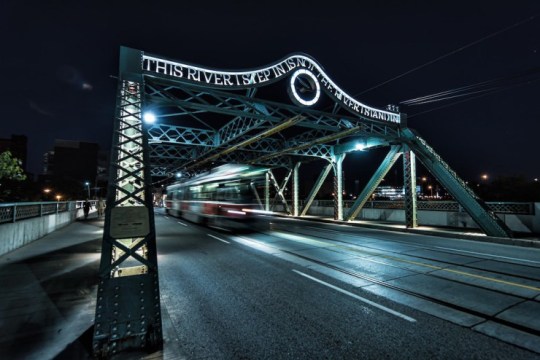
    I was over at the Riverside Bridge yesterday taking photos and I was reminded of Eldon Garnet’s installation called, TIME: AND A CLOCK (1995). 

    The work spans a few physical sites, but perhaps the most well known component is the line of text on the west side of the bridge, which reads in 18″ high letters: “This river I step in is not the river I stand in.” (Photo above from Garnet’s website.)

    If you’re from Toronto, you may be already be familiar with this installation. But I love the message and I think it’s an important one. So I thought I would reiterate it here on the blog. 

    The text is derived from the thinking of the Greek philosopher Heraclitus. Its meaning is a simple one: change is fundamental to the universe. 

    Neighborhoods change. Cities change. Industries change. We change. The river you first step into, is not the same river that you’ll be standing in. That initial river has come and gone, replaced by a new river. In the words of Heraclitus, “No man ever steps in the same river twice.”

    As people, organizations and cities age, there can be a tendency to resist change. I believe in fighting that tendency. 

    Because that’s how established rich companies get destroyed by young poor companies. They – the incumbents – underestimate the importance of change. They forget that the river is constantly flowing.

  • Open for business

    I just received the September issue of Monocle magazine. One of the features I always read is the “Observation” on the very last page. It reads as the editor in chief’s personal blog.

    In this issue he talks about the recent EU referendum and the changes he is making to his business in response to that. Monocle is headquartered in London, but he is now finding it challenging to be “an international media business in a country that hasn’t figured out how it’s going to move forward.”

    His response?

    They are shoring up the Zürich office. They are looking at the possibility of a second bureau somewhere on the continent. And they are similarly looking to increase staff in both Toronto and Singapore.

    When one place closes up, the companies and talent will find other cities that are open for business. 

    As someone who is closing one chapter this week and starting a new one, Tyler Brûlé’s Observation also reminded me of the importance of change. Oftentimes change feels uncomfortable. But that’s not necessarily a bad thing. In fact, it’s more likely a sign that you’re on to something.

    What have you done lately that made you feel uncomfortable?