Daily insights for city builders, delivered every morning at 6 AM ET. I’m Brandon Donnelly — a Toronto-based real estate developer and founder of Globizen. I’ve been writing here since 2013.

Tag: car ownership

  • Car washes are hot right now

    We talk a lot about walkable urban communities on this blog, and I’ll be the first to admit that this is my own bias. It’s my preference. But at the same time, we can’t ignore that, as of 2022, there were nearly 280 million registered personal and commercial vehicles in the United States. And that only about 8.3% of households do not have a vehicle. Most households drive in this part of the world.

    The result is that lots of people want to regularly wash their car(s). According to Bloomberg, there are some 60,000 car washes across the US, and the overall sector has been growing at roughly 5% per year (I’m not sure over what time period). More thrilling, though, are the stats that the car wash market is expected to double by 2030 and that there were more car washes built in the last decade compared to all prior years combined.

    The obvious reason for this is that there are a lot of drivers. But why right now? Apparently, there are other more specific reasons for the recent boom in car washes:

    Now, washes can take just 90 seconds, labor costs have been automated down, and recurring revenue from memberships has eliminated weather risks. Plus, the tax reforms enacted in 2017 by former president Donald Trump allowed car wash owners to claim 100% depreciation on new equipment — a generous subsidy to further investment. While that incentive was written to shrink over time, the tax proposal currently in Congress would restore the 100% depreciation allowance.

    This has the PE and real estate industries interested:

    “If private equity thinks it’s sexy, they’re gonna throw money at it, right?” said Emil Khodorkovsky, founder and CEO of Forbix, a real estate firm that just acquired a car wash in Santa Monica, California. “It’s a basic business. It isn’t complicated finance. Certain actors are getting squeezed but this one still has a much higher-yielding return than an apartment building or a retail center.”

    It’s hard to think of a retail use that is more antithetical to walkable urban communities. Even most drive-through places have the ability to service things that aren’t cars. It is also possible to go through a drive-through on a bicycle or other micro-mobility device. I have done this before and it was fun. But going through a car wash on a bicycle is probably a lot less fun.

    Intuitively, as long as there are lots of cars, there will be lots of people who want car washes. At the same time, there may even be a more urban use case, here. If you happen to have a garage and a driveway, there is always the possibility that you could wash your own car. But if you live in a walkable urban center and you park your car in a stacker accessed via an elevator, it’s probably a lot harder for you to do that.

    In this case, there’s a subscription for that.

  • Cars make cities less compact

    The relationship between car ownership and urban density is a fairly intuitive one. Below are two charts from a study by Francis Ostermeijer, Hans Koster, Jos van Ommeren, and Victor Nielsen, showing how urban density is inversely correlated with car ownership. In other words, the more people with cars, the less dense that a particular place is likely to be.

    But there’s an interesting chicken-and-egg question here. Does Atlanta, which is near the bottom right in the above chart, have a lot of cars because it wasn’t dense enough to support other modes of transport, or did the prevalence of cars in Atlanta cause the city to spread out and become less dense? And that is exactly what the above researchers set out to determine.

    To do this, they started by looking at the presence of commercial car manufacturers in the above geographies in the 1920s. One of the things they found was that having a car manufacturer in your city at this time appears to have had no effect on population density. But over the long run, rising car ownership seems to have had a sizeable effect on reducing population densities in those places.

    The conclusion they draw from this is the title of this post: cars have made cities less compact, rather than low population densities causing people to go out and buy more cars. This makes some sense to me because cities were doing just fine before we invented cars. But like all transportation innovations that allow us to move faster over longer distances, the car encouraged decentralization.

    There are, of course, all sorts of possible implications for a finding like this. But the authors specifically mention developing countries where car ownership may still be relatively low. This is something to be mindful of because if you put most people into cars, history strongly suggests that it will impact the kind of city that you end up building.

    Chart: Cars make cities less compact

  • Lyft announces subscription plan

    Last week, Lyft announced a new subscription plan

    It costs $299 every 30 days and you get 30 rides included (up to $15 each). So it represents a possible 1/3 discount on rides. If you go over the 30 rides per month or over $15 on any one ride, you simply pay the difference. Though as a subscriber, you get 5% off additional rides.

    Subscriptions are good for business. They can be like an annuity. And I suspect that with the above model, there will be unutilized rides every month that the company is just able to bank. You can’t carryover rides with this plan.

    But moreover, Lyft’s “All-Access Plan” is designed to help you ditch your car. Trade your car payment for a ride subscription plan. So if the numbers didn’t quite work for you before, maybe they do now. Depending on the situation, I can certainly see this plan being cost effective.

    But as ride hailing/sharing continues to nibble away at public transportation and personal vehicle ownership, what will this mean for cities?

  • BOOK by Cadillac

    Cadillac is just about to launch a new subscription-based car service in New York City. It’s called “BOOK by Cadillac” and the inspiration for the idea is as follows (taken from this Cool Hunting interview):

    “We believe there is an as-yet untapped space between traditional ownership (leasing, financing, buying) and the rental, ride or car sharing options available today (Car2Go, rental, Zipcar, Uber) — a space where experience is more important than ownership, but a luxury experience is paramount.”

    The way it works is that you pay a flat fee of $1,500 per month, which includes repairs & maintenance, insurance, taxes, unlimited mileage, and the ability to swap out your Cadillac vehicle 18 times per year. The idea here is that you can have one car in the city, one car when you drive to the mountains, and one car when you land in LA and are just feeling something a little different. It’s also commitment-free. Cancel any time.

    It’s all done through their app and there’s a concierge to take care of every little detail, including moving your stuff (sunglasses, phone charger, and so on) to whatever new car you’re swapping to. My understanding is that you can also make the swapping as carefree as you’d like. Meaning: “Oh look, there’s a new Escalade in my parking spot.”

    Here’s their marketing video (click here if you can’t see it below):

    [youtube https://www.youtube.com/watch?v=m-2c6BsqRYU?rel=0&w=560&h=315]

    Now, $1,500 is not cheap. But the value prop here is effortless luxury. I think it’s interesting to see car companies experimenting with new and different business models. 

    My view has always been that the most cost effective way to have a car is to buy a 2-year old model, pay it off, and then drive it for as long as it remains respectable. I am currently in that camp. But even that approach is starting to feel antiquated to me. 

    So much is changing in this space. Pretty soon, I don’t believe we’ll be thinking about car ownership in the same way.

  • Should you buy a car or just take Uber?

    Urban dawn by Raymond  on 500px.com

    https://500px.com/embed.js

    My friend Evgeny published a great blog post today called, On Car Ownership And The Future Of Transportation

    And in it he made the argument that instead of buying a car and an expensive downtown Toronto parking spot (average price: $40,000 – 60,000), most of us urbanites would be better of just taking a taxi or Uber.

    This got me thinking: At what point does it really make sense to completely forgo owning a car? (Full disclosure: I own both a car and a downtown parking spot.) So I decided to dig into the numbers a bit more and compare 4 mobility options:

    • Owning a car ($25,000 upfront) + downtown parking spot ($40,000 upfront) and driving yourself everywhere
    • Taking a regular taxi exclusively ($3.25 base + $1.75 per km)
    • Taking an UberX exclusively ($2.50 base + $1 per km)
    • Or, taking a futuristic driverless car everywhere (here I assumed $1.50 base + $0.25 per km)

    With the above numbers, I then assumed 15,000 km traveled per year and an average trip length of 15 km (so 1,000 trips per year). The trip length and number of trips per year matter because of the “base fare” that is charged when you take a taxi or Uber.

    I also assumed that the cost of owning a car is $0.60 per km (estimated from this Globe and Mail article) and that there is an opportunity cost to NOT renting out your downtown parking spot ($200/month). That is, every month that you spend driving yourself around and parking your car, you are forfeiting parking revenue.

    Finally, I looked at a 10 year time horizon and then “discounted” all the costs back to today’s dollars so that I could compare each mobility option.

    So what did I find?

    image

    What this says is that if you’re driving 15,000 km per year (average trip length 15km), then you’re better off taking UberX everywhere, as opposed to going out, buying a car and parking spot, and driving yourself around.

    But does this hold true at different travel distances?

    Based on my model, once you hit around 18,000 km per year, then you’re better of with option 1 (owning a car). That’s because the per km savings associated with driving yourself around are enough to offset the upfront costs of the car and parking spot.

    On the flip side, when you drop below 7,500 km traveled per year, even a regular taxi starts to make sense. That’s because you’re simply not traveling enough to reap the benefits of owning a car/parking spot. Again, high upfront costs; lower per km operating costs.

    Of course, there are a number of things I didn’t consider in my model. For one, most people finance their car and parking spot (it is bundled into their home mortgage). So I’m sure there are ways that you could change the above outcomes using leverage.

    At the same time, I didn’t account for the fact that when you’re being driven around (as opposed to driving around) you have the flexibility of doing work, responding to emails, and so on. If you want to attach a value to your time, then the scale would tip back in favor of taxis and Uber.

    But all of this was really just to make one point: look how cheap it could be to ride around in a driverless car. When that becomes the reality in our cities, which it will, it’s going to completely transform our current beliefs around cars, parking, and many other things.

    I guess that’s why General Motors just invested $500 million in the peer-to-peer ridesharing company, Lyft. They know the shit is coming.

  • Uber, commuting, car ownership, and the future of urban mobility

    Earlier this week I wrote a “Tech Tuesday” post talking about Uber’s new Smart Routes functionality, which it is currently testing out in San Francisco. At the end of the post I ended by saying that it’s not just the taxi industry that should be thinking about Uber, it’s also public transit authorities. 

    And that’s because many people in cities rely on multi-modal forms of transportation (I know I do) and in my mind it is clear that Uber is trending away from just “Everyone’s Private Driver” to a service that is starting to look and feel a lot like urban mass transit.

    Then today my good friend Evgeny sent me a post called, “Public Transit Should Be Uber’s New Best Friend.” And it’s one of the best pieces I’ve read on Uber and its impact on urban mobility. I highly recommend you give it a read, particularly if you’re in the city building arena.

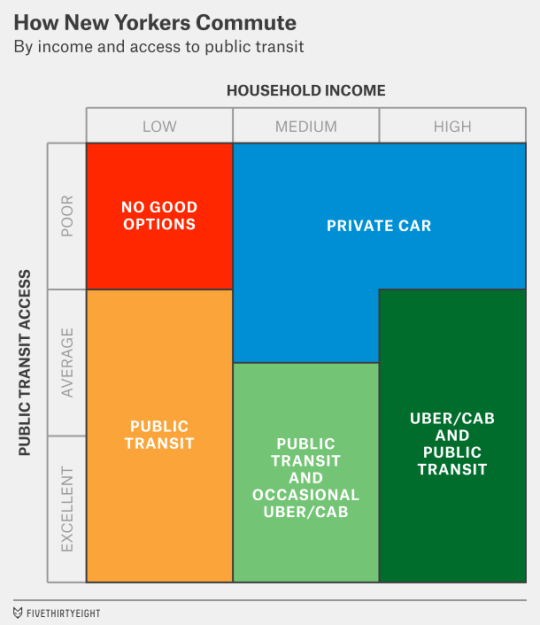
    The article does a deep dive into how New Yorkers commute. Here’s how they broke it down.

    image

    It then talks about what it will take for a company like Uber to make a meaningful dent in car ownership (which is one of the company’s goals) and how the truly big opportunity for Uber is to go more mass market and tap into the public transit market – either by interfacing with or by building its own version of it.

    Here’s their concluding paragraph:

    But there’s a much wider potential audience if Uber can also reach middle-class customers who want to save money. Perhaps in the distant (or even the not-so-distant) future, Uber can build its own version of “public” transit, making rides so cheap that they cost less than the $4 or $5 that Americans now pay, on average, to make a trip in their personal cars. In the meantime, it might have more success among “car-cutting” customers who can use Uber along with public transit. That might mean Uber’s growth is concentrated more in cities like New York, San Francisco and Chicago — and in Europe and Asia — that already have reasonably strong public transit networks.

    It’s definitely worth a full read. Thanks again for sending this over Evgeny.

  • Engaging with the sharing economy

    image

    Last week I wrote (yet another) post about Uber where I argued that leading cities will be the ones that engage with the sharing/rental economy (as opposed to try and outright ban it) and that Uber is going to continue to impact current beliefs around vehicle ownership.

    As to be expected, some people agreed with me and some people didn’t:

    //platform.twitter.com/widgets.js

    But I also discovered following that post that there are groups, and hopefully cities, who are working to adapt to the changing realities brought about by disruptive innovation.

    One of those groups is The National League of Cities – which I truthfully don’t know that much about. But they have created something called “The Sharing Economy Advisory Network.”

    “Cities across the country have been struggling to respond to the rapid emergence of the Sharing Economy,” said Clarence Anthony, National League of Cities executive director. He continued, “Cities are looking for ways to update and improve their current regulatory framework to ensure that regulations like safety and health protect residents, while at the same time supporting the growth of new businesses. It is imperative for cities to learn how this industry operates and discover ways to engage in order to support these new modes of doing business and to create jobs.”

    It sounds like the right kind of initiative and I wish them lots of success. I hope it’s effective and I hope that Toronto will look at how it too can properly manage these economic changes. This is going to take both the private and public sectors working together.

    Image: Sidecar

  • Why buy a car when you’ve got mobile apps

    One of the things that many city planners, transportation experts, and municipalities are trying to figure out is how to successfully shift people away from driving towards alternative modes of transportation, such as biking and transit. Now, this is no easy task. There are a myriad of factors that influence a person’s decision to drive or not drive–or if they should even own a car in the first place. Though, land use and density are, in my opinion, probably the biggest.

    But of all the solutions thrown around, mobile apps are typically not within the playbook. However a recent New York Times article is making the argument that it should be, because car-sharing services and apps like Uber seem to be indeed having an affect on people’s decision to own a car. And that’s because in some cities it’s actually cheaper to use Uber every day (than to own a car) and because taxi use has been shown to correlate with other (non-driving) forms of mobility.

    Paradoxically, some experts say, the increased use of ride-sharing services could also spawn renewed interest in and funding for public transportation, because people generally use taxis in conjunction with many other forms of transportation.

    In other words, if Uber and its ride-sharing competitors succeed, it wouldn’t be a stretch to see many small and midsize cities become transportation nirvanas on the order of Manhattan — places where forgoing car ownership isn’t just an outré lifestyle choice, but the preferred way to live.

    And to be honest, I don’t think this is all that far stretched. More and more I find myself wondering why I even own a car. It’s not appreciating sitting downstairs in my garage and, given the frequency in which I use it, I would definitely be better off financially if I simply used an app like Uber or Hailo more often. About the only thing those apps aren’t great for are trips to Home Depot and snowboard trips to the mountain.