Daily insights for city builders, delivered every morning at 6 AM ET. I’m Brandon Donnelly — a Toronto-based real estate developer and founder of Globizen. I’ve been writing here since 2013.

Tag: capitalism

  • Happiness vs. satisfaction

    I have heard from some of you that you don’t like it when I write about crypto and NFTs. This personal blog is supposed to be largely about city building after all. So today I thought I would write about crypto and NFTs. More specifically, this podcast episode, which I watched last night.

    It’s with Marc Andreessen and Chris Dixon of the venture firm a16z, and it’s actually less about specific things like NFTs and more about the reinvention of the internet in general. Why I found it particularly interesting is that Marc co-invented the first widely-used web browser. Anyone remember Netscape?

    So he was around for what we are now calling web 1 and he is around for what we are today calling web 3. And there are lots of parallels between then and now. Similar to today with crypto, the early internet had lots of critics and lots of people who thought it was dumb and that it would never amount to much.

    Oops.

    Here are a few other thoughts and ideas from the podcast that I found interesting (some of them even relate to city building):

    • No matter how many times we have seen the same movie, humanity seems doomed to repeat the same mistakes when it comes to, among other things, embracing new ideas and innovations. I agree with Marc in that part of this is generational. Younger people are often more open to new ideas because they view it as a way for them to establish themselves and make their mark on the world. Whereas older people (established people) often view new ideas and change as a threat to their current position in the world.
    • Marc drops a number of books throughout the talk and one of them is The Mystery of Capital — Why Capitalism Succeeds in the West and Fails Everywhere Else. This is a well known book by Hernando De Soto and the big idea is that property ownership and property rights are really the fundamental ingredients in our modern world. People need to know that if they hold title and invest money into something, it’s not just going to get taken away by someone. And it is this underlying legal structure that has allowed people to leverage property into wealth.
    • This is a fascinating observation in its own right, but it also relates to crypto. Hear me out. Chris Dixon makes the argument in the episode that web1 democratized information (anyone can search for stuff), and that web2 democratized publishing (anyone can share stuff through platforms like Twitter or the blogging platform I’m writing on right now). He then goes on to argue that the promise of web3 and crypto is really to democratize ownership of the internet. Anyone can buy crypto tokens.
    • Why might this be a big deal? Well if property rights in our offline world are a fundamental ingredient to modern society, it seems logical to me that property rights in our digital world(s) might also be equally transformative. And this is precisely one of the things that blockchain technologies enable for the very first time.
    • Finally, on a mostly unrelated note, I liked Marc’s comparison of happiness vs. satisfaction in life. Happiness, he explains, is like getting an ice cream cone on a hot summer day. The first and second feel great, but after that you move on. Satisfaction on the other hand is enduring. It’s the feeling you get from working on something really challenging and then finally succeeding. And that’s exactly how I feel about real estate development. There are lots of shitty days and lots of grinding. But in the end, I do feel very satisfied.
  • The World After Capital

    Years ago I wrote about a book that venture capitalist Albert Wenger was writing — in public I would add — called The World After Capital. The public bit is interesting. As he was writing the book over the last ten years or so, he did it in public and published drafts along the way. This allowed him to get feedback, learn things, and revise accordingly. He calls this a “knowledge loop” and it ties in nicely with some of the topics that he covers in the book.

    The first focus of the book is on explaining that capital (which was a constraint of industrialization) is no longer scarce. This isn’t necessarily true everywhere, but he argues that it is true in the developed world. What is instead scarce today is attention. That is our defining constraint as we continue to move into the Knowledge Age. The second focus of his book is on how he thinks we should best respond to these changes, as well as to the limitations of capitalism.

    I haven’t read the book yet (only scanned it), but it’s now in my queue. Normally my queue consists of a stack of partially read books next to my bed. But this one is digital only for the time being. If you’d like to read a digital copy (there’s a downloadable PDF), go here. Apparently there will also be a hard copy available sometime later this year or early next year.

  • Doing stuff vs. owning stuff

    “People get income for doing stuff, and they get income for owning stuff. Increasingly the latter. And the ownership share of income goes to a small slice of households that own almost all the stuff.”

    This is a quote from a recent article by Steve Roth over at Evonomics, where he breaks down the share of US household income that is derived from “labor” vs. “capital.” In other words, how much money do households make from working (trading their time for money) and how much do they make from their existing wealth (that is, owning stuff)?

    If I were to oversimplify how he calculates this (you can read all of the details, here), it is: (Income – Labor Compensation) / Income. Take all of the household income. Subtract the money made from doing stuff. And then divide it by total income to get the percentage made from “unearned property income.” There are gray areas and others things to consider, but that’s the gist of it.

    What he discovers and argues is that basically 50% of household income comes from simply being wealthy and owning stuff. He also reminds us that approximately 60% of US wealth is… “earned the old-fashioned away: it’s inherited.”

  • Should we love bubbles?

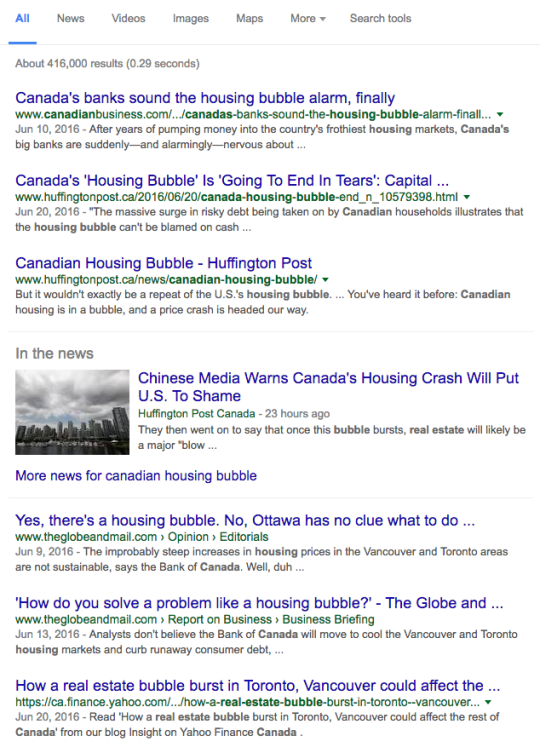
    There’s no shortage of talk about a Canadian housing bubble:

    image

    In Vancouver, the price of a single-family home (as of June of this year) increased 39% to C$1.6 million from the year prior. Does that constitute bubble territory?

    In an effort to stop prices from running away even further, I am sure you all know that the BC government has recently imposed an additional 15% transfer tax on Metro Vancouver homes purchased by foreign buyers (people who are not Canadian citizens or permanent residents).

    The data that I have seen (here and here) suggests that foreign buyers could make up somewhere around 5-10% of the market. Given that many will now get creative in terms of hiding their foreignness, I am not so sure this new tax will have a dramatic impact on affordability. But it certainly sounds nice if you’ve been grouchy about home prices and thinking “those damn foreigners.” We’ll have to see how it plays out.

    Having said all of this, if Vancouver is in fact in bubble territory, would that be so bad? Are we thinking about this the right way?

    Here’s an alternative viewpoint.

    I recently stumbled upon an old blog post by Tom Evslin (2005) called: Why we need bubbles. I discovered it via it Fred Wilson. Tom’s argument is that we need irrational exuberance because it provides the capital that allows for dramatic overbuilding. The overbuilding of things like rail infrastructure, internet infrastructure and – I’m adding this – housing infrastructure. And once this happens, it dethrones the incumbents and paves the way for future economic progress.

    Tom’s focus is on technology, but I couldn’t help but think of the parallels with city building. Is the proposed Rail Deck Park in Toronto so bold that it’s only possible during a period of irrational exuberance? Should Vancouver instead be working to dramatically expand its housing supply instead of trying to tax away a portion of demand? Is a period of irrational exuberance precisely the moment where we lay the ground work for our future successes?

    I’m not saying we’re in a bubble. I don’t believe in or know how to time markets. But I am asking whether the bubble headlines are missing the greater opportunity.

  • 3 thoughts from Rem Koolhaas

    Earlier this year, architect Rem Koolhaas of OMA spoke with Mohsen Mostafavi (dean of the Harvard Graduate School of Design) to close out the 2016 AIA convention

    I still remember my first architectural theory class where the professor told us all that Koolhaas was the most important living architect of our time. And today, if you think about all of the stars that have grown out from his firm – such as Bjarke Ingels and Joshua Prince-Ramus – it is certainly a defensible argument.

    Koolhaas is generally very critical of globalization and the market economy when it comes to creating good architecture. His view is that “pure profit motives” are leading to cities that are basically not designed.

    This is a fairly common belief within architectural circles, which is why many celebrated names would rather work on a museum over a residential condo project. The latter is too motivated by profit. It’s not architecturally interesting.

    I, on the other hand, have always believed in working within the confines of the market to try and promote great architecture and city building. I’m not saying that the market is perfect, but profitability is a constraint that every industry deals with. Architecture is no exception.

    That said, there are other things that I agree with Koolhaas on. Below are 3 verbatim highlights taken from a Fast Company article summarizing his talk with Mostafavi: 

    Communication needs an overhaul.

    “Architecture has a serious problem today in that people who are not alike don’t communicate. I’m actually more interested in communicating with people I disagree with than people I agree with.”

    "To have a certain virtuosity of interpretation of every phenomenon is crucial. We’re working in a world where so many different cultures are operating at the same time, each with their own value system. If you want to be relevant, you need to be open to an enormous multiplicity of values, interpretations, and readings. The old-fashioned Western ‘this is’ ‘that is’ is no longer tenable. We need to be intellectual and rigorous, but at the same time relativist.”

    Architecture’s greatest value in the future might not even be architecture.

    “Architecture and the language of architecture—platform, blueprint, structure—became almost the preferred language for indicating a lot of phenomenon that we’re facing from Silicon Valley. They took over our metaphors, and it made me think that regardless of our speed, which is too slow for Silicon Valley, we can perhaps think of the modern world maybe not always in the form of buildings but in the form of knowledge or organization and structure and society that we can offer and provide.”

    Preservation is a path forward.

    "We’ve tried to discover domains and areas in architecture which are not a simple vulgar multiplication of uninspired global projects. Recently, we have looked at preservation. The beautiful thing about preservation is you begin with something that already exists and therefore is already local. By definition, a preservation project is an homage to earlier cultures and mentalities to which you can add a new dimension, a new function, a new beauty or appeal. Almost every impulse signals that globalization needs rethinking or adjustment.”

  • Architecture as a tool of capital

    I just stumbled upon an interesting Architectural Review article from last year called: Architecture is now a tool of capital, complicit in a purpose antithetical to its social mission. The author is Reinier de Graaf, who is an architect and partner at the firm OMA.

    The focus of the article is on inequality; capitalism vs. socialism; Thomas Piketty’s book, Capital in the Twenty-First Century (which is now on my reading list); and on how Modernism lost its social mission and got repurposed as a tool that just serves capitalist interests. It went from an ideology to simply an architectural style.

    Here is an excerpt:

    “Once discovered as a form of capital, there is no choice for buildings but to operate according to the logic of capital. In that sense there may ultimately be no such thing as Modern or Postmodern architecture, but simply architecture before and after its annexation by capital.”

    Given that I am initially trained as an architect, but that I work as a real estate developer, this article hits home for me. But unlike the author, I am not as fussed by this intertwining of capital and architecture. In fact, I have always believed that the more architecture can understand its economic milieu, the more likely it can affect positive change.

    Of course, there’s the question of whether that economic milieu is even the right one in the first place. I’ll echo this blog post (on the limits of capitalism), by saying that I consider myself a capitalist, but not an absolute capitalist. Capitalism isn’t perfect.

    I like Reinier’s description of income vs. wealth (borrowed from Piketty):

    He identifies two basic economic categories: income and wealth. He then proceeds to define social (in)equality as a function of the relation between the two over time, concluding that as soon as the return on wealth exceeds the return on labour, social inequality inevitably increases. Those who acquire wealth through work fall ever further behind those who accumulate wealth simply by owning it.

    What are your thoughts?

  • The MFA is the new MBA

    Harvard Business Review recently published a conversation between Roger Martin – who is the former dean of the Rotman School – and Tim Brown – who is CEO of the global design firm IDEO. The title of the talk is “Capitalism Needs Design Thinking.” But I decided to call this post something else after reading Roger say this:

    My friend Dan Pink argued in an HBR piece in 2004 that the MFA is the new MBA. I wrote to Dan to say that if that’s the case we have a problem because America pumps out a mere 1,500 MFAs a year versus 150,000 MBAs. Thirty MFAs per state per year is just a rounding error. This is one of the reasons I was so keen on transforming business education. It’s a huge infrastructure: 27% of all graduate students in America are in an MBA program. If they’re all being taught how to analyze things to death, that’s going to affect how they’ll shape the future of business.

    But what this conversation is really about is the future of democratic capitalism, which is why I think it’s a nice tie-in to yesterday’s Architect This City post about startups and inequality.

    I’m very worried about the fact that in America we’ve now gone 24 years without the median household income rising — it was the same in 2013 as it was in 1989. That’s unprecedented in American history. The longest that’s ever happened before is when it took just under 20 years to recover, after the Great Depression. This long period of stagnation has coincided with the top 1% of the economy doing spectacularly.

    And so while it’s easy to point fingers at the tech community and say that it’s to blame for rising income inequality, the reality, I think, is that there are other more fundamental issues that need addressing. Roger and Tim believe that design thinking can help. Here’s another great snippet from the former:

    I think the way that government generally works is to think, think, think, think, and then finally create legislation that brings about some change, and then they ignore their legislation and say okay, we’re finished with that. Then people go and figure out how to game that legislation, and the government doesn’t do anything about it. Whereas if they had a design view of it, they’d say when they passed a bill, that’s just the best idea we’ve got now, we have to go see how it works in practice, and then fix it. That’s just not the mentality.

    Technology is having a profound impact on the world. And it’s something that is very visible. But part of the challenge is that governments aren’t keeping up. They are almost never out in front.

    So when something new comes along, like Airbnb or Uber, the reaction is to just stop it. It doesn’t conform to the rules and regulations currently in place, and so it shouldn’t exist.

    But as Roger and Tim point out, maybe we need to look at our rules and regulations as simply part of an iterative process (like designers do). Because if we did that, maybe we’d be better equipped to transfer the benefits of innovation over to society as a whole.

    Image: HBR

  • Capitalism and the future of the world

    Last night I watched an interesting presentation by Fred Wilson (New York VC) where he talks (at LeWeb in Paris) about the big 3 technology trends shaping our world. In his view, they are 1) non-hierarchical networks (think Twitter vs. newspapers); 2) unbundling; and 3) smartphones (the most obvious of the 3). It’s a great talk even if you’re not interested in technology per se, because these trends are impacting virtually every industry, from banking to education.

    This morning Fred wrote a post on his blog called “The Limits of Capitalism.” And I think it’s an excellent follow-up to his talk on the future. I would also classify myself as a capitalist, but I also think that unfettered capitalism will eventually break down. And in the context of the changes outlined in his presentation, I think we need to think long and hard about how we’re going to—not stop them from happening, because they’re inevitable—but best cope with them.

    Because already we’re seeing rising income inequality and a complete “bifurcation of the labor market into high-skill and low-skill jobs.” And that in turn is impacting our cities. In fact, that bifurcation is what largely got Rob Ford elected here in Toronto.