
This week it was reported that a South American family has bought and closed on ~$27 million worth of residential condos at Waterline Square in Manhattan. Apparently they went into contract (after the online showings) and closed on the same day, which I suppose you can do when it’s an all-cash deal like this was. The agent, Maria Velazquez, didn’t disclose who the family was, but apparently they’re from Peru and they wanted a safe place to park their money during this pandemic. Uncertain times usually create buying opportunities, and it sounds like the family did get a bit of a bulk discount here. But it’s also interesting to see where capital is flowing right now and what is perceived as a safe haven. Residential real estate in one of the world’s preeminent global cities probably won’t come as a surprise to any of you.
Tag: capital flows
-
Hong Kong vs. Singapore

There’s now evidence to suggest that the political crisis in Hong Kong may be having an impact on capital flows. Bloomberg, as well as others, reported today that wealth managers in Asia have been receiving a heightened number of requests to transfer assets out of the country — to places like Singapore — and to setup new overseas bank accounts so that they can be ready to transfer, should the situation gets worse.
In fact, the Monetary Authority of Singapore (MAS) even asked the country’s financial institutions not to prey on the wealthy in Hong Kong during this period of uncertainty. They want to avoid the perception that Singapore is trying to capitalize on the situation. Of course, it remains to be seen how much all of this is here-say and how much of it will actually translate into a meaningful transfer of wealth.
Hong Kong has a significantly larger private wealth base, with about 853 individuals worth more than $100 million. This is more than double the number in Singapore (figure from Credit Suisse). But the current demonstrations have people questioning what will happen to Hong Kong in 2047 when the constitutional article committing Hong Kong to a capitalist way of life is set to expire.
The flows of capital can be fickle.
Photo by Florian Wehde on Unsplash
-
Buy land, Chip. Buy land.
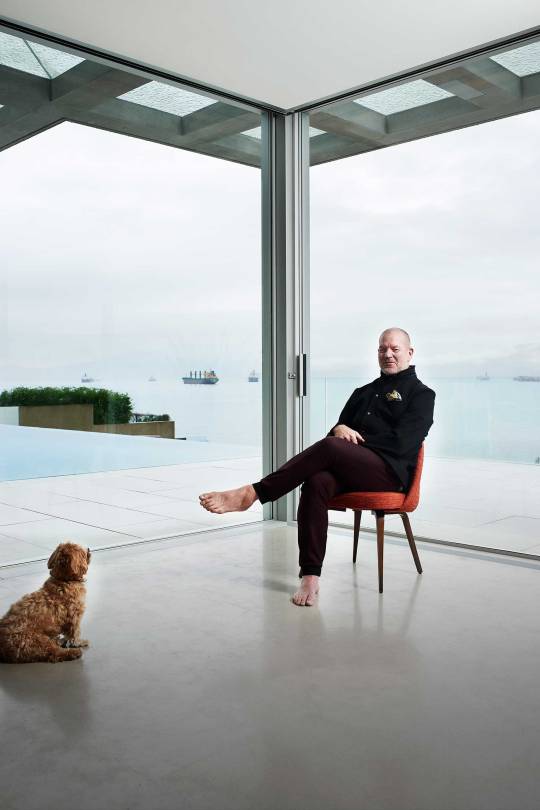
Bloomberg Businessweek just published a longish article about Vancouver and the Chinese capital that fuels it. It’s called, The City That Had Too Much Money.
Most of you are already familiar with this narrative, but here’s an excerpt that talks about the city’s economic base and its apparent dependency on foreign capital:
Change will be difficult and fraught. Vancouver has been closely connected to Asia since the late 19th century, when the first Chinese laborers arrived to help build the trans-Canada railway, and the city is proud of its record of integrating immigrants. Also, beyond real estate, Vancouver’s economic base is shallow. It’s not the business capital of western Canada—that’s Calgary—and it has few major corporate headquarters or large-scale manufacturing operations. “Asian capital has kept this economy alive, end of story,” says Ron Shon, a Chinese-Canadian venture capitalist who arrived as a teenager in the late 1960s. “You can see it in every aspect of our lives.”
One of the things I found particularly interesting were Chip Wilson’s comments around what is going on. Chip is the founder of Lululemon and is largely credited with pioneering the current “athleisure” trend.
Yet as Wilson explains, sitting in his office on the top floor of a century-old warehouse, these days he’s as interested in bricks and mortar as in quick-drying fabrics. “The global capital flowing out of China across the world, you’d have to be an idiot not to acknowledge it,” he says. “You know, we could just be at the cusp of that.”
To profit from the deluge, he’s been buying up land all over town, especially in False Creek Flats, a derelict industrial area that’s slated for redevelopment. He estimates that about a third of his holdings are now in real estate. British Columbia’s current government may succeed in slowing inflows temporarily, Wilson says, but China’s boom has created many multimillionaires who need a place to put their money. “So where do you go if you’re Chinese? Sydney, maybe. But nowhere, probably, is more friendly than Vancouver.” One way or another, he says, those funds will find their way to Canada.
That’s why, Wilson says, whenever he returns from a trip to Asia, his first thought is simple: “Buy land, Chip. Buy land.”
For the full article, click here.
Image: Jens Kristian Balle/The Forbes Collection/Contour/Getty Images (via Bloomberg)
-
The global pyramid of wealth
Every year the London-based property consultancy Knight Frank publishes something called The Wealth Report. And it’s one of those reports that I could go through for hours.
It includes a ton of really fascinating stats that speak volumes about where in the world wealth is being created and how it’s moving around. And of course there are a lot of connections between wealth, real estate, and city building.
Below are 3 diagrams that really stood out for me in the 2015 version.
The first diagram shows which cities have the most Ultra High Net Worth Individuals (UHNWIs). An UHNWI is defined as an individual with assets exceeding US$30 million, but excluding personal assets and property (such as one’s principal residence). Click here to see the full size image (I know the numbers are small).
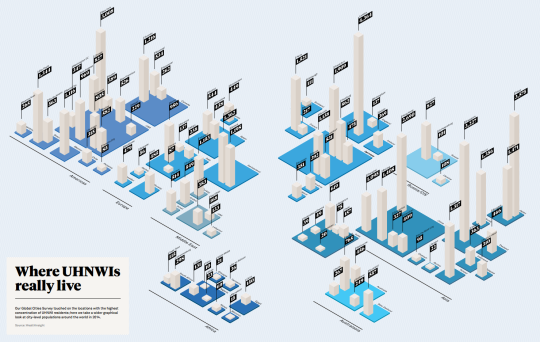
Not surprisingly, London (4,364), Tokyo (3,575), Singapore (3,227), New York (3,008), and Hong Kong (2,690) are at the top of the list. But I was a little surprised – albeit happily surprised – to see Toronto (1,216) come in at #2 in North America, beating out Mexico City (1,116), Los Angeles (969), and Chicago (827).
The second diagram shows you how many square meters of luxury property (apartment) you can buy for US$1 million in a bunch of different cities around the world.
In Monaco (top end), that’ll buy you 17 square meters (183 square feet) and in Cape Town (bottom end), that’ll buy you 208 square meters (2,196 square feet).

The third and last diagram is what they call the global pyramid of wealth. It’s a pyramid of everyone in the world and then the number of millionaires, UHNWIs (see above), centa-millionaires, and billionaires. And if you do the math, the top of this pyramid comes nowhere close to 1% of the global population.
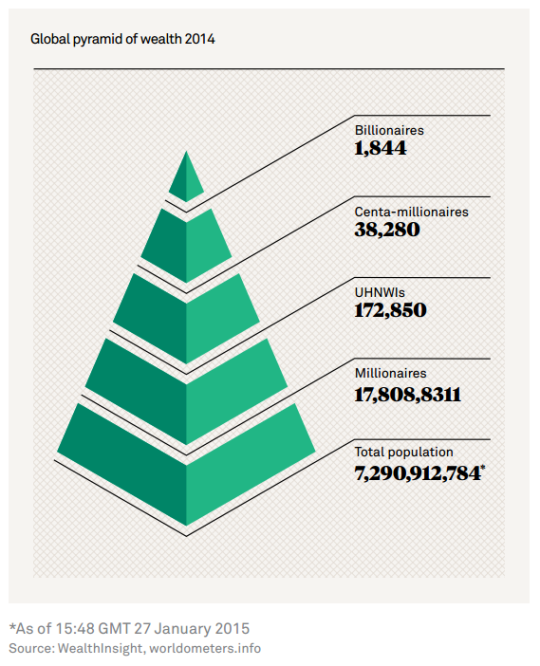
It’s fascinating (and exciting) to see where and how global wealth is concentrating. But it should also make you think about rising income inequality. I know it does for me.