
Daily insights for city builders, delivered every morning at 6 AM ET. I’m Brandon Donnelly — a Toronto-based real estate developer and founder of Globizen. I’ve been writing here since 2013.

Tag: cannes

  • 1/21st of a second home

    I don’t know for exactly how long, but for a very long time people have been trying to solve this real estate problem: “I have a desire to own a home, or multiple homes, around the world. However, I don’t know how often I’d actually use it/them, and this desire is both expensive and a pain in the ass.”

    And so unless you have a lot of money and can make the pain in the ass part go away, there seems to exist an ongoing need to make fulfilling this desire both cheaper and easier. Perhaps the most common ways are through a timeshare property or through some kind of fractional ownership structure, where you own a share of a property.

    Some companies are even “tokenizing” this second structure on blockchains. I have read about one company that is buying vacation homes and then issuing 365 corresponding tokens. Each token represents 1 day of occupancy (and actual title ownership apparently). In theory this sounds kind of neat, but you’re also buying a second home with potentially 364 other strangers.

    So here’s another approach that I just learned about. The UK-based company, August, has devised a model that works like this:

    • August starts with “homeowner curation.” Meaning, they start by vetting homeowners to make sure that they’re not weird or something.
    • Once they have a suitable collection of homeowners, August sets up a new real estate entity that all of the homeowners must then fund equally.
    • This entity, by way of August, goes out and buys 5 properties, and each homeowner receives an equal share of the ownership. (Typically, they target 16-21 groups per entity.)
    • August renovates the 5 properties, gets them ready for occupancy, and then manages them on ongoing basis. This includes bookings.
    • Finally, each homeowner gets an average of 8-10 weeks per year across all of their homes.

    In terms of the homes themselves, their pied-à-terre collection includes homes in Paris, Rome, Cannes, Barcelona, and London. They are typically between 70-100 square meters with 2 bedrooms and 1-2 bathrooms. And the average price/value is supposedly around €1,250,000 (post-renovation?), with the entry price of a share starting at €340,000.

    I’m not sure if this share figure is based on 21 homeowners, but if it is, then that’s €7,140,000 of equity being raised in order to buy somewhere around €6,250,000 of real estate. Is the spread their margin for setting this all up? There’s also an annual fee per owner (€8,600), which presumably covers operating costs and the ongoing management of the properties.

    A model like this naturally provokes a lot of questions. What happens if somebody wants to sell? Does the next buyer need to be similarly vetted for overall weirdness? And how liquid is 1/21st of a 5-property apartment portfolio? I don’t know these answers, but intuitively these shares have got to be less liquid than a 100% sale.

    However, as a solution to the problem of “I have a desire to own homes across Europe but I’m not quite rich enough to make it truly carefree”, this seems like a pretty clever solution.
  • The City as a Place for People

    The City of London Corporation recently published a report called “The City as a Place for People”, which talks primarily about itself and how great London is as a magnet for talent. 

    But as self-serving as it may be – the report is timed to be ahead of this year’s MIPIM – there appears to be some data and interviews backing up the claims.

    58% of “institutional investors” said that London is the best European city for business. Dublin was next at 22%. 

    A separate survey of 2,568 “corporate decision makers” in Europe revealed that 21% of respondents felt that London was the best European city for business, followed by Paris (13%) and Frankfurt (7%). When asked which city had the best talent pool, the responses were fairly similar.

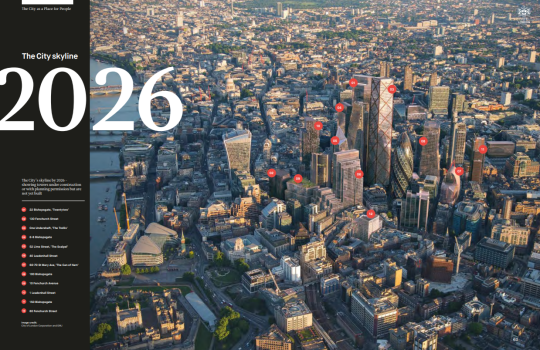
    Also included in the report is a rendering of the City’s skyline by 2026. These are always fun to see. Here is a screen grab:

    image

    It is showing all towers under construction and all towers with their planning permissions in place. If you’d like to download the full report, you can do that here.

  • TIFF + TORONTO

    During TIFF is an awesome time to be in Toronto. The city is buzzing, the bars are open until 4am (that should be standard), and everybody is talking about films. I used to go to a lot more movies when I was younger, but that’s sort of fallen off in recent years. Thankfully, my good friend Meg was kind enough to invite me out last night. We saw Blood Ties, which I really enjoyed. It’s about a good cop and a bad brother.

    Before the movie started we started talking about the history of TIFF and it’s impact on Toronto’s economy. Curious, I looked it up today and the estimated annual contribution in 2011 was approximately $170M (which appears to be comparable to Cannes). That’s pretty impressive given that, even though there’s technically programming all throughout the year, it’s really only an 11 day festival.

    I was also reminded of Roger Martin’s book the Opposable Mind, where he talks about the founding of the festival and the dichotomy the founders were faced with. He argues that, at the time (1970s), there were 2 predominate film festival models in place: the elitist jury driven Cannes model and the sort of grassroots model. The problem with the former was that it didn’t feel inclusive for festival goers and the problem with the latter was that it didn’t attract the buzz of say a Cannes.

    image

    The solution was to do both – basically make the audience the jury. The solution was a People’s Choice Award. This made festival goers feel like they had a say and were a part of the process, and it served as an effective buzz machine. There were also a bunch of other benefits, including the fact that the industry could now get a clear sense of a movie’s commercial appeal prior to going to market. More insular festivals couldn’t do this as well.

    Here’s how Roger Martin put it:

    “The People’s Choice Award put the Toronto International Film Festival on the map. By 1999, Roger Ebert, America’s most influential film critic, was telling one reporter that “although Cannes is still larger, Toronto is more useful and more important.” By 2005, TIFF had booked the largest volume of sales in film festival history, and film critic Liam Lacey named it “the most important film festival in the world – the largest, the most influential, the most inclusive.””

    This is an incredible achievement and we’re lucky to have it in our city. Now let’s get out and create some more of the world’s best.