Daily insights for city builders, delivered every morning at 6 AM ET. I’m Brandon Donnelly — a Toronto-based real estate developer and founder of Globizen. I’ve been writing here since 2013.
At the beginning of this month, between Sep 2 and Sep 4, the research company Nanos conducted a random survey asking Canadians about their views on housing. The survey reached 1,044 adults and you may find the results interesting:
Nationally, three in five Canadians “support” or “somewhat support” decreasing the number of immigrants coming into Canada until housing becomes more affordable. (The feds plan to welcome 500,000 immigrants per year by 2025.)
The provinces that are the most in support of reduced immigration are the Prairies (65%), and the province with the lowest support is BC (52%).
82% of Canadians are “opposed” or “somewhat opposed” to building new housing on land currently set aside as green space. Of this group, 64% responded with “opposed”.
55% of Canadians “support” or “somewhat support” giving tax incentives to private developers to build new rental housing. The highest support for this is in BC (61%), Quebec (60%), and among Canadians 55 or older (55%).
However, this support flips when Canadians are asked about giving tax incentives to private developers to build for-sale housing. 58% of Canadians are “opposed” or “somewhat opposed” to doing this.
These last two points took me a second to decipher, because the wording in the article is “new rental units” and “new homes.” Naturally, I initially read these two things as being the same thing. New rentals are new homes. So what are they trying to say here?
My assumption (in the above) is that it’s a housing bias coming through and that a “new home” equals a for-sale low-rise house. Hmm. We really need to be more mindful of the semantics in our housing vocabulary.
This past week at Collision Toronto, Canada unveiled a new “Tech Talent Strategy” that includes a number of initiatives designed to attract more human capital across the science, technology, engineering, and math sectors. (Sidebar: The STEM sectors are great, but I’m really a fan of STEAM.)
At a high level, these measures are intended to continue to grow Canada as a hub for global tech talent. So they cover things like promoting Canada as a destination for digital nomads, improving the Start-up Visa Program, and dunking on US immigration policies by creating an open work permit stream for H-1B specialty occupation visa holders.
Overall, it seems great.
But there are people who are concerned about the pace of immigration in Canada. Over the past year (ending in Q2-2023), the country added about 1.2 million people. This is a record. And perhaps the greatest concern, is that we simply aren’t building enough housing and related infrastructure.
But I don’t get this logic. Canada is a relatively small country. Attracting smart and ambitious people from around the world is good for us. And there are simple ways to address these concerns: build more housing and related infrastructure. I’m pretty sure that we can figure out how to do that.
The central bank tightening and interest rate hikes that we saw last year will come to an end in the first quarter of 2023 as inflation gets under control. This will ultimately lead to a recession but my sense is that it will be more mild than severe. For this reason, I don’t think anyone should expect ultra-low rates to return in the short-term.
Much of the real estate sector went on pause in the second half of 2022. But ultimately this reset to a more balanced market is going to be necessarily painful for some. And I think we will see that pain play out in the first half of the year. This will obviously be bad for some, but it will create opportunities for others.
Construction costs tempered in the second half of 2022 and started to show some evidence of price softening. I think we will see more of this in 2023, which will be healthy for the market. Cost management over the last few years has been a meat grinder for the development industry.
Pre-construction condominium sales for well-located projects will return in a more fulsome way by the spring. This will be driven by buyers now having clarity around where interest rates will be hanging out in the short-term and, in the case of Canada’s largest cities, by record-high immigration levels.
For the tertiary/fringe housing markets that saw big run ups in pricing during the pandemic, I unfortunately think it will take many years for prices to fully rebound. The price increases we saw in these submarkets were of course a result of low rates, but it was also driven by a view on urban decentralization that in my view did not actually materialize.
The desire to add more housing to single-family neighborhoods will continue to pick up steam across North America. How exactly this plays out will be market specific, but in Toronto I expect to see new planning policies put in place, as well as supportive building code changes.
Public transit ridership will remain below pre-pandemic levels throughout 2023. This will continue to exacerbate public finances.
Autonomous taxis will grow rapidly this year. Companies, such as Cruise, will expand into a number of new US markets and, at some point during the year, I will take my very first ride in an autonomous vehicle.
2023 will be a big year for augmented reality and “phygital” goods. Last year I thought Apple would release a new product in this space. That didn’t happen, but it will this year. At the same time, we will see more companies releasing products that blur the lines between our online and offline worlds (hence “phygital”). This will include NFTs and other crypto-related things that will start to operate more seamlessly in the background of consumer-facing products/services.
I continue to be bullish on Ethereum and I think it will overtake Bitcoin in terms of market cap in the next 2-3 years. But I was very wrong about Solana last year. And now I am struggling with its value proposition. Today, layer 2 chains such as Polygon feel more likely to win out. Broadly speaking, I suspect 2023 will be a positive year for crypto, but not a record-setting one.
In summary, I think we are going to see more pain at the beginning of 2023, but that on the other side of it will be healthier and more balanced markets. This means that we can look forward to the end of the year feeling much better than it does right now. All of this said, please keep in mind that I’m often wrong and that nothing in this post should be construed as actual advice.
Population growth — so, immigration — is a crucial demand driver for the real estate industry, and for the growth of the overall Canadian economy. Last year, Canadian immigration averaged about 28,400 people per month, according to a recent equity research report (on the apartment sector) by TD Bank. The total number for 2019 was 341,175 people.
Not surprisingly, this number fell off in March of this year with the closing of our borders. In March, immigration declined to 18,560 per month and bottomed out in April with only 4,135 immigrants being admitted to the country. This has no doubt been a factor in some of the rent softening that we have seen in the multi-family space.
While it’s unlikely that Canada will meet its 2020 target of 320,000 to 370,000 new immigrants, it’s important to note that we have seen a fairly swift recovery (see above). In June of this year, the number rebounded to 19,175 new immigrants. And I’m certain that most of this cohort still went straight toward our biggest cities.
It’s also important to keep in mind that Canada’s three-year goal (2020-2022) remains 1 million new immigrants. TD is of the opinion that this target is still attainable, as this “short-term immigration headwind” is likely to flip into a tailwind once our borders become more porous and we get to the other side of this pandemic.
Looking back on this post from earlier in the week, I think it’s pretty safe to say that you could bucket this immigration blip into (1) short-term dislocation. It is not a (3) long-term structural change. Canada remains one of the greatest countries in the world. We will continue to attract smart and ambitious people from all around the world, and most will want to settle in our urban centers.
All of this, of course, will be good for the real estate industry and will be vital to the strength of the Canadian economy as a whole.
This has become a frequently reported topic, but here’s a recent article from Wired talking about tech workers living out the American Dream — in Canada. The story is pretty simple. Immigrants are smart and work hard. Canada has a system in place that privileges newcomers who are young and smart. And this has become a boon for our largest city and for the country. Here are two excerpts from the article:
But there’s a new global winner: Canada, and particularly Toronto. Since 2013, the tech scene there has grown faster than in any other North American city. In 2017, Toronto added more tech jobs than Seattle, the San Francisco Bay Area, and Washington, DC, combined; in 2018 (the most recent year for which numbers are available), the city was second only to the Bay Area in new tech jobs. Toronto is so crammed with immigrants that nearly 50 percent of all residents were born outside the country.
Canada’s immigration policy is hardly warm and fuzzy. On the contrary, it’s icily calculating. The government loves educated, elite newcomers, because they help propel the economy, says immigration lawyer Peter Rekai, but it wants them young, so they won’t drain the public health care system. Their parents are much less welcome.
In the first quarter of this year, international migration accounted for 82.3% of Canada’s population growth. And at the beginning of this year, Ottawa was planning for up to 370,000 new permanent residents. It is highly unlikely that we hit that number given our current health crisis, but I have no doubts in my mind that we will hit it in the very near term. And when we do, it will be a good thing for Toronto.
Bloomberg recently reported that Canada admitted 321,065 permanent residents last year. This is up 12% from 2017, where the country admitted 286,479. Last year was also the largest cohort since 1913 (the year before World War I), where the country admitted just over 400,000 people.
Here is a chart from Bloomberg (it is interactive if you click through):
Of course, Canada was a much smaller country back in 1913 (about 7.6 million people), and so on a percentage basis we are much lower than where we were at the beginning of the 20th century. We’d have to admit close to 2 million permanent residents a year to get to a similar rate.
I couldn’t find a geographic breakdown for last year, but in 2017, about 40% of admitted permanent residents (or 111,925 total) ended up in Ontario and about 72% ended up in Ontario, Quebec, and Alberta (the top 3 provinces for this year). If we add in BC, it brings this figure up to 86%.
Here are also the top 10 countries of origin:
If you’d like to download a PDF of the full report, you can do that here.
Last week a friend of mine sent me a really fascinating article from The Economist talking about the role of foreign investors in Vancouver’s housing market. If you subscribe to The Economist, you can click here to read the article. If you don’t subscribe, you’ll have to rely solely on what I’m about to say.
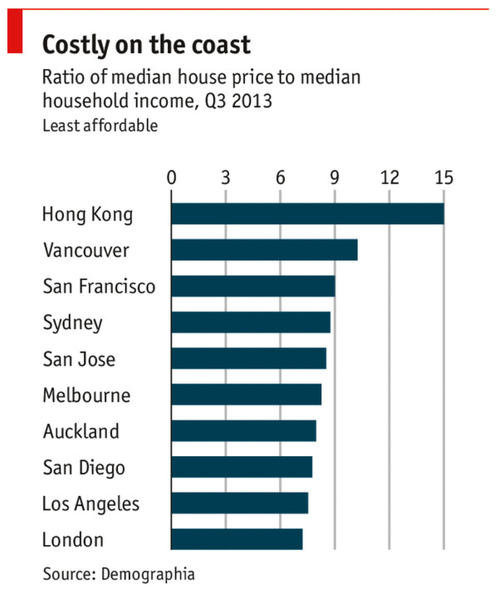
In case you weren’t aware, Vancouver is an incredibly expensive city when it comes to real estate. The average price for a single-family detached house is now around C$1 million. By some measures, that makes it the most expensive housing market in North America. Here’s a chart that looks at house prices as they relate to household income:
According to The Economist, the median household income in Vancouver is $68,970. This places them 23rd out of 28 in terms of Canada’s major cities. So how is it that homes are, on average, selling for $1 million? The locals don’t seem to be able to afford them.
Well, it’s a well known fact that Chinese buyers continue to be an integral part of Vancouver’s housing market. In fact, up until this year, Canada offered a fast track option for citizenship applications if you brought at least $800,000 into the country.
So we know that foreign buyers are having an impact. It’s a phenomenon we’re seeing in many other cities around the world, such as London. But to what extent is hard to measure–which has forced analysts to get creative.
To try and figure out what percentage of homes are going to foreign buyers, analysts have been looking at macro data, filing through sales records, and even monitoring utility bills to see which homes might be sitting empty.
What they found is that there’s a fairly significant correlation between economic activity in China, and Vancouver’s housing market. When the Chinese economy does well, so do Vancouver homes. Interesting. Still, that doesn’t quantify impact.
When analysts looked for utility bills that would suggest an empty home, they found that only about 8% of high end downtown condos were likely sitting empty. That’s a relatively small amount. It could be vacancy rate.
But when they looked for “mainland Chinese-sounding names” on sales records, they found that for homes priced $3M and up, almost ¾ of the buyers could be from mainland China. Now that’s a significant number!
I found this all rather fascinating and I thought you all might as well. It yet again reminds me of how much opacity there is in real estate markets. We’re all craving better data. Why else would people be scouring utility bills?