Daily insights for city builders, delivered every morning at 6 AM ET. I’m Brandon Donnelly — a Toronto-based real estate developer and founder of Globizen. I’ve been writing here since 2013.

Tag: canadian cities

  • Density is good

    Here is an interesting chart (source) showing housing starts in Canada, by type, between 2000 and 2023:

    As recent as 2000, single-family houses accounted for 61% of total starts and multi-family housing accounted for 39%. This flipped somewhere around the financial crisis and, last year in 2023, the percentages were 23% and 77%, respectively. This is a meaningful inversion which has helped our cities become more vibrant and more conducive to non-car modes of transport.

    But in this recent article about Canadian housing, Donald Wright more or less argues: so what? We’ve been densifying our cities for all these years, but it hasn’t helped our affordability problem. Supply must not be the answer to our housing crisis.

    I’m not exactly sure what he believes to be the solution, but I don’t think this problem is as simple as “we’ve built some housing, we made our cities denser, and yet housing is still expensive — more supply must not be the answer. Let’s move on.”

    Among many other things, it’s important to understand what kind of density we’ve been building. Because up until very recently, we’ve basically taken the position that single-family neighborhoods should never be touched, and that density should only go in very specific areas — and only after a lengthy and expensive rezoning process has been completed.

    We’ve designed new housing to be expensive.

    But attitudes are changing all across North America. We are now starting to do two very important things: (1) we are opening up more of our cities to intensification and (2) we are now allowing more multi-family housing on an as-of-right basis. Meaning, no lengthy rezoning exercises and no risk of community opposition.

    These are two fundamental changes that should alter the kind of density that gets built. And in my view, it’s going to be a positive thing for Canadian cities.

  • Impostor cities

    Canadian cities are well known in the world of film for their ability to stand-in for other global cities. They rarely play themselves, which actually pisses me off. Because I take it as a sign that we’re not doing nearly enough to make Canadian cities the most beautiful and remarkable cities in the world. Canadian cities should play starring roles. Movies should want to feature them, rather than repurpose them.

    That said, it’s an interesting phenomenon to explore. And that’s exactly what the Canadian pavilion will be doing this year at the Venice Biennale. The exhibition is called Impostor Cities and it will explore the various buildings and cityscapes that have been featured in films but that most people probably had no idea were Canadian.

    It is perhaps a new perspective on Canadian cities, bringing our stand-ins into the limelight. And it’ll be available online and onsite (yes, real life) starting May 22. I’m sure it’ll be great. I just hope that it makes us realize how embarrassing it is that our cities aren’t being celebrated in the way that they should be. Let’s be bolder. Let’s build greatness.

  • Just how valuable is public transit?

    Benjamin Dachis and Rhys Godin of the C.D. Howe Institute have a new report out talking about the effect of COVID-19 on the future of public transit in Canadian cities. In it, they make the argument that public transit is a key enabler of the agglomeration economies that make cities so valuable. And right now, most people aren’t using it (see above).

    Why are agglomeration economies so important?

    According to some studies, doubling the population of an urban area has tended to increase mean incomes by between 3-8%. In the Canadian context, similar research has found that people living in more populated regions (cities) tend to have incomes that are between 3-5% higher than those living in more rural areas. So when it comes to average incomes, bigger cities tend to be better. (Does Zoom change this? I’m not convinced.)

    Of course, to make bigger cities function properly, you generally need public transit. And when you do have fast and reliable transit, that, they argue, is going to help drive the agglomeration economies which ultimately help to increase incomes. Because of this important relationship, Dachis and Godin argue that Canadian governments have a habit of systematically undervaluing the importance of transit investment.

    If you’re interested in reading the full report, click here.

  • Only about a quarter of Canadians are living the 15-minute city

    This is an excellent article by Alex Bozikovic, Joe Castaldo and Danielle Webb about the 15-minute city. In it, they do a block-by-block analysis of how many Canadians actually live in what they are calling an “amenity dense” neighborhood.

    Their definition of amenity dense:

    • Grocery store, pharmacy, and public transit stop within one kilometer
    • Childcare facility, primary school, and a library within 1.5 kilometers
    • Healthcare facility within three kilometers
    • Place of employment within 10 kilometers

    Once you apply this filter to Canadian cities, it turns out that only about 23.3% of city dwellers live in this kind of amenity dense neighborhood. It’s really only our three largest cities. For the most part, we have built environments that want you to have a car.

    When it comes Toronto, and also Montreal, it is a tale of two almost equally divided cities. If you live in a central neighborhood, you’re probably dense with amenities. But in the inner suburbs, it becomes pretty spotty. And though it can be done, this is not an easy change.

    The full article has many more of these city maps and so I would encourage you to check it out. It’s a great piece of journalism.

    Photo by Chloe Evans on Unsplash

  • Do Canadians embrace winter?

    Curbed published an article this week called, Why U.S. cities should stop whining and embrace winter. It is about Canada and how we allegedly embrace winter, which is arguably true, except I think there’s still a healthy dose of whining combined with trips to the south.

    I went ice skating a few weeks ago along the waterfront here in Toronto. It was a cold night and we debated whether we should skate or do something indoors involving Niagara’s finest red wines. We opted for skating and weren’t cold at all. It was great.

    I was reminded of this when I read the line: “The purpose is to get you skating. If you are skating, you are warm.” It is a good reminder that one of the keys to a successful winter space is physical activity. That and hot tubs.

    Photo by Joseph Barrientos on Unsplash

  • How megacities are changing the map of the world

    In advance of his new book, titled Connectography, Parag Khanna recently delivered an interesting TED Talk called, How megacities are changing the map of the world. It’s about 20 minutes long.

    A lot of what is covered won’t be new to this audience, but I like how he talks about the importance of urban connectivity, the shift from political to functional geography, and the idea that, in a megacity world, countries can actually be the suburbs of some cities.

    One thing you might notice about the talk is how he glosses over both Canada and Europe. This is a reminder to me that if Canadian cities are going to continue to compete against the emerging megacities of the world, we are going to need to think at the scale of the megalopolis. And a big part of that means a focus on extra-urban connectivity.

    Click here if you can’t see the embedded talk below.

    https://embed-ssl.ted.com/talks/parag_khanna_how_megacities_are_changing_the_map_of_the_world.html

  • Natural resources drive employment growth in Canadian cities

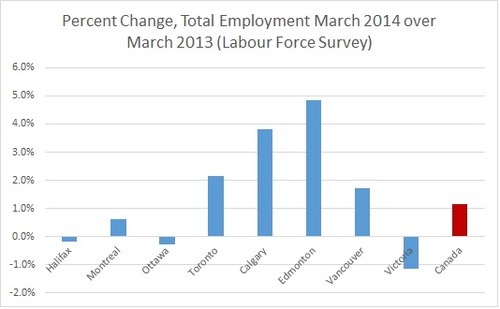
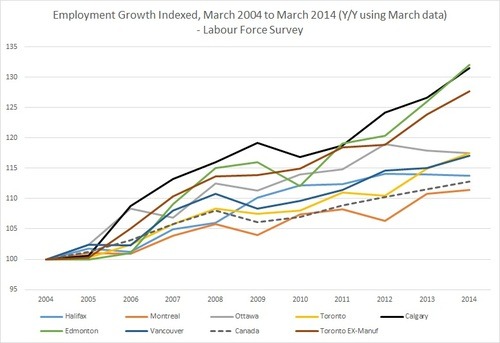
    I was reading Wendy Waters’ All About Cities blog this morning and I came across the following charts showing employment growth across Canadian cities. The first chart shows total employment growth over the last year and the second chart shows employment growth over the past 10 years.

    What is immediately obvious from these charts is that Calgary and Edmonton–both resource driven economies–have and are leading Canada in terms of employment growth.

    Toronto isn’t that far behind though, particularly if you exclude manufacturing from the equation (see second chart). The decline of manufacturing in the Greater Toronto Area really represents a structural change in the economy.

    I wanted to post these charts because, for all the talk about the rise of the information and digital age, Canada’s economy is still very much based on natural resources. We extract and sell. And we have one of the largest proven oil reserves in the world.

    Now, I’m not opposed to this business model, but there’s lots of evidence out there to suggest that resource dependency ultimately hurts innovation and productivity–which makes sense. If we didn’t have resources, we’d be forced to figure out other ways to make money.

    So while it’s great to see our cities growing, let’s not take it for granted.