Daily insights for city builders, delivered every morning at 6 AM ET. I’m Brandon Donnelly — a Toronto-based real estate developer and founder of Globizen. I’ve been writing here since 2013.

Tag: canadian architecture

  • Is Canadian architecture bad?

    Tracey Lindeman over at the Walrus recently asked: Why is Canadian architecture so bad? Is it because Canadians are too passive and apathetic when it comes to good design? Or is it because we’re too cheap and don’t like our tax dollars being spent on unnecessarily lavish public buildings?

    Whatever the case, there is an argument out there that we maybe had this wonderful period between the 50s and 70s where we really excelled in modern architecture and design (including graphic design), but that we kind of stopped caring and have built mostly banal stuff since then.

    Part of Tracey’s argument is simply that we’re cowards. We’re more interested in “checking boxes instead of taking chances.” We’ve become too bureaucratic when it comes to procuring new public architecture. And she’s not wrong.

    Why we accept it is a patently Canadian phenomenon: our national psyche has us much more interested in checking boxes than in taking chances. Our standard process for contracting buildings often gives projects to the lowest bidders, even if a vastly more beautiful design is just a little bit more expensive. We have become so devoted to frugality and bureaucracy, and are so readily appeased by basic functionality, that we have lost the fortitude to take and demand risks, even if the outcome could be the most beautiful thing we’ve ever seen.

    Great architecture requires not only great architects, but also great patrons of architecture. That has generally been the way all throughout history. But here’s the fortunate thing. We have lots of wonderfully talented architects in this country and lots of people who see the value in architecture.

    In fact, I think you could argue that over the last 5-10 years we have seen the quality of architecture in our cities step up dramatically. Some of these projects have been designed by top Canadian architects and some have been designed by leading international architects.

    In both cases it’s because we see the value proposition and have decided to invest in architecture and design. Now we just need to be bolder across the board and get bureaucracy and checkboxes out of the way of Canadian creativity.

  • Impostor cities

    Canadian cities are well known in the world of film for their ability to stand-in for other global cities. They rarely play themselves, which actually pisses me off. Because I take it as a sign that we’re not doing nearly enough to make Canadian cities the most beautiful and remarkable cities in the world. Canadian cities should play starring roles. Movies should want to feature them, rather than repurpose them.

    That said, it’s an interesting phenomenon to explore. And that’s exactly what the Canadian pavilion will be doing this year at the Venice Biennale. The exhibition is called Impostor Cities and it will explore the various buildings and cityscapes that have been featured in films but that most people probably had no idea were Canadian.

    It is perhaps a new perspective on Canadian cities, bringing our stand-ins into the limelight. And it’ll be available online and onsite (yes, real life) starting May 22. I’m sure it’ll be great. I just hope that it makes us realize how embarrassing it is that our cities aren’t being celebrated in the way that they should be. Let’s be bolder. Let’s build greatness.

  • A circular spaceship in Winnipeg

    Winnipeg has a building along its waterfront that, I am told, is affectionately referred to as the “spaceship.” Designed by the award-winning architecture practice, 5468796, the spaceship is a 41-unit circular condominium building that is raised up on 35 foot stilts in order to fabricate views outward from the site. Sans stilts, the site wouldn’t have really had any.

    The raised up portion is made up of two circular floors, each with 20 identical units (so 40 in total). The 610 square foot units are all pie-shaped studios that splay outward to a 22 foot wide living room/bedroom. Supposedly, a circle creates 30% more perimeter glass than if the building were orthogonal. So good for views. I should know this.

    The building is organized around a central core and circulation system. The building’s common area corridors are also open and exposed to the elements. A fascinating design decision given the climate in Winnipeg, and most of Canada. But this would be good for build costs, good for the building’s overall efficiency/loss factor, and probably pretty good if you’re worried about things like airborne viruses.

    Completed in 2017, the hard cost budget for the project was supposedly $4.75 million. The developer in me is wondering how the hell they built 28,000 square feet for $170 per square foot. And the Torontonian in me is aghast at studios as large as 610 square feet. These would be generally sized 3 bedroom suites here in Toronto (I kid).

    On top of the building’s two floors is also a pretty unique penthouse suite that can be rented on Airbnb for what looks to be a reasonable price. The main living space is essentially a glass box with 360 degree views of the city. I am ashamed to say that I have never been to Winnipeg. But as soon travel resumes and these provincial boundary checkpoints dissolve, I think it might be time for a trip to the spaceship.

    All photography by James Brittain Photography

  • Thom’s Trent

    image

    This afternoon I walked Trent University’s campus with my father on our way back from the cottage. It is embarrassing that it has taken this long.

    Trent University straddles the Otonabee River in Peterborough, Ontario. It admitted its first students in 1964 and by the early 1970s the renowned Canadian architect Ron Thom had completed the campus plan and its original college buildings, including Champlain College, Lady Eaton College (originally a female-only dormitory), the Bata Library, and the Chemistry Building.

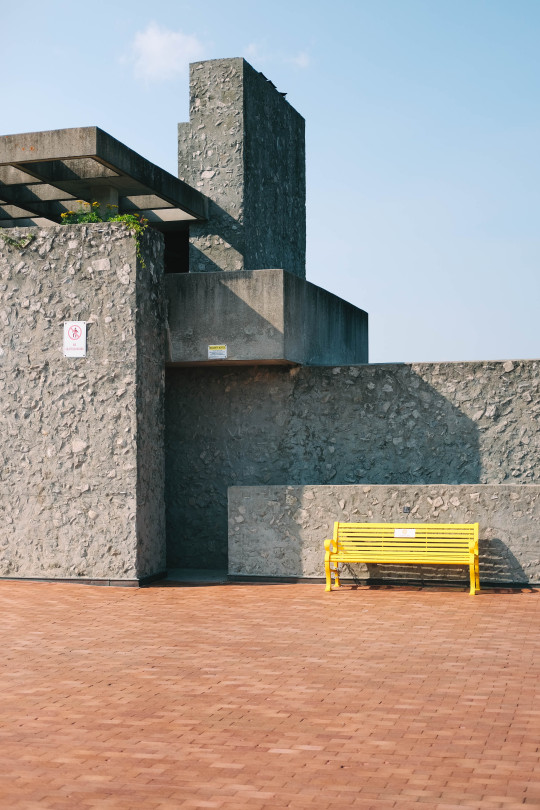
    The photo at the top of this post is one I took of the south elevation of Champlain College, on the north edge of the west bank’s main plaza. (Yes, the sign on the far left says “no skateboarding.”)

    Rob Thom is perhaps not as well known as other Canadian modernists such as Arthur Erickson. But his two masterpieces – Massey College at the University of Toronto and this campus – were instrumental in helping to define modernism in Canada. It is a shame that alcohol and illness ended his life at the young age of 63.

    The first thing that struck me was the rubble aggregate walls. I immediately went to touch them. (See, again, above.) That, combined with the very clear Prairie influences and the terracotta colored pavers, gave the campus grounds an incredible warmth.

    Also notable was the connection to the natural landscape. Around the corner from where I took the above photo was a staircase leading down to the river. At the bottom of the staircase was a broad set of concrete steps and a handful of young people jumping in and out of the water.

    If you happen to find yourself in this part of southern Ontario, I would encourage you to check out Thom’s campus. And maybe bring your bathing suit.

  • Architect Profile: Omar Gandhi

    image

    This week – thanks to an introduction from a mutual friend – I had the pleasure of having lunch with architect Omar Gandhi. 

    Based in both Halifax and Toronto, the Globe and Mail has called Omar one of Canada’s next top architects and Wallpaper Magazine has named him one of the top 20 young architects in the world. So if you haven’t yet heard of him, consider this post as your heads up.

    What’s exciting about his work is how it really reflects the ethos of the places he works in (east coast Canada in many cases). At the same time though, his works seems to define a new modern and Canadian design sensibility. 

    And this is what I believe great architecture should do. It should respond to and reinforce local cultures, but also help to shape them as they invariably evolve. Architecture and culture are inextricably linked.

    I love seeing local talent thrive, so I hope you will take a minute to visit Omar Gandhi’s website.

    Image: Modern Cabin in Cap Breton from OG

  • Can the creation of urban destinations transform or hinder a city’s development?

    I was recently asked by a Canadian architecture website called sixty7 Architecture Road to respond to the following: Can the creation of urban destinations transform or hinder a city’s development? It was for a regular Q+A series they do on their website. Here is my response (I was specifically asked about Dundas Square):

    The best line I’ve ever heard about public spaces and urban destinations was from Bruce Kuwabara of KPMB Architects. He said that the outside of buildings need to be thought of as the inside walls of the public realm. And I think that’s a really great way of framing this discussion. We often think of buildings inwardly and as self contained objects, but by virtue of their existence we’re creating and framing many other spaces.

    With that in mind, I absolutely believe that beautiful and well designed urban destinations–whether public or private–can transform a city and its development patterns. A perfect, but perhaps overused, example of this is the High Line in New York. Not only has it become a destination (“Have you been to the High Line yet?”), it has become an unbelievable city building catalyst. All of a sudden development is happening in, on and around the High Line, where as before developers would have tried to completely ignore it. And so today, the High Line, as an urban destination, is almost being continually reinvented by new development.

    To talk specifically about Toronto, I think that downtown needed a “public” space like Dundas Square. The design could have been less unidirectional (towards the Eaton Centre) and the building to the north is repulsive, but it provided a forum along Toronto’s main street in the heart of downtown. I also believe that good urban destinations give areas a sense of identity, which is why I’m somewhat bothered by the loss of the square at Yonge & Eglinton. Sure it was bad, but we could have made it better. It is the heart of midtown in my mind.

    So not only do urban destinations have the ability to transform, I would argue that they are essential to any great global city. Whether it’s the High Line in New York, the Spanish Steps in Rome, the old Love Park in Philadelphia, or Trafalgar Square in London, these spaces are integral to those city’s brands and identities. What do ours say about Toronto?

    For the full Q+A, click here.